We The People
We know how the story ends. Your students do not, and that is what makes the choices real.
See what your students get, and why it lands.
No mockups. Every page below is real, pulled straight from the files you download. Tap any one to see it full size.
A worksheet was never going to teach this.
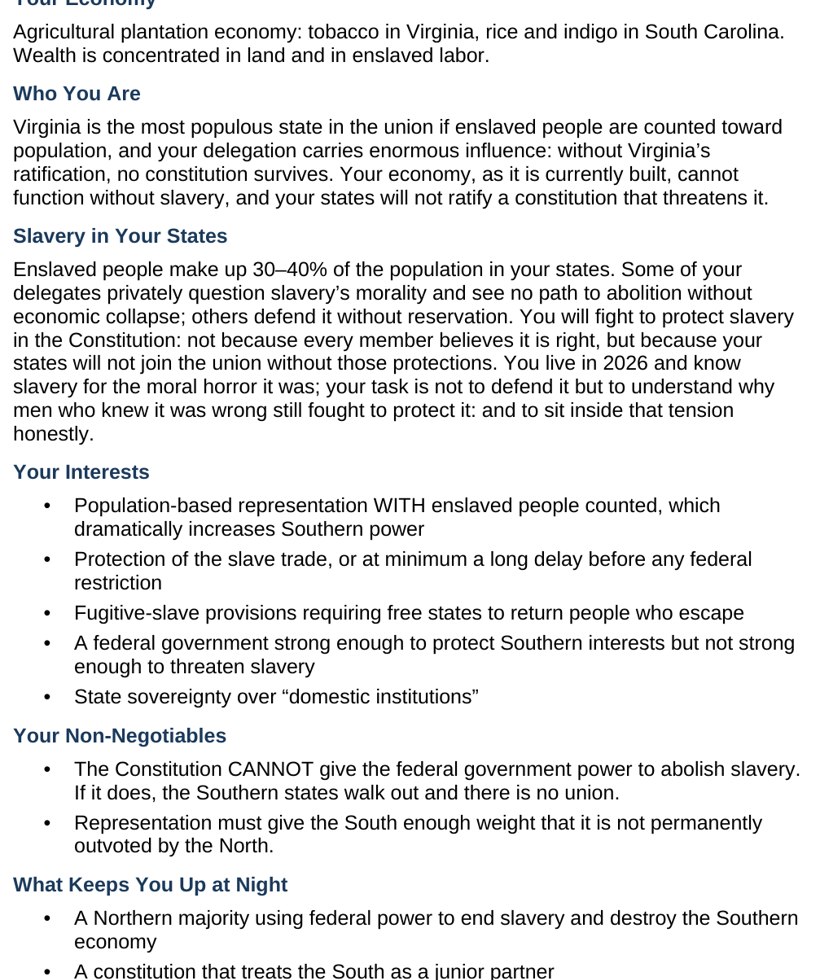
On a provision day in We The People, your students do not answer questions about the Constitution. They write one. Each student carries a Delegation Profile with real interests, a population, an economy, and constituents who will hold them to account. They debate draft language for representation, executive power, or the line between federal and state authority, then watch the convention floor react in real time. They count votes, knowing a provision needs four of the six delegations to move onto the Provision Ledger. They abandon an idealist's stance to build the coalition they can actually hold. The work is not a reading guide. It is a real call from competing evidence, made under pressure, with 250 years of consequence riding on the text they lock.
Tap to see the delegation profiles
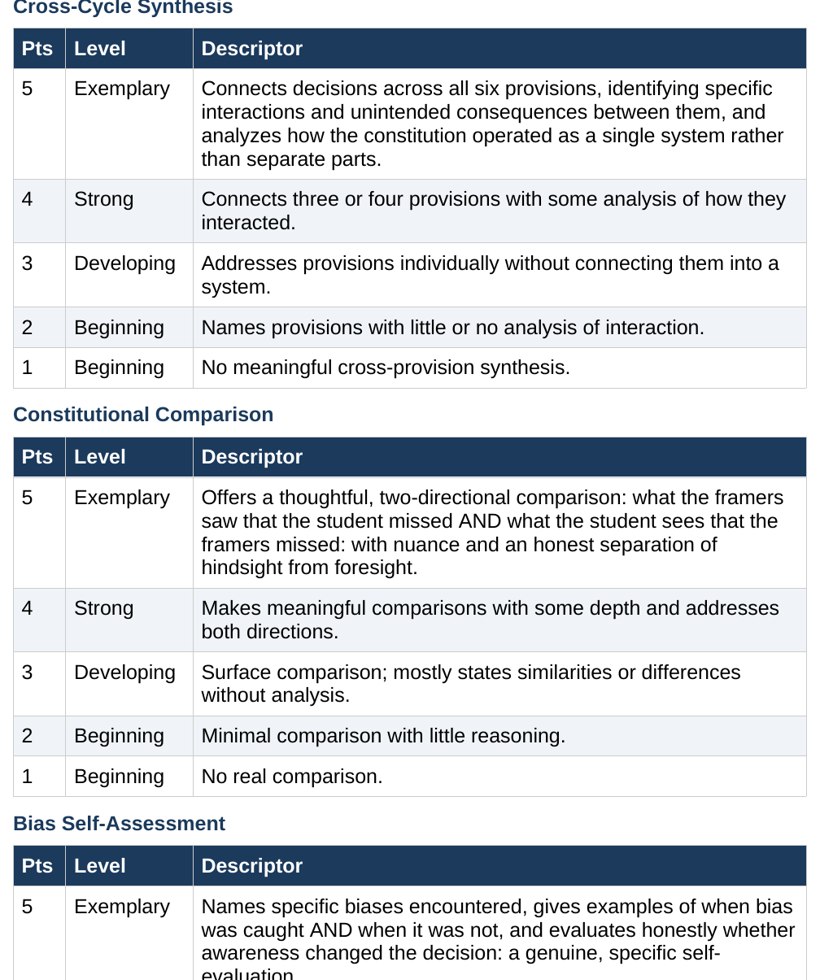
They are graded on the reasoning, not the outcome.
The Assessment Rubrics make the scoring principle explicit. Students are never penalized for their constitution's outcome. They are graded on whether they accounted for their choices. The Hybrid-100 model splits the work: Daily Journal Engagement carries 60 points across 12 entries, read quickly on a 0/1/3/5 scale for specific, evidence-based reasoning. Holistic Journal Quality adds 20 points for the pattern of reasoning, bias awareness, and the habit of navigating uncertainty. A 700-word Final Reflection closes with 20 points for analyzing the constitution as one interacting system. A delegate who builds a flawed provision but names exactly why, and what they would amend, outscores a delegate who got a tidy result and cannot say how. Sound process beats a lucky outcome.
Tap to read the grading rubric
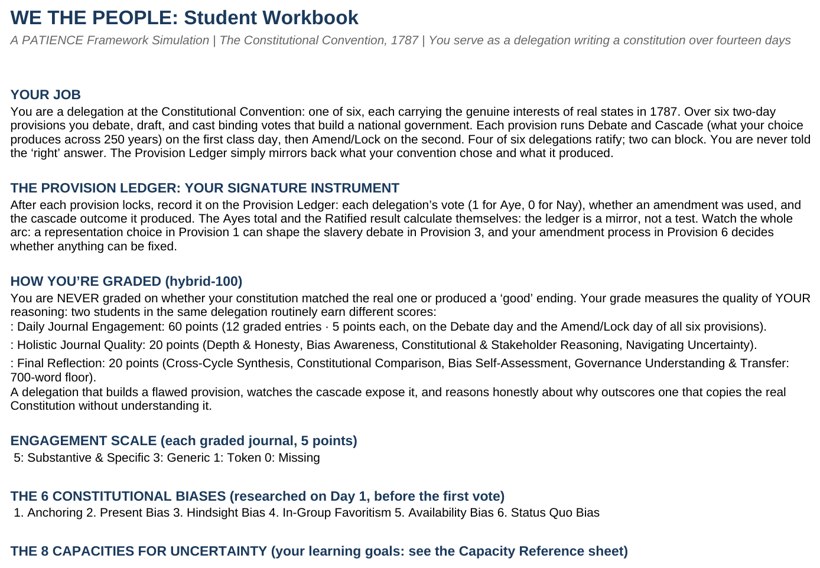
Let the workbook hold the busywork.
The student Workbook is a structured spreadsheet that carries the mechanical load. The Provision Ledger updates as the convention locks each provision, so your students see the running text of their constitution rather than rebuilding it from notes. Vote math tracks the four-of-six coalition for them, so a delegate can read where they stand instead of recounting hands. Tabs hold the delegation interests, the amendment window for each provision, and the daily journal in one place. The point is not to remove the deliberation. The point is to remove the recopying and the bookkeeping, so student energy goes to the judgment: what does this language actually commit us to, and who does it leave without a voice.
Tap to see the tracker
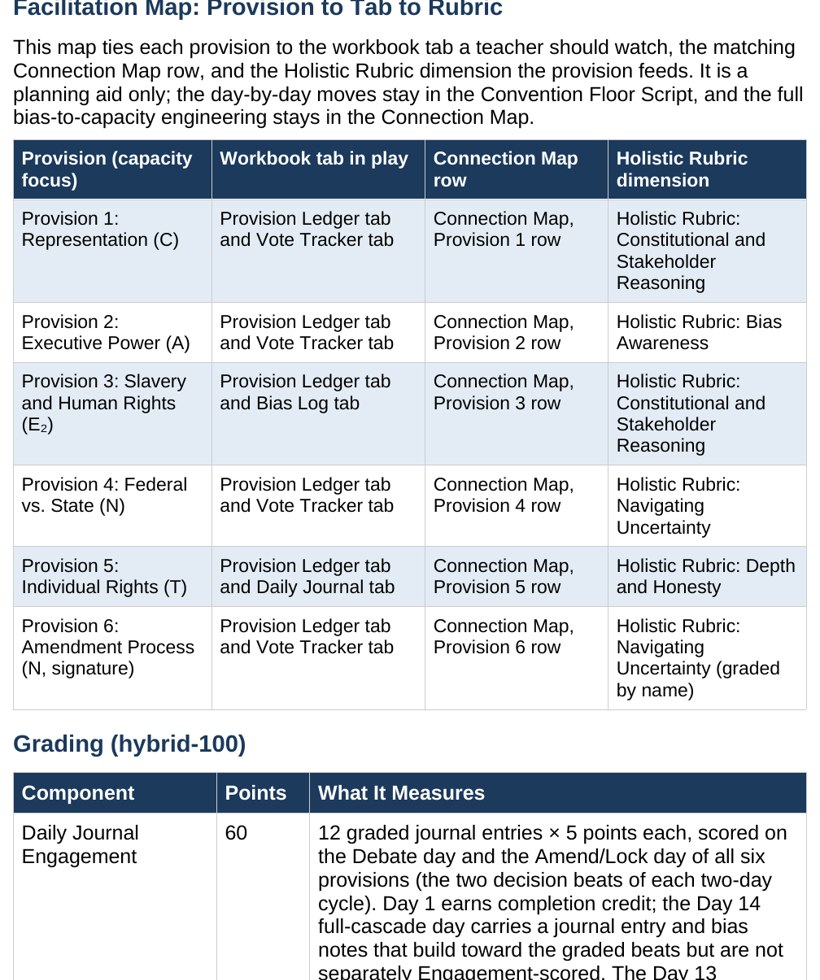
Every day is already scripted.
The Teacher Guide scripts all 14 days so prep stays light. Each session has its objectives, the historical context to narrate, the facilitation moves for the debate and amendment rounds, and the Cascade outcomes tied to the exact text the convention locks. The scripted Convention Floor guides carry all the narration, so you run the room instead of researching it. The guide flags the engineered pivots, the planted hypocrisies, and the sensitivity protocol for Provision 3, where Delegations 2 and 4 must be briefed privately before class. You bring the facilitation and the questions that make a delegate defend their text. The simulation brings the case, the consequences, the rubrics, and the script.
Tap to read the teacher guide
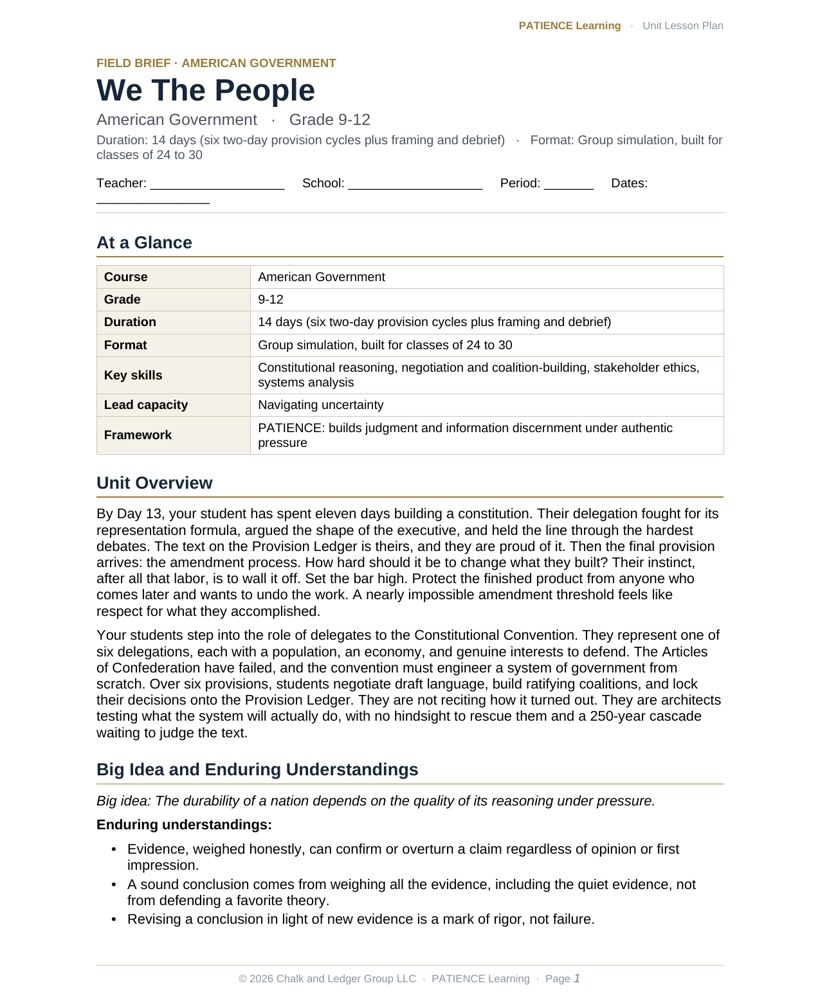
The lesson plan is already written.
Every simulation comes with a fully editable, admin-ready lesson plan. Standards alignment, daily pacing, learning objectives, differentiation, and an assessment plan are already done, so you can hand it to an administrator or adapt it to your district template in minutes.
Tap to preview the lesson plan
Close
Close
Close
Close
The day pride almost locked the door.
By Day 13, your student has spent eleven days building a constitution. Their delegation fought for its representation formula, argued the shape of the executive, and held the line through the hardest debates. The text on the Provision Ledger is theirs, and they are proud of it. Then the final provision arrives: the amendment process. How hard should it be to change what they built? Their instinct, after all that labor, is to wall it off. Set the bar high. Protect the finished product from anyone who comes later and wants to undo the work. A nearly impossible amendment threshold feels like respect for what they accomplished.
That instinct is status quo bias dressed as pride, and it is the trap. At the pivot, the student has to choose between protecting their work and trusting that a living document must be able to change. If they wall it off, the Cascade shows a nation frozen against crises the convention could not imagine, unable to repair its own mistakes. If they leave a workable path, they see what the durable choice always was. The constitution they were proudest of needed the humility to be amended. Pride in the work is not the same as wisdom about it.
Philadelphia, 1787, from total structural collapse.
Your students step into the role of delegates to the Constitutional Convention. They represent one of six delegations, each with a population, an economy, and genuine interests to defend. The Articles of Confederation have failed, and the convention must engineer a system of government from scratch. Over six provisions, students negotiate draft language, build ratifying coalitions, and lock their decisions onto the Provision Ledger. They are not reciting how it turned out. They are architects testing what the system will actually do, with no hindsight to rescue them and a 250-year cascade waiting to judge the text.
| Grade level | 9-12 |
| Course | American Government |
| Duration | 14 days (six two-day provision cycles plus framing and debrief) |
| Format | Group simulation, built for classes of 24 to 30 |
| Key skills | Constitutional reasoning, negotiation and coalition-building, stakeholder ethics, systems analysis |
Engineering better thinkers.
Civic judgment lives in the gray areas, where interests compete and no choice is clean. Each provision in We The People pairs a named cognitive bias with the capacity that defeats it, so students discover the trap by walking into it, then learn the discipline that gets them out.
| Bias targeted | The remedy, built into the work |
|---|---|
| Anchoring | Productive failure recoveryOn Provision 1, the first plan proposed, population-based or equal-by-state, quietly frames the entire debate. Students learn to treat that anchor as a draft to revise in the amendment window, not a ceiling on the compromise they can reach. |
| Present bias | MetacognitionOn Provision 2, students design the executive around a leader they can picture today, one they trust or fear. They audit that pull and reason instead about an unknown future officeholder the office must constrain. |
| In-group favoritism | Adaptive strategyOn Provision 4, delegations demand strong federal power when it serves them, then pivot to states' rights to block interference. Students catch the hypocrisy and negotiate the line they can actually defend across both cases. |
| Availability bias | Information discernmentOn Provision 5, students fight for rights vivid in their own lives while durable rights, like those of the accused, get forgotten. They learn to weigh what is essential over what is merely available to memory. |
| Hindsight bias | Navigating uncertaintyOn Provision 3, knowledge of the 250-year trajectory tempts a shallow hero-villain story. Students separate 2026 moral clarity from 1787 constraints, auditing the tragedy of the choice without ever excusing it. |
| Status quo bias | Emotional regulationOn Provision 6, pride in eleven days of work pushes students to wall off the amendment process. They steady that attachment and reason about a document that must change to survive crises they cannot yet imagine. |
14 days of governance under pressure.
The convention runs on a two-day rhythm. On the first day of each provision, students debate draft language and face the immediate historical consequence. On the second, they use their single amendment window to refine the text before it locks. The arc moves through six provisions, then a final reflection that reads the constitution as one system.
| Day | What lands | Capacity in focus |
|---|---|---|
| 1 | Representation is debated: population, equal by state, or both | Anchoring and the first-plan frame |
| 2 | The representation provision is amended and locked | Productive failure recovery in the amendment window |
| 3 | Executive power is drafted: one leader or many, what term | Present bias and the future officeholder |
| 4 | The executive provision is amended and locked | Metacognition about who students pictured |
| 5 | Slavery and human rights open under the sensitivity protocol (critical pivot) | Centering the unheard constituency |
| 6 | The Provision 3 text is amended and locked | Hindsight bias and the tragedy of the choice |
| 7 | Federal versus state authority is debated | In-group favoritism and delegation hypocrisy |
| 8 | The authority provision is amended and locked | Adaptive strategy and coalition math |
| 9 | Individual rights are debated: which to list and why | Availability bias and durable rights |
| 10 | The Bill of Rights provision is amended and locked | Information discernment under pressure |
| 11 | The amendment process is debated (critical pivot) | Status quo bias and pride in the work |
| 12 | The final provision is amended and the Ledger closes | Emotional regulation over attachment |
| 13 | The 250-year Cascade is narrated against the locked text | Systems analysis and consequence |
| 14 | The Final Reflection and debrief land | Navigating uncertainty as a transferable habit |
Standards alignment.
We The People maps to the C3 Framework for Social Studies and to NCSS civics and government standards. Students work directly in the Civic and Political Institutions dimension (D2.Civ.1, D2.Civ.3, and D2.Civ.5) as they construct constitutional language and weigh the structures of power. The deliberation and coalition work aligns with the participation and deliberation standards (D2.Civ.8, D2.Civ.9, and D2.Civ.10), and the Cascade analysis hits processes, rules, and laws (D2.Civ.12 and D2.Civ.14). The Inquiry Arc runs throughout, from developing questions (Dimension 1) to communicating conclusions and taking informed action (Dimension 4). The simulation also supports AP United States Government and Politics requirements on the constitutional foundations of the republic.
The hidden architecture.
The design rewards the careful, evidence-led choice, and it is engineered to make that choice hard. Outcomes are never random. There are no die rolls. The Cascade Mechanism narrates real branches of history dictated by the exact text the convention locks onto the Provision Ledger. Each provision is a planted contradiction: the first plan anchors the debate, the executive invites present bias, Provision 3 invites a hindsight hero-villain story, and the amendment process invites status quo bias after eleven days of earned pride. The proof sits in the inflection points. Count enslaved people for representation in Provision 1, and the Missouri Compromise becomes the structural engine of Southern legislative power. Leave a vacuum in the removal process, and Watergate becomes a paralyzing crisis. When the Cascade reveals a bad outcome, students treat it as data to govern, not a verdict on their worth, and the amendment window becomes the tool for repair.
Turnkey, classroom-ready.
- An admin-ready lesson plan. A fully editable plan with standards alignment, daily pacing, differentiation, and assessment, ready to adapt to your district template. Included with every purchase.
- 14-day playbooks. Scripted Convention Floor guides with the historical context, narration, and facilitation moves for every debate and amendment round.
- A tech-enabled Workbook. A structured spreadsheet that runs the Provision Ledger and the four-of-six vote math, so students deliberate rather than recopy.
- Turnkey student files. Six Delegation Profiles with real interests, populations, and constraints, ready to assign across a class of 24 to 30.
- A sensitivity protocol. Private briefing standards for Provision 3 that keep enslaved people as full human beings, never a debate position or a laundered deal.
- An assessment system. The Hybrid-100 rubric grades the quality of reasoning across the daily journal and final reflection, not whether the constitution turned out well.
- The Teacher Guide. Daily objectives, the engineered pivots flagged in advance, and the Cascade outcomes tied to each locked provision.
Bring We The People to your American Government classroom.
Give your students the convention without the safety net of hindsight, and watch them learn to reason through a system they have to build and live with.
Get this simulationPreview real pages from the simulation before you spend a dollar. No guessing, no surprises.