Discernment
Separate signal from noise and evidence from assumption.
Together, we can prepare students for the moment no one tells them what to do next.
PATIENCE Learning develops student judgment. Through realistic classroom decisions, students separate evidence from assumption, choose a course, experience what follows, and defend—or responsibly revise—their reasoning.
Grades 3–12 · 89 classroom-ready simulations · About 20 minutes of initial teacher preparation
Public-safe website vignette inspired by the PATIENCE simulation. No confidential reveal is shown.
Website vignette inspired by The Crime Scene: Your reconstruction team has one hour before the museum reopens. The alarm log, floor plan, physical evidence, and witness account do not point neatly in the same direction.
You can recommend one investigative lead now—or delay long enough to verify one more measurement. Either choice carries a cost.
PATIENCE does not reward guessing a hidden preferred answer. The work is in the evidence you prioritize, the tradeoffs you recognize, and the reasoning you can defend.
Students repeatedly interpret incomplete information, determine what matters, make a defensible decision, and learn from what follows. Understand the complete method →
Separate signal from noise and evidence from assumption.
Make a sound decision when certainty is unavailable.
Justify, defend, or responsibly revise the decision.
The practice environment where students use the foundation, make the decision, encounter consequences, and reflect.
Choose a grade band and I’ll send a complete free lesson with a teacher script, student pages, and answer key.
A PATIENCE simulation is not a worksheet wearing a story. The Decision Dossier makes the learning sequence visible through real classroom materials.
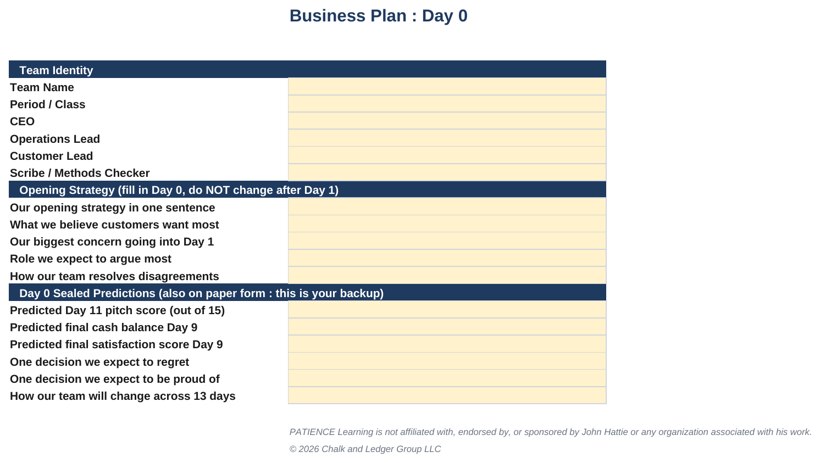
Students become the people who must decide. The role, constraints, and stakes make the academic content matter.
Choose the classroom job. We’ll point you toward the clearest starting place.
You do not need to understand every PATIENCE product before you know where to begin.
I have taught the students and hired the graduates. From both seats, I kept seeing the same gap: bright, capable people could complete the task in front of them, then stop when no one supplied the next step.
That is not a failure of students, teachers, or families. It is a kind of practice education has rarely made explicit. PATIENCE exists so students can build judgment, discernment, initiative, and resolve while the cost of a bad decision is still a lesson—not a lost job, a damaged relationship, or a consequence they cannot undo.
Read the whole story →A planned annual Judgment Development system with broad access to PATIENCE simulations and Mini Missions. The first 300 members keep the $99 annual price while membership remains continuous. The exact launch library and timing will be published before any payment.
Choose your grade band and receive a complete free lesson with the teacher script, student materials, and decision experience.