The Treaty
The treaty that feels like winning is usually the one that starts the next war.
See what your students get, and why it lands.
No mockups. Every page below is real, pulled straight from the files you download. Tap any one to see it full size.
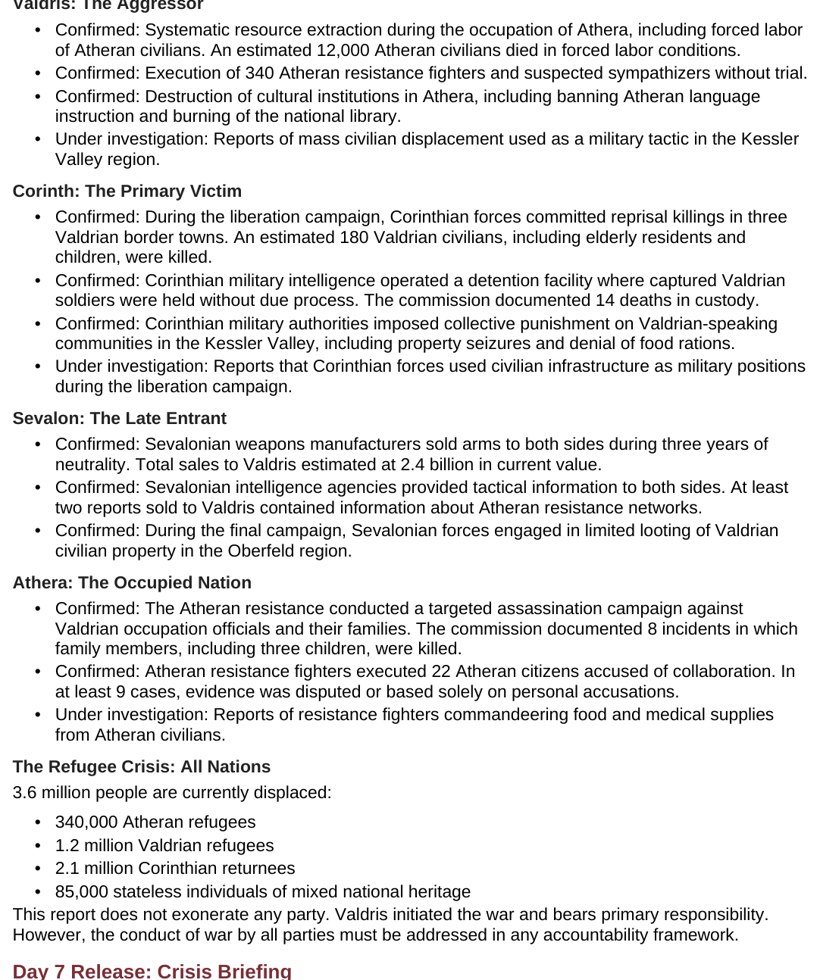
A worksheet was never going to teach the psychology of peace.
Your students do not answer questions about the post-war conference. They sit inside a delegation and make the call. Each day opens with a Daily Release: a War Aftermath Briefing, a Humanitarian update, a domestic pressure card, a rival nation's proposal on the table. They read 3.6 million refugees, 85,000 stateless people, 85 percent industrial destruction in Athera, and then they decide what their nation will accept. Do they hold the Kessler Valley or trade it away. Do they punish Valdris or rebuild it. Every choice is made from evidence under pressure, with real stakes for the durability of the peace, not from a fill-in-the-blank prompt.
Tap to see the Daily Release
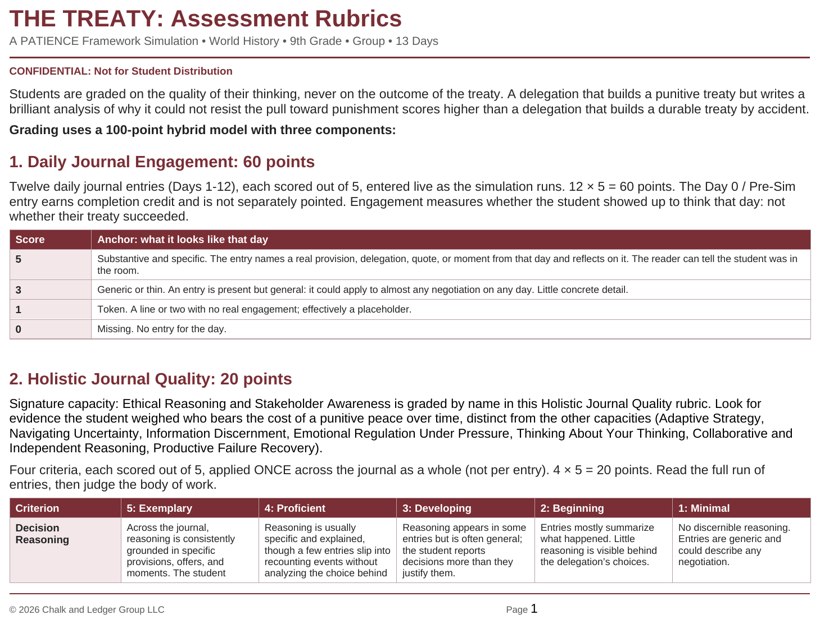
They are graded on their reasoning, not on whether the treaty holds.
The rubric makes the rule plain. A delegation that builds a punitive, failing treaty but writes a sharp metacognitive analysis of the biases that drove that failure scores higher than a delegation that stumbled into a durable peace by luck. The 100-point model puts 60 points on daily journal engagement, 20 on holistic quality with a focus on ethical reasoning, and 20 on the final reflection. Students are never penalized for a treaty that collapses. They are rewarded for catching the moment their own anchoring or naive realism pulled them off course. A sound process behind a broken treaty beats a lucky guess every time, and the rubric is written so your students can see exactly why.
Tap to read the grading rubric
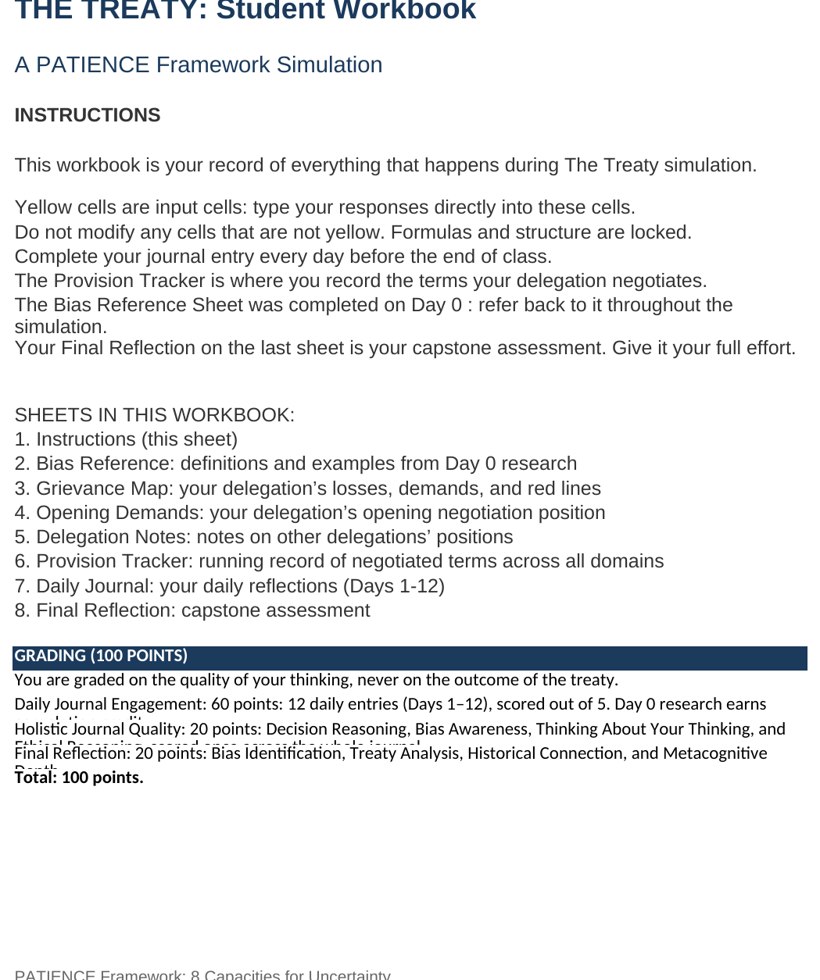
Let the workbook hold the paperwork so students spend their energy on judgment.
The student workbook is a 10-sheet Excel hub built so the busywork disappears. Yellow input cells tell students exactly where their data goes. A Grievance Map keeps every nation's losses and demands in one place, so a delegate is weighing real positions instead of flipping through pages. A Bias Tracker asks students to name the cognitive pressure pushing on them each day and audit it against what they actually did. It runs through Google Classroom with no setup friction. The tracker does the bookkeeping of the negotiation so the thinking, the trade-offs between satisfaction and durability, stays where it belongs, in your students' hands.
Tap to see the tracker
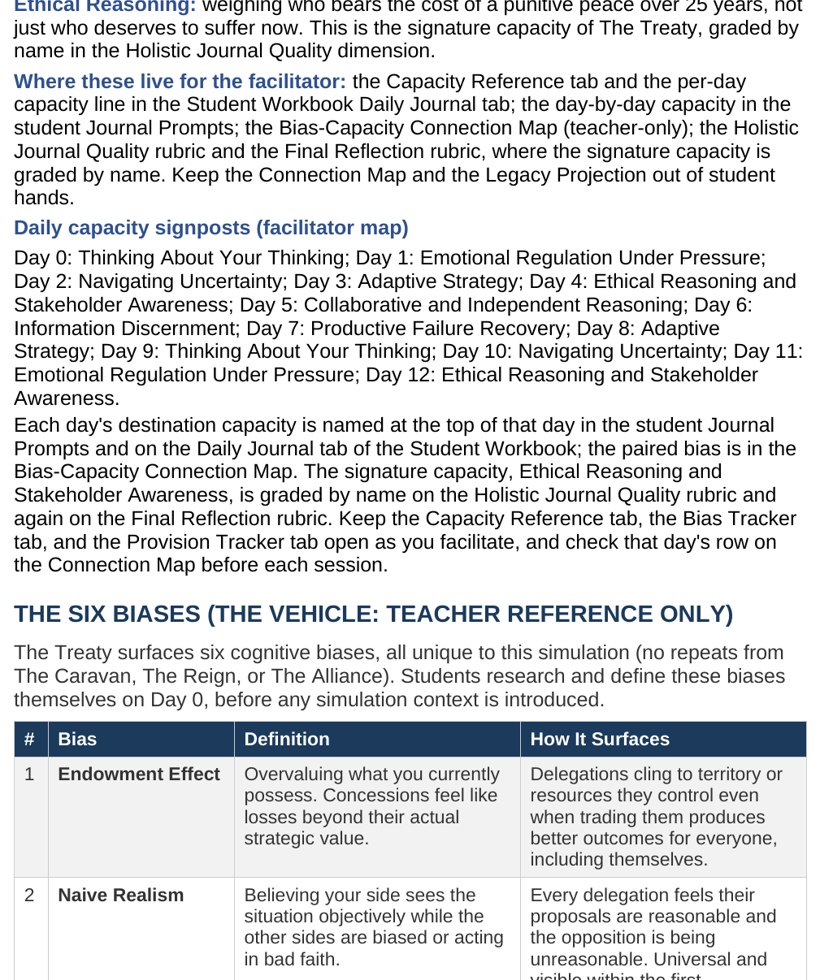
Every day is already scripted. You bring the facilitation.
The teacher guide carries 12 daily scripted playbooks, the War Aftermath and Humanitarian briefings written for you, and cut-and-print domestic pressure cards that put political stakes on every delegation. You do not prepare the scenario, the numbers, or the hidden scoring. It is all written down, including the Starter Scripts for the Day 12 debrief, the questions that walk students back through the Just-World Hypothesis and the Distinction Bias they just lived. The simulation maps to class periods, not calendar days, and runs for any class from 12 to 35-plus students. You read the briefings with gravity, you ask the questions, and the design does the rest. Prep is light because the work is done.
Tap to read the teacher guide
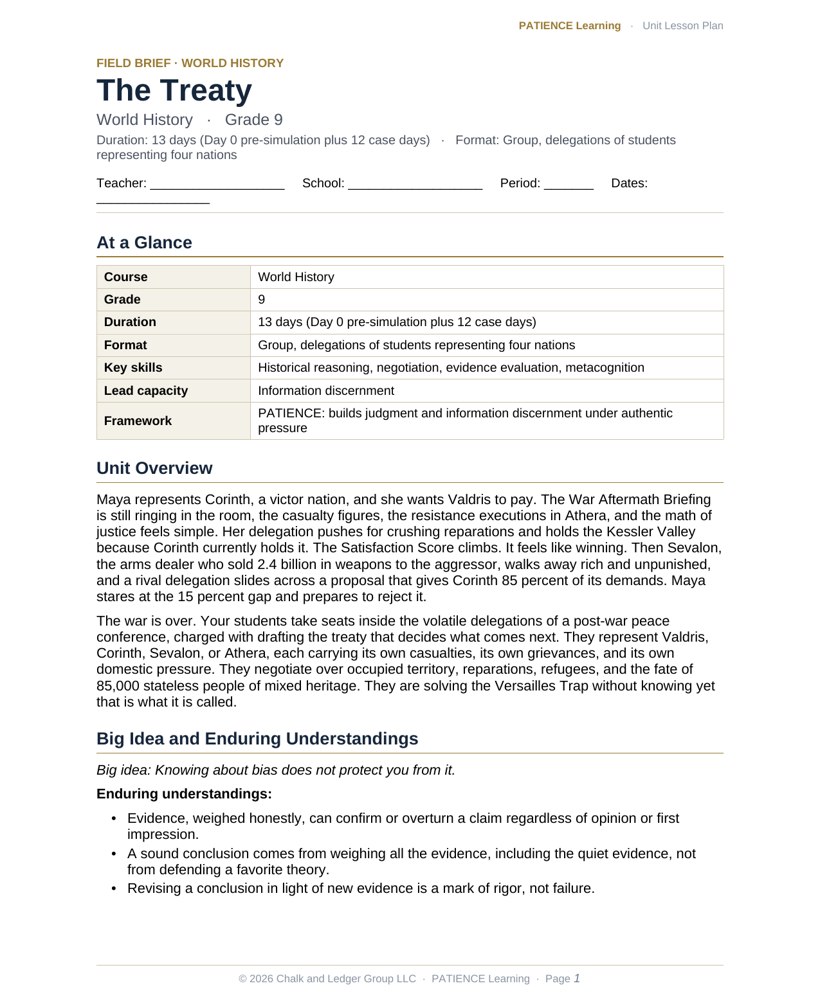
The lesson plan is already written.
Every simulation comes with a fully editable, admin-ready lesson plan. Standards alignment, daily pacing, learning objectives, differentiation, and an assessment plan are already done, so you can hand it to an administrator or adapt it to your district template in minutes.
Tap to preview the lesson plan
Close
Close
Close
Close
The moment the satisfying treaty turns out to be the one that fails.
Maya represents Corinth, a victor nation, and she wants Valdris to pay. The War Aftermath Briefing is still ringing in the room, the casualty figures, the resistance executions in Athera, and the math of justice feels simple. Her delegation pushes for crushing reparations and holds the Kessler Valley because Corinth currently holds it. The Satisfaction Score climbs. It feels like winning. Then Sevalon, the arms dealer who sold 2.4 billion in weapons to the aggressor, walks away rich and unpunished, and a rival delegation slides across a proposal that gives Corinth 85 percent of its demands. Maya stares at the 15 percent gap and prepares to reject it.
At the pivot she has to choose between the treaty that feels like justice and the treaty that might actually last. She kills the workable compromise over the 15 percent gap, the way her gut told her to. On Day 12 the Legacy Projection fast-forwards 5, 15, and 25 years. Valdris collapses economically, the punished population radicalizes, and the durable peace she could have signed never existed. Once she trusts the evidence instead of the moral intuition, she sees it. The boring compromise was the strong one all along, and knowing about bias did not protect her from it.
A post-war peace conference, and four nations who cannot all be right.
The war is over. Your students take seats inside the volatile delegations of a post-war peace conference, charged with drafting the treaty that decides what comes next. They represent Valdris, Corinth, Sevalon, or Athera, each carrying its own casualties, its own grievances, and its own domestic pressure. They negotiate over occupied territory, reparations, refugees, and the fate of 85,000 stateless people of mixed heritage. They are solving the Versailles Trap without knowing yet that is what it is called.
| Grade level | 9 |
| Course | World History |
| Duration | 13 days (Day 0 pre-simulation plus 12 case days) |
| Format | Group, delegations of students representing four nations |
| Key skills | Historical reasoning, negotiation, evidence evaluation, metacognition |
Engineering better thinkers.
Diplomacy is where discernment either holds or breaks. A treaty is built from competing evidence under emotional pressure, and the seductive choice is rarely the durable one. Each day pairs one cognitive bias with the capacity that defeats it, so students feel the pressure and practice the remedy in the same move.
| Bias targeted | The remedy, built into the work |
|---|---|
| Anchoring | Productive failure recoveryWhen a collapsing provision or external shock wrecks a delegation's opening position, students recover and rebuild the negotiation instead of clinging to the first number on the table. |
| Confirmation bias | MetacognitionStudents predict the cognitive vulnerabilities they will face, then audit those predictions against what they actually did in the Bias Tracker, catching the evidence they ignored. |
| Sunk cost fallacy | Adaptive strategyDelegations learn to divest from occupied territory like the Kessler Valley when the long-term cost of holding it exceeds its value, rather than keeping it because they already paid for it. |
| Availability bias | Information discernmentStudents judge proposals on objective signal, what is actually delivered, rather than on the vivid gap between the offer and an ideal that lives only in their head. |
| Tunnel vision | Navigating uncertaintyStudents decide without seeing the opposition's reasoning, resisting the urge to treat their own perspective as the single objective view of a contested peace. |
| Overconfidence | Emotional regulationStudents hold a rational, fact-based stance even in the hot emotional state triggered by the War Aftermath Briefing, when harsh terms feel obviously deserved. |
13 days of evidence, negotiation, and consequence.
Day 0 arms students with the cognitive vocabulary they are about to ignore under pressure. From Day 1 the briefings, proposals, and domestic pressure cards build a negotiation that rewards the satisfying choice and quietly tracks the durable one. The arc bends toward Day 12, where the hidden score and the historical parallel finally land.
| Day | What lands | Skill in focus |
|---|---|---|
| 0 | Bias Research lesson: students study the biases as academic concepts before they meet them as pressures | Information discernment |
| 1 | War Aftermath Briefing read with gravity triggers the first affective disruption and opens the conference | Emotional regulation |
| 2 | Delegations stake opening positions on territory, reparations, and refugees from their Nation Profiles | Independent and collaborative reasoning |
| 3 | Humanitarian briefing surfaces the 3.6 million refugees and 85,000 stateless people of mixed heritage | Ethical reasoning |
| 4 | First cross-delegation proposals land and the Satisfaction Score starts to climb visibly | Information discernment |
| 5 | Domestic pressure cards force delegations to weigh home politics against a workable deal | Navigating uncertainty |
| 6 | Sevalon and Athera complicate the simple good versus evil story students arrived with | Metacognition |
| 7 | An external shock destabilizes a near-settled provision and tests recovery | Productive failure recovery |
| 8 | Delegations confront sunk cost over occupied territory like the Kessler Valley | Adaptive strategy |
| 9 | A proposal delivering 85 percent of a delegation's demands forces the distinction bias question (critical pivot) | Information discernment |
| 10 | Final trade-offs are locked as students optimize for the visible Satisfaction Score | Independent and collaborative reasoning |
| 11 | Delegations sign the treaty believing they have won the negotiation | Emotional regulation |
| 12 | Legacy Projection reveals the hidden Durability Score and names the Versailles parallel at last (critical pivot) | Metacognition |
Standards alignment.
The Treaty maps to the C3 Framework for social studies inquiry and NCSS world history themes. Students evaluate sources and weigh competing evidence under D3.1.9-12 and D3.4.9-12, construct and defend arguments using specific claims and evidence under D4.1.9-12, and analyze multiple perspectives and the long-term consequences of decisions under D2.His.4.9-12 and D2.His.14.9-12. The negotiation work develops the communication and deliberation skills in D4.6.9-12 and D4.7.9-12. The historical-reasoning core, comparing the students' invented peace to the Treaty of Versailles in the final debrief, targets causation and continuity over time in line with NCSS Time, Continuity, and Change.
The hidden architecture.
The engine is a split-scoring system. Students see a Satisfaction Score that tracks immediate delegation happiness, and they optimize for it because a high number feels like winning. They never see the Durability Score, the hidden metric that calculates whether each provision survives 25 years, until the very end. The trap is engineered: the satisfying punitive choice scores high on Satisfaction and low on Durability, while the boring pragmatic compromise scores the reverse. The historical parallel to Versailles is withheld on purpose until the Day 12 debrief, so students discover the connection only after they have lived the same cognitive traps as the 1919 delegates. The lesson is the gap between what felt like winning and what actually held.
Turnkey, classroom-ready.
- An admin-ready lesson plan. A fully editable plan with standards alignment, daily pacing, differentiation, and assessment, ready to adapt to your district template. Included with every purchase.
- 12 daily scripted playbooks. Minute-by-minute facilitation for every session, including the Day 12 debrief Starter Scripts.
- A tech-enabled student workbook. A 10-sheet Excel hub with yellow input cells, a Grievance Map, and a Bias Tracker, ready for Google Classroom.
- Turnkey student files. Four Nation Profiles for Valdris, Corinth, Sevalon, and Athera, War Aftermath and Humanitarian briefings, and cut-and-print domestic pressure cards.
- The hidden Satisfaction and Durability engine. The split-scoring system that exposes the Versailles Trap, with the Legacy Projection that reveals the long-term cost.
- A 100-point hybrid rubric. Grades the quality of reasoning across journal engagement, holistic quality, and final reflection, never whether the treaty holds.
- 11 Google Classroom-ready files. Everything uploads cleanly so the digital workspace is live with zero prior preparation.
Hand your students the same trap the 1919 delegates walked into.
Bring The Treaty to your World History classroom and let your students discover, through 13 days of real negotiation, why the satisfying peace so often fails.
Get this simulationPreview real pages from the simulation before you spend a dollar. No guessing, no surprises.