The Trajectory
The bold guess feels like courage. On Day 13, the evidence tells you which boldness gets the crew home.
See what your students get, and why it lands.
No mockups. Every page below is real, pulled straight from the files you download. Tap any one to see it full size.
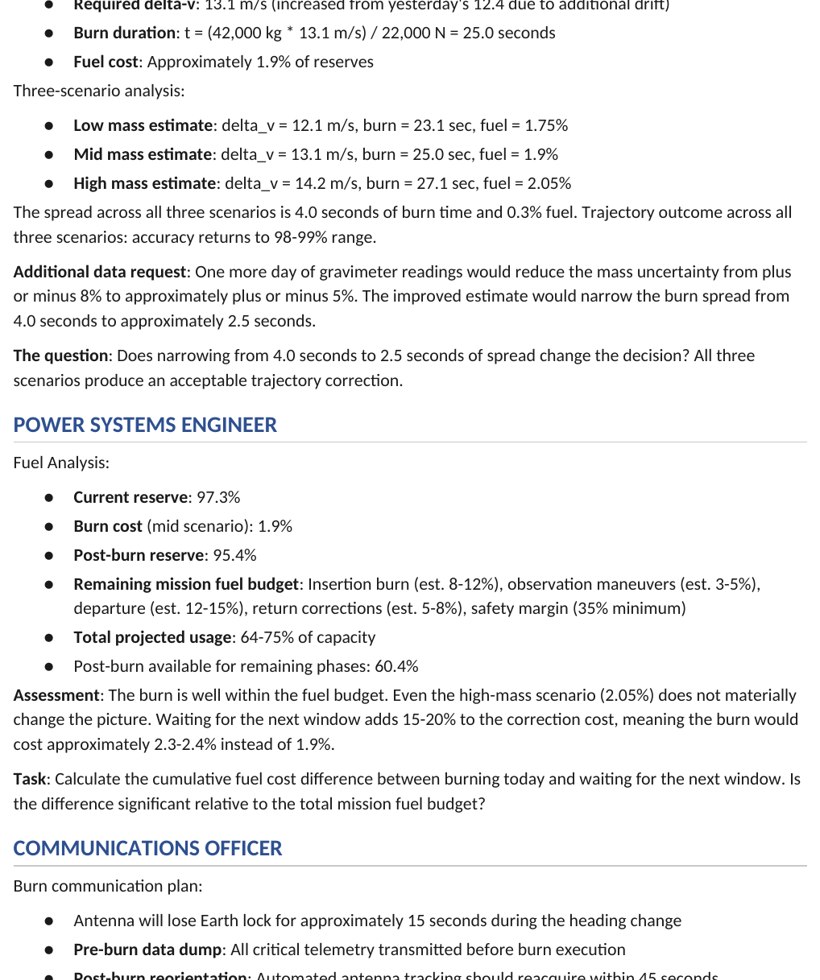
Your students are not answering questions. They are calling a burn.
Each case day drops fresh telemetry into Mission Control. Your students read velocity and acceleration data, run the impulse-momentum theorem on a course correction, and decide whether to commit fuel now or wait for a cleaner signal. The data is always 12 minutes old, so the call is never clean. A worksheet asks them to find delta-v and move on. This asks them to spend it. When they fire the wrong burn vector, the fuel reserve does not reset, and the next day's options narrow because of what they did the day before. The numbers on the page belong to their team's unique mission path, so the choice is theirs to own, and theirs to defend in the journal.
Tap to see a mission case day
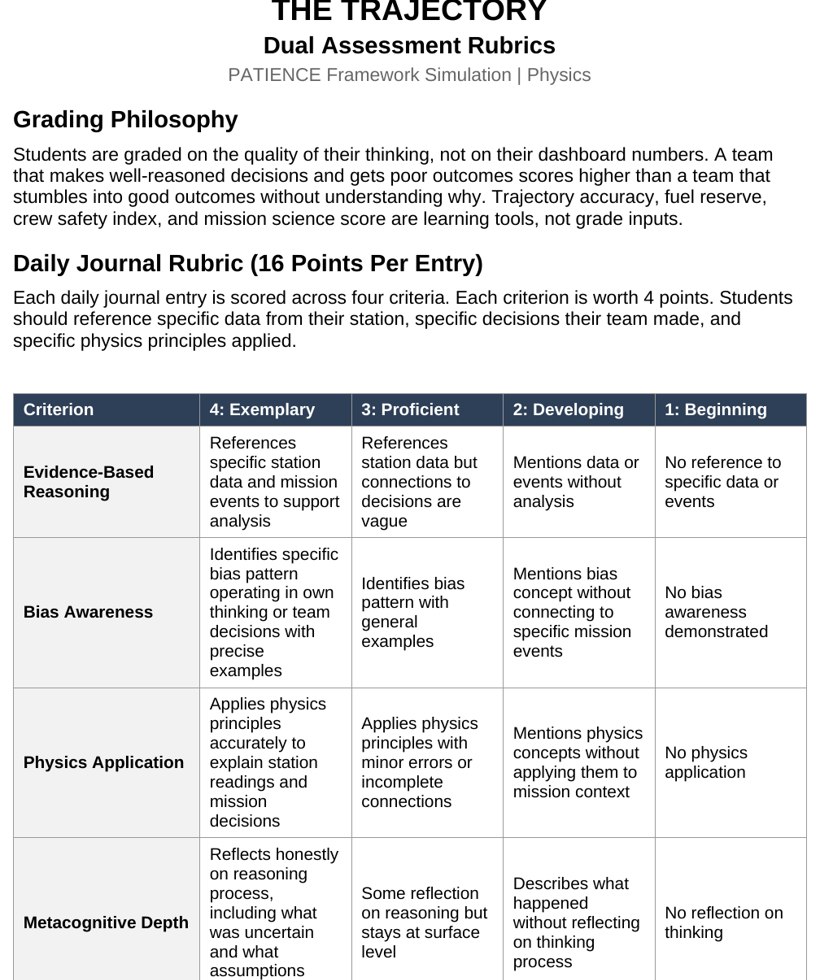
A sound burn that fails beats a lucky one that lands.
The Dual Rubric grades how your students think, not whether the mission survives. Daily journals carry 224 points, scored at 16 points a day across 14 case days, where students log their station data and the reasoning behind each team choice. The Final Reflection adds 20 points for honest analysis of their own biases and the line between boldness and recklessness. A crew lost to a well-reasoned 30 percent risk that the data did not flag loses no points for the outcome. A crew saved by a guess earns nothing for the guess. The rubric leans on specific dashboard numbers, role-only data feeds, and named team disagreements, which is exactly the detail an AI draft cannot fake.
Tap to read the grading rubric
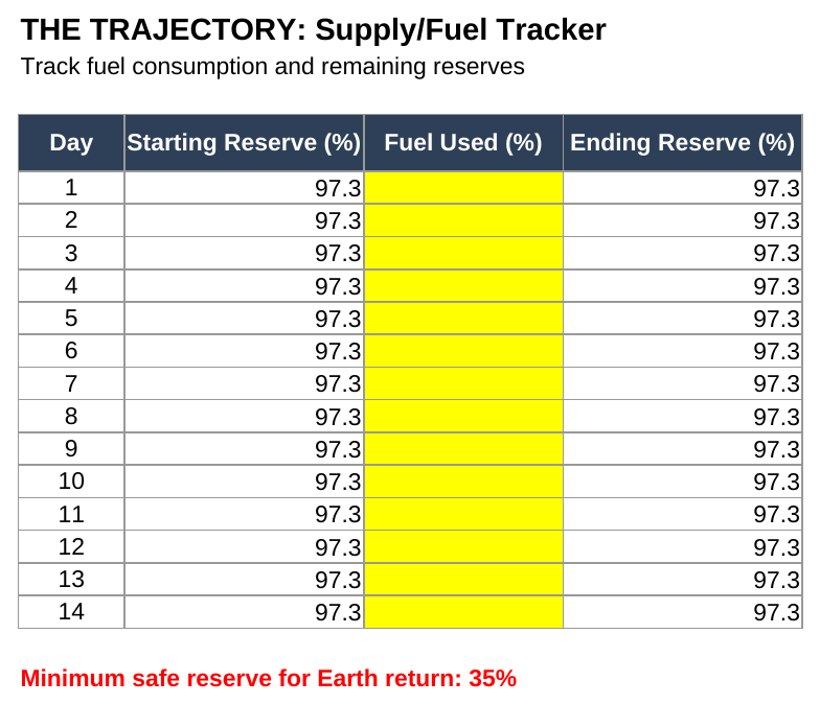
Let the workbook carry the bookkeeping so judgment gets the energy.
The tech-enabled workbook holds the six mission metrics so your students never lose a session to arithmetic cleanup. Trajectory accuracy, fuel reserve, crew safety index, mission science score, communication uptime, and system integrity all update as the team commits each decision. Nine Physics Reference Cards sit beside it, covering delta-v, Doppler shifts in spectroscopy, power budgeting, and orbital velocity, the only tools your students have as they interpret telemetry in real time. The spreadsheet does the carrying, the totaling, and the tracking. That frees the period for the part that matters: reading the trade-off, because no single metric can be maxed without spending another, and defending the call the team finally makes.
Tap to see the tracker
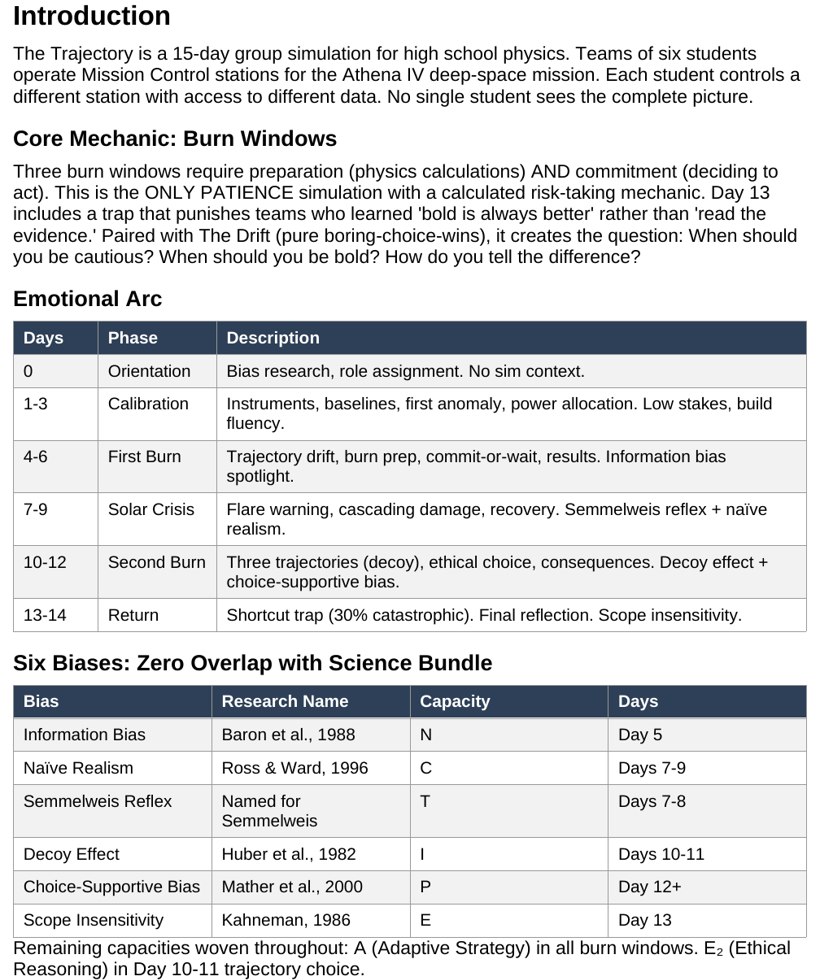
Every period is scripted. You bring the room, the sim brings the rest.
The Teacher Guide scripts all 15 periods, so the mission can be run cold with no physics prep the night before. Each day gives you the data release, the facilitation moves, the questions to ask when a team anchors too hard on Day 1, and the expected reasoning to listen for. The 15-period arc is sequential but not bound by the clock, so you can pause it or block it without breaking the logic of the data. Class size flexes through parallel mission teams or combined stations for smaller groups. You facilitate the room and read the reasoning out loud. The simulation handles the narrative, the telemetry, the scoring, and the day-by-day pacing.
Tap to read the teacher guide
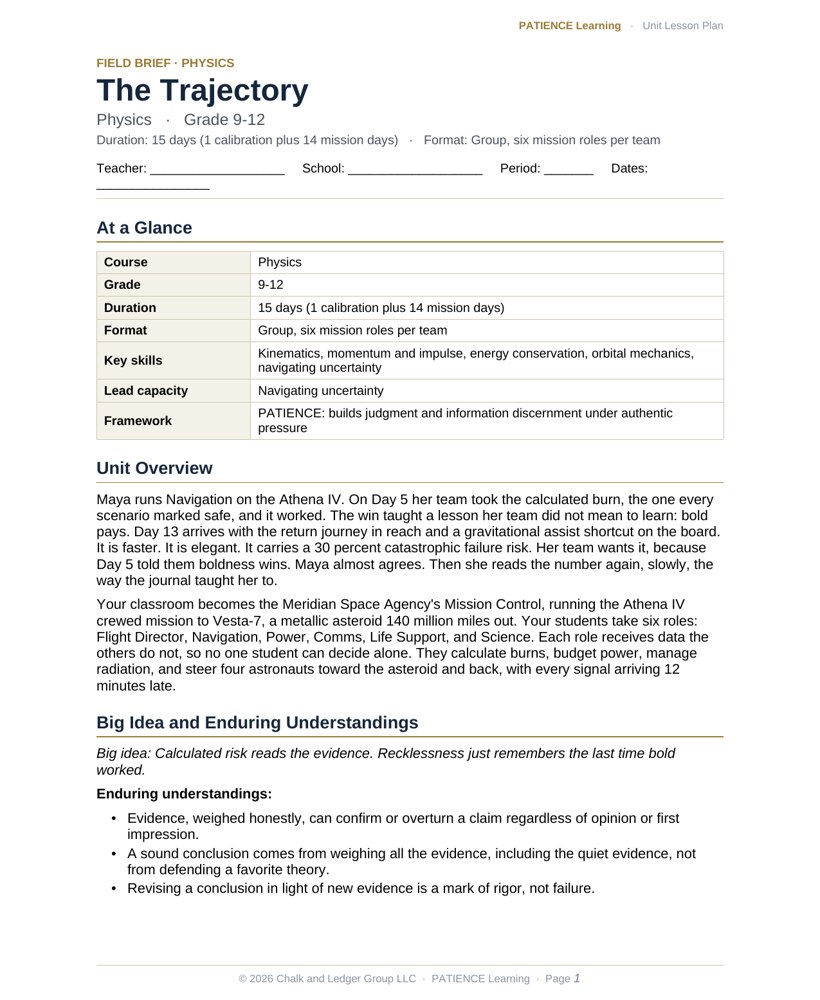
The lesson plan is already written.
Every simulation comes with a fully editable, admin-ready lesson plan. Standards alignment, daily pacing, learning objectives, differentiation, and an assessment plan are already done, so you can hand it to an administrator or adapt it to your district template in minutes.
Tap to preview the lesson plan
Close
Close
Close
Close
The day the bold pattern stops being courage.
Maya runs Navigation on the Athena IV. On Day 5 her team took the calculated burn, the one every scenario marked safe, and it worked. The win taught a lesson her team did not mean to learn: bold pays. Day 13 arrives with the return journey in reach and a gravitational assist shortcut on the board. It is faster. It is elegant. It carries a 30 percent catastrophic failure risk. Her team wants it, because Day 5 told them boldness wins. Maya almost agrees. Then she reads the number again, slowly, the way the journal taught her to.
Thirty percent does not feel large on a screen. Maya makes it feel large. Three out of ten crews lost, she writes, four people each time. She checks the board for the option her teammates skipped past, and finds it: a safe return trajectory, slower, less elegant, intact. The choice is between protecting the pattern her team fell in love with and trusting what the evidence actually says. She picks the evidence. Once she does, the trap is obvious. Day 5 was bold because the data was safe. Day 13 was never bold. It was reckless wearing the same coat.
Mission Control for the Athena IV.
Your classroom becomes the Meridian Space Agency's Mission Control, running the Athena IV crewed mission to Vesta-7, a metallic asteroid 140 million miles out. Your students take six roles: Flight Director, Navigation, Power, Comms, Life Support, and Science. Each role receives data the others do not, so no one student can decide alone. They calculate burns, budget power, manage radiation, and steer four astronauts toward the asteroid and back, with every signal arriving 12 minutes late.
| Grade level | 9-12 |
| Course | Physics |
| Duration | 15 days (1 calibration plus 14 mission days) |
| Format | Group, six mission roles per team |
| Key skills | Kinematics, momentum and impulse, energy conservation, orbital mechanics, navigating uncertainty |
Engineering better thinkers.
In space, the data is always incomplete and always late, and a confident wrong call costs fuel you cannot replace. Each mission day pairs a named bias with the capacity that defeats it, so your students practice catching their own thinking under pressure, not just running the physics.
| Bias targeted | The remedy, built into the work |
|---|---|
| Information bias | Navigating uncertaintyDay 5 tempts teams to wait for more telemetry before the first burn. Students learn that data 12 minutes old will never be perfect, and that a sound call on present evidence beats a stalled one. |
| Naive realism | Independent and collaborative reasoningOn Days 7-9 each role sees only its own feed. Students learn their view of the mission is partial, and that the true picture only appears when six stations synthesize what they separately know. |
| Semmelweis reflex | MetacognitionWhen solar event telemetry contradicts the team's working plan on Days 7-8, students must notice their urge to reject the inconvenient reading and instead update the shielding decision to match the evidence. |
| Decoy effect | Information discernmentThree approach trajectories on Days 10-11 include one engineered to make a riskier option look reasonable. Students learn to score each path on its own physics rather than against a planted comparison. |
| Choice-supportive bias | Productive failure recoveryAfter a costly burn, teams tend to defend the decision rather than learn from it. From Day 12 students practice naming the error honestly so the next correction is grounded in what actually happened. |
| Scope insensitivity | Emotional regulationOn Day 13 a 30 percent failure risk does not feel large until students translate it into three of ten crews lost. They learn to hold steady and let the magnitude, not the adrenaline, drive the final call. |
15 days of telemetry, burns, and consequences.
Day 1 calibrates the team, establishes baselines, and builds fluency with the dashboard and the reference cards. From there the mission moves through three phases: calibration, the first burn and solar crisis, then the second burn and the return. Two engineered pivots test whether your students read evidence or follow a pattern.
| Day | What lands | Physics in focus |
|---|---|---|
| 1-3 | Calibration. Teams set baselines, detect minor anomalies, and budget initial power. | Kinematics and power budgeting |
| 4 | The first trajectory correction. Teams commit fuel to a course change. | Momentum and impulse |
| 5 | The calculated burn. Every scenario is safe, but only if students stop waiting for perfect data. The first pivot. | Navigating uncertainty |
| 6 | Drift consequences. Day 4 errors surface as accumulated trajectory drift. | Kinematics |
| 7-8 | Solar crisis. A coronal mass ejection forces a choice between array retraction and crew shielding. | Thermodynamics and energy |
| 9 | Synthesis. Six stations reconcile conflicting feeds into one picture. | Collaborative reasoning |
| 10-11 | Approach selection. Three trajectories trade mission science against crew safety, with mass uncertainty in play. | Orbital mechanics |
| 12 | Thermal venting discovered on Vesta-7. Teams reckon honestly with prior choices. | Energy conservation |
| 13 | The Trap. A 30 percent gravitational assist shortcut tempts the pattern learners. A safe return exists. The decisive pivot. | Scope insensitivity and risk |
| 14 | The return. Consequences of every prior burn arrive at once. | Momentum and orbital mechanics |
| 15 | Final reflection. Students analyze their own biases and the line between boldness and recklessness. | Metacognition |
Standards alignment.
The Trajectory targets NGSS high school physics performance expectations head on. Burn calculations and trajectory drift exercise HS-PS2-1 and HS-PS2-2 on Newton's second law and momentum conservation, applied directly through the impulse-momentum theorem. Power budgeting and the solar crisis hit HS-PS3-1 and HS-PS3-3 on energy and engineered systems that minimize energy loss. The science practices run throughout: students plan and carry out investigations, use mathematics and computational thinking on real telemetry, and construct evidence-based explanations under uncertainty. Orbital approach and mass uncertainty connect to gravitation and HS-PS2-4. Every calculation carries a mission consequence, so the physics is practiced, not memorized.
The hidden architecture.
The whole 15 days is built to spring one trap. Day 5 hands students a calculated burn where every scenario is genuinely safe, and rewards them for committing on imperfect data. That win plants the lesson the design wants them to over-learn: bold pays. Day 13 then offers a gravitational assist shortcut at 30 percent catastrophic failure, framed to feel like the same kind of bold. It is not. A safe return trajectory sits right beside it, and scope insensitivity hides the magnitude of 30 percent behind a number that does not feel heavy. Pattern learners take the shortcut and lose three crews in ten. The students who reread the evidence see that Day 5 was bold because the data was safe, and Day 13 was reckless because it never was. That contrast is the lesson.
Turnkey, classroom-ready.
- An admin-ready lesson plan. A fully editable plan with standards alignment, daily pacing, differentiation, and assessment, ready to adapt to your district template. Included with every purchase.
- A 15-day facilitation playbook. Minute-by-minute scripting for every period, runnable cold with no physics prep.
- A tech-enabled mission workbook. Tracks all six metrics and the burn math so student energy goes to judgment.
- Nine Physics Reference Cards. Delta-v, Doppler shifts, power budgeting, and orbital velocity as working tools, not study guides.
- Role-specific data releases. Unique feeds for six mission roles, so no student can decide alone and the team must synthesize.
- A dual rubric system. Grades the quality of reasoning across 244 points, not whether the mission survives.
Put your students in Mission Control.
Bring The Trajectory to your physics classroom and let your students learn the difference between calculated risk and recklessness before the burn that cannot be undone.
Get this simulationPreview real pages from the simulation before you spend a dollar. No guessing, no surprises.