The Theory
The right answer is not the assignment. Defending a theory you can be wrong about is.
See what your students get, and why it lands.
No mockups. Every page below is real, pulled straight from the files you download. Tap any one to see it full size.
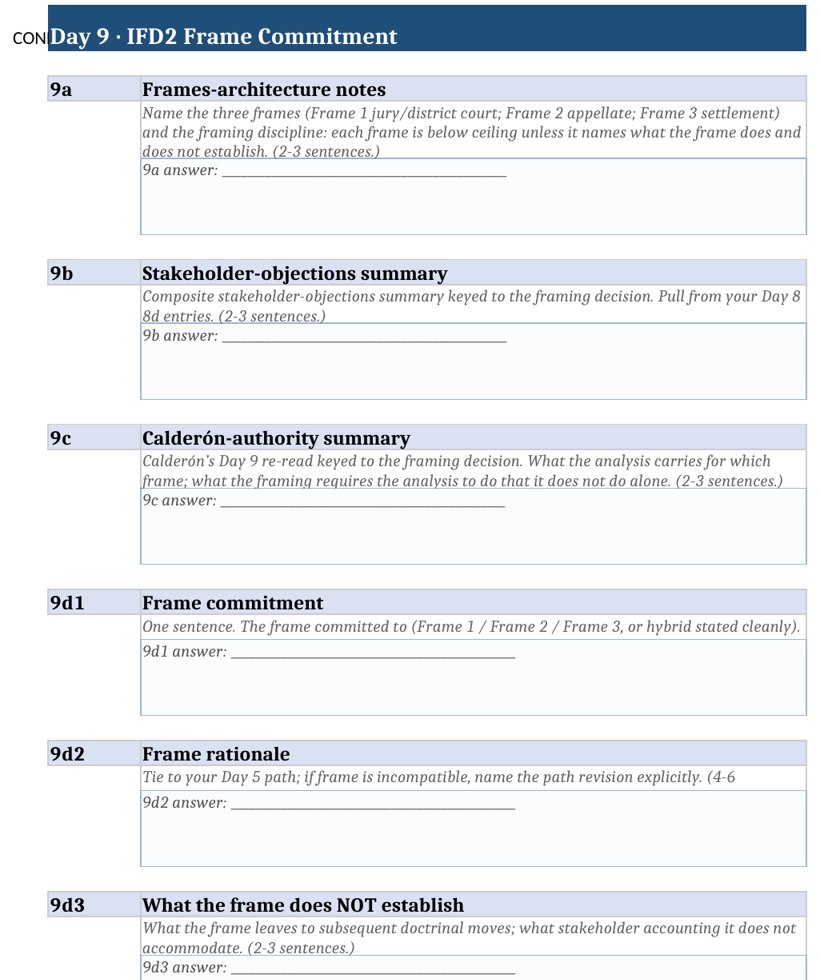
A worksheet was never going to teach this.
Open the student Workbook and there is no comprehension quiz waiting. Your students are junior attorneys at the Westview Civil Rights Project, handed the record in McAllister v. WUSD, a Section 1983 Equal Protection challenge. The page asks them to read a contested documentary record, name a working theory of the case, and commit to it while the facts are still incomplete and the depositions disagree. They are not answering questions someone already has the key to. They are making a binding strategic call from evidence, then writing the specific condition that would force them to abandon it. That is what an attorney does on Day 1 of a real file, and it is what your students do here.
Tap to open the student workbook
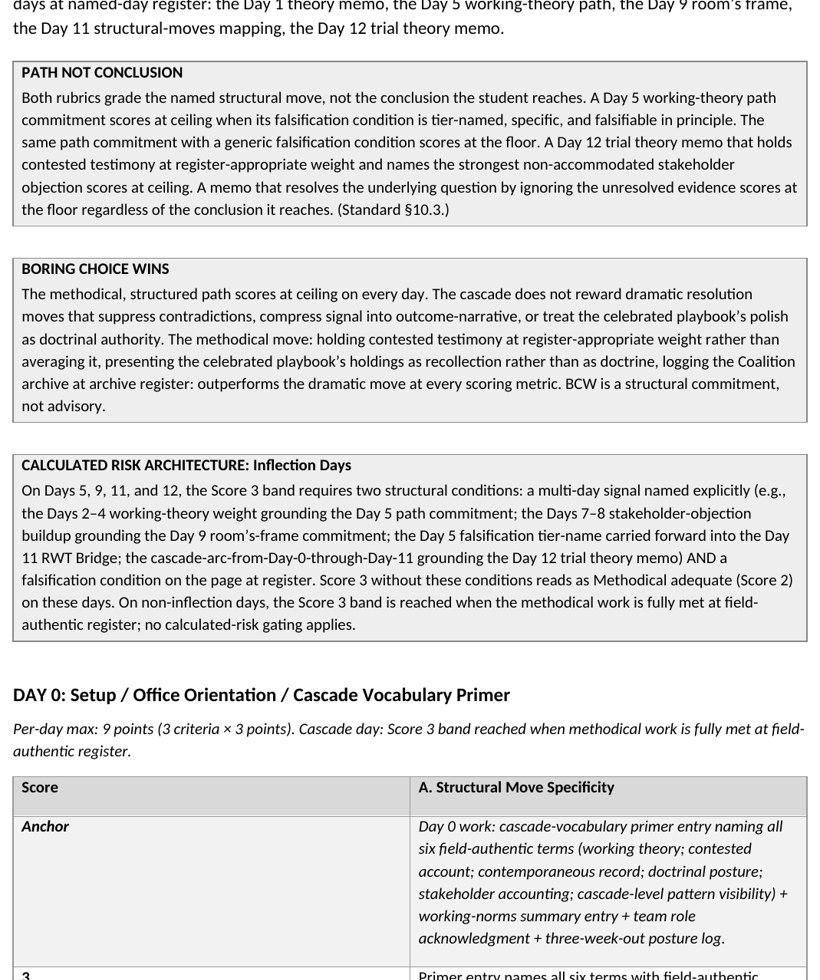
They are graded on the reasoning, not the verdict.
The Daily Rubric scores the path, not the conclusion. A student who builds a tight theory, names the trade-offs, and writes an in-principle-falsifiable condition earns full marks even if the case ultimately breaks the other way. A student who guesses the favored outcome with thin support does not. The scale is three points, applied daily, so you read for the structural moves on the page instead of grading a stack of narrative essays. Sound process behind a wrong call beats a lucky guess every time. Your students learn that fast, because the rubric rewards exactly the discipline a courtroom rewards, and nothing else.
Tap to read the grading rubric
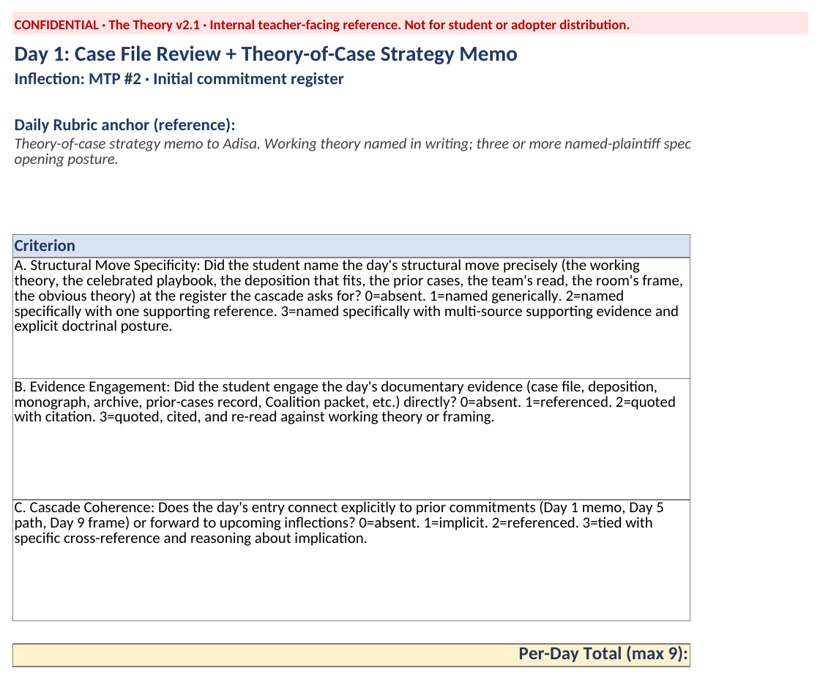
Let the tracker hold the paperwork.
Litigation generates paper. The student Tracker carries it so the thinking does not have to. It holds the running theory, the conditions that would falsify it, the frame the team chose, and the trail of commitments across all 13 days. When a deposition complicates the working read, your students update one place and keep moving, instead of losing an hour reorganizing notes. The Tracker also feeds the team's independent-write discipline, capturing each attorney's draft before the caucus converges. Your students spend their energy on judgment, on which evidence holds and which condition would break the theory, while the spreadsheet remembers everything else for them.
Tap to see the tracker
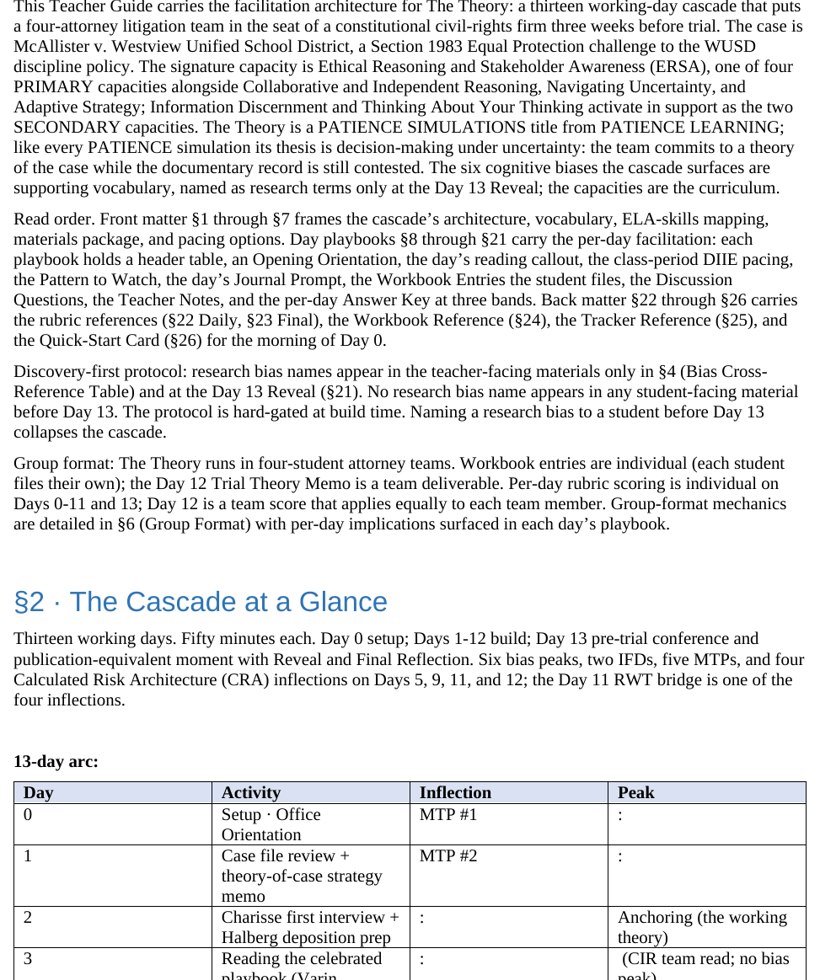
Every day is already scripted.
You bring the facilitation. The simulation brings everything else. The Teacher Guide gives you minute-by-minute run-docs and a pacing card for all 13 sessions, so you can lead a high-stakes constitutional case without building one. It tells you when to open the first commitment window, when teams choose their frame, and how to run the independent-write-before-caucus discipline that keeps one loud student from steering the team's read. Grading stays light on the 3-point daily scale, with the terminal memo team-scored on Day 12. The case tolerates gaps for testing days and assemblies, and the four-attorney team structure scales to any class size by running teams in parallel.
Tap to read the teacher guide
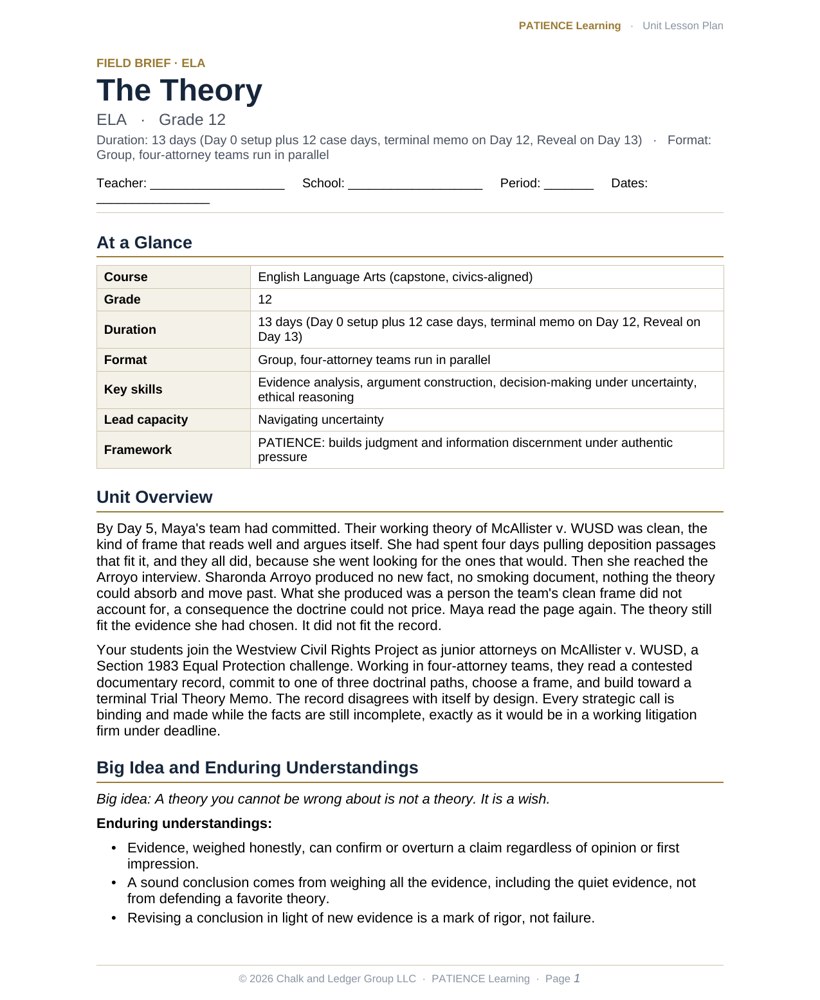
The lesson plan is already written.
Every simulation comes with a fully editable, admin-ready lesson plan. Standards alignment, daily pacing, learning objectives, differentiation, and an assessment plan are already done, so you can hand it to an administrator or adapt it to your district template in minutes.
Tap to preview the lesson plan
Close
Close
Close
Close
The day the favored theory stopped fitting the record.
By Day 5, Maya's team had committed. Their working theory of McAllister v. WUSD was clean, the kind of frame that reads well and argues itself. She had spent four days pulling deposition passages that fit it, and they all did, because she went looking for the ones that would. Then she reached the Arroyo interview. Sharonda Arroyo produced no new fact, no smoking document, nothing the theory could absorb and move past. What she produced was a person the team's clean frame did not account for, a consequence the doctrine could not price. Maya read the page again. The theory still fit the evidence she had chosen. It did not fit the record.
Here is the pivot. Maya could keep the frame and quietly leave Arroyo out, or she could trust what the full record showed and rebuild. The rubric does not reward the prettier theory. It rewards the attorney who names the condition that breaks her own case and meets it honestly. So she wrote it down, the specific evidence that would force the team to overturn the path they loved, and then she watched the favored read come apart against it. What she saw on the other side was not a worse theory. It was a defensible one, and she knew exactly why.
A civil rights firm, a contested record, a terminal deadline.
Your students join the Westview Civil Rights Project as junior attorneys on McAllister v. WUSD, a Section 1983 Equal Protection challenge. Working in four-attorney teams, they read a contested documentary record, commit to one of three doctrinal paths, choose a frame, and build toward a terminal Trial Theory Memo. The record disagrees with itself by design. Every strategic call is binding and made while the facts are still incomplete, exactly as it would be in a working litigation firm under deadline.
| Grade level | 12 |
| Course | English Language Arts (capstone, civics-aligned) |
| Duration | 13 days (Day 0 setup plus 12 case days, terminal memo on Day 12, Reveal on Day 13) |
| Format | Group, four-attorney teams run in parallel |
| Key skills | Evidence analysis, argument construction, decision-making under uncertainty, ethical reasoning |
Engineering better thinkers.
Discernment decides cases. A theory survives only if the record supports it and the team can name what would break it. Each day pairs one cognitive bias with the capacity that defeats it, then withholds the formal name until the Day 13 Reveal so the lesson lands as recognition.
| Bias targeted | The remedy, built into the work |
|---|---|
| Anchoring | Productive failure recoveryThe Day 1 working theory quietly shapes every later read. Students learn to revisit the first frame, treat it as provisional, and recover when the evidence forces a rebuild rather than defending the opening guess. |
| Confirmation bias | MetacognitionIt is easy to pull only the deposition passages that fit a committed path. A self-audit makes students watch how their first read steers which evidence they even notice, then correct for it. |
| Sunk cost fallacy | Adaptive strategyDays of work on a favored theory tempt a team to keep it. Students commit to a provisional path while naming the specific conditions that would require them to change it, so abandoning it costs nothing extra. |
| Availability bias | Information discernmentA vivid deposition or a celebrated precedent can crowd out quieter, stronger evidence. Students weigh the full documentary record on its merits instead of the passages that happen to be loudest. |
| Tunnel vision | Navigating uncertaintyA clean frame narrows what a team can see. Students commit to a binding path while the record stays contested, holding contradicting accounts in view rather than resolving them away early. |
| Overconfidence | Emotional regulationCertainty feels like strength and reads like risk. Students write in-principle-falsifiable conditions at register, keeping the theory honest by stating plainly what would prove it wrong. |
13 days of evidence under pressure.
The early days set the firm, the record, and the working theory. From there the case cascades, building deadline pressure toward the terminal Trial Theory Memo. Two binding commitment windows force strategic calls while the record is still contested, and the final day reveals the cognitive science behind everything students just lived.
| Day | What lands | Skill in focus |
|---|---|---|
| 1 | The firm, the McAllister record, and the first working theory | Reading a contested record |
| 2 | Mapping what the record establishes and what it does not | Evidence analysis |
| 3 | Depositions complicate the opening read | Holding contradiction in view |
| 4 | Drafting tier-named, falsifiable conditions | Naming what would break the theory |
| 5 | Path Commitment: the first binding window across three doctrinal paths (critical pivot) | Decision-making under uncertainty |
| 6 | Independent-write before caucus on the team's read | Independent and collaborative reasoning |
| 7 | Testing the committed path against the fuller record | Information discernment |
| 8 | The Arroyo interview and the stakeholder the doctrine cannot price | Ethical reasoning and stakeholder awareness |
| 9 | Room's-Frame Commitment: choosing Jury, Appellate, or Settlement and naming trade-offs (critical pivot) | Adaptive strategy |
| 10 | Consolidating the team theory and its falsification condition | Argument construction |
| 11 | Real-World Transfer against the Bonauto, Goodridge, and Obergefell precedents | Transfer and analogy |
| 12 | The terminal Trial Theory Memo, team-scored | Disciplined strategic writing |
| 13 | The Reveal: the formal bias vocabulary maps onto their own documented behavior | Metacognition |
Standards alignment.
The Theory is built on grade-12 CCSS-ELA anchor standards. Students cite strong and thorough textual evidence and analyze where the record leaves matters uncertain (RI.11-12.1). They evaluate the reasoning in seminal U.S. texts, including constitutional argument and precedent (RI.11-12.8). The terminal memo asks students to write arguments with valid reasoning and sufficient evidence, anticipating counterclaims (W.11-12.1), and to conduct sustained analysis of a complex documentary record (W.11-12.7, W.11-12.9). Team caucus work develops collegial discussion that builds on others' ideas and weighs evidence (SL.11-12.1). Throughout, students attend to precise legal and academic register (L.11-12.3).
The hidden architecture.
The pivot is engineered, and it runs on a planted contradiction. The McAllister record is built so that a clean, attractive theory will fit the evidence a team chooses to gather, which is exactly why confirmation bias and anchoring lead them straight into it. The Arroyo interview on Day 8 is the trap: by design it adds no new fact, so it cannot be argued away. It only exposes the human consequence the favored frame never priced. A team protecting its theory will leave Arroyo out. The Falsification Quality Diagnostic and the independent-write mandate force the sound move instead, making students name the condition that would break their own case and meet it before the team smooths it over. The discipline, not the verdict, produces the defensible theory.
Turnkey, classroom-ready.
- An admin-ready lesson plan. A fully editable plan with standards alignment, daily pacing, differentiation, and assessment, ready to adapt to your district template. Included with every purchase.
- 13-day playbooks. Minute-by-minute facilitation and a pacing card for every session, with the two commitment windows scripted.
- A tech-enabled tracker. Carries each team's theory, falsification conditions, and chosen frame across all 13 days so the paperwork never eats the thinking.
- Turnkey student files. The McAllister case record, depositions, and the Arroyo interview, ready to hand out, no building required.
- A dual rubric system. A 3-point daily scale plus a team-scored terminal memo, grading the quality of reasoning, not whether they solve it.
- The Day 13 Reveal kit. Maps the formal cognitive-science vocabulary onto the behavior students already documented across the case.
- A final reflection tool. Walks each student back through their own 13-day path, turning the experience into transferable insight.
Hand your students a case they can be wrong about.
Bring The Theory to your Grade 12 classroom and let your students learn the discipline that holds up long after the verdict is read.
Get this simulationPreview real pages from the simulation before you spend a dollar. No guessing, no surprises.