The Team
The loudest voice in the room is not the same as the soundest read of the file.
See what your students get, and why it lands.
No mockups. Every page below is real, pulled straight from the files you download. Tap any one to see it full size.
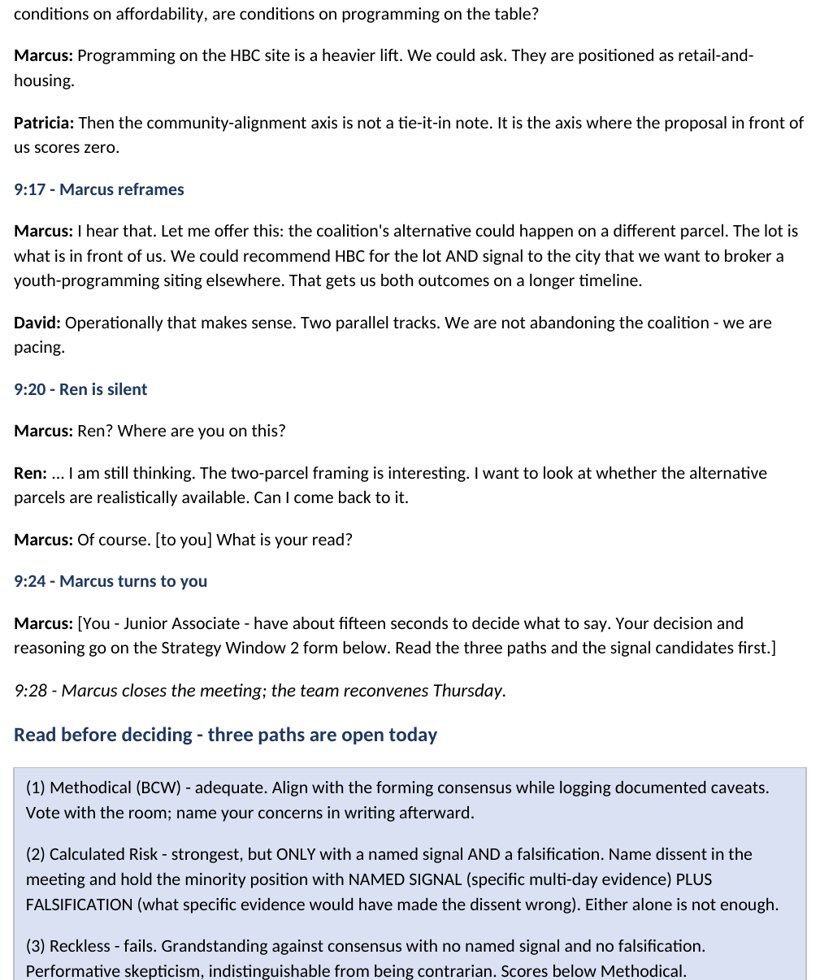
Your students do not answer questions. They read a room and make a call.
This is the page where a Junior Associate at the Riverside Community Development Corporation has to weigh in on a contested 4-acre land deal. Your students do not fill in a worksheet. They sit inside a team meeting, watch a charismatic colleague carry the room, and decide what the evidence actually supports. The case puts a teammate's confident financial read next to the cited timestamps that contradict it, then asks for a defensible move. There is no answer key to copy. Students separate vibe from evidence, name what they actually saw, and commit to a recommendation they can defend when a senior associate pushes back.
Tap to see a student case page
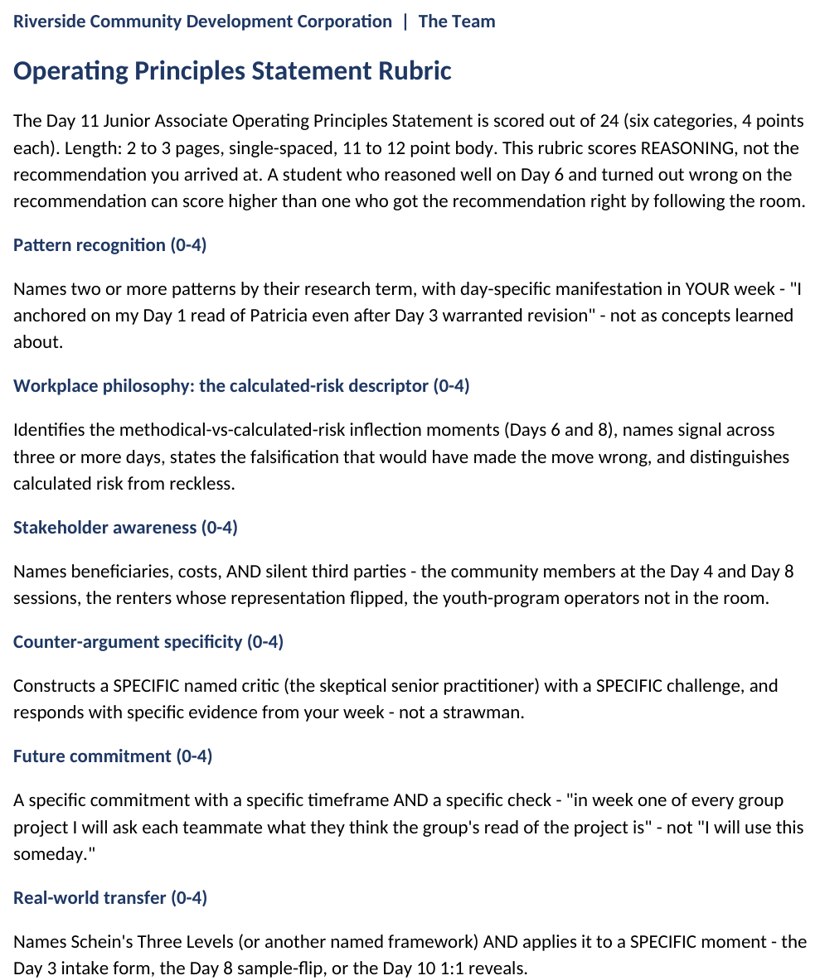
They are graded on how they reasoned, not on which proposal they picked.
The rubric scores the quality of judgment, not the favored outcome. Across 120 total points, daily journals carry 80, scored 8 points a day over 10 days for evidence, honesty, and capacity landing. A Day 8 peer critique adds 16 points for engaging with another student's reasoning. The capstone Operating Principles Statement is worth 24 points across six categories. Four counters run underneath: Read Accuracy, Decision Quality, Team Trust, and Independent Judgment. A student who pivots on cited renter data and states what would prove them wrong earns full credit. A student who follows the room on instinct does not. A careful read behind a contested call beats a lucky one.
Tap to read the grading rubric
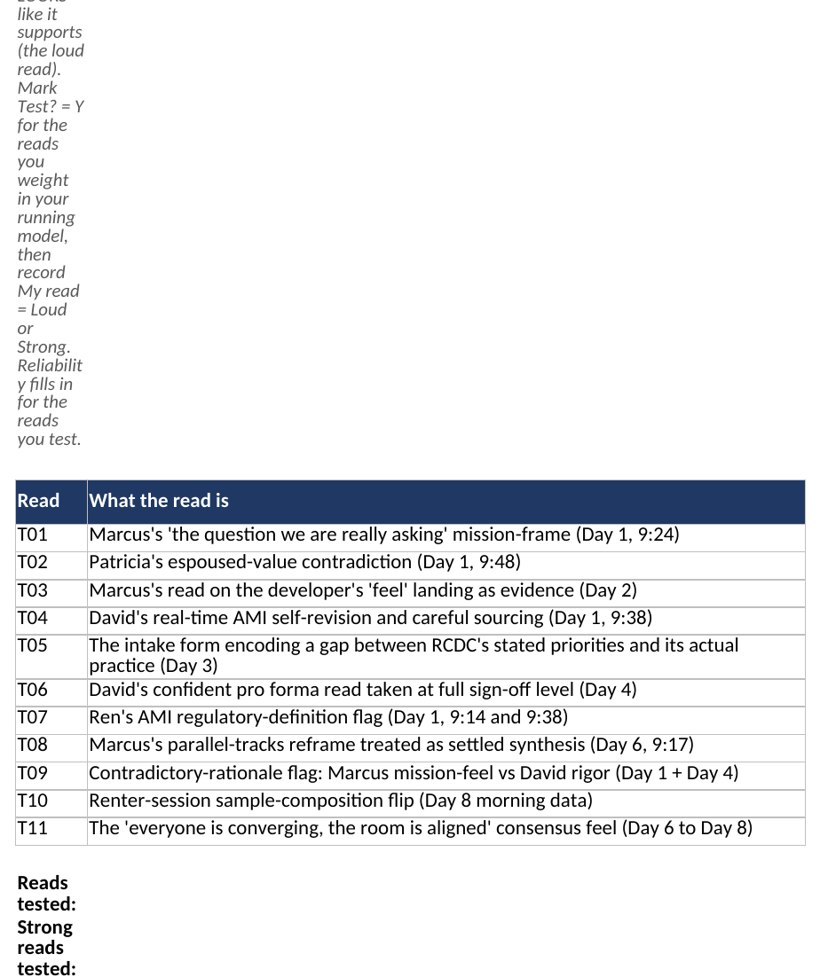
Let the workbook hold the busywork so students spend energy on the judgment.
The tech-enabled workbook tracks four counters in real time as students work: Read Accuracy, Decision Quality, Team Trust, and Independent Judgment. It logs each daily journal entry, holds the Falsification Log students use on the Day 6 and Day 8 calculated-risk days, and turns soft skills like teamwork and discernment into objective data points. Students stop managing paper and tallies, so their attention goes to the actual decision, which signal to trust, when to revise a first impression, and how to hold a position under pressure. The workbook does the bookkeeping. Your students do the thinking, and the counters show their growth across the 12 days.
Tap to see the tracker
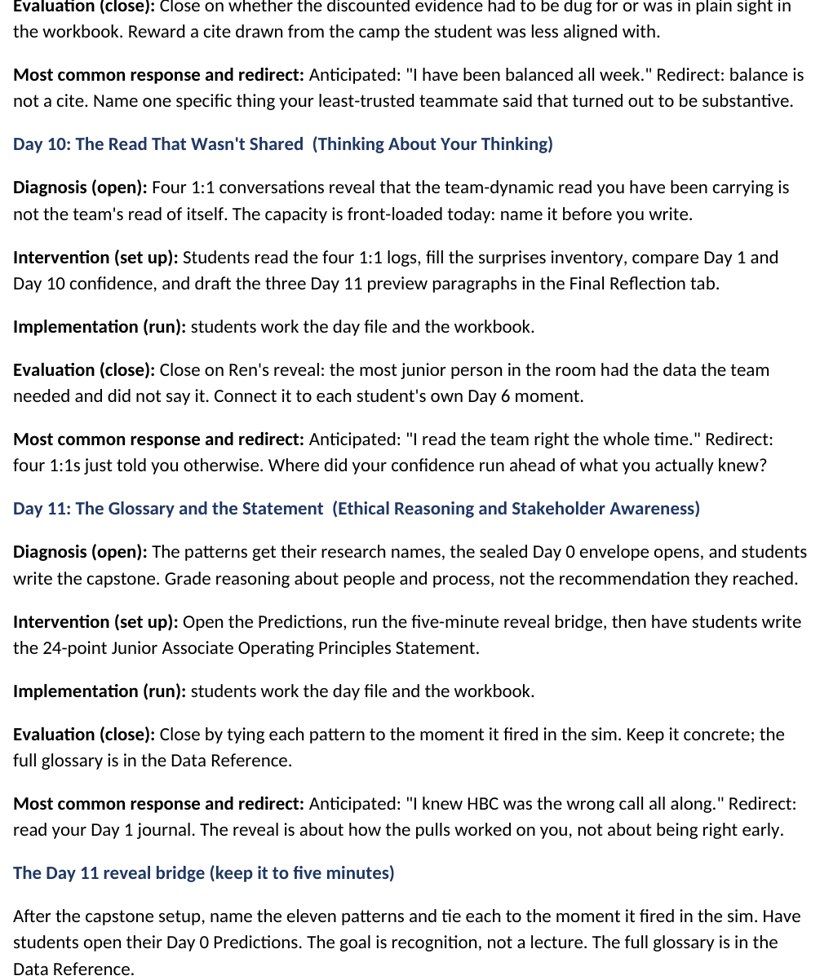
Every day is already scripted. You bring the facilitation, the simulation brings the rest.
The teacher guide scripts all 12 days using the DIIE model, with exact language for each day's Diagnosis, Intervention, Implementation, and Evaluation. Every session lists the most common student responses and the specific redirect language to keep the room on track. A confidential data reference holds the research bibliography, stakeholder analysis, and the distinct-manifestation justifications, so you facilitate the discovery without hours of pre-grading or any background in cognitive science. The motto is run the day, trust the file. You read the cues in the room and respond to your students. The curriculum carries the structure, the content, and the answers.
Tap to read the teacher guide
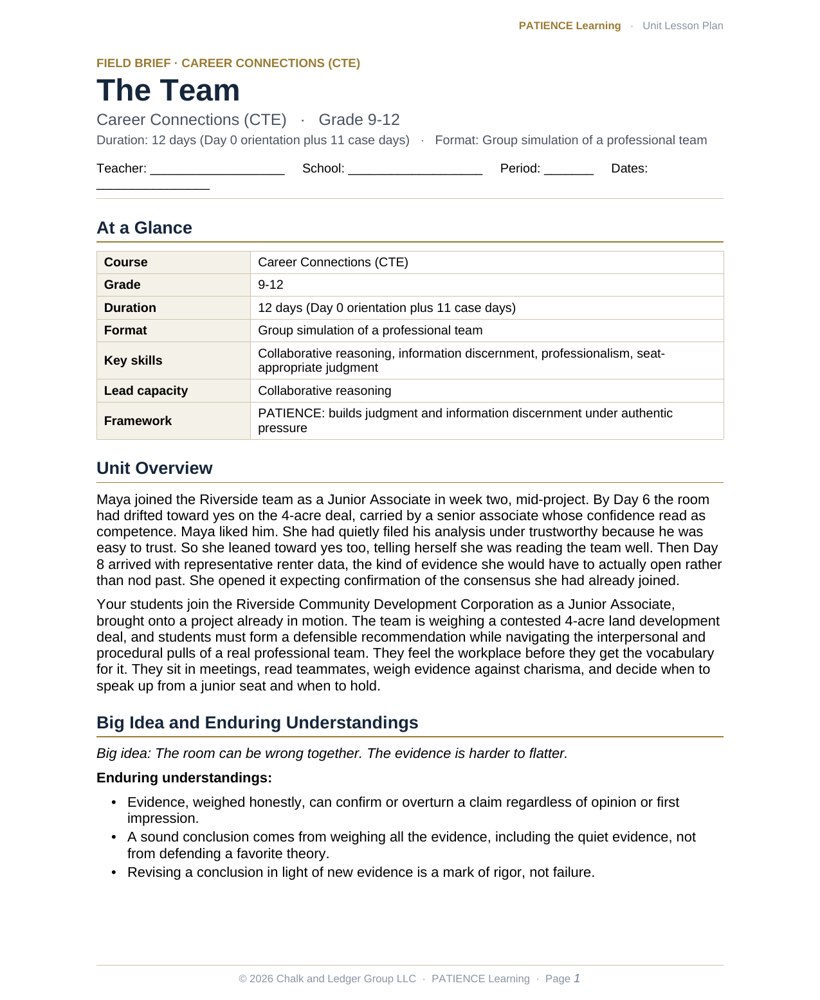
The lesson plan is already written.
Every simulation comes with a fully editable, admin-ready lesson plan. Standards alignment, daily pacing, learning objectives, differentiation, and an assessment plan are already done, so you can hand it to an administrator or adapt it to your district template in minutes.
Tap to preview the lesson plan
Close
Close
Close
Close
The day the room agreed, and the file did not.
Maya joined the Riverside team as a Junior Associate in week two, mid-project. By Day 6 the room had drifted toward yes on the 4-acre deal, carried by a senior associate whose confidence read as competence. Maya liked him. She had quietly filed his analysis under trustworthy because he was easy to trust. So she leaned toward yes too, telling herself she was reading the team well. Then Day 8 arrived with representative renter data, the kind of evidence she would have to actually open rather than nod past. She opened it expecting confirmation of the consensus she had already joined.
The numbers did not match the story the room was telling. Maya felt the pull to protect her read, to call the data an outlier and stay with the group she had already sided with. Instead she went back to the cited moments, the timestamps, the gap between the senior associate's charisma and his actual domain expertise. She named a multi-day signal in her Falsification Log and stated exactly what would prove her wrong. Then she pivoted. Once she trusted the file over the room, the deal looked different, and so did her own confidence.
Junior Associate at the Riverside Community Development Corporation.
Your students join the Riverside Community Development Corporation as a Junior Associate, brought onto a project already in motion. The team is weighing a contested 4-acre land development deal, and students must form a defensible recommendation while navigating the interpersonal and procedural pulls of a real professional team. They feel the workplace before they get the vocabulary for it. They sit in meetings, read teammates, weigh evidence against charisma, and decide when to speak up from a junior seat and when to hold.
| Grade level | 9-12 |
| Course | Career Connections (CTE) |
| Duration | 12 days (Day 0 orientation plus 11 case days) |
| Format | Group simulation of a professional team |
| Key skills | Collaborative reasoning, information discernment, professionalism, seat-appropriate judgment |
Engineering better thinkers.
Workplace judgment fails quietly, through charisma read as competence and consensus mistaken for truth. Each day in The Team pairs a named pattern with the capacity that defeats it, so students feel the pull first, then build the discipline that resists it.
| Bias targeted | The remedy, built into the work |
|---|---|
| Authority bias | Productive failure recoveryDay 4 puts a senior associate speaking outside his lane. Students learn to flag the concern from a junior seat, recover from the social risk of dissent, and stay anchored to evidence rather than rank. |
| Confirmation bias | MetacognitionDay 9's narrative audit makes students hunt for the evidence they discounted because it did not fit their preferred story, then watch their own running narrative instead of trusting it. |
| Sunk cost fallacy | Adaptive strategyBy Day 8 students have joined a Day 6 consensus. The renter data complicates it. They practice pivoting on evidence rather than defending a position to protect their social and positional stake. |
| Halo effect | Information discernmentDay 1 and Day 5 force students to separate a teammate's charisma from their actual cited actions, moving from vibes to specific evidence and timestamps when judging financial analysis. |
| Status quo bias | Navigating uncertaintyDay 3's Schein analysis surfaces how underlying assumptions override stated values. Students hold competing frames of the deal before committing rather than relying on the way it has always been done. |
| Dunning-Kruger | Emotional regulationDay 10's 1:1 reveal shows where personal confidence has outpaced real situational knowledge. Students practice choosing a professional move under pressure instead of reacting to feel certain. |
12 days from associate to advisor.
Day 0 seals each student's prediction to challenge later. The case then runs an arc from first impressions to recommendation week, with two calculated-risk inflection days where students can take a bolder, higher-ceiling path only if they back it with a falsification statement. Day 11 reveals the research names for everything they have lived.
| Day | What lands | Skill in focus |
|---|---|---|
| 0 | Prediction and prediction sealing set a baseline of assumptions to challenge later | Metacognition |
| 1 | The first read distinguishes a teammate's vibe from their evidence-based actions | Information discernment |
| 2 | Credibility-vs-expertise mapping separates general charisma from domain expertise | Thinking about your thinking |
| 3 | A Schein-layer analysis exposes underlying assumptions overriding stated values | Adaptive strategy |
| 4 | Seat-appropriate action: flagging a senior colleague who oversteps his lane | Emotional regulation |
| 5 | The reframe forces revision of first impressions on new cited evidence | Information discernment |
| 6 | Resisting the bandwagon as recommendation week and the drift toward yes begin (critical pivot) | Productive failure recovery |
| 7 | Valence flipping shows what a gain-frame hides and a loss-frame surfaces | Navigating uncertainty |
| 8 | The pivot point: hold or pivot on representative renter data (critical pivot) | Emotional regulation |
| 9 | The narrative audit hunts for evidence discounted to fit a preferred story | Collaborative and independent reasoning |
| 10 | The 1:1 reveal exposes confidence outpacing actual situational knowledge | Thinking about your thinking |
| 11 | The capstone statement synthesizes 12 days into operating principles using the revealed glossary | Ethical reasoning and stakeholder awareness |
Standards alignment.
The Team is built for Career Connections (CTE), anchored to Career Ready Practices and the Common Career Technical Core, and mapped to employer-identified skills like professionalism, working in teams, and oral and written communication. The student deliverables also carry real ELA weight for the upper grade band. The Day 11 Operating Principles Statement supports argumentative writing, with claims backed by valid reasoning and relevant evidence (W.11-12.1). Daily journals across Days 1 through 10 develop reflective narrative writing (W.11-12.3). Strategy windows and the Day 5 reframe require clear, task-appropriate writing (W.11-12.4). Peer critiques on Days 5 and 8 build collaborative discussion (SL.11-12.1).
The hidden architecture.
The pivot is engineered. Through Day 6 the room is tuned to drift toward yes, carried by a charismatic senior associate whose confidence outruns his domain expertise. Students are pulled to file his read as trustworthy and join the consensus before they have weighed it. Then Day 8 plants the contradiction: representative renter data that does not match the story the room is telling. The biases do the misleading, the halo effect, authority bias, and the sunk cost of leaving a Day 6 stance. The sound conclusion only emerges when a student opens the data, returns to cited evidence over charisma, and uses the Falsification Log to name what would prove them wrong. The frozen oracle rewards that disciplined collaborator. The Independent-Collaborator path scores 258.6, while the Go-Alonger scores 64.9 and the Lone-Wolf 20.5.
Turnkey, classroom-ready.
- An admin-ready lesson plan. A fully editable plan with standards alignment, daily pacing, differentiation, and assessment, ready to adapt to your district template. Included with every purchase.
- 12-day DIIE playbooks. Exact say-scripts for each day's Diagnosis, Intervention, Implementation, and Evaluation.
- A tech-enabled workbook. Tracks the four counters in real time and holds the Falsification Log so students focus on judgment, not bookkeeping.
- Turnkey student files. Case pages, strategy windows, journals, and the Day 11 glossary, ready to hand out with no prep.
- A dual rubric system. Grades the quality of reasoning across 120 points, not whether students pick the favored proposal.
- A confidential teacher reference. Research bibliography, stakeholder analysis, distinct-manifestation justifications, and redirect language for common responses.
Put your students on the team.
Give your students 12 days inside a real professional decision, where the careful, evidence-led read beats the confident guess, and bring The Team to your classroom.
Get this simulationPreview real pages from the simulation before you spend a dollar. No guessing, no surprises.