The Studio
Run a design shop for a week, and learn that the biggest order is not always the one worth taking.
The biggest order is not always the one worth taking.
The Studio puts your fifth graders in charge of a print and design shop with limited materials, work slots, and budget. They read client orders, figure out which jobs are actually worth the resources, and manage a week of work. On Day 3 a huge festival order tempts every team to overcommit. It is grade-5 math with real trade-offs.
See what your students get, and why it lands.
No mockups. Every page below is real, pulled straight from the files you download. Tap any one to see it full size.
A worksheet cannot do what a real decision does.
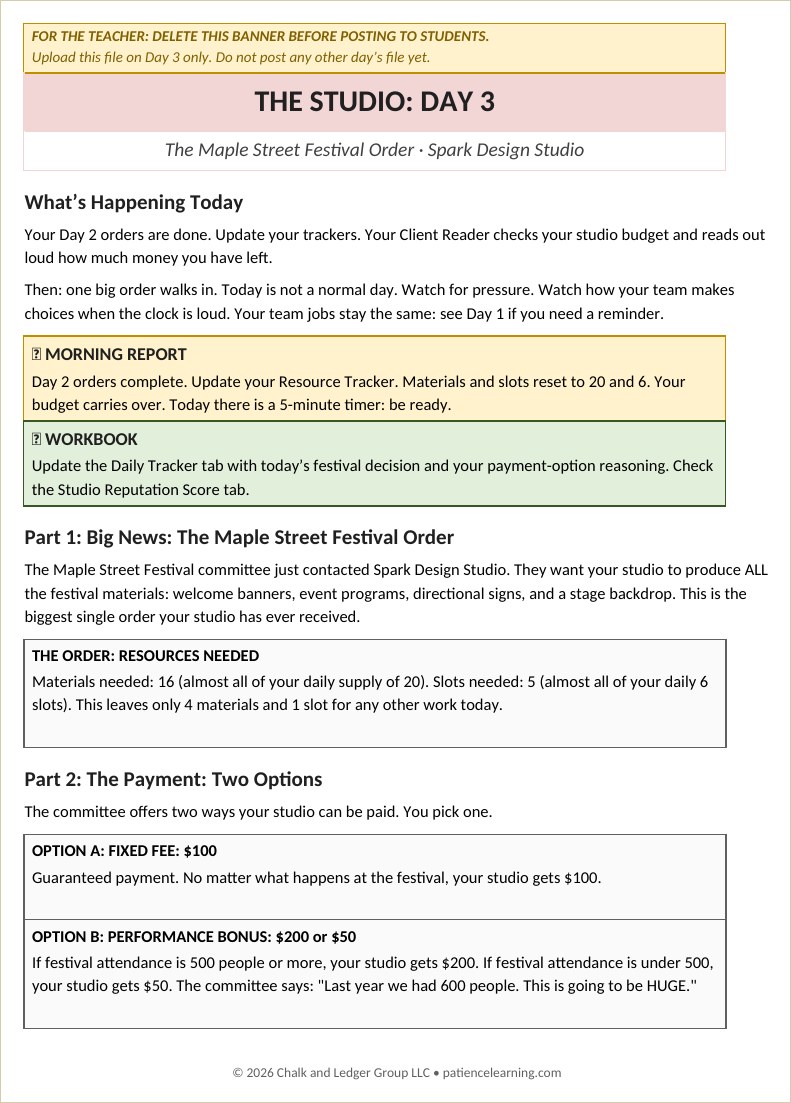
Your fifth graders are not working through someone else's word problems. They are running a design shop, deciding which client orders are worth the materials and the time. On Day 3 a giant festival order arrives that sounds like a windfall, and the team has to figure out whether they can actually fill it without running out of materials or slots. The teams who do the per-resource math before they say yes stay in business. That is efficiency and trade-offs, lived.
Tap to read the festival order
They are graded on their thinking, not on the earnings.
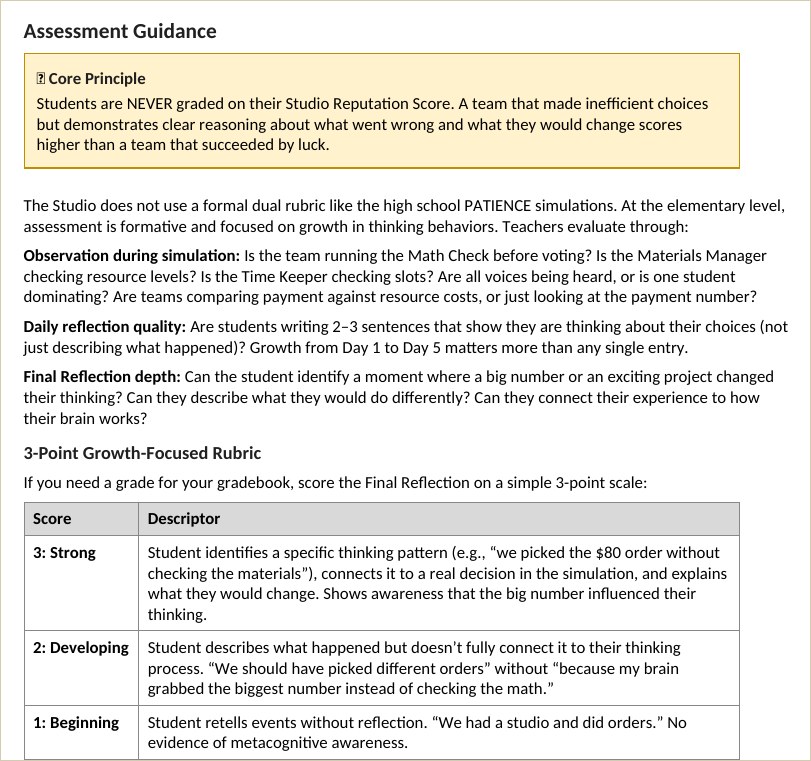
Here is what surprises teachers. The team that earned the most is not graded higher than the team that earned the least. There is no winning number. Students are graded on the quality of their reasoning, written in their own reflection. A team that made a smart call that did not pay off scores higher than a team that got lucky and cannot explain why. That is how a fifth grader learns that the thinking matters more than the total.
Tap to read the grading note
Let the workbook handle the math.
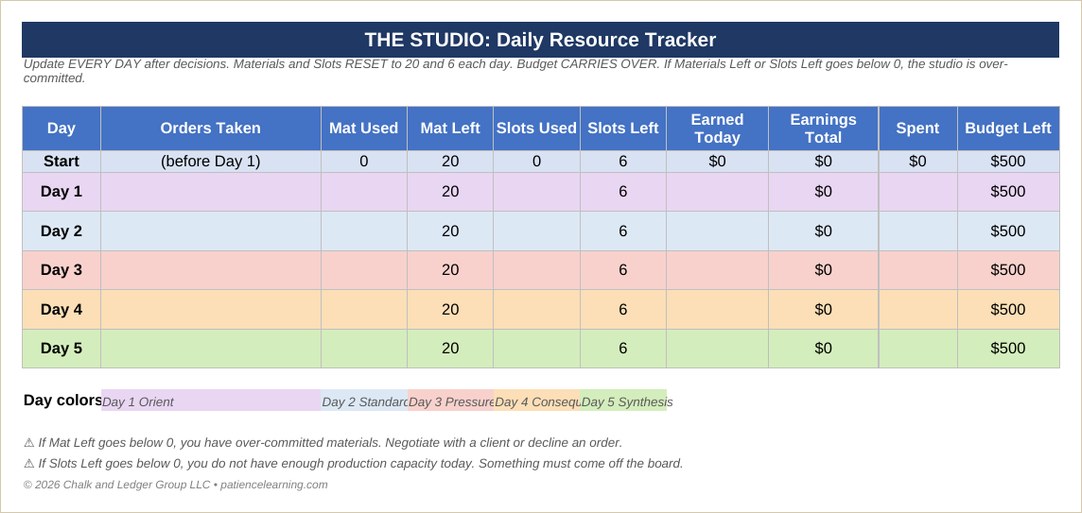
No fifth grader should miss the lesson because the resource math got away from them. The Studio comes with a workbook that tracks materials, slots, earnings, and budget for the team. They enter their orders, and the totals and what is left all calculate on their own. Their attention stays on the real question, which jobs are worth it, instead of on the arithmetic.
Tap to see the resource tracker
Five days, already scripted. You just run the room.
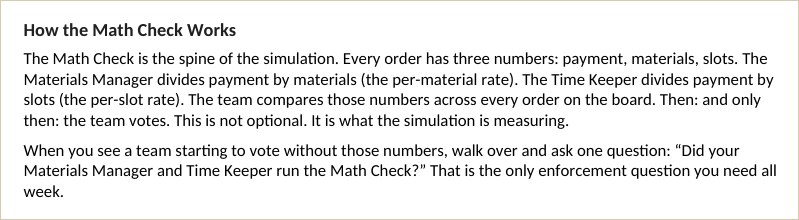
You do not need a business background to teach this. The guide scripts every day, tells you what students will likely say, and gives you exactly how to respond. The client orders, the festival twist, and the Day 5 portfolio are all written for you. You bring the facilitation. The mission brings everything else.
Tap to read the teacher guide
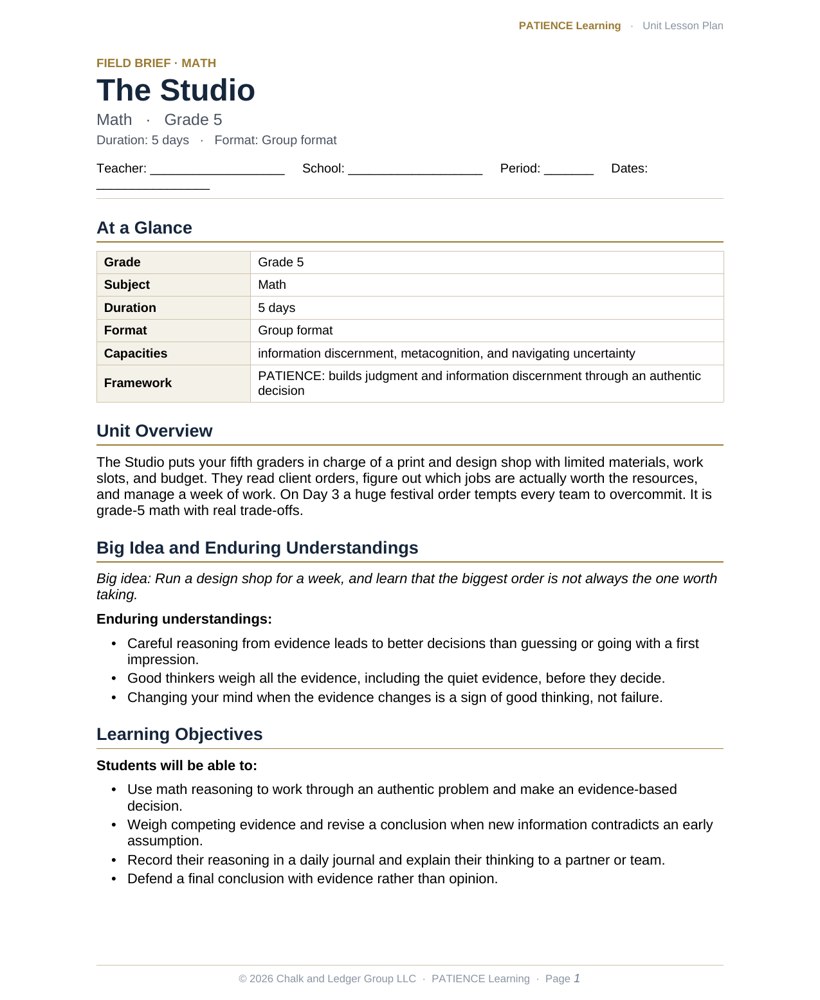
The lesson plan is already written.
Every simulation comes with a fully editable, admin-ready lesson plan. Standards alignment, daily pacing, learning objectives, differentiation, and an assessment plan are already done, so you can hand it to an administrator or adapt it to your district template in minutes.
Tap to preview the lesson plan
Close
Close
Close
Close
Everything you need to run it.
- An admin-ready lesson plan. A fully editable plan with standards alignment, daily pacing, differentiation, and assessment, ready to adapt to your district template. Included with every purchase.
- Five daily playbooks that script every day, including the Day 3 festival order.
- A student workbook that tracks materials, slots, earnings, and budget for each team.
- Scenario cards with client orders, feedback, and the big festival job.
- Daily reflection prompts and a simple rubric that grades thinking, not the earnings.
- A full Student Activity Packet, plus a connection map and pacing card for you.
- Aligned to the Common Core State Standards for Grade 5 Mathematics (Operations and Algebraic Thinking, Number and Operations).
Bring The Studio to your classroom.
Five days, fully planned, and a week of math your students will actually argue about.
Get this simulationPreview real pages from the simulation before you spend a dollar. No guessing, no surprises.