The Strike
No one in the room has the whole truth, and every early choice is made in the dark.
See what your students get, and why it lands.
No mockups. Every page below is real, pulled straight from the files you download. Tap any one to see it full size.
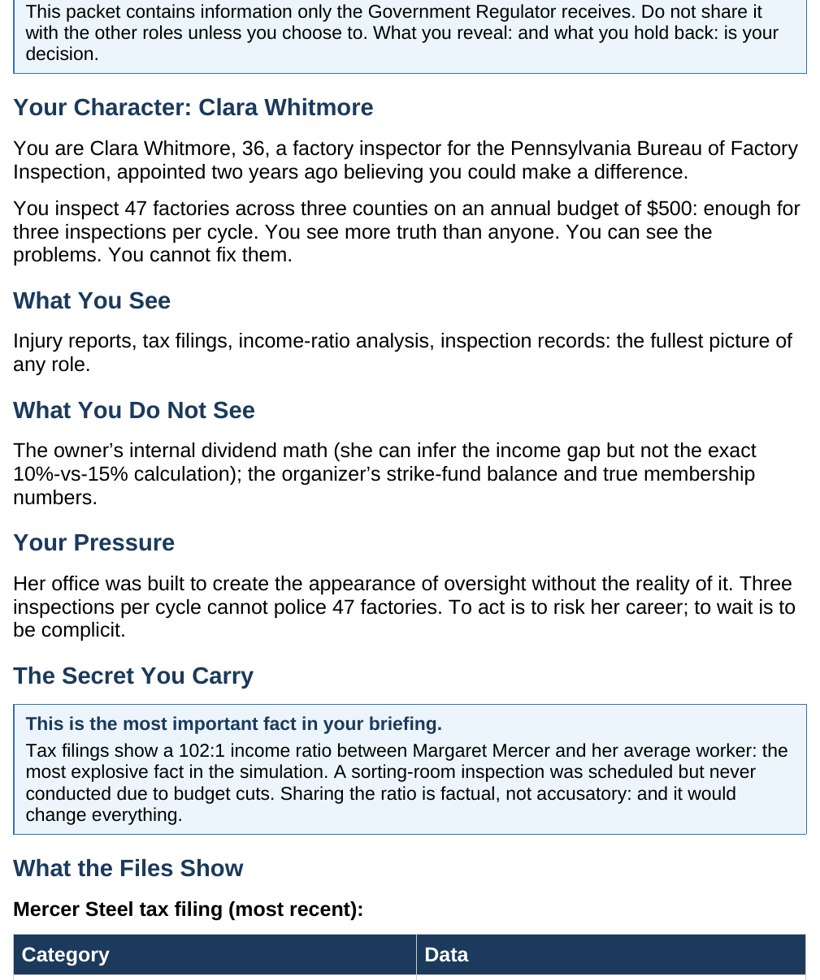
Your students are not answering questions. They are making a call from what they know, and what they do not.
This is the Role Briefing each student works from. One student is Margaret Mercer, the mill owner staring at a $180,000 dividend her Philadelphia investors demand. Another is Thomas Kolak, the organizer who has seen children in the sorting rooms but cannot see the mill's books. A third is Clara Whitmore, the regulator with three inspections to cover forty-seven factories. Each packet carries facts the others will never read. From this paper alone, a student decides whether to push, withhold, or release information when 14-year-old Stefan Nowak loses two fingers on the line. There is no answer key in the briefing. There is only the situation, the pressure, and a choice that other students will feel.
Tap to read the role briefing
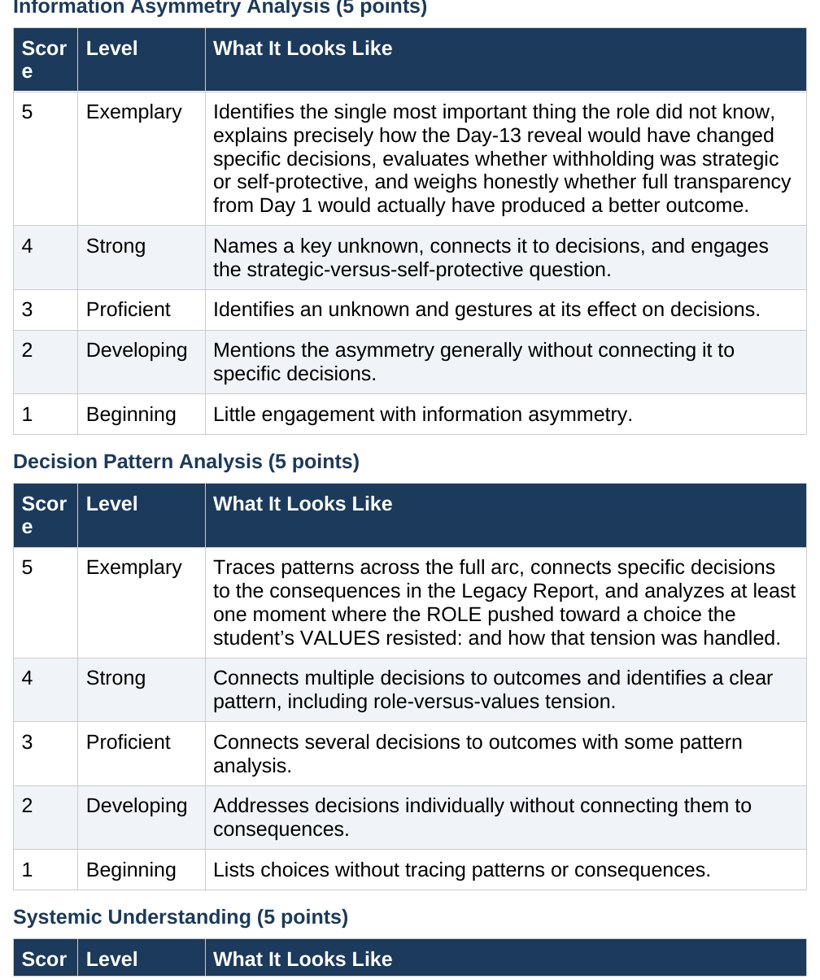
They are graded on how they reasoned, not on whether the strike ended their way.
This is the Assessment Rubric. It scores reasoning under incomplete information on a clean 0 to 5 scale, so a student who names the right evidence and explains the information gap earns the marks even when their side loses. The model splits 100 points across daily engagement, holistic journal quality, and a final reflection, and every line rewards the same thing: did the student cite specific figures, names, and briefing details, and did they reason past their own loyalty. A sound process behind a losing outcome beats a lucky guess that happened to land. The rubric makes that explicit on the page, which means students stop chasing the win and start defending the thinking that got them there.
Tap to read the grading rubric
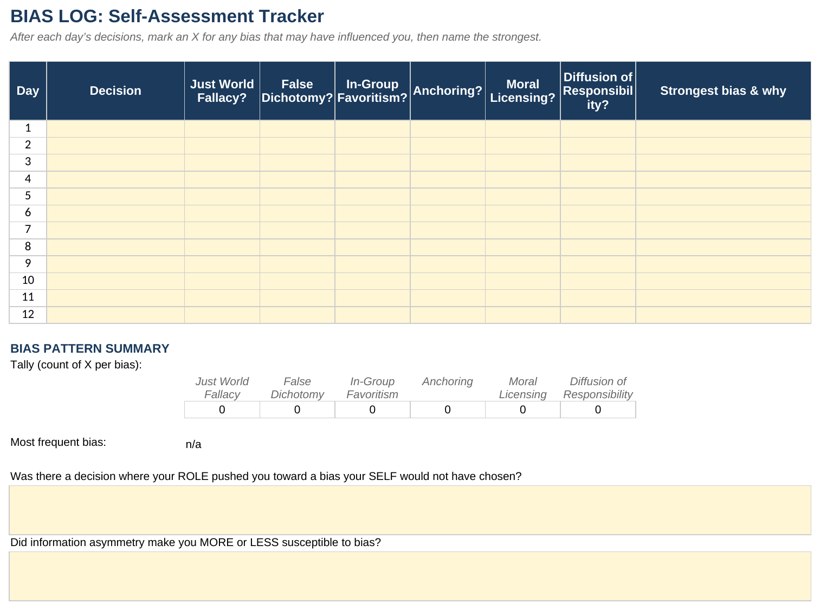
Let the workbook hold the busywork so students spend their energy on the judgment.
This is the student Workbook, a spreadsheet built around the Info Tracker. It treats data as currency, logging what each student knows, what they shared, and what they chose to withhold across all fifteen days. The daily journal tab captures the reasoning behind each move, so the record of who knew what and when builds itself rather than living in a teacher's head. Dashboards roll up the consequences of group choices and feed the Legacy Report at the end. Students are not copying notes or hunting for cells to fill. The tracker carries the bookkeeping of a fifteen-day information economy, which frees the student to do the one thing the simulation actually grades: weigh evidence and decide.
Tap to see the tracker
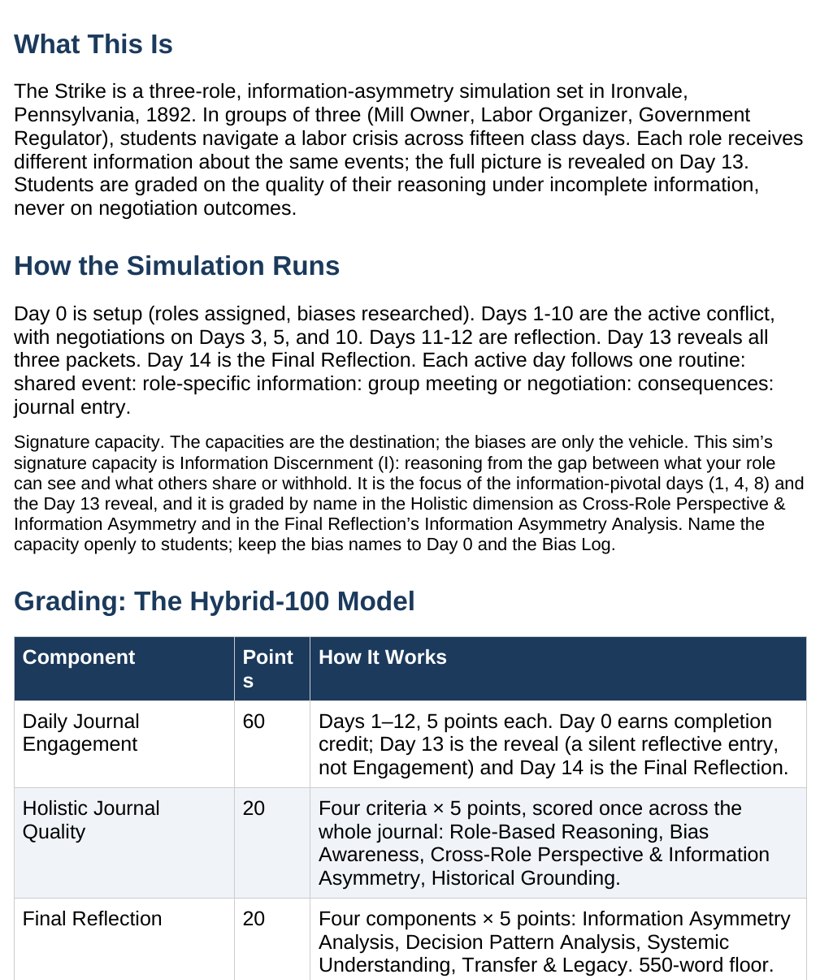
Every day is already scripted. You bring the facilitation, the simulation brings everything else.
This is the Teacher Guide. Each of the fifteen days arrives as a no-prep Daily Dispatch, ready to project or print, with the role-specific data already separated for private distribution. You do not build the injury thread, write the wage-cut announcement, or invent the Day 13 reveal. The guide hands you the script, the talking points, and the data drops in order. Days are self-contained, so you can pause for a holiday or double up to fit a long block without losing the thread. The night-before work is gone. What remains is the part only you can do: reading the room, pressing a student to defend a claim, and steering the negotiation when three stakeholders collide. Prep is light, and the rigor stays high.
Tap to read the teacher guide
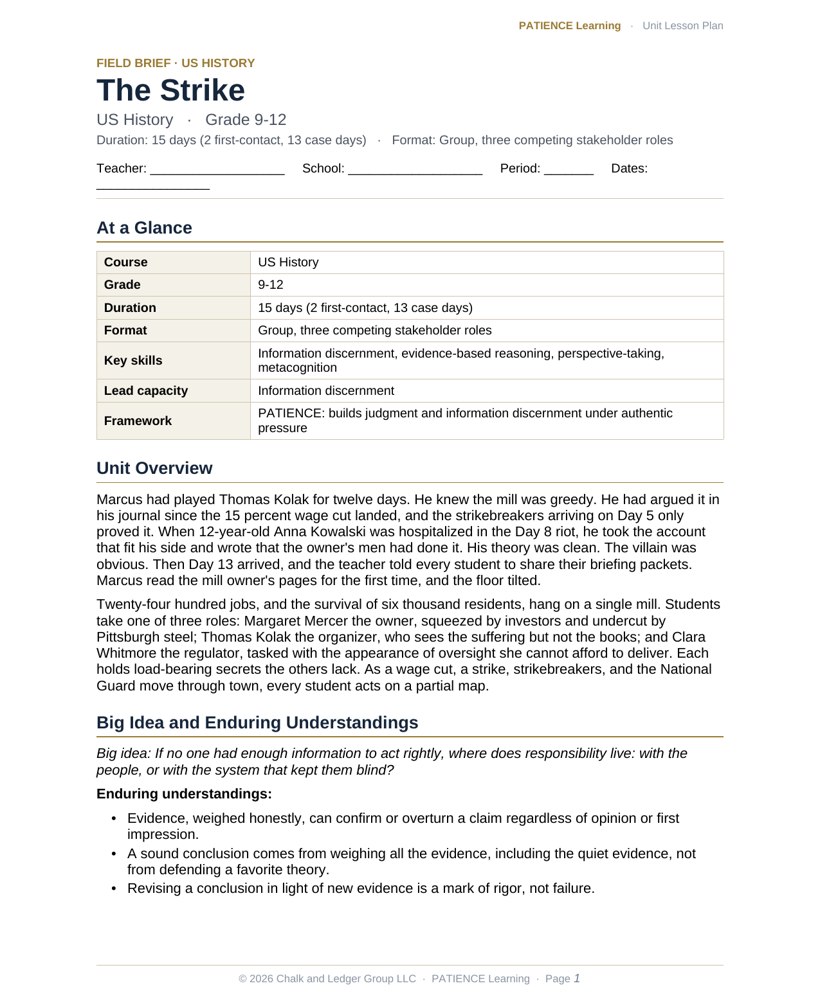
The lesson plan is already written.
Every simulation comes with a fully editable, admin-ready lesson plan. Standards alignment, daily pacing, learning objectives, differentiation, and an assessment plan are already done, so you can hand it to an administrator or adapt it to your district template in minutes.
Tap to preview the lesson plan
Close
Close
Close
Close
The day the packets open and the theory falls apart.
Marcus had played Thomas Kolak for twelve days. He knew the mill was greedy. He had argued it in his journal since the 15 percent wage cut landed, and the strikebreakers arriving on Day 5 only proved it. When 12-year-old Anna Kowalski was hospitalized in the Day 8 riot, he took the account that fit his side and wrote that the owner's men had done it. His theory was clean. The villain was obvious. Then Day 13 arrived, and the teacher told every student to share their briefing packets. Marcus read the mill owner's pages for the first time, and the floor tilted.
The owner's math was real. A 10 percent cut would have stabilized the mill; the extra 5 percent, $29,400 a year, went straight to an investor dividend Mercer never controlled. The strike fund Marcus had counted on held exactly $800, four days of food. He had to choose: keep the clean story he had defended for twelve days, or trust the evidence now in front of him. He chose the evidence. Once he did, the villain dissolved into a system built to keep all three of them blind, and the tragedy stopped looking like a choice anyone in the room had actually been free to make.
Ironvale, Pennsylvania, 1892.
Twenty-four hundred jobs, and the survival of six thousand residents, hang on a single mill. Students take one of three roles: Margaret Mercer the owner, squeezed by investors and undercut by Pittsburgh steel; Thomas Kolak the organizer, who sees the suffering but not the books; and Clara Whitmore the regulator, tasked with the appearance of oversight she cannot afford to deliver. Each holds load-bearing secrets the others lack. As a wage cut, a strike, strikebreakers, and the National Guard move through town, every student acts on a partial map.
| Grade level | 9-12 |
| Course | US History |
| Duration | 15 days (2 first-contact, 13 case days) |
| Format | Group, three competing stakeholder roles |
| Key skills | Information discernment, evidence-based reasoning, perspective-taking, metacognition |
Engineering better thinkers.
Discernment matters here because the truth is distributed, not hidden in a textbook. No role can Google its way out. Each day pairs a named bias built into the asymmetry triangle with the capacity that defeats it, traced in a daily journal.
| Bias targeted | The remedy, built into the work |
|---|---|
| In-group favoritism | Information discernmentDays 1 and 2 push students to trust their own side's account of the town and Stefan Nowak's injury. The journal forces them to ask which facts they accepted only because the facts flattered their role. |
| Anchoring | Adaptive strategyThe announced 15 percent cut becomes the only reference point for every negotiation. Students learn to drop the anchor and rebuild a fair figure from the mill's actual stabilization math, not the headline number. |
| False dichotomy | Navigating uncertaintyDays 5 and 6 frame the crisis as strike or accept, erasing the middle. The simulation rewards students who hold the uncertainty long enough to surface the compromise both binary positions hid. |
| Just world fallacy | Emotional regulationWhen Anna Kowalski is hospitalized on Day 8, students get three conflicting accounts. Regulating the urge to believe hardship is earned lets them weigh the evidence over the version their loyalty prefers. |
| Diffusion of responsibility | MetacognitionAfter the break, every role blames the governor, the market, or the Guard. The journal turns students back on their own choices, naming where they personally chose the partial map over asking for more. |
| Moral licensing | Productive failure recoveryDays 11 and 12 tempt students to use a small safety concession to justify refusing real reform. Naming the move, and recovering from the failure it covers, is the work the rubric scores. |
15 days of decisions made in the dark.
The first two days establish the three vantage points and the injury thread, building emotional investment before the crisis peaks. From there the case moves through the cut, the strike, the strikebreakers, and the break, until Day 13 opens every packet and forces a reckoning with everything decided before.
| Day | What lands | Bias in focus |
|---|---|---|
| 1 | Three vantage points open. The town, the mill, the stakes. | In-group favoritism |
| 2 | Stefan Nowak loses two fingers. Each role frames the same event differently. | In-group favoritism |
| 3 | The 15 percent wage cut is announced. | Anchoring |
| 4 | Negotiation opens, anchored to a number nobody chose to question. | Anchoring |
| 5 | The strike begins as 60 replacement workers arrive. | False dichotomy |
| 6 | Positions harden into strike or accept, with no middle ground. | False dichotomy |
| 7 | Tension builds between strikers and strikebreakers. | Just world fallacy |
| 8 | Anna Kowalski is hospitalized in a riot. Three conflicting accounts arrive. (critical pivot) | Just world fallacy |
| 9 | The National Guard arrives and production resumes. | Diffusion of responsibility |
| 10 | The strike is effectively broken. Every role points elsewhere. | Diffusion of responsibility |
| 11 | A minor safety promise is offered to close the matter. | Moral licensing |
| 13 | The reveal. All packets are shared and every prior choice is re-judged. (critical pivot) | Metacognition |
| 14 | The Legacy Report traces the path the group's reasoning produced. | Transfer to the present |
Standards alignment.
The Strike is built for the C3 Framework's inquiry arc and NCSS thematic standards, and it maps directly onto APUSH US History work. Students develop claims and counterclaims from primary-style source packets (C3 D3.1.9-12 and D3.4.9-12), evaluate the credibility of conflicting accounts (D2.His.9.9-12 and D2.His.16.9-12), and analyze causation and contextualization across the 1892 conflict (D2.His.1.9-12 and D2.His.14.9-12). The final reflection's transfer requirement, bridging the 102:1 Gilded Age income ratio to today's figures, meets D4.1.9-12 and the historical-reasoning skills of contextualization, causation, and continuity over time. The work is documentary and argumentative, not recall.
The hidden architecture.
The engine is information asymmetry, and the contradictions are planted on purpose. Mercer's packet holds the secret that a 10 percent cut would have stabilized the mill, with the extra 5 percent, $29,400 a year, earmarked for the investor dividend. Kolak's packet reveals the strike fund holds exactly $800, four days of food for 200 families. Whitmore's packet carries the 102:1 income ratio nobody else can see. Because each role argues from a partial map, students' biases feel like clear sight: the organizer sees a villain, the owner sees market forces, the regulator sees helplessness. The Day 13 reveal collapses all three views into one, and the sound conclusion, that the system itself manufactured the blindness, becomes unavoidable only once every packet is on the table.
Turnkey, classroom-ready.
- An admin-ready lesson plan. A fully editable plan with standards alignment, daily pacing, differentiation, and assessment, ready to adapt to your district template. Included with every purchase.
- 15-day playbooks. A scripted Daily Dispatch for every session, ready to project or print with zero night-before prep.
- A tech-enabled workbook. The Info Tracker spreadsheet logs what each role knows, shares, and withholds, and rolls the consequences into a Legacy Report.
- Turnkey student files. Three role briefings with load-bearing secrets, plus the privately distributed data drops for each day in order.
- A dual rubric system. Grades the quality of reasoning under incomplete information, not whether students reach a particular outcome.
- A transfer reflection. A capstone that bridges 1892 to a named present-day labor case, with the 102:1 to 300:1 ratio shift built in.
Put your students inside the asymmetry.
Bring The Strike to your US History classroom and let your students learn what it costs to decide before anyone has the whole truth.
Get this simulationPreview real pages from the simulation before you spend a dollar. No guessing, no surprises.