The Storefront
The team with the most cash is not always the best-run business.
See what your students get, and why it lands.
No mockups. Every page below is real, pulled straight from the files you download. Tap any one to see it full size.
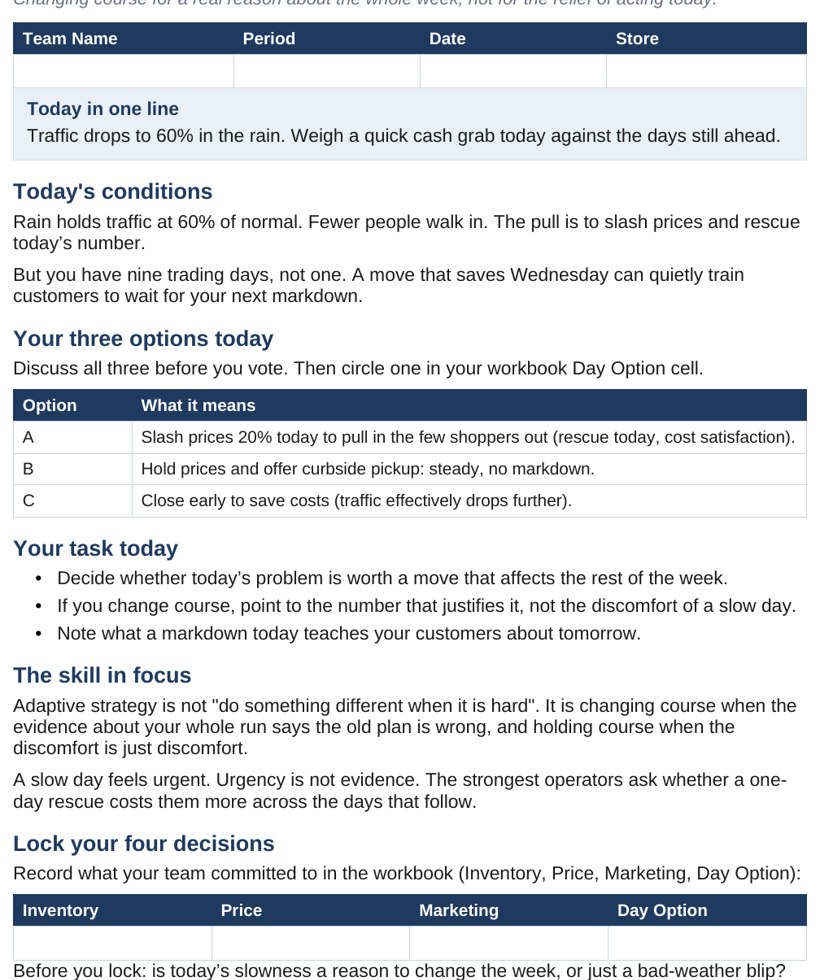
Your students are not answering questions. They are running a store.
Each trading day opens with a live situation, not a worksheet prompt. A weather shift, a rent increase, a sudden run on stock. Your students set inventory, price, and marketing while a $148 fixed daily overhead burns whether they sell or not. They commit those numbers before anyone names the pattern at work, so the call is theirs and the consequence is real. Day 3 pricing follows them into the Day 8 peak through cash on hand and reputation. There is no answer key to copy, no definition to recall. There is a store with money on the line and a team that has to decide together, read the signals in front of them, and live with what the engine returns.
Tap to see a student decision page
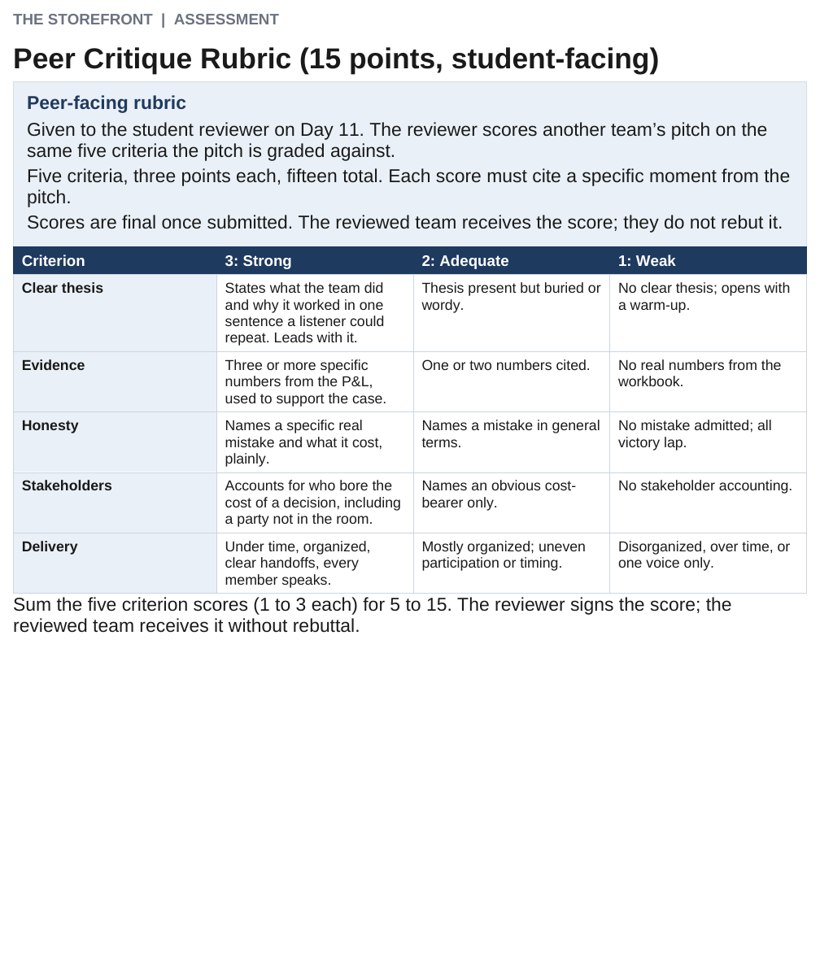
Graded on the reasoning, not on the cash.
Raw profit can come from reckless luck or a gutted reputation, so the rubric does not reward it. Your students are scored on the team daily journal across two lines. Diagnostic precision asks them to cite the specific workbook numbers behind a decision. Pattern awareness asks them to name the trap in their own behavior. A sound process behind a middling day beats a lucky windfall every time. The pitch and the peer critique add points for a clear thesis, honest disclosure of a real mistake, and accounting for the customer who bore the cost but was never in the room. This gives you an objective read on subjective reasoning, the same standard applied to a team of five or a class of five hundred.
Tap to read the grading rubric
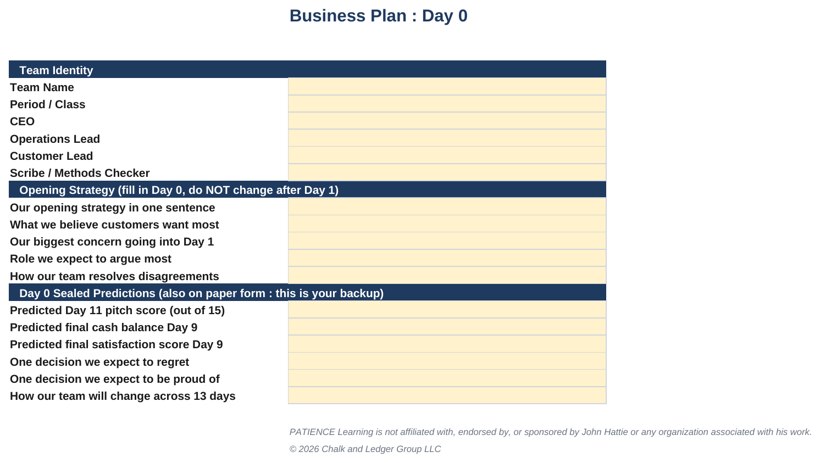
Let the workbook hold the math so the team holds the judgment.
The tech-enabled workbook is the engine of the store. Your students enter inventory, price, and marketing, and it resolves every figure live: revenue, the $148 burn, the Day 6 rent increase, and the satisfaction delta that compounds across the week. No hand calculation, no formula troubleshooting, no spreadsheet you have to repair before class. The feedback is instant, so a team sees the cost of a thin margin or a sold-out shelf the moment they commit. That frees the energy in the room for the part that matters: reading the whole week instead of one day, weighing served demand against fear, and arguing the call out loud. When a teammate is absent, the team simply resumes at the next decision point and the engine logic holds.
Tap to see the tracker
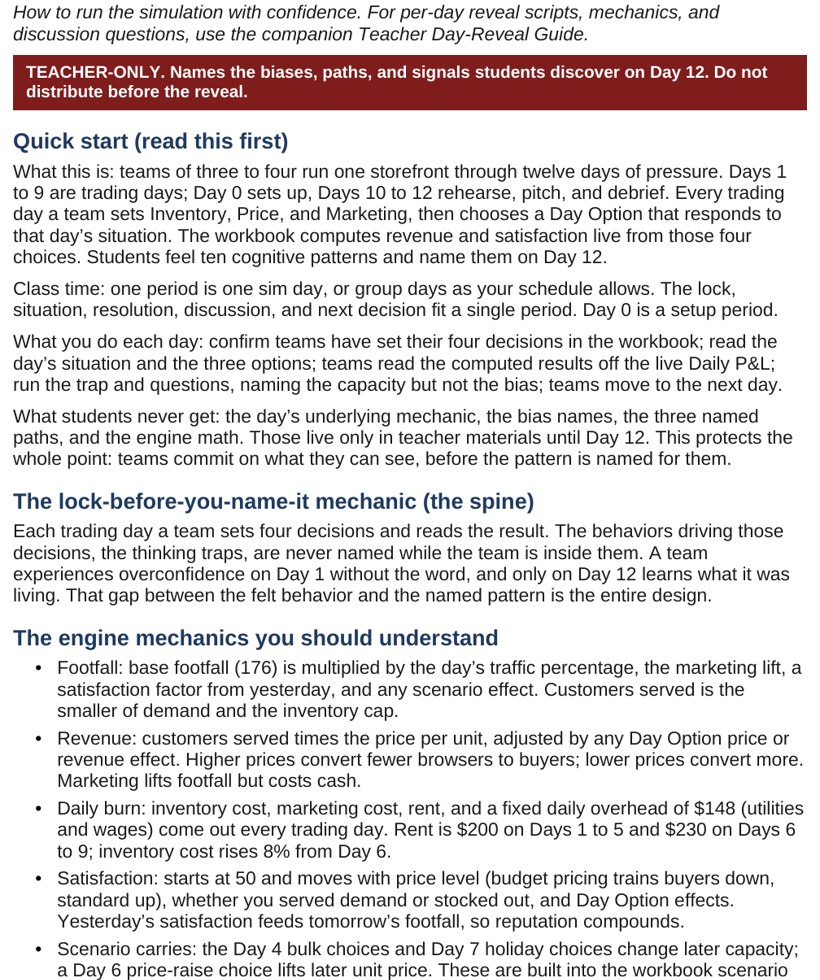
Every day is already scripted. You bring the questions.
The teacher day-reveal guide gives you a one-page, read-aloud script for each of the twelve days. You do not need a business background to run it, and there is no 40-page software manual to wade through. The guide sets up the day, tells you exactly what to say, and shows you where the planted contradiction sits so you can probe it without giving it away. Prep is light by design. You can group days, absorb absences, and resume teams at the next decision point without breaking the engine. Your role shifts from lecturer to facilitator: instead of fixing formulas, you stand over the reasoning, asking your students to defend a number or name the trap they just walked into. The simulation brings the structure. You bring the facilitation.
Tap to read the teacher guide
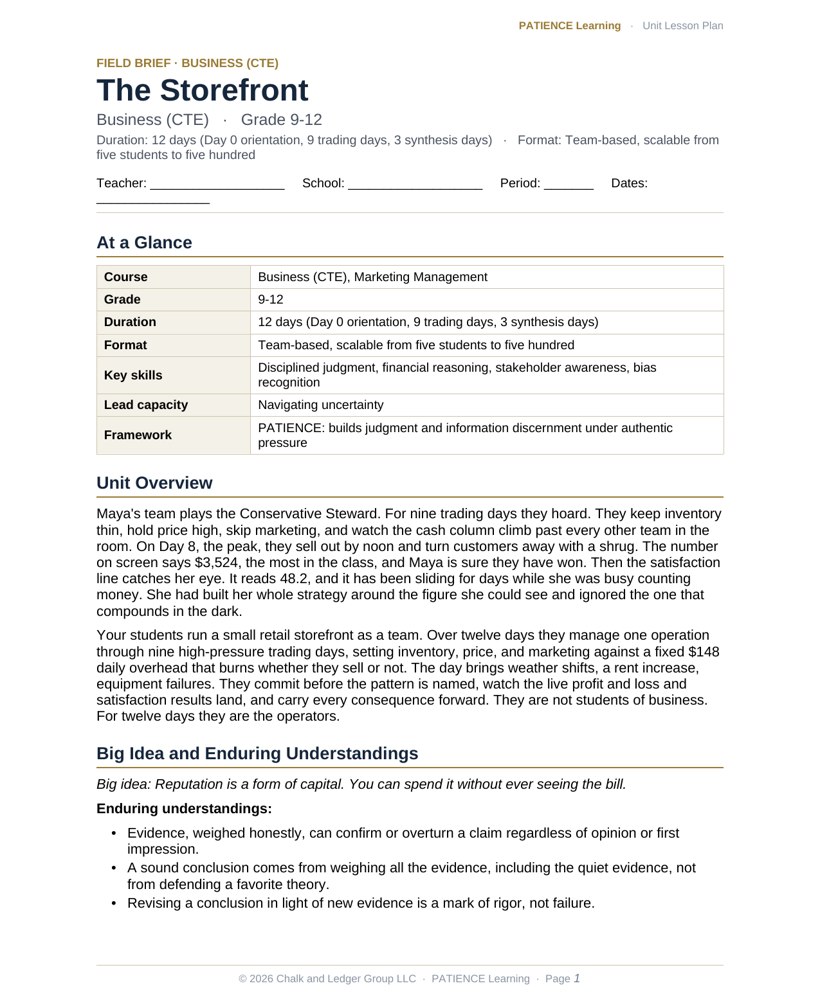
The lesson plan is already written.
Every simulation comes with a fully editable, admin-ready lesson plan. Standards alignment, daily pacing, learning objectives, differentiation, and an assessment plan are already done, so you can hand it to an administrator or adapt it to your district template in minutes.
Tap to preview the lesson plan
Close
Close
Close
Close
The day the most cash stops looking like winning.
Maya's team plays the Conservative Steward. For nine trading days they hoard. They keep inventory thin, hold price high, skip marketing, and watch the cash column climb past every other team in the room. On Day 8, the peak, they sell out by noon and turn customers away with a shrug. The number on screen says $3,524, the most in the class, and Maya is sure they have won. Then the satisfaction line catches her eye. It reads 48.2, and it has been sliding for days while she was busy counting money. She had built her whole strategy around the figure she could see and ignored the one that compounds in the dark.
At the Day 12 reveal, the engine maps the outcomes. The Methodical Operator, a team that balanced price and service and finished with less cash, is named the Signature Outcome, the designed winner. Maya has a choice. She can protect the story that cash is the score, or she can trust what the satisfaction curve has been telling her all week. She traces it back and sees it. Reputation is a form of capital, and she spent it. The store that looked strongest was the most fragile, bled dry of the one asset that would have carried it into the next month.
Nine trading days under a $148 daily burn.
Your students run a small retail storefront as a team. Over twelve days they manage one operation through nine high-pressure trading days, setting inventory, price, and marketing against a fixed $148 daily overhead that burns whether they sell or not. The day brings weather shifts, a rent increase, equipment failures. They commit before the pattern is named, watch the live profit and loss and satisfaction results land, and carry every consequence forward. They are not students of business. For twelve days they are the operators.
| Grade level | 9-12 |
| Course | Business (CTE), Marketing Management |
| Duration | 12 days (Day 0 orientation, 9 trading days, 3 synthesis days) |
| Format | Team-based, scalable from five students to five hundred |
| Key skills | Disciplined judgment, financial reasoning, stakeholder awareness, bias recognition |
Engineering better thinkers.
Business runs on judgment under incomplete information, not on recall. Each trading day plants a specific thinking trap and pairs it with the capacity that defeats it, so your students feel the bias before they ever learn its name, then build the discipline that beats it.
| Bias targeted | The remedy, built into the work |
|---|---|
| Overconfidence | Emotional regulationOn Day 1 students name the specific number that would prove their opening plan wrong, so confidence is anchored to evidence rather than nerve and a bad bet gets caught early. |
| Loss aversion | Emotional regulationOn Day 2 students separate money already lost from the choice in front of them, refusing the revenge decision and sizing the next move on future store health, not past pain. |
| Endowment effect | Information discernmentOn Day 4 students value stock at what it will actually sell for in the market, not at what they paid to own it, pricing on reality instead of personal attachment. |
| Status quo bias | MetacognitionOn Day 5 students treat inaction as a choice with a satisfaction price, weighing the real cost of doing nothing instead of drifting along the path of least resistance. |
| Authority bias | Independent and collaborative reasoningOn Day 8 students run the stakeholder gate so a high-status option cannot win by default, making every teammate's logic count before the vote is cast. |
| Hindsight bias | Navigating uncertaintyOn Day 12 students honor the real uncertainty of Day 0 instead of claiming they knew it all along, learning to judge a decision by its process, not its outcome. |
12 days of decisions with trailing consequences.
Day 0 captures raw instinct before the market applies any pressure. The nine trading days form the daily engine, where each call compounds into the cash and reputation available later. The final three days turn the simulation toward accountability: rehearsal, a high-stakes pitch, and the reveal that maps every behavior to research.
| Day | What lands | Bias in focus |
|---|---|---|
| 0 | Teams decide whether to invest and seal their predictions in an envelope (critical pivot) | Raw instinct, pre-pressure |
| 1 | Set the opening plan and name the number that would prove it wrong | Overconfidence |
| 2 | A loss hits; separate sunk money from the next move | Loss aversion |
| 3 | Read the whole week; size inventory to served demand | Present bias |
| 4 | Value leftover stock at what it will sell for, not its cost | Endowment effect |
| 5 | Weigh the satisfaction price of doing nothing | Status quo bias |
| 6 | Rent increase lands; face the burn and read the P and L aloud | Ostrich effect |
| 7 | Read signal versus noise heading into the peak | Present bias |
| 8 | The peak day; run the stakeholder gate before the big call (critical pivot) | Authority bias |
| 9 | Equipment breaks; choose recovery that protects long-term value | Productive failure recovery |
| 10 | Rehearsal; build the thesis and surface the real mistake | Confirmation bias |
| 11 | Pitch day; defend the reasoning and account for the unseen stakeholder | Groupthink |
| 12 | The bias reveal maps behavior to research and names the Signature Outcome | Hindsight bias |
Standards alignment.
The Storefront aligns to the Common Career Technical Core for the Business Management and Administration and the Marketing career clusters, hitting strands in business operations, financial analysis, pricing, promotion, and informed decision-making. It builds the Career Ready Practices, including acting as a responsible employee, applying critical thinking to solve problems, modeling integrity and ethical leadership, and using technology to enhance productivity. The work develops core employability skills: collaboration, communication, financial literacy, and disciplined judgment under pressure. There are no Common Core State Standards codes claimed here, because this is a CTE business simulation rather than an ELA or math course. Alignment is honest, mapped to the standards business educators actually plan against.
The hidden architecture.
The whole design rests on the lock-before-you-name-it mechanic. Your students commit each day's inventory, price, and marketing before the cognitive trap is ever revealed, which makes the reveal land on their own behavior instead of a hypothetical. The planted contradiction is the cash column. It climbs fastest for the team that hoards and starves its customers, so most students chase it, certain they are winning. Satisfaction, meanwhile, compounds quietly and never shows up as a dramatic number until it is too late. On Day 12 the engine names the Methodical Operator, a team with less cash but balanced service, as the Signature Outcome. That reversal is engineered. It forces the sound conclusion that reputation is capital, and it only works because no one saw it coming while the decisions were live.
Turnkey, classroom-ready.
- An admin-ready lesson plan. A fully editable plan with standards alignment, daily pacing, differentiation, and assessment, ready to adapt to your district template. Included with every purchase.
- 12-day teacher day-reveal guide. One-page, read-aloud scripts for every session, runnable by any instructor regardless of business background.
- A tech-enabled workbook. A live engine that resolves revenue, the $148 burn, the Day 6 rent increase, and compounding satisfaction the moment a team commits.
- Turnkey student files. Daily journals, the peer critique and pitch materials, and the individual Founders' Philosophy statement, ready to print or share.
- A dual rubric system. Grades diagnostic precision and pattern awareness, the quality of the reasoning, not whether the team finished with the most cash.
- The bias library. Ten cognitive traps with citations and the disciplined move that defeats each one, mapped day by day.
Hand your students a store and watch them learn to think.
Bring The Storefront to your classroom and give your students twelve days of real decisions, honest grading, and the discipline that outlasts any single right answer.
Get this simulationPreview real pages from the simulation before you spend a dollar. No guessing, no surprises.