The Shelf
The boring shelf out-earns the buzz, if your students can hold the line.
See what your students get, and why it lands.
No mockups. Every page below is real, pulled straight from the files you download. Tap any one to see it full size.
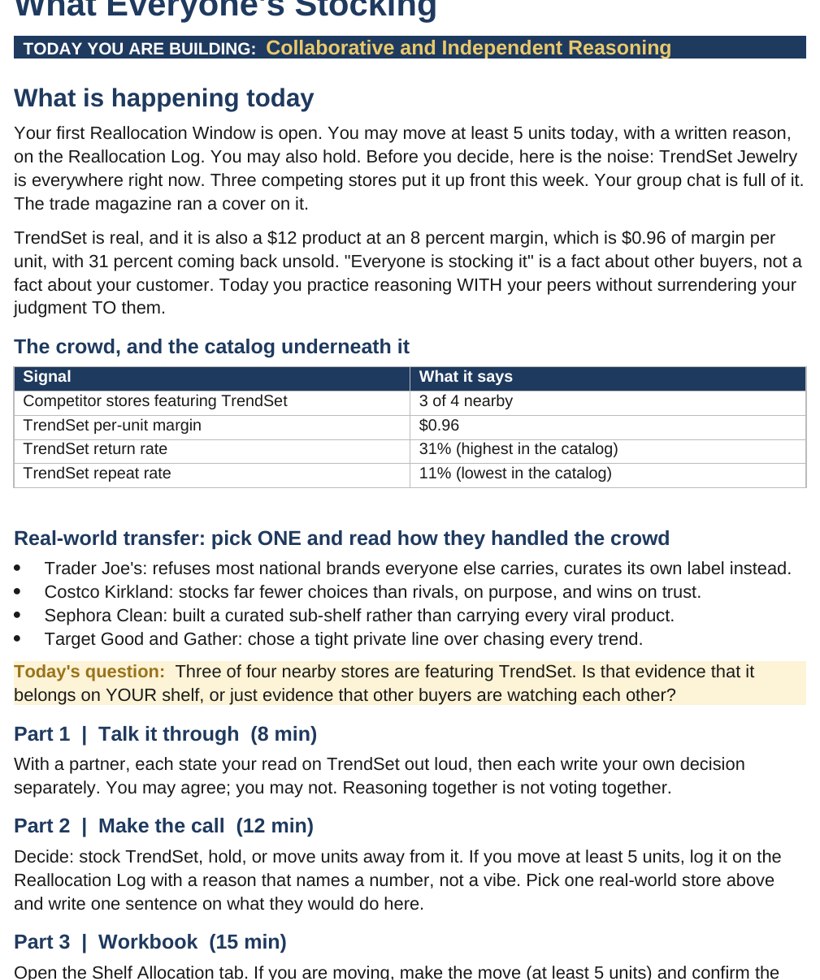
Your students are not answering questions. They are making a call.
On a reallocation window your students do not fill in a blank. They run a 100-unit shelf for MainStreet Market and decide which products to move and which to hold. The page hands them performance signals, repeat rates, return rates, and the noise of a loud sales rep or a celebrity review, then asks for at least five units of change. Once the window closes the choice is locked, so there is no quiet undo. Every move is logged in the daily journal with the reasoning behind it. Your students learn that a buyer reads evidence under pressure and lives with the result, which is a far cry from circling the correct multiple-choice option.
Tap to see a student case page
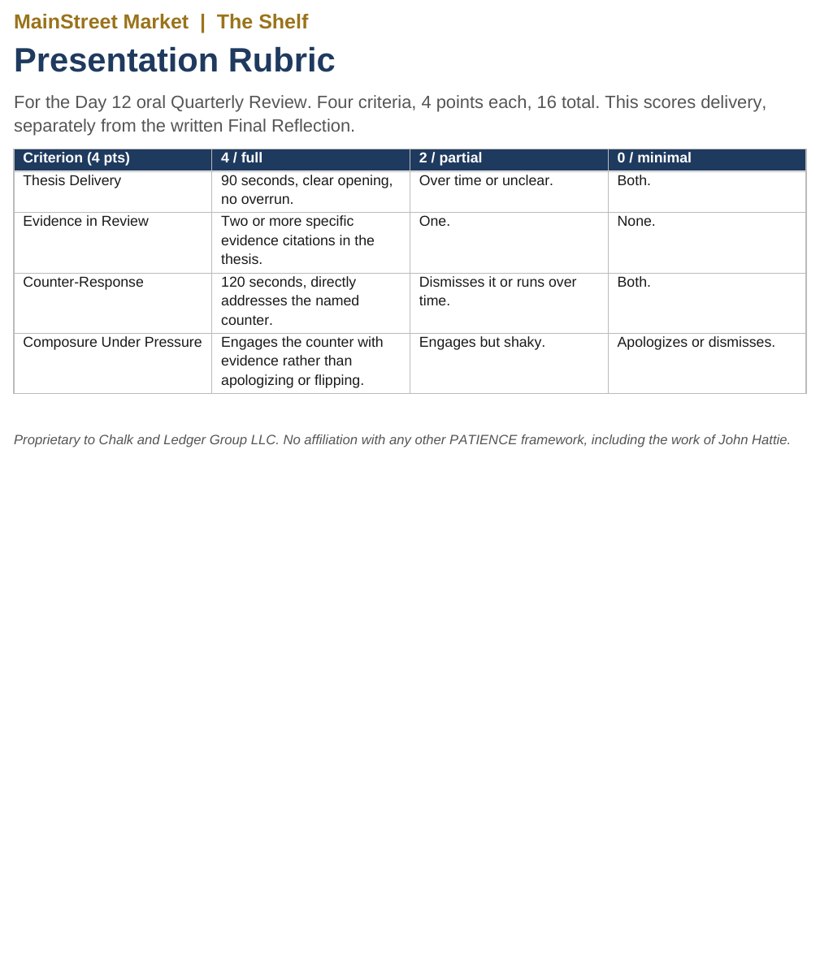
They are graded on the thinking, not the revenue.
The rubric scores reasoning quality, not whether your students picked the shelf that happened to win. A 140-point model puts 80 points on ten daily journal entries, where you grade evidence use and the logic behind each move. The rest covers a formal peer critique, a final reflection with a Curation Ethics Statement, and the Day 12 oral defense. A student who cuts a product for sound reasons and watches it rebound still earns full marks, because the process held. A lucky guess with thin justification does not. The frozen scoring engine reproduces every workbook number to the penny, so grading stays objective and you spend your time on the reasoning, not the math.
Tap to read the grading rubric
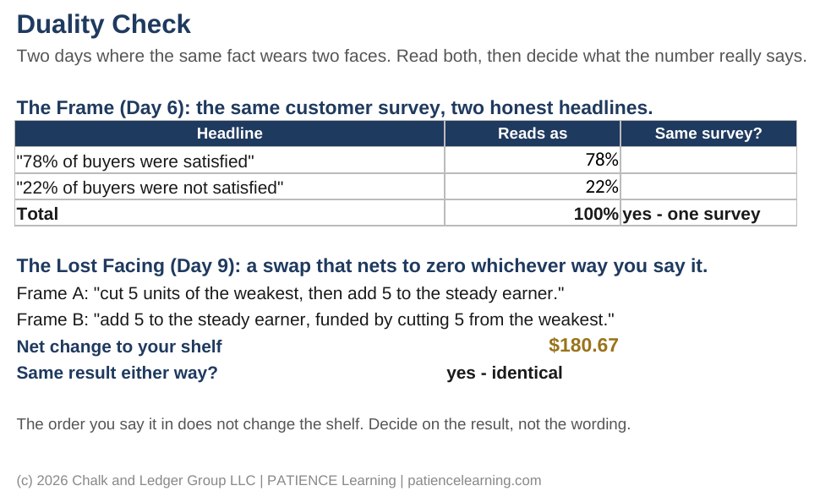
Let the workbook hold the busywork.
The tech-enabled workbook carries every calculation so your students spend their energy on judgment. It tracks the 100-unit shelf, applies the effective facings penalty when a product is overstocked above 15 units, and returns net margin, a Trust Score, and an early-window volume score on its own. Your students do not grind through arithmetic. They read what the numbers say and decide what to do next. Each window prompts a journal entry, so the record of their thinking builds as they go. The same engine that powers the workbook backs the Data Reference you hold, which means the figures in front of your students match the figures behind your grading, exactly.
Tap to see the tracker
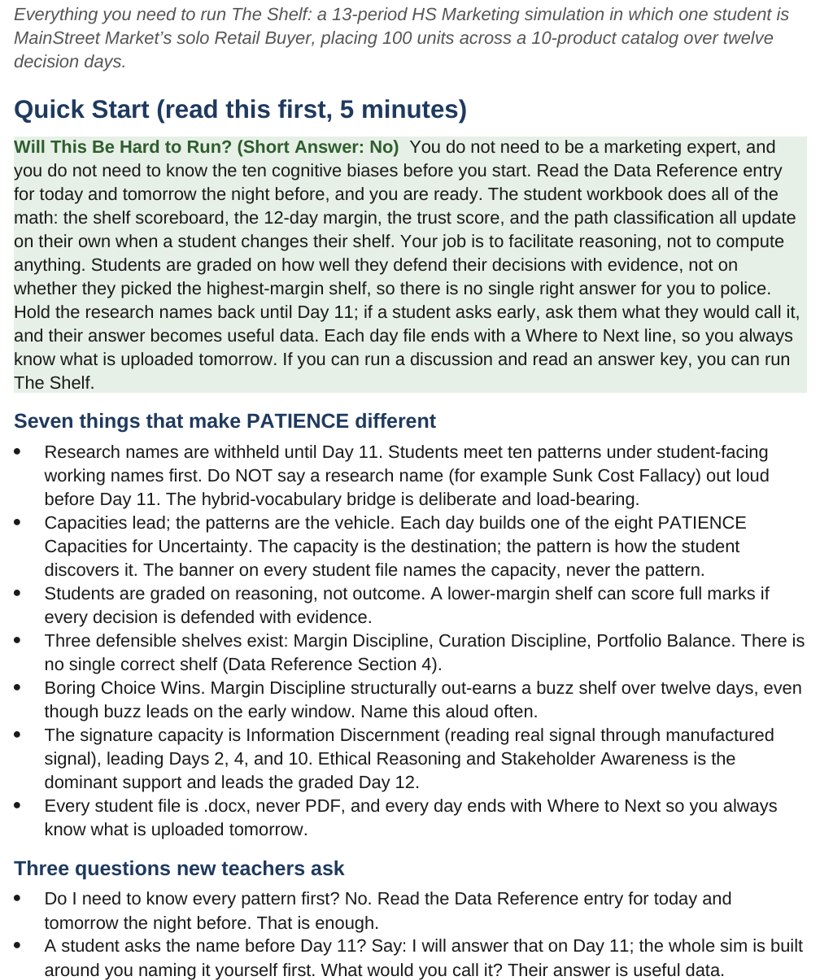
Every day is already scripted.
You bring the facilitation. The simulation brings everything else. The teacher guide scripts all 13 periods, from the Day 0 sealed prediction through the Day 12 Quarterly Review. Each session names the bias in focus, lays out what your students should notice, and tells you what to say. You do not need to be a marketing expert or a math expert. On Day 12 you play Maya Kowalski, the COO, and the Counter-Argument Bank hands you the exact challenge for each student path, whether they over-curated, chased trends, or drove by the mirror. The Data Reference acts as your shield, reproducing the workbook results so you can grade with confidence. Prep stays light.
Tap to read the teacher guide
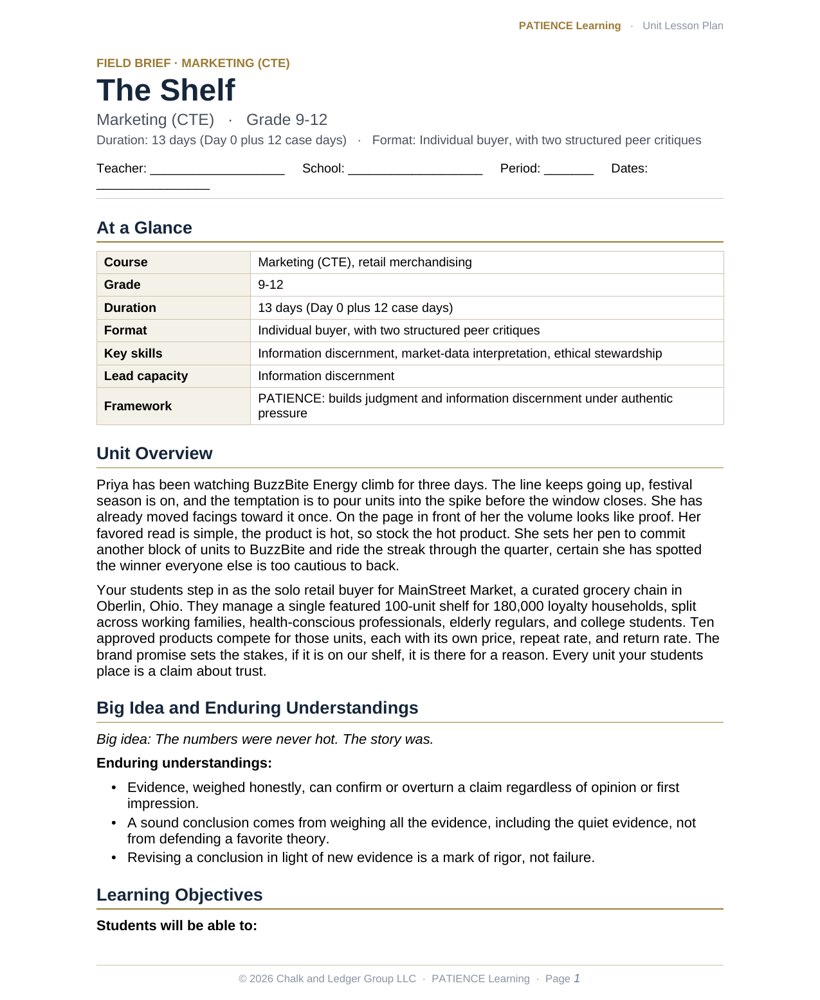
The lesson plan is already written.
Every simulation comes with a fully editable, admin-ready lesson plan. Standards alignment, daily pacing, learning objectives, differentiation, and an assessment plan are already done, so you can hand it to an administrator or adapt it to your district template in minutes.
Tap to preview the lesson plan
Close
Close
Close
Close
The day the streak stops being a signal.
Priya has been watching BuzzBite Energy climb for three days. The line keeps going up, festival season is on, and the temptation is to pour units into the spike before the window closes. She has already moved facings toward it once. On the page in front of her the volume looks like proof. Her favored read is simple, the product is hot, so stock the hot product. She sets her pen to commit another block of units to BuzzBite and ride the streak through the quarter, certain she has spotted the winner everyone else is too cautious to back.
Then she checks the columns she had been skipping. BuzzBite repeats at 38 percent and returns at 8 percent, and the spike has the shape of every collapse the simulation has shown her. The choice is plain. She can protect the story she told herself, or she can trust the repeat and return data. She pulls back, holds her units on CleanSlate and PureLeaf, and writes why in the journal. Two days later BuzzBite craters. The boring shelf is still standing, and so is her reasoning.
One buyer, one shelf, 180,000 households watching.
Your students step in as the solo retail buyer for MainStreet Market, a curated grocery chain in Oberlin, Ohio. They manage a single featured 100-unit shelf for 180,000 loyalty households, split across working families, health-conscious professionals, elderly regulars, and college students. Ten approved products compete for those units, each with its own price, repeat rate, and return rate. The brand promise sets the stakes, if it is on our shelf, it is there for a reason. Every unit your students place is a claim about trust.
| Grade level | 9-12 |
| Course | Marketing (CTE), retail merchandising |
| Duration | 13 days (Day 0 plus 12 case days) |
| Format | Individual buyer, with two structured peer critiques |
| Key skills | Information discernment, market-data interpretation, ethical stewardship |
Engineering better thinkers.
Retail data is a noisy flood, not a clean signal. Each day of The Shelf drops a real bias into your students' path under a working name they feel before they name, then pairs it with the capacity that defeats it. They live the pull first, then learn what to call it.
| Bias targeted | The remedy, built into the work |
|---|---|
| Anchoring | Productive failure recoveryThe sealed Day 0 prediction locks in a first guess. When the shelf moves against it, your students must recover from the anchor and reallocate on evidence rather than defend the number they sealed. |
| Confirmation bias | MetacognitionOn the selective-reading window your students catch themselves hunting for data that flatters a product they already like, then audit which columns they skipped and why. |
| Sunk cost fallacy | Adaptive strategyThe Sunk-Shelf Day forces a Hard-Shelf Acknowledgment, so your students confront the cost of a failing product and adapt instead of pouring more units into a loss. |
| Availability bias | Information discernmentLoud sales-rep backing and celebrity reviews make some products feel obvious. Your students learn to read repeat and return signals through the manufactured noise. |
| Tunnel vision | Navigating uncertaintyThe framing day shows how the same numbers shift meaning by presentation. Your students widen their view and hold a decision open under uncertainty rather than locking on one read. |
| Overconfidence | Emotional regulationThe Hot Hand streak baits a confident over-commit. Your students regulate the urge to chase a spike and keep units on the steady performers that repeat. |
13 days of evidence under permanence.
Day 0 builds the foundation, your students study the Buyer Kit and demographics, then seal a 100-unit prediction. From there the case runs on time-locked windows where moves cannot be undone, so each reallocation carries real weight and each bias arrives paired with the capacity that answers it.
| Day | What lands | Bias in focus |
|---|---|---|
| 0 | Orientation and a sealed 100-unit prediction | Anchoring |
| 1-2 | First signals arrive, no reallocation allowed | Availability bias |
| 3 | Decision Window 1, at least five units move | Social proof |
| 4 | The Halo, celebrity backing distorts the data (critical pivot) | Information discernment |
| 5 | Decision Window 2, selective data reading | Confirmation bias |
| 6 | The Frame, presentation alters the decision | Framing |
| 7 | The Default and Peer Critique 1, status-quo audit | Status quo bias |
| 8 | The Sunk-Shelf Day, final window and Hard-Shelf Acknowledgment (critical pivot) | Sunk cost fallacy |
| 9 | The Lost Facing, a net-zero swap tests loss aversion | Loss aversion |
| 10 | The Streak, the Hot Hand spikes then collapses | Overconfidence |
| 11 | The Big Picture, research names revealed and Peer Critique 2 | Metacognition |
| 12 | The Quarterly Review, oral defense and Ethics Statement | Navigating uncertainty |
Standards alignment.
The Shelf aligns to the MBA Research National Marketing Standards and the Common Career Technical Core for the Marketing cluster, with a focus on Information Management and Market-Data Interpretation, plus the Business Administration Core strands for Emotional Intelligence and Ethics. The Day 12 oral defense and the two peer critiques carry the Career Ready Practices for reasoning, communication, and ethical decision-making. Assessment is a 140-point model spread across ten daily journals, a formal peer critique, a final reflection, and the oral defense. No Common Core State Standards codes are claimed, because this is a CTE marketing simulation, not an ELA course.
The hidden architecture.
The scoring engine is frozen and deterministic, and it is built so the boring choice wins. Disciplined curation earns the highest net margin over the 12-day quarter, while the buzzy shelf leads early volume and then collapses to the bottom by Day 12. The effective facings penalty, where any product above 15 units sells its excess at 35 percent, quietly blocks the over-stock shortcut. The streak and halo days are engineered to bait overconfidence and availability, and the repeat and return columns hold the contradiction that exposes the trap. The Counter-Argument Bank guarantees that whatever path a student takes, the Day 12 defense surfaces the axis they ignored. The evidence is sound. The biases lead astray.
Turnkey, classroom-ready.
- An admin-ready lesson plan. A fully editable plan with standards alignment, daily pacing, differentiation, and assessment, ready to adapt to your district template. Included with every purchase.
- 13-period playbooks. Minute-by-minute facilitation for every session, from the sealed prediction to the oral defense.
- A tech-enabled workbook. Tracks the 100-unit shelf and returns net margin, Trust Score, and early-window volume automatically.
- Turnkey student files. The Buyer Kit, the ten-product catalog, the daily journal, and the Curation Ethics Statement, ready to hand out.
- A frozen Data Reference. Reproduces every workbook result to the penny so your grading stays objective.
- The Counter-Argument Bank. Path-specific challenges for the Day 12 Quarterly Review, so the COO role plays itself.
- A 140-point rubric. Grades the quality of reasoning, not whether your students pick the winning shelf.
Put your students behind the shelf.
Bring The Shelf to your marketing classroom and let your students learn to read real signals through the noise, one locked decision at a time.
Get this simulationPreview real pages from the simulation before you spend a dollar. No guessing, no surprises.