The Rezoning
The exciting proposal is not the right vote. The data says so.
The exciting proposal is not the right vote. The data says so.
The Rezoning seats your seventh graders on a youth advisory board weighing a rezoning decision. Over ten days a charismatic endorsement, a popular opinion, and the most exciting option all pull against the data. The teams who weigh who actually benefits, past the charisma and the crowd, cast the vote that holds up. It is civic decision-making with real pressure.
See what your students get, and why it lands.
No mockups. Every page below is real, pulled straight from the files you download. Tap any one to see it full size.
A worksheet was never going to teach this.
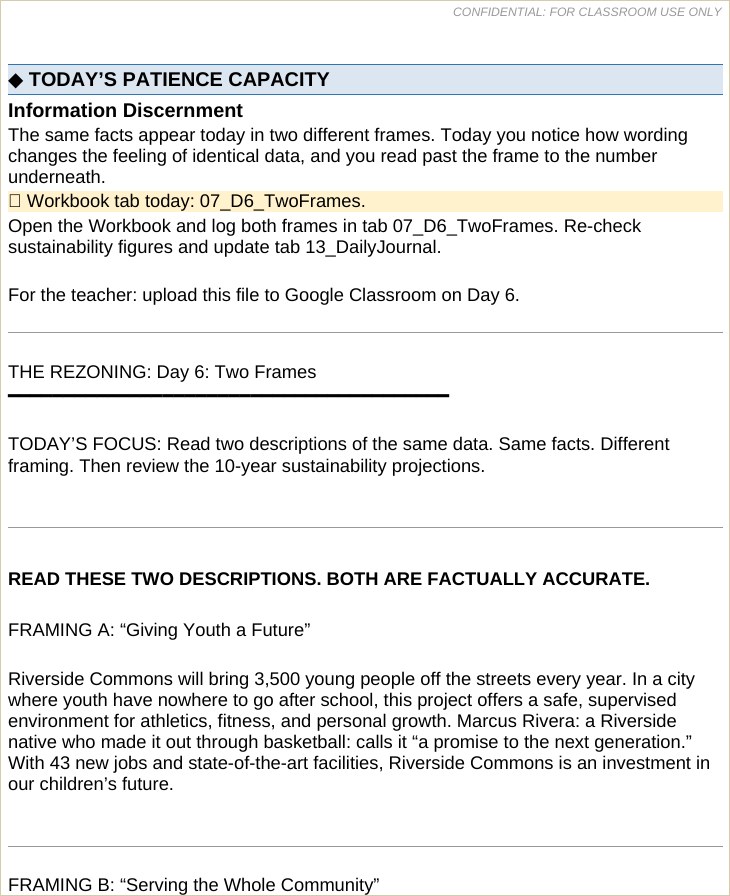
Your seventh graders are not reading about local government. They are a youth advisory board deciding a rezoning question, where the same proposal is framed as a community win one day and a community cost the next. A local celebrity endorses the exciting option; the data points elsewhere. The boards who look past the framing and ask who actually benefits vote well. That is civic reasoning, with a neighborhood riding on it.
Tap to read the two frames
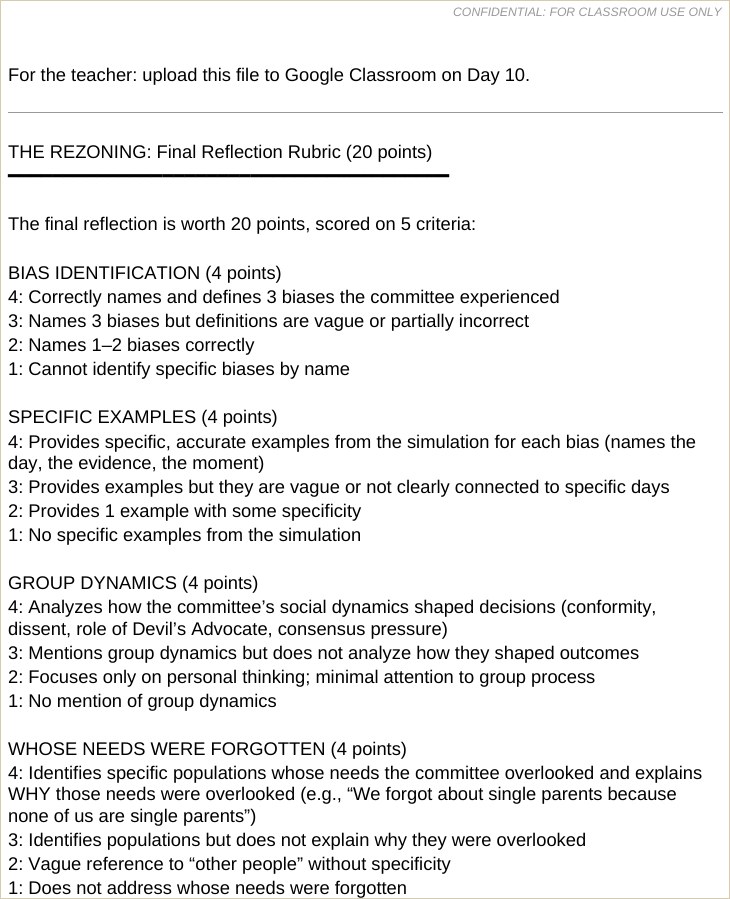
They are graded on their reasoning, not on how they vote.
Here is what surprises teachers. A board that voted the way the designers intended is not graded higher than one that did not. There is no correct vote. Students are assessed on the quality of their reasoning, traced through their own daily journal. A defensible decision that ran against the crowd scores higher than a popular one with no thinking behind it. That is how a seventh grader learns that a defensible judgment beats a popular one.
Tap to read the grading note
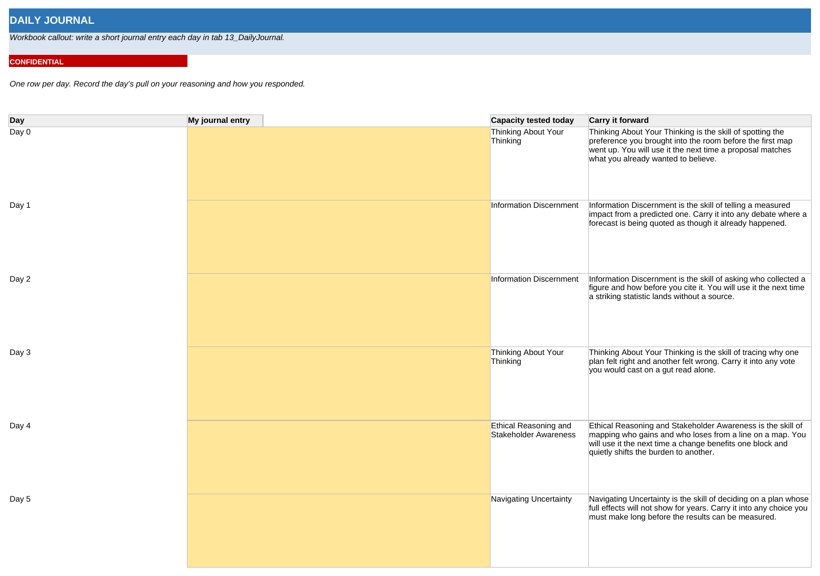
Let the workbook organize the evidence.
The Rezoning comes with a workbook that organizes the community voices, the polling, and the data behind each option. The board logs the evidence, and the picture builds across the ten days. Their attention stays on the hard part, who actually benefits, instead of on keeping the arguments straight.
Tap to see the evidence sheet
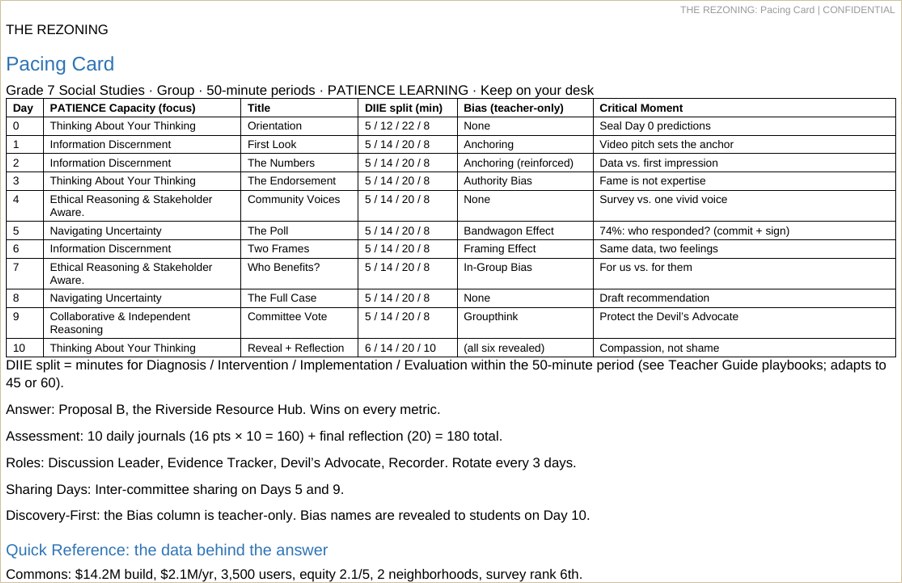
Every day is already scripted. You just run the room.
You do not need a civics or planning background to teach this. The guide scripts every day, names what students will likely say, and gives you exactly how to respond. The voices, the endorsement, the poll, and the final vote are all written for you. You bring the facilitation. The simulation brings everything else.
Tap to read the teacher guide
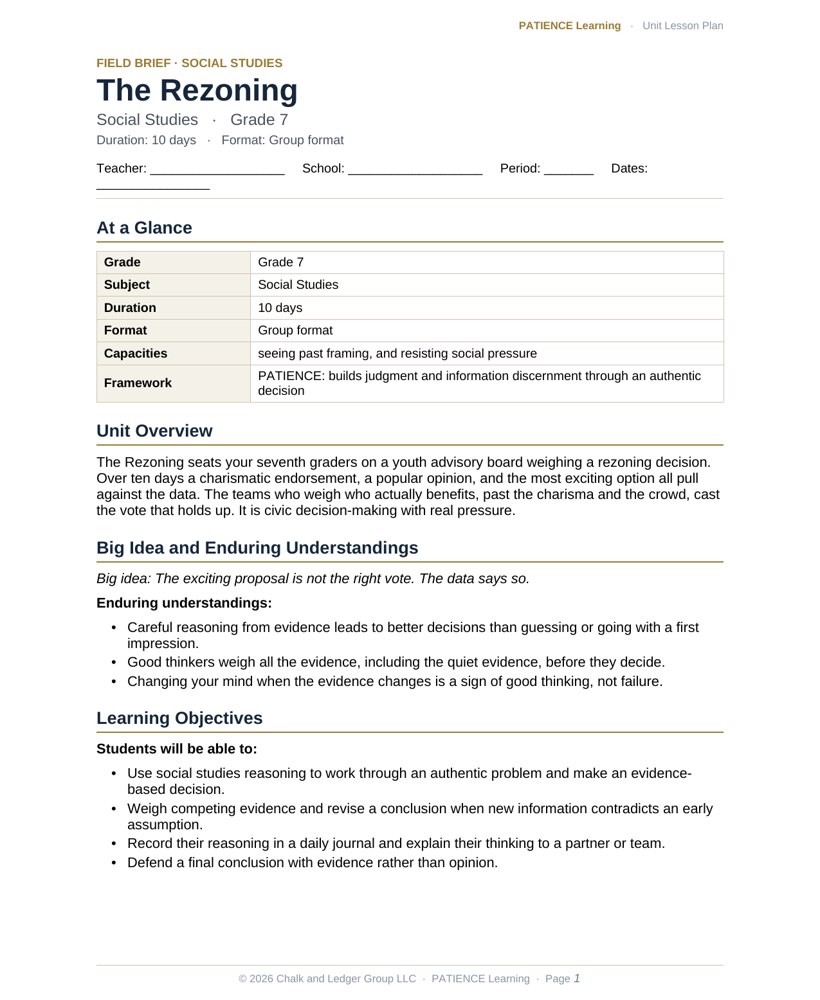
The lesson plan is already written.
Every simulation comes with a fully editable, admin-ready lesson plan. Standards alignment, daily pacing, learning objectives, differentiation, and an assessment plan are already done, so you can hand it to an administrator or adapt it to your district template in minutes.
Tap to preview the lesson plan
Close
Close
Close
Close
Everything you need to run it.
- An admin-ready lesson plan. A fully editable plan with standards alignment, daily pacing, differentiation, and assessment, ready to adapt to your district template. Included with every purchase.
- Eleven days of playbooks (Day 0 plus ten) that script every session.
- A student workbook that organizes community voices, polling, and trade-offs.
- Community voices, an endorsement, a poll, and role cards for the board.
- Daily journals and a rubric that grade reasoning, not how they vote.
- Scaffolded student files for the early days, for learners who need more support.
- Built on the PATIENCE framework: seeing past framing, and resisting social pressure.
Bring The Rezoning to your classroom.
Ten days, fully planned, and a vote your students have to earn.
Get this simulationPreview real pages from the simulation before you spend a dollar. No guessing, no surprises.