The Reign
The factions that chased power built nothing that survived them.
See what your students get, and why it lands.
No mockups. Every page below is real, pulled straight from the files you download. Tap any one to see it full size.
A worksheet was never going to teach this.
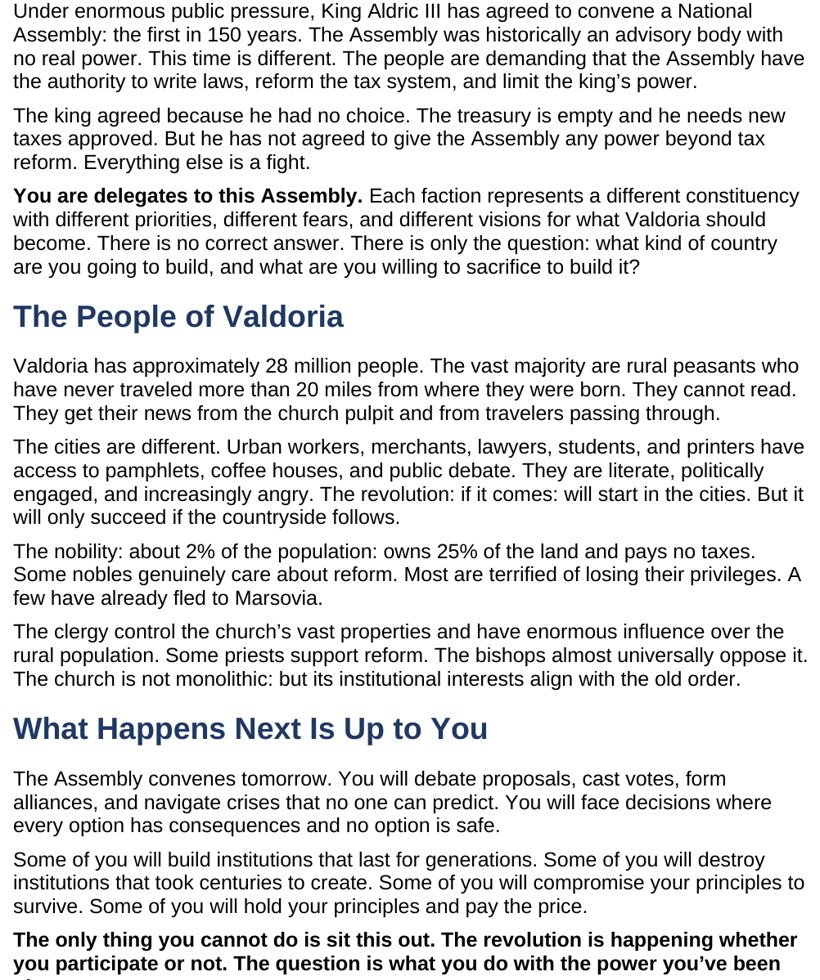
Your students do not answer questions about revolution. They run one. From the Kingdom Profile they inherit Valdoria, a kingdom buried in debt with famine spreading and a king losing his grip. Each group takes a faction, Constitutionalists, Populists, Traditionalists, Radicals, or Opportunists, with a real platform to defend. Every day a new crisis lands and the assembly must vote. The king flees. Foreign armies mass at the border. Food runs short. Students weigh intelligence dispatches, negotiate alliances, and cast votes that move the whole kingdom. They are not recalling the causes of upheaval from a textbook. They are making the call from the evidence in front of them, in real time, with the cost falling on someone.
Tap to see the Kingdom Profile
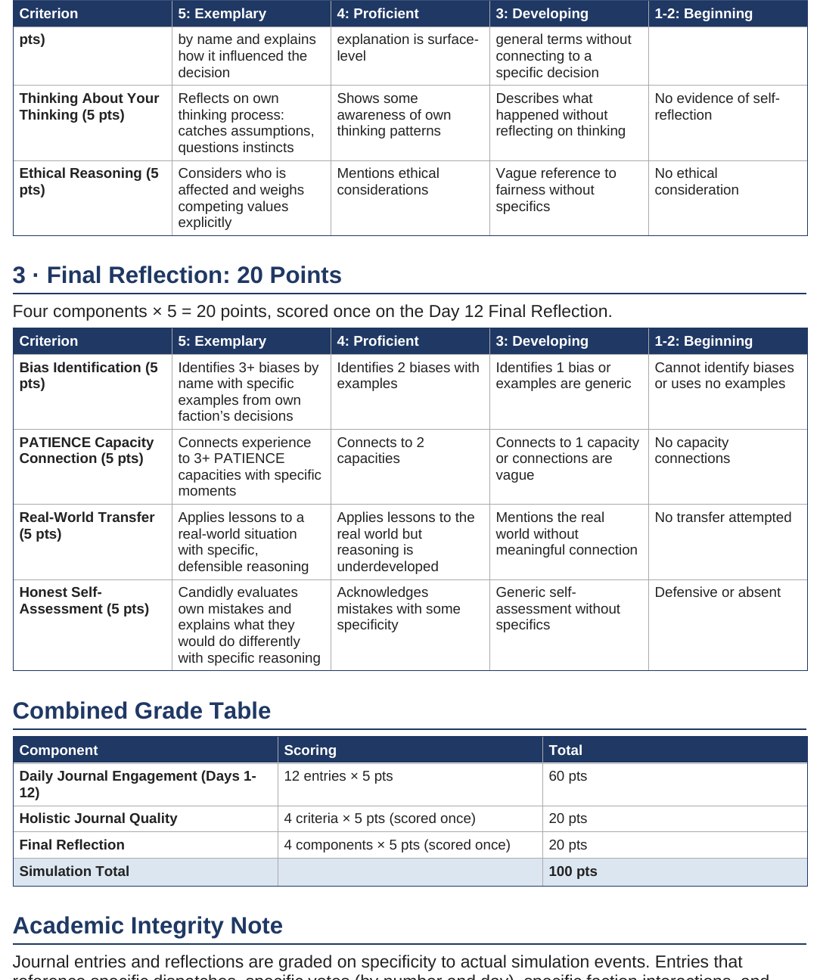
They are graded on their reasoning, not on who wins.
A faction can lose every vote and still earn top marks. That is by design. The dual rubric grades the quality of thinking, never the political outcome. A live daily check scores each journal entry zero to five on specificity, did the student name the actual vote, the actual dispatch, the actual faction moment by day. A separate holistic score rates Decision Reasoning, Bias Awareness, Metacognition, and Ethical Reasoning across the whole run. A sound process behind a losing position beats a lucky win every time. The rubric also flags integrity red flags, entries that name a bias without citing a day, or polished reflections that lack the messiness of real-time choices. Students learn that the careful, evidence-led call is the one that scores.
Tap to read the grading rubric
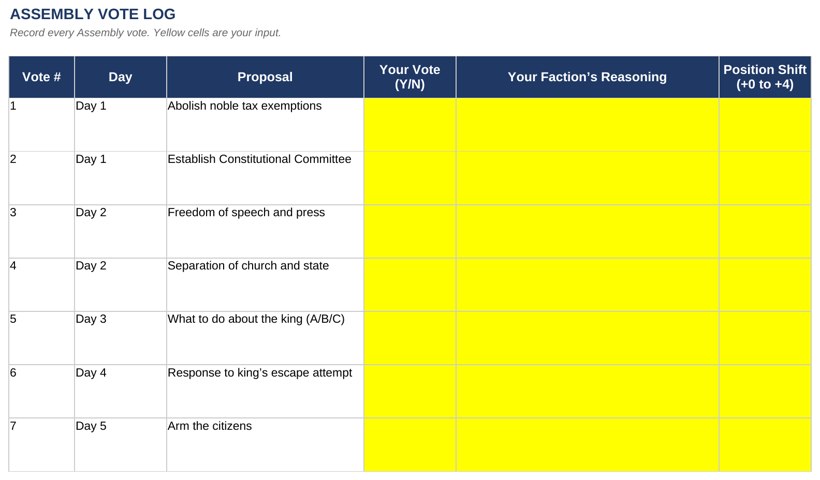
Let the workbook hold the busywork.
Tracking a revolution by hand would bury your students in bookkeeping. The student workbook carries that load. It is an Excel-based tracker that logs every vote, holds each faction's running Position Score, and charts the Revolutionary Temperature as it climbs from reform to terror. A built-in bias tracker prompts students to log where their own thinking slipped. The spreadsheet does the arithmetic and keeps the record straight, so the gap between a faction's position and the rising temperature shows up as a number students can see, not a mess they have to reconstruct. With the clerical work handled, their energy goes where it belongs, into reading the dispatches, judging the alliances, and defending a position under pressure.
Tap to see the tracker
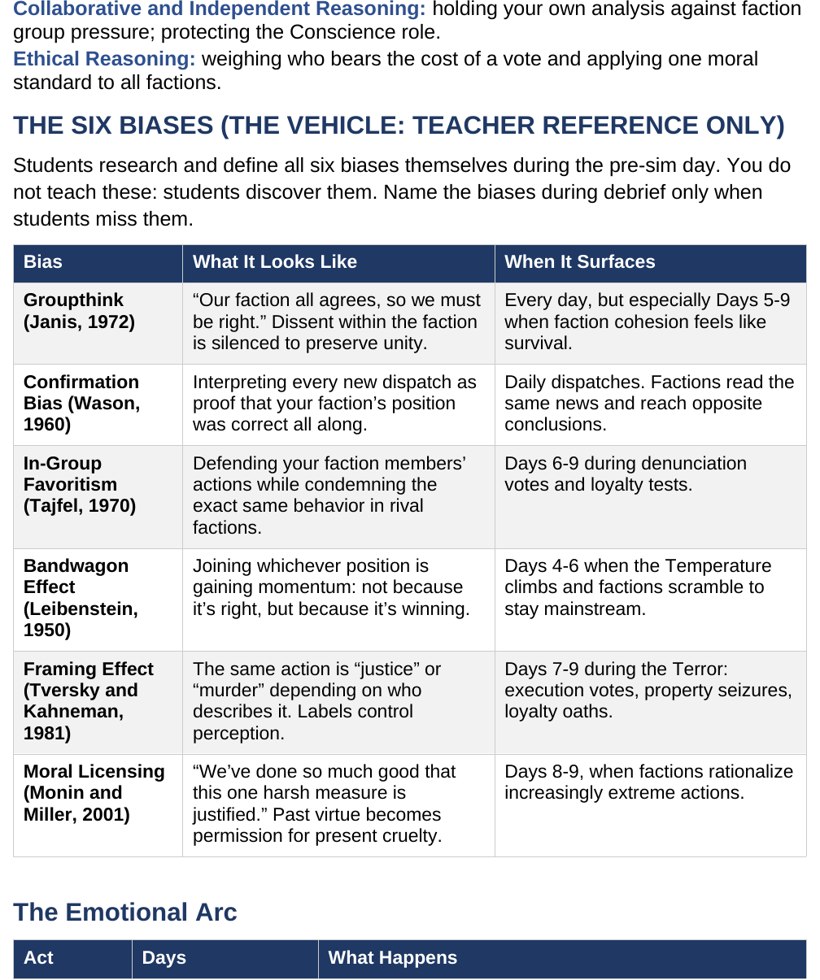
Every day is already scripted.
You bring the facilitation. The simulation brings everything else. The teacher guide carries 12 daily playbooks that script each period, what to set up, when to call the vote, which dispatch to release, and how the Temperature should move that day. A quick-start brief gets you running in five steps, skim the guide, assign factions, distribute the workbooks and Kingdom Profile, walk the rubrics on Day 0, then launch. The DIIE instructional model keeps the assessment manageable while staying rigorous. There is no nightly lesson to build and no grading guesswork. Your prep is light because the structure is already in the box. You spend class facilitating the assembly, not engineering it from scratch.
Tap to read the teacher guide
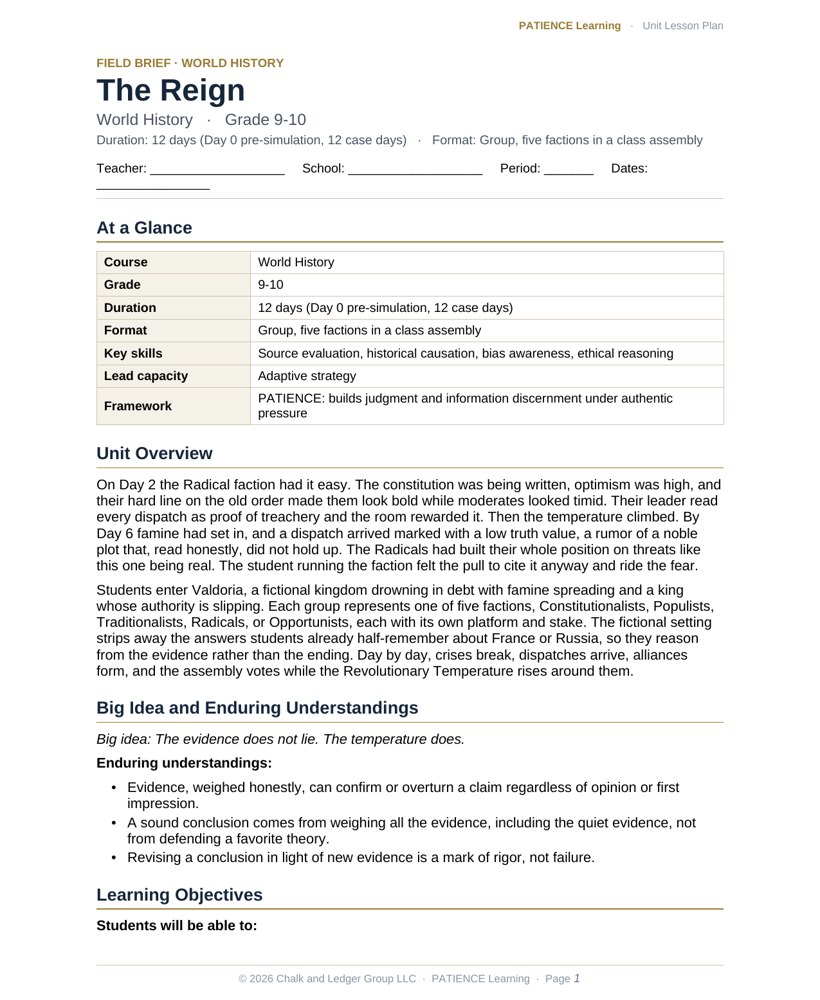
The lesson plan is already written.
Every simulation comes with a fully editable, admin-ready lesson plan. Standards alignment, daily pacing, learning objectives, differentiation, and an assessment plan are already done, so you can hand it to an administrator or adapt it to your district template in minutes.
Tap to preview the lesson plan
Close
Close
Close
Close
The day the evidence stops matching the story.
On Day 2 the Radical faction had it easy. The constitution was being written, optimism was high, and their hard line on the old order made them look bold while moderates looked timid. Their leader read every dispatch as proof of treachery and the room rewarded it. Then the temperature climbed. By Day 6 famine had set in, and a dispatch arrived marked with a low truth value, a rumor of a noble plot that, read honestly, did not hold up. The Radicals had built their whole position on threats like this one being real. The student running the faction felt the pull to cite it anyway and ride the fear.
At that moment the choice is bare. Protect the theory that has carried the faction this far, or trust what the evidence actually says and lose the momentum. The student who pauses, checks the truth value, and tells the assembly the rumor is thin gives up an easy win. What they see next is the point of the whole simulation. The 50-Year Legacy Report shows the factions that chased the heat built nothing that lasted, while the restrained ones built the institutions that survived the century. The honest call was the durable one.
A kingdom unraveling, one vote at a time.
Students enter Valdoria, a fictional kingdom drowning in debt with famine spreading and a king whose authority is slipping. Each group represents one of five factions, Constitutionalists, Populists, Traditionalists, Radicals, or Opportunists, each with its own platform and stake. The fictional setting strips away the answers students already half-remember about France or Russia, so they reason from the evidence rather than the ending. Day by day, crises break, dispatches arrive, alliances form, and the assembly votes while the Revolutionary Temperature rises around them.
| Grade level | 9-10 |
| Course | World History |
| Duration | 12 days (Day 0 pre-simulation, 12 case days) |
| Format | Group, five factions in a class assembly |
| Key skills | Source evaluation, historical causation, bias awareness, ethical reasoning |
Engineering better thinkers.
In a revolution, the pressure to follow the crowd is the whole danger. Discernment is what holds a student steady. Each day of The Reign pairs a named bias with the capacity that defeats it, so students do not just define the trap, they feel it and learn to climb out.
| Bias targeted | The remedy, built into the work |
|---|---|
| Anchoring | Productive failure recoveryWhen a faction's Day 2 platform no longer fits the famine of Day 6, students must turn a failing strategy into an honest account of what went wrong instead of clinging to the opening position. |
| Confirmation bias | MetacognitionDispatches carry truth values, and students catch themselves reading a low-reliability rumor as proof simply because it confirms their faction's worldview, then naming that move in the journal. |
| Sunk cost fallacy | Adaptive strategyHaving voted hard one way on Day 2, students feel the pull to stay the course on Day 8, and the rubric rewards the principled pivot on new evidence over the dogmatic hold. |
| Availability bias | Information discernmentVivid denunciations and dramatic dispatches crowd out quieter, more reliable reports, so students learn to weight a source by its truth value rather than its volume. |
| Tunnel vision | Navigating uncertaintyWith foreign armies at the border and information conflicting, students must act decisively without locking onto a single threat, holding several possibilities open at once. |
| Overconfidence | Emotional regulationAs the temperature peaks and former allies become targets, students resist justifying harsh measures off past virtuous votes and keep one moral standard for every faction. |
12 days from reform to reckoning.
Day 0 sets the ground, students research the bias definitions, study their factions, and walk the rubrics so they own the reasoning-over-outcomes model before the first vote. From there the case follows the Revolutionary Temperature as it climbs from easy reform into terror, peaks on the defining vote, then crashes into the long look at what survived.
| Day | What lands | Skill in focus |
|---|---|---|
| 0 | Bias definitions, faction profiles, and rubric walkthrough | Teacher clarity and self-assessment |
| 1 | Reform begins, moderate positions are safe, agreement is easy | Collaborative reasoning |
| 2 | The constitution is written under high optimism | Source evaluation |
| 3 | First cracks, disagreement over the role of the king | Independent reasoning |
| 4 | The king flees and urgency rises (critical pivot) | Navigating uncertainty |
| 5 | Foreign armies at the border, moderates feel the squeeze | Emotional regulation |
| 6 | Food shortages make moderation look like indifference | Information discernment |
| 7 | The Committee, loyalty oaths and demands for proof | Metacognition |
| 8 | Denunciations, former allies become targets | Ethical reasoning |
| 9 | The Peak, the defining vote on the moderate leader (critical pivot) | Adaptive strategy |
| 10 | The Fall, the extremist leader drops and the temperature crashes | Productive failure recovery |
| 11 | Legacy, evaluating long-term stability and social trust | Historical causation |
| 12 | Reckoning, cross-faction comparison and final synthesis | Transfer |
Standards alignment.
The Reign maps to the C3 Framework and NCSS world history practice. Students work the historical thinking dimensions head on, evaluating the credibility of intelligence dispatches (D3.1, D3.2) and analyzing multiple causation as debt cascades into famine and terror (D2.His.14, D2.His.15). The assembly debates and the cross-faction reckoning build evidence-based argument and communication (D4.1, D4.6). The unit aligns to standard world history content on Enlightenment thought and the universal patterns of revolution seen in France, Haiti, and Russia, so the fictional case transfers directly to the real upheavals on your syllabus.
The hidden architecture.
The engine is the Revolutionary Temperature, a daily number that drives the center of acceptable opinion upward without students noticing the floor move. An act that reads as mainstream on Day 2 is reframed as treason by Day 8, the planted framing effect that catches students relabeling the same behavior as the heat rises. The dispatches carry truth values, so confirmation bias has real bait, low-reliability rumors that confirm a faction's fears. The factions that chase the momentum thrive during the terror and then collapse in the 50-Year Legacy Report, which is engineered so restraint, not power, builds what lasts. The bias-capacity map stays confidential, students know the definitions from Day 0 and fall for them anyway, which is exactly what makes the lesson stick.
Turnkey, classroom-ready.
- An admin-ready lesson plan. A fully editable plan with standards alignment, daily pacing, differentiation, and assessment, ready to adapt to your district template. Included with every purchase.
- 12 daily playbooks. Minute-by-minute facilitation for every session, plus a quick-start brief and the DIIE instructional model.
- A tech-enabled student workbook. Excel-based trackers for votes, faction positions, the bias log, and the Revolutionary Temperature.
- Revolutionary dispatches. Daily intelligence reports carrying truth values, so source evaluation is built into the case.
- Five faction profiles and a Kingdom Profile. Detailed roles for Constitutionalists, Populists, Traditionalists, Radicals, and Opportunists, with the setting students inherit.
- The 50-Year Legacy Report. Modular long-term outcomes that resolve from the actual decisions your class made.
- A dual rubric system. Grades the quality of reasoning, not whether a faction survives.
Hand your students the revolution.
Bring The Reign to your world history classroom and let your students learn to reason under pressure instead of chasing the crowd.
Get this simulationPreview real pages from the simulation before you spend a dollar. No guessing, no surprises.