The Rebrand
The exciting guess loses. The student who reads the data and names what would prove them wrong wins.
See what your students get, and why it lands.
No mockups. Every page below is real, pulled straight from the files you download. Tap any one to see it full size.
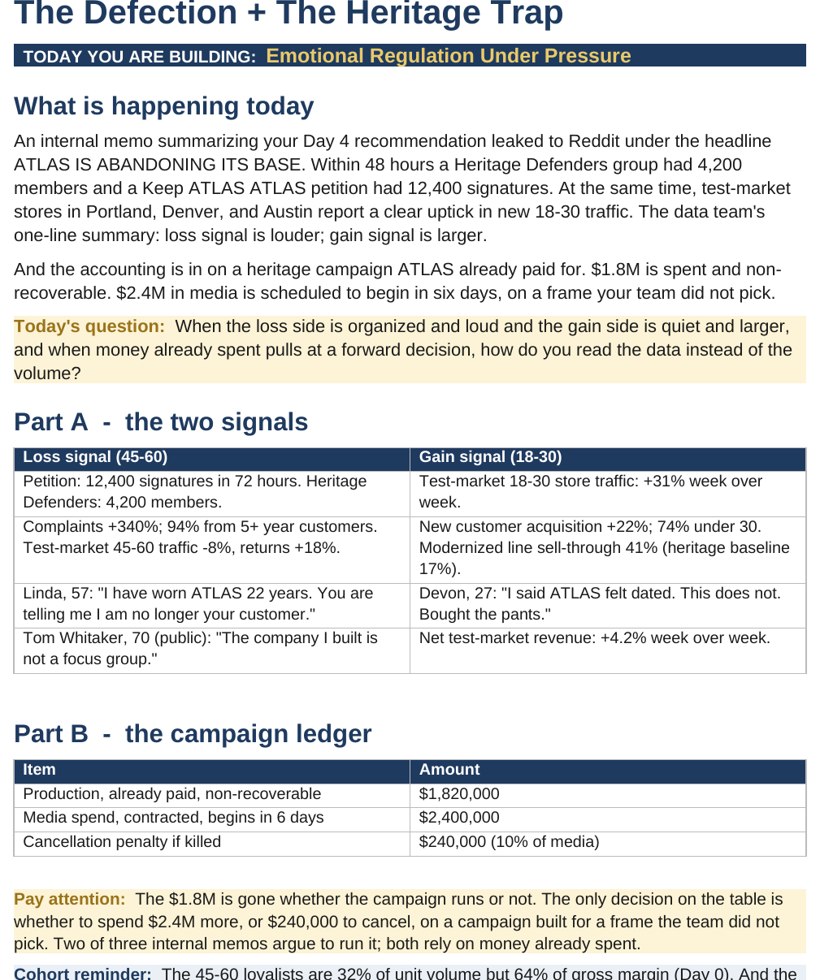
Your students are not answering questions. They are making a brand manager's call.
On the page in front of them, ATLAS is a heritage brand losing ground, and a decision is due. Students read the Brand Health Index across four metrics, Loyalist Retention, Acquisition, Brand Coherence, and Stakeholder Trust, then choose a path through a 144-path landscape. There is no answer box. They pick a repositioning move and, to earn the higher tier, they must name the specific multi-day signal behind it and the condition that would prove it wrong. On Day 6 that means citing the 18 percent return rate and stating they would be wrong if returns fell below 12 percent. The Scoreboard Oracle scores the result live, so the call has weight before anyone debriefs it.
Tap to open a student case page
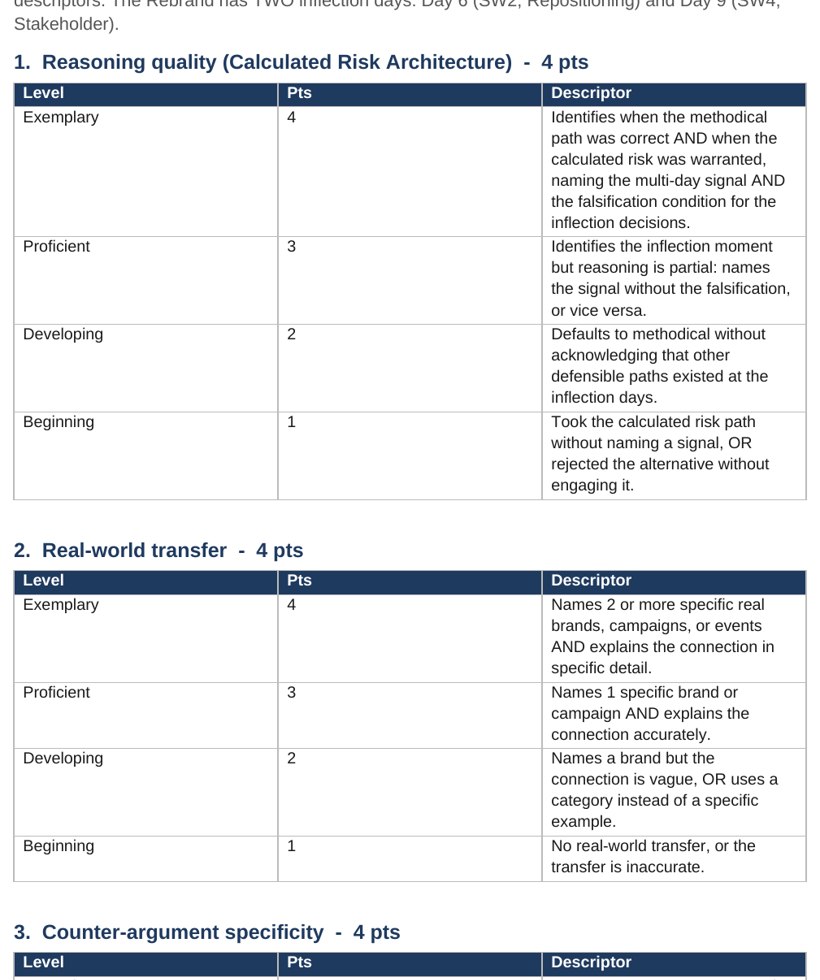
They are graded on their reasoning, not on the final score.
The rubric does not reward a lucky brand turnaround. It scores how students think. The Brand Ethics Statement is a 24-point individual assessment built on the Calculated Risk Architecture descriptors. A Methodical call that follows the conservative, evidence-aligned path is always defensible and passes. A Calculated Risk that names a real multi-day signal and a falsification condition scores above the baseline. A Reckless call, one that leans on intuition, aesthetics, or invented data, fails even when the brand happens to recover. Students are judged on why they chose what they chose and what evidence would have proven them wrong. A sound process behind a wrong path beats a guess that got lucky, every time.
Tap to read the grading rubric
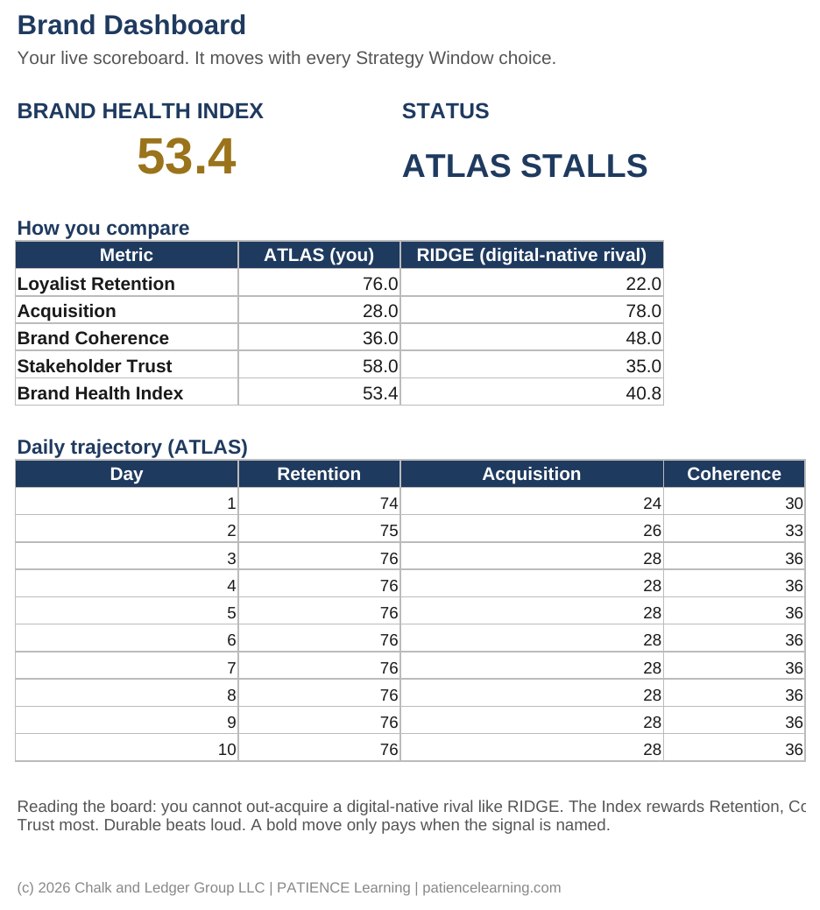
Let the Scoreboard Oracle hold the busywork.
The Scoreboard Oracle is the tech-enabled workbook at the center of the sim. It calculates the Brand Health Index across the four metrics, tracks each team's path through the 144 outcomes, and returns ATLAS THRIVES, SURVIVES, or STALLS the moment a decision lands. Students are not adding columns or hunting for last session's numbers. The tool carries the arithmetic and the bookkeeping so their energy goes to the judgment, reading the signals, weighing the trade-offs, and writing the reasoning into their daily journal. A Hidden Pattern Ledger collects the twelve consumer-psychology patterns they discover along the way, in their own words, before any technical name appears.
Tap to see the tracker
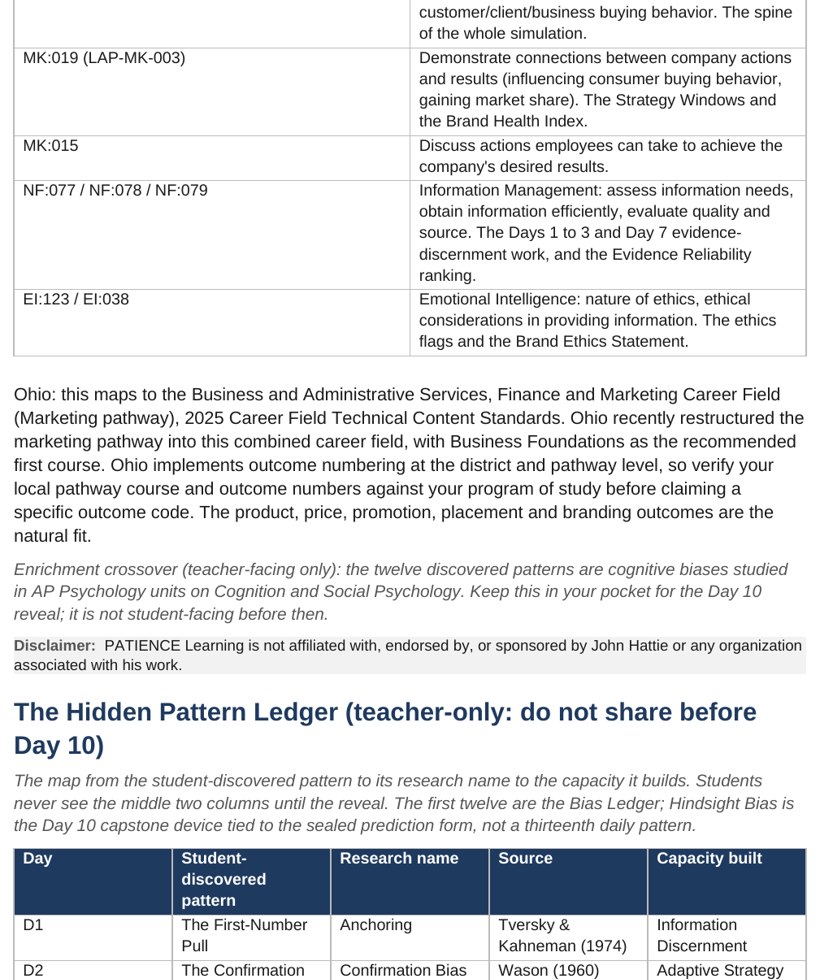
Every day is already scripted. You bring the facilitation.
The teacher guide runs on the DIIE rhythm, Diagnosis, Intervention, Implementation, and Evaluation, a 50-minute cycle laid out session by session. Your role is Verifier. There are only two specialist moves, on Day 6 and Day 9, where you confirm whether a team's named signal and falsification condition hold up against the data before the higher scoring tier unlocks. Everything else is on the page: reveal scripts, the answer key for all 144 paths, and a pacing card that keeps the 11-day arc on schedule. As the materials put it, if you can hand out a file and ask a class to defend a decision with evidence, you can run The Rebrand. Prep stays light.
Tap to read the teacher guide
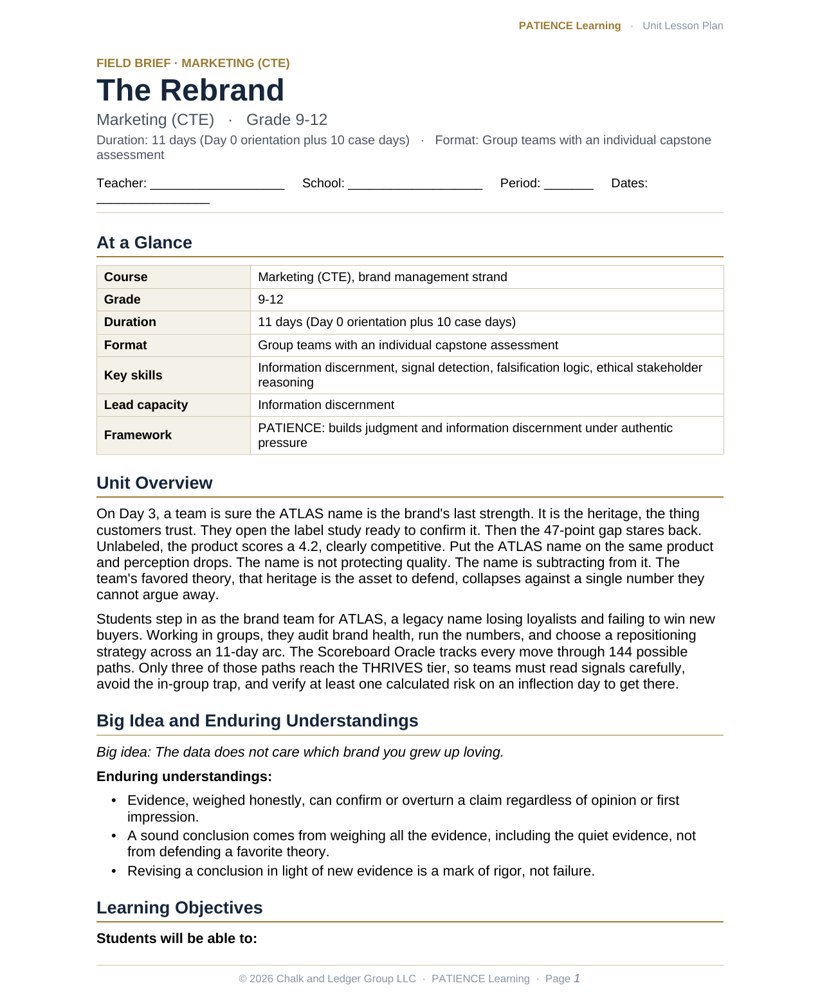
The lesson plan is already written.
Every simulation comes with a fully editable, admin-ready lesson plan. Standards alignment, daily pacing, learning objectives, differentiation, and an assessment plan are already done, so you can hand it to an administrator or adapt it to your district template in minutes.
Tap to preview the lesson plan
Close
Close
Close
Close
The day the brand name turns out to be the problem.
On Day 3, a team is sure the ATLAS name is the brand's last strength. It is the heritage, the thing customers trust. They open the label study ready to confirm it. Then the 47-point gap stares back. Unlabeled, the product scores a 4.2, clearly competitive. Put the ATLAS name on the same product and perception drops. The name is not protecting quality. The name is subtracting from it. The team's favored theory, that heritage is the asset to defend, collapses against a single number they cannot argue away.
At the pivot they face the choice the sim is built around. They can protect the theory they walked in with, or they can trust what the evidence just showed them. If they protect the theory, they keep defending a name that the data says is costing the brand. If they trust the evidence, they reposition around the product, not the legacy. The teams that choose the evidence see the Brand Health Index respond. They also see, in their own words, that a brand name can tangibly subtract value, a pattern they discovered before anyone called it the reverse halo effect.
A heritage brand in crisis, and you are the one repositioning it.
Students step in as the brand team for ATLAS, a legacy name losing loyalists and failing to win new buyers. Working in groups, they audit brand health, run the numbers, and choose a repositioning strategy across an 11-day arc. The Scoreboard Oracle tracks every move through 144 possible paths. Only three of those paths reach the THRIVES tier, so teams must read signals carefully, avoid the in-group trap, and verify at least one calculated risk on an inflection day to get there.
| Grade level | 9-12 |
| Course | Marketing (CTE), brand management strand |
| Duration | 11 days (Day 0 orientation plus 10 case days) |
| Format | Group teams with an individual capstone assessment |
| Key skills | Information discernment, signal detection, falsification logic, ethical stakeholder reasoning |
Engineering better thinkers.
Brand decisions live in noise: loud feedback, mixed metrics, and theories people are attached to. Discernment is the work. Each day pairs a consumer-psychology bias with the capacity that defeats it, so students learn to catch the pull before it drives the call.
| Bias targeted | The remedy, built into the work |
|---|---|
| Anchoring | Productive failure recoveryThe first number students see frames every later judgment. When that anchor proves misleading, they recover by re-reading the full data set and rebuilding the call on the multi-day signal, not the opening figure. |
| Confirmation bias | MetacognitionStudents walk in loyal to a theory about the brand. The daily journal forces them to state what they expected and check it against the 47-point label gap before committing to a path. |
| Sunk cost fallacy | Adaptive strategyPast spend on the heritage name pulls teams to keep defending it. They practice abandoning a losing position when the Brand Health Index says the repositioning, not the legacy, is what moves the metrics. |
| Availability bias | Information discernmentThe loudest customer complaint is not the strongest signal. Students filter vivid anecdotes from the quantitative trend and choose the data that actually predicts brand health. |
| Tunnel vision | Navigating uncertaintyWith multiple defensible paths and no single correct route, teams resist locking onto one strategy too early. They hold options open through the Day 6 cascade until the evidence narrows the field. |
| Overconfidence | Emotional regulationThe Day 9 loyalist revolt rattles a confident team. They regulate the reaction, return to the signal and the falsification condition, and avoid a reckless swing dressed up as decisiveness. |
11 days of evidence under pressure.
Day 0 sets the baseline with a sealed prediction. The discovery phase trains students to describe what they see before they name it. From there the case escalates: a framing choice, a repositioning cascade, an audience split, a stakeholder revolt, and a reveal that measures how far their thinking has moved.
| Day | What lands | Skill in focus |
|---|---|---|
| 0 | Orientation and the 8-tactic sealed prediction form | Navigating uncertainty |
| 1-2 | Discovery phase: describing market behavior in plain language | Information discernment |
| 3 | The perception lock, the 47-point label gap (critical pivot) | Information discernment |
| 4 | The frame: choosing the brand frame in the first specialist workbook | Thinking about your thinking |
| 5 | Pressure-testing the chosen frame against fresh signals | Metacognition |
| 6 | The cascade: repositioning pace, verified against the 18 percent return rate (critical pivot) | Navigating uncertainty |
| 7 | Holding the strategy steady as new data arrives | Adaptive strategy |
| 8 | The audience split: allocating effort across loyalists and new buyers | Adaptive strategy |
| 9 | The loyalist revolt and the stakeholder response (inflection) | Ethical and stakeholder reasoning |
| 10 | The reveal: reopening the Day 0 prediction to expose hindsight bias | Productive failure recovery |
Standards alignment.
The Rebrand maps to MBA Research National Marketing Standards, including MK:014, explain factors that influence buying behavior; MK:019, demonstrate connections between company actions and results; NF:077, evaluate the quality and source of information; and EI:123, discuss ethical considerations in providing information. It supports the Common Career Technical Core marketing cluster and Career Ready Practices, particularly applying appropriate academic and technical skills and using critical thinking. The simulation also aligns with the Common Career Technical Core (CCTC) for the Business Management, Finance, and Marketing career clusters. Because state CTE course and outcome numbers vary, verify them against your program of study before claiming specific outcome codes.
The hidden architecture.
The pivot is engineered. On Day 3 the label study is built so the product scores well unlabeled and worse with the ATLAS name attached, a planted 47-point contradiction. Students arrive loyal to the heritage name, so confirmation bias points them toward defending it, and that is exactly the wrong move. The data forces the sound conclusion: the name itself subtracts value. Because terminology is withheld until the Day 10 reveal, students discover the reverse halo effect through evidence before they can hide behind the jargon. The Day 0 sealed prediction is the second device. Reopening it at the end exposes hindsight bias and gives every student a measurable record of their own former ignorance.
Turnkey, classroom-ready.
- An admin-ready lesson plan. A fully editable plan with standards alignment, daily pacing, differentiation, and assessment, ready to adapt to your district template. Included with every purchase.
- An 11-day teacher guide. Full facilitation manual with the DIIE daily cycle, reveal scripts, and the two specialist verifier moves.
- The Scoreboard Oracle. A tech-enabled workbook that scores decisions live across the Brand Health Index and tracks every team through the 144-path landscape.
- Turnkey student files. Case pages, the 8-tactic sealed prediction form, and the Hidden Pattern Ledger, ready to hand out.
- A data reference and answer key. Complete documentation for all 144 paths so you can verify any team's signal and falsification condition.
- A dual rubric system. The 24-point Brand Ethics Statement grades reasoning quality with the Calculated Risk descriptors, not whether the brand recovers.
- A pacing card. An at-a-glance roadmap that keeps the 11-day arc on schedule.
Give your students a real brand to save.
Bring The Rebrand to your marketing classroom and let your students prove their judgment on a brand crisis that grades how they think, not whether they get lucky.
Get this simulationPreview real pages from the simulation before you spend a dollar. No guessing, no surprises.