The Reactor
The dashboard is the weather. Your reasoning is the job.
See what your students get, and why it lands.
No mockups. Every page below is real, pulled straight from the files you download. Tap any one to see it full size.
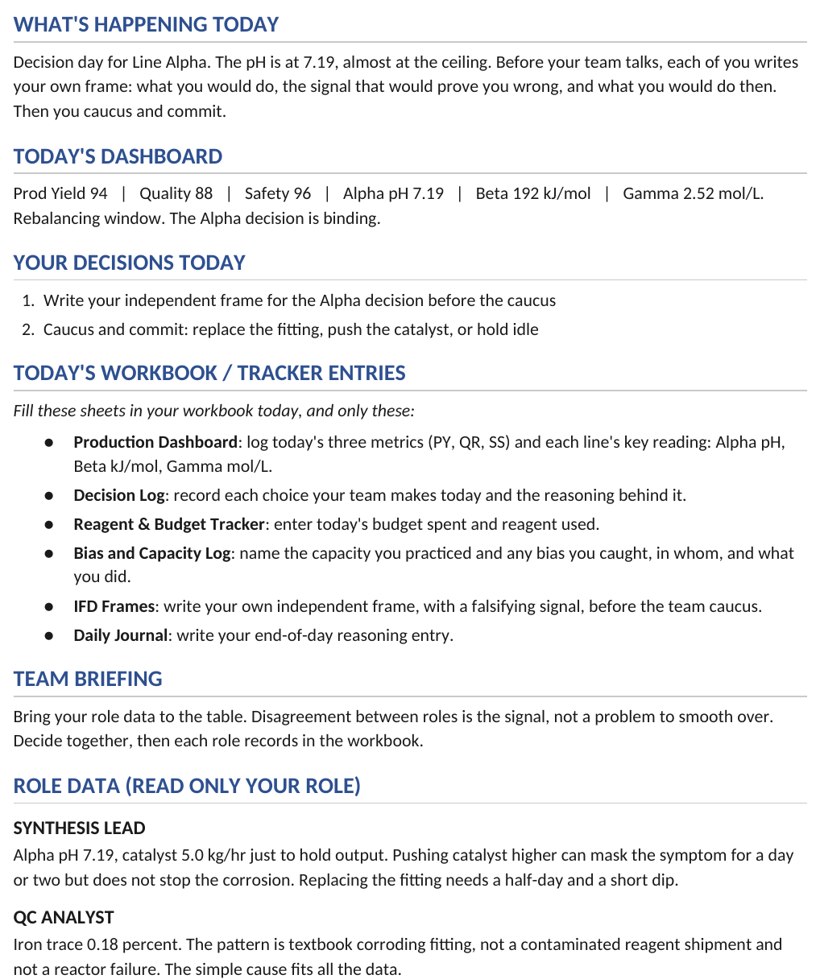
A worksheet was never going to teach this.
On the Alpha Call, your students are not answering questions about reaction rates. They are running Meridian Chemical Works, and a batch is drifting out of spec. The temptation is to hunt for a dramatic cause like sabotage. The data points somewhere duller: a corroding fitting. Each student reads only their slice of the plant, reactor temperature, purity, emissions logs, or budget, then has to commit to a posture and name the metric that would prove them wrong. They are making a real call from incomplete evidence, with money and a client contract on the line. The chemistry is the costume. The reasoning is the course. By the time they defend the boring fix to their team, they have done the work no problem set asks for.
Tap to see a decision day
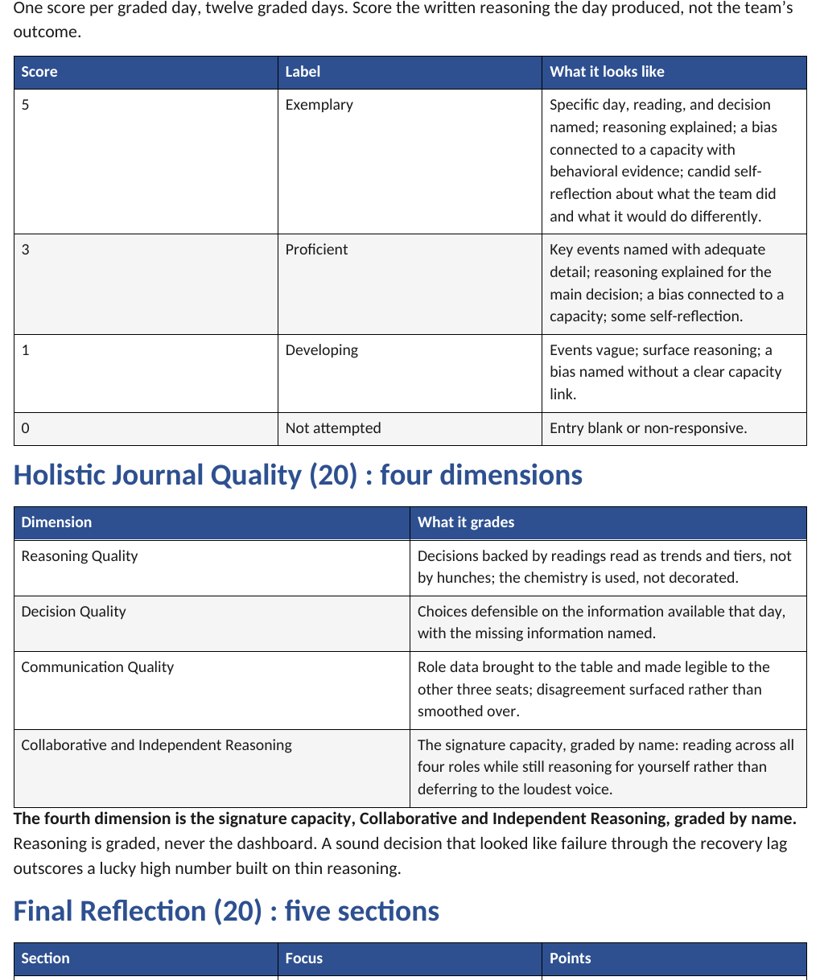
They are graded on their reasoning, not on getting it right.
A student who replaces the corroding fitting, names the falling iron trace as the signal to watch, and holds steady while purity dips has earned full marks, even if the dashboard stays red for two more days. A student who panics, reverses the fix, and happens to land a clean number has not. The dual rubric scores each daily journal entry on a 5, 3, 1, 0 scale for the quality of the reasoning, then pairs that with a holistic read of the whole journal. This is how you separate a calculated risk from luck: a named signal, a written falsification condition, and the patience to hold through the lag. Grading runs to roughly thirty seconds per student because the rubric tells you exactly what a sound process looks like.
Tap to read the grading rubric
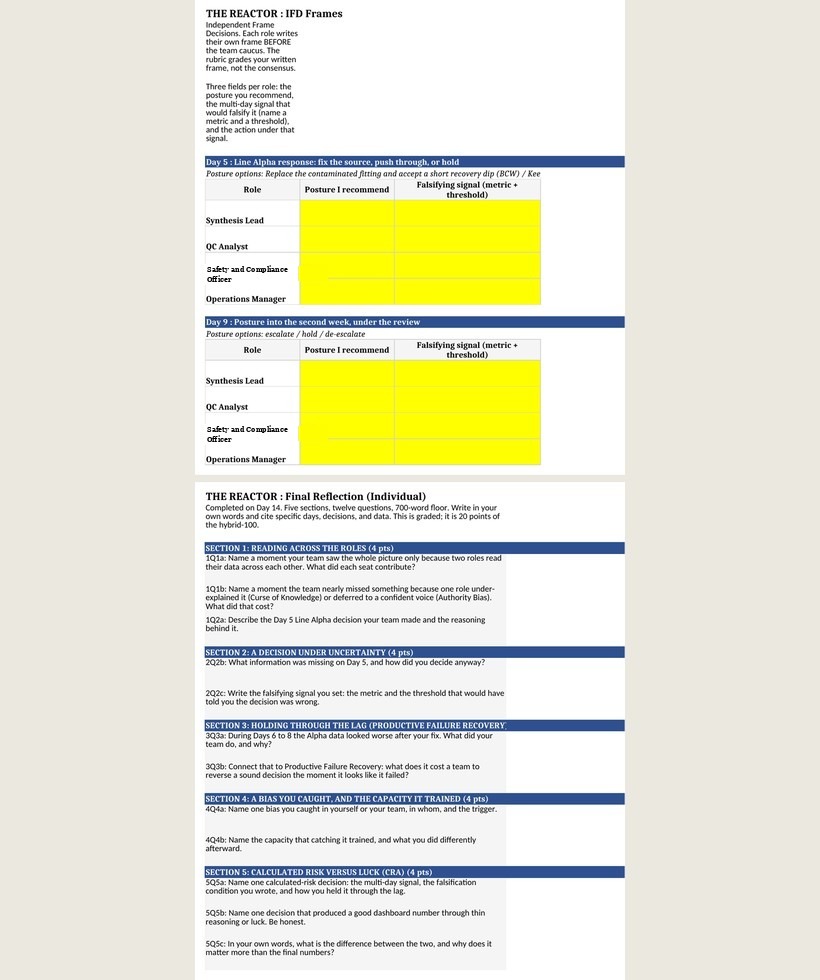
Let the workbook hold the busywork.
Each student owns one role, Synthesis Lead, QC Analyst, Safety and Compliance Officer, or Operations Manager, and the tech-enabled workbook holds that role's data so nobody is recopying tables by hand. It logs reactor temperatures and catalyst ratios, purity and contaminant readings, emissions and near-miss records, or budget and inventory, depending on the seat. On critical days it prompts each student to write their independent posture and falsification condition before the group talks, so the loudest voice does not set the answer. The slow pump drift that starts on Day 2 sits quietly in the numbers, in spec for nine days, waiting for someone to notice the trend. The workbook does the arithmetic. Your students spend their energy on the judgment.
Tap to see the tracker
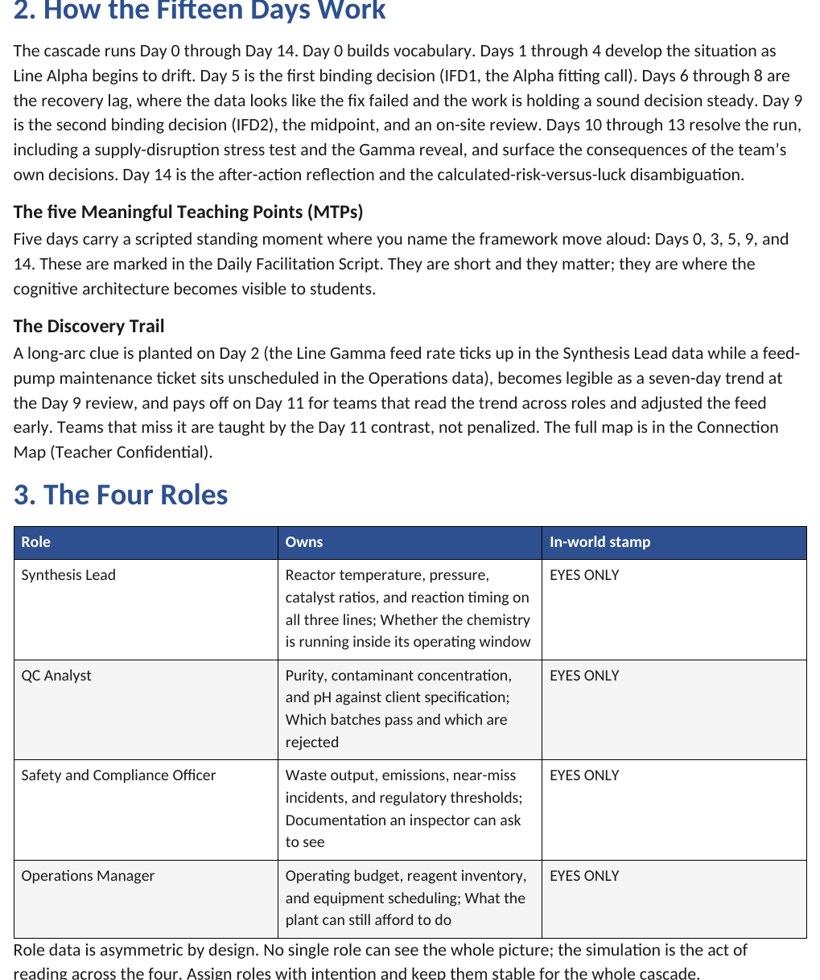
Every day is already scripted.
The teacher guide runs each session on a clear cycle: diagnose where the team is, set up the day's decision, let students reason, then debrief. Scripted teaching points land on five specific days, 0, 3, 5, 9, and 14, so the cognitive architecture becomes visible at the right moments without you having to invent them. The simulation is day-indexed, not clock-indexed, so you can compress the building days or stretch the 14-day arc to fit a block schedule or a packed calendar without losing the cascade. You bring the facilitation and the questions. The simulation brings the case, the data, the postures, and the answer key for what sound reasoning looks like. Prep stays light because the day is already written.
Tap to read the teacher guide
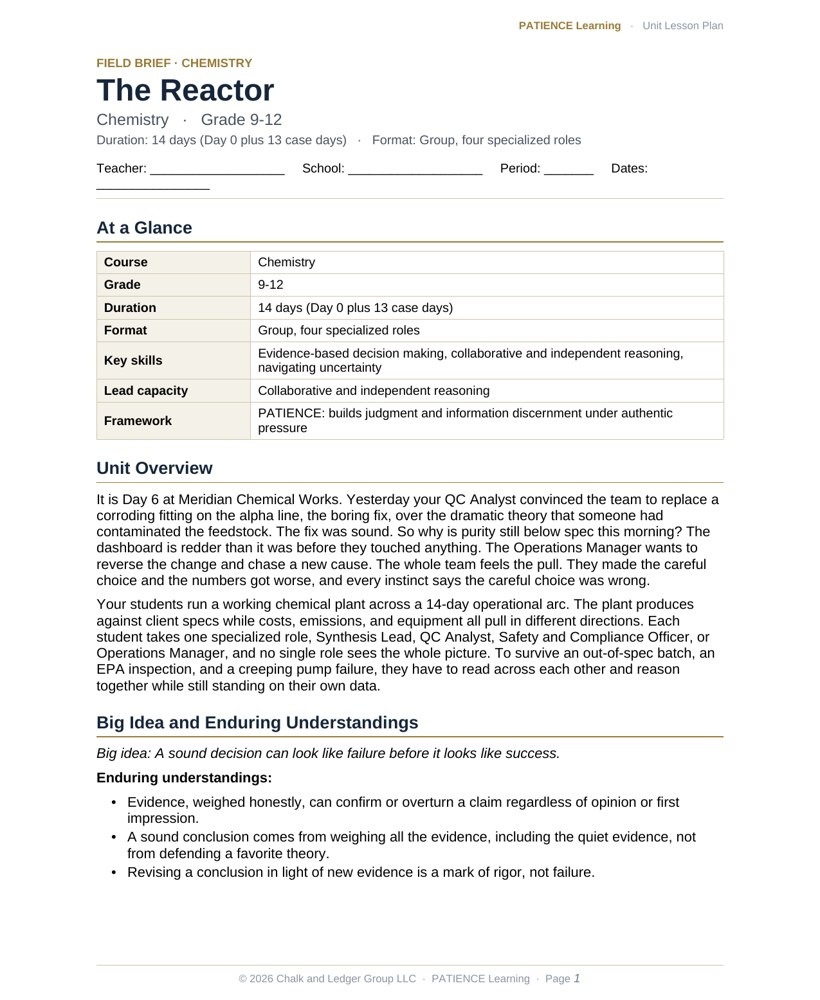
The lesson plan is already written.
Every simulation comes with a fully editable, admin-ready lesson plan. Standards alignment, daily pacing, learning objectives, differentiation, and an assessment plan are already done, so you can hand it to an administrator or adapt it to your district template in minutes.
Tap to preview the lesson plan
Close
Close
Close
Close
The day the dashboard turns red and the right call is to do nothing new.
It is Day 6 at Meridian Chemical Works. Yesterday your QC Analyst convinced the team to replace a corroding fitting on the alpha line, the boring fix, over the dramatic theory that someone had contaminated the feedstock. The fix was sound. So why is purity still below spec this morning? The dashboard is redder than it was before they touched anything. The Operations Manager wants to reverse the change and chase a new cause. The whole team feels the pull. They made the careful choice and the numbers got worse, and every instinct says the careful choice was wrong.
Here is the pivot. One student scrolls past the angry purity line to the contaminant trace and sees the iron reading falling, slowly, steadily, day over day. That is the planted tell. The chemistry is settling exactly the way a real fix settles, with a lag. The choice is between protecting their pride by reversing course and trusting the one quiet signal that says hold. The team that holds watches purity climb back on Day 8. The team that panics restarts the whole problem. Once they have seen it, they never trust a single red number again.
Meridian Chemical Works, four roles, one plant, incomplete information.
Your students run a working chemical plant across a 14-day operational arc. The plant produces against client specs while costs, emissions, and equipment all pull in different directions. Each student takes one specialized role, Synthesis Lead, QC Analyst, Safety and Compliance Officer, or Operations Manager, and no single role sees the whole picture. To survive an out-of-spec batch, an EPA inspection, and a creeping pump failure, they have to read across each other and reason together while still standing on their own data.
| Grade level | 9-12 |
| Course | Chemistry |
| Duration | 14 days (Day 0 plus 13 case days) |
| Format | Group, four specialized roles |
| Key skills | Evidence-based decision making, collaborative and independent reasoning, navigating uncertainty |
Engineering better thinkers.
Discernment matters here because the plant data is noisy, partial, and split across four roles, so the easy read is almost always wrong. Each day pairs a named bias with the capacity that defeats it, made concrete through the chemistry students are running.
| Bias targeted | The remedy, built into the work |
|---|---|
| Authority bias | Collaborative and independent reasoningStudents write a posture and a falsification condition before the caucus, so a senior-sounding teammate cannot set the answer and every call rests on the data, not the loudest voice in the room. |
| Negativity bias | Emotional regulationDuring the cooling alarm scare, a single loud distraction pulls attention off the systems that matter. Students practice managing several readings at once instead of fixating on the scariest number. |
| Omission bias | Navigating uncertaintyWhen a reading is still passing but trending toward failure, doing nothing feels safer than acting. Students learn to make a defensible move on a trend rather than waiting for the crisis to force a costly reaction. |
| Proportionality bias | Thinking about your thinkingA small problem invites a dramatic story like sabotage. Students check their own causal reasoning and accept that a corroding fitting, the boring cause, fits the evidence better than the exciting one. |
| Recovery lag pressure | Productive failure recoveryAfter a correct fix, purity stays below spec while the chemistry settles. Students read the falling iron trace, hold the sound decision through the dip, and resist the urge to reverse a good call. |
| Curse of knowledge | Collaborative and independent reasoningEach role knows things the others cannot see. Students learn to share their slice clearly and to ask for the data they lack rather than assuming the team already knows what they know. |
14 days of evidence under pressure.
Day 0 sets the plant, the roles, and the rules of evidence. From there the case builds: a quiet pump drift starts early and hides in spec for nine days, the alpha line forces a binding call, a recovery lag tests nerve, and a final inspection asks whether each team can tell a calculated risk from luck.
| Day | What lands | Skill in focus |
|---|---|---|
| 0 | Plant orientation, role assignments, and the rules of evidence | Reading the case |
| 2 | A slow pump drift begins and sits quietly in spec | Information discernment |
| 3 | First teaching point: separating the signal from the dashboard | Thinking about your thinking |
| 5 | The Alpha Call, the first binding decision, boring fix versus dramatic theory (critical pivot) | Independent and collaborative reasoning |
| 6 | The recovery lag begins, purity stays low after the correct fix | Emotional regulation |
| 7 | The planted tell, a falling iron trace, rewards teams who read trends | Productive failure recovery |
| 8 | Purity climbs back for teams that held the line (critical pivot) | Productive failure recovery |
| 9 | Mid-run teaching point on causal stories and assumptions | Thinking about your thinking |
| 11 | The pump failure forces a costly reactive flush for teams that ignored the trend | Navigating uncertainty |
| 13 | An EPA inspection tests the compliance records built across the run | Information discernment |
| 14 | Final call and journal: distinguishing a calculated risk from luck | Independent and collaborative reasoning |
Standards alignment.
The Reactor maps to the Next Generation Science Standards and HS-PS physical science practices, with the chemistry serving as a genuine context rather than a backdrop. Students plan and carry out investigations and analyze and interpret data (SEP practices) as they read purity, contaminant, and reactor readings against client specs, touching HS-PS1 chemical reactions content through reaction conditions, catalysts, and contamination. The simulation lives most fully in the Nature of Science strand, specifically that scientific knowledge is open to revision in light of new evidence, since teams must revise their causal models as fresh plant data releases. It also models scientific inquiry as a human, collaborative endeavor under real pressure.
The hidden architecture.
The engineered pivot is the recovery lag. On Day 5 the team makes the sound fix, replacing the corroding fitting, and the simulation deliberately keeps purity below spec for the next two to three days. This contradicts the instinct that a correct action should produce an immediate good result, and it tempts students to reverse a decision that is actually working. The escape is planted in plain sight: the iron trace falls steadily through the lag, a quiet positive indicator that the chemistry is settling. Teams that notice that one subtle trend hold their decision and watch purity recover on Day 8. Teams that fixate on the angry purity line panic, reverse the fix, and restart the problem. The slow pump drift runs the same trap on a longer timescale, rewarding the trend reader and punishing the crisis reactor.
Turnkey, classroom-ready.
- An admin-ready lesson plan. A fully editable plan with standards alignment, daily pacing, differentiation, and assessment, ready to adapt to your district template. Included with every purchase.
- 14-day facilitation playbooks. A scripted cycle for every session, with teaching points landing on Days 0, 3, 5, 9, and 14.
- A tech-enabled workbook. Holds each role's plant data and prompts independent postures and falsification conditions, so students spend their energy on judgment.
- Turnkey student files. Four role packets, daily data releases, and the case materials students need to run Meridian Chemical Works.
- A dual rubric system. Scores daily reasoning on a 5, 3, 1, 0 scale plus a holistic journal read, grading the quality of reasoning, not whether they solve it.
- Flexible scheduling. Day-indexed, not clock-indexed, so you can compress or stretch the arc to fit a block or traditional schedule.
Give your students a real call to defend.
Bring The Reactor to your chemistry classroom and let your students learn, under genuine pressure, why a sound process beats a lucky guess every time.
Get this simulationPreview real pages from the simulation before you spend a dollar. No guessing, no surprises.