The Podium
The line everyone loves is not always the line the evidence earns.
See what your students get, and why it lands.
No mockups. Every page below is real, pulled straight from the files you download. Tap any one to see it full size.
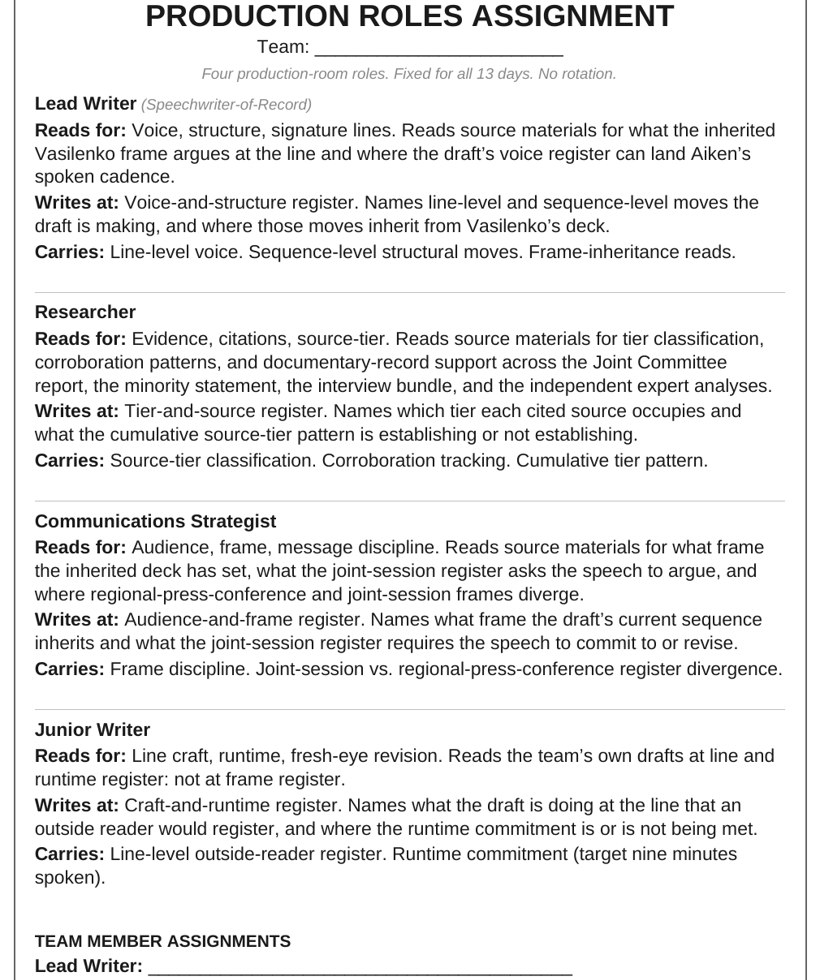
Your students do not answer questions. They take a position at the podium.
Each student picks up a role card and steps into a working speechwriting unit. The Lead Writer owns voice and structure. The Researcher tiers every source and names what the pattern establishes. The Communications Strategist guards the frame. The Junior Writer watches the runtime against the 18-minute commitment. These are not worksheet seats. Before any caucus, each student writes an independent frame in their own register, then defends it against the room. The team has inherited a position deck from a senior writer on leave, so your students are not starting clean. They are the speechwriter of record now, making real editorial calls from a 40-source binder under a fixed calendar. The card tells them what they read for. The evidence tells them what to say.
Tap to see the role cards
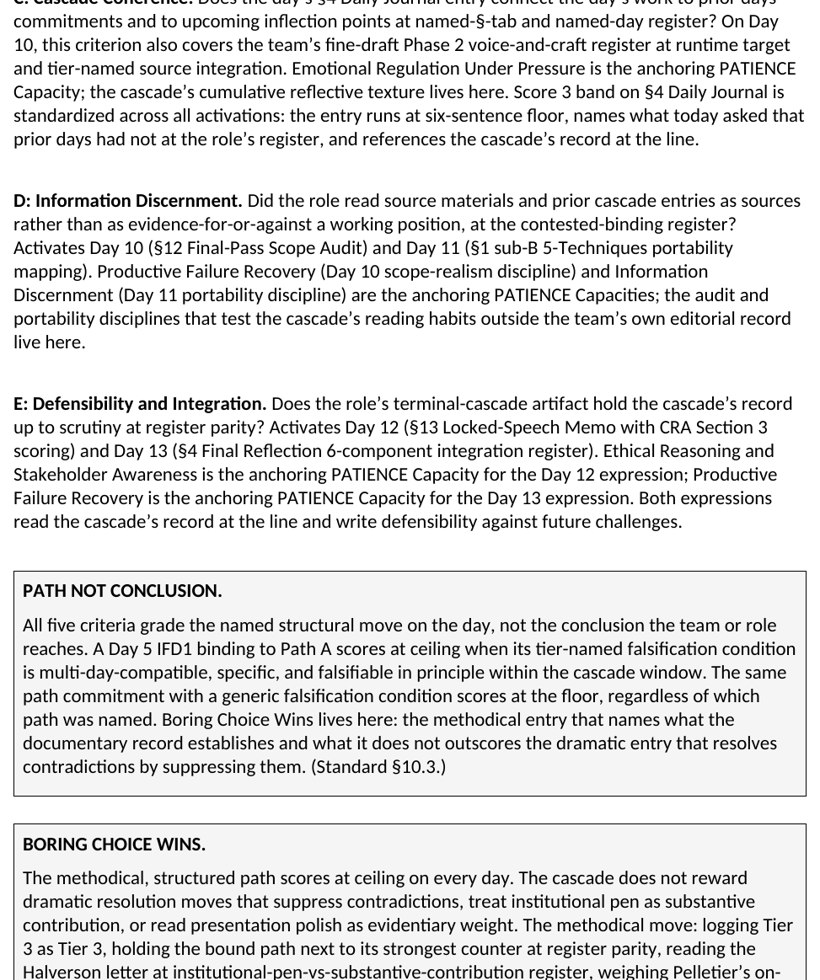
They are graded on how they read the evidence, not on the line they pick.
The Daily Rubric scores the work students actually do each session: field-authentic reading and source discipline. A student who names a Tier 6 stakeholder voice as exactly that, and refuses to let an institutionally weighty pen elevate it to a Tier 1 record, scores well even if the team later disagrees with them. A student who picks a strong-sounding line because the room already loves it scores poorly, regardless of how the speech lands. The rubric rewards the methodical, evidence-first path the simulation calls Boring Choice Wins. A sound process behind a position the team rejects beats a lucky guess dressed up as confidence. Reasoning is the grade. The final answer is just where the reasoning happened to point.
Tap to read the grading rubric
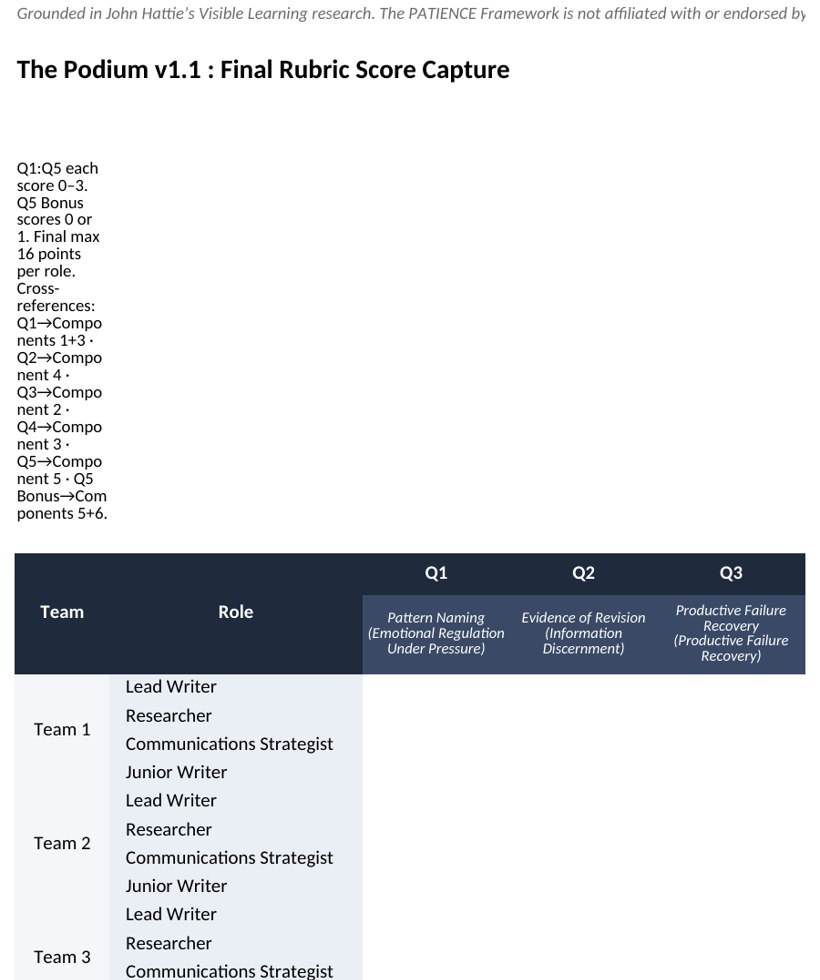
Let the workbook hold the busywork so judgment gets the energy.
The 13-tab Tracker is where thinking becomes visible. Students log the source stream chronologically, tier each entry against the six-level evidence hierarchy, and record their register write before each caucus. The tabs handle the mechanical load: which source arrived when, which tier it sits in, how many minutes the current draft runs against the 18-minute constraint. None of that lives in a student's head or gets lost in a shared doc. Because the spreadsheet carries the logistics, your students spend their attention on the calls that matter, like whether the Halverson letter belongs anywhere near the Joint Committee Report. The Tracker is the physical evidence of their cognitive progression, day by day, ready for you to grade without reconstructing what they did.
Tap to see the tracker
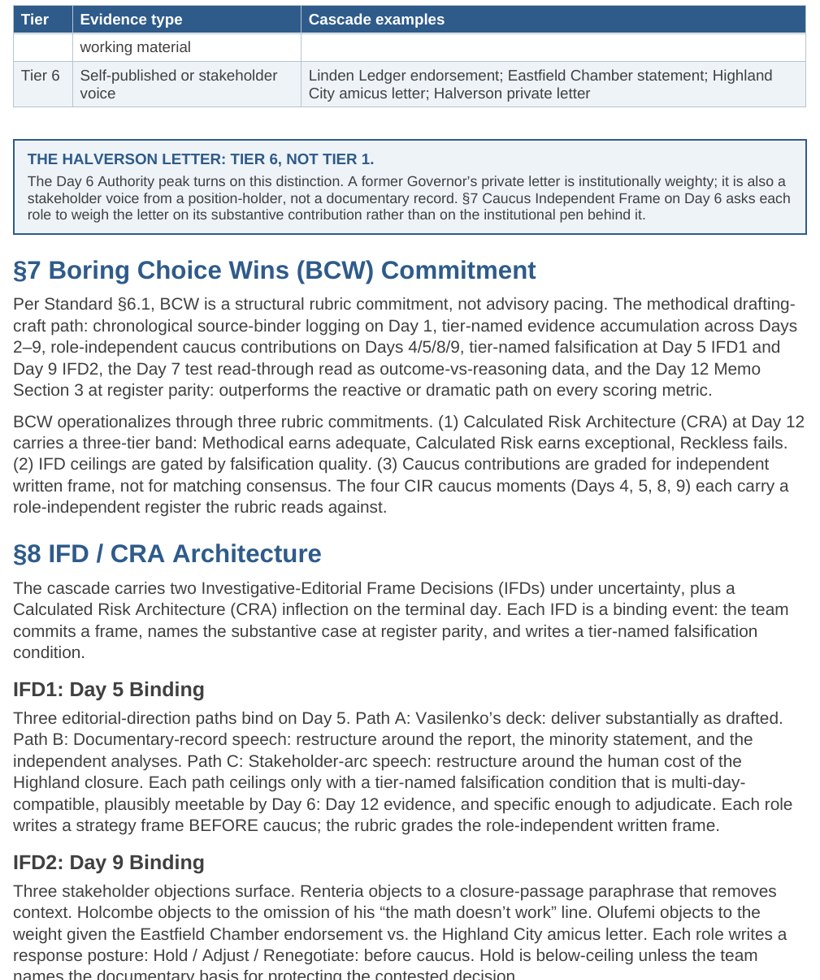
Every day is already scripted. You bring the facilitation.
The Teacher Guide runs on a DIIE spine: Diagnosis, Intervention, Implementation, Evaluation. Each session opens with diagnostic questions to read where students stand, moves through pacing blocks engineered to surface a specific bias, then closes with a hook that links today to tomorrow's requirement. You are told what to ask, when to step in, and which workbook artifact students should produce in that block. The bias peaks are mapped to the exact days they tend to spike, so you know when the room will reach for the line that is landing or defer the hard cut to the final pass. Prep is light because the design work is done. You facilitate the conversation. The simulation brings the structure, the timing, and the scripts.
Tap to read the teacher guide
The lesson plan is already written.
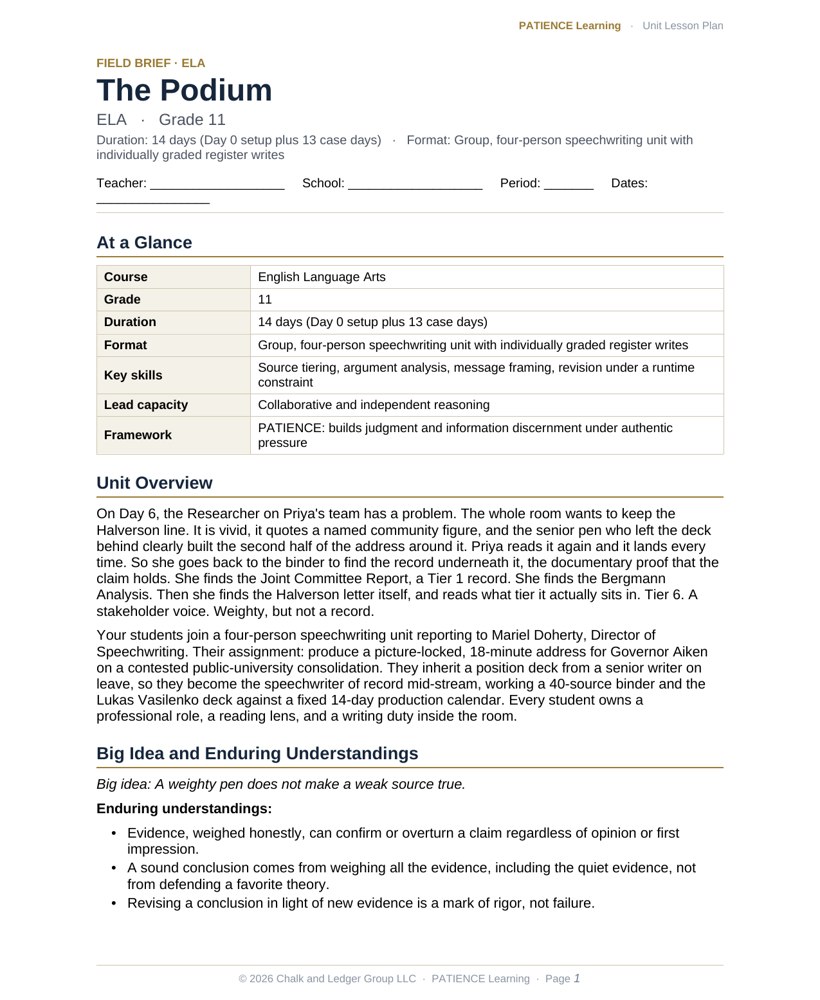
Every simulation comes with a fully editable, admin-ready lesson plan. Standards alignment, daily pacing, learning objectives, differentiation, and an assessment plan are already done, so you can hand it to an administrator or adapt it to your district template in minutes.
Tap to preview the lesson plan
Close
Close
Close
Close
The day the line everyone loved fell apart under the binder.
On Day 6, the Researcher on Priya's team has a problem. The whole room wants to keep the Halverson line. It is vivid, it quotes a named community figure, and the senior pen who left the deck behind clearly built the second half of the address around it. Priya reads it again and it lands every time. So she goes back to the binder to find the record underneath it, the documentary proof that the claim holds. She finds the Joint Committee Report, a Tier 1 record. She finds the Bergmann Analysis. Then she finds the Halverson letter itself, and reads what tier it actually sits in. Tier 6. A stakeholder voice. Weighty, but not a record.
The favored line was carrying weight it had not earned. Priya can protect the inherited frame, keep the room happy, and let the speech ride a stakeholder quote dressed as evidence. Or she can write her register frame honestly, name the tier, and tell the team the line cannot anchor the claim. She chooses the evidence. She names the gap in her pre-caucus write, the team reweights the sequence around the Tier 1 record, and the address gets quieter and far harder to break. The exciting line was the trap. The boring, sourced one was the speech.
A governor's address, fourteen days, and a deck you did not write.
Your students join a four-person speechwriting unit reporting to Mariel Doherty, Director of Speechwriting. Their assignment: produce a picture-locked, 18-minute address for Governor Aiken on a contested public-university consolidation. They inherit a position deck from a senior writer on leave, so they become the speechwriter of record mid-stream, working a 40-source binder and the Lukas Vasilenko deck against a fixed 14-day production calendar. Every student owns a professional role, a reading lens, and a writing duty inside the room.
| Grade level | 11 |
| Course | English Language Arts |
| Duration | 14 days (Day 0 setup plus 13 case days) |
| Format | Group, four-person speechwriting unit with individually graded register writes |
| Key skills | Source tiering, argument analysis, message framing, revision under a runtime constraint |
Engineering better thinkers.
Information triage is the real skill behind a speech that holds. Each day pairs the bias most likely to spike at that moment with the capacity that defeats it, surfaced through field-authentic phrases your students must catch before they ever hear the textbook name on Day 13.
| Bias targeted | The remedy, built into the work |
|---|---|
| Anchoring | Productive failure recoveryThe inherited deck anchors the team to the prior writer's frame. Students recover a defensible draft by naming what they kept, what they cut, and the cost of the work they deferred. |
| Confirmation bias | MetacognitionWhen the senior pen wants a line, students separate the substance of the argument from the authority of its source, weighing a voice on what it actually contributes to the record. |
| Sunk cost fallacy | Adaptive strategyWe will tighten it in the final pass hides a planning fallacy. Students name the cost of deferred work and recut scope now rather than protecting minutes already drafted. |
| Availability bias | Information discernmentThe example everyone remembers pulls toward the vivid case. Students tier the full evidence bundle and read salience against weight before letting a memorable line carry the claim. |
| Tunnel vision | Navigating uncertaintyEach editorial frame decision is binding, so students commit to a path and name the falsification condition, the specific multi-day evidence that would prove the choice wrong. |
| Overconfidence | Emotional regulationThe last draft we heard pulls toward recent feedback. Students resist recency, weight feedback on its grounding rather than its timing, and hold an independent read as the team converges. |
Fourteen days of evidence, drafts, and locked decisions.
Day 0 sets the roles and the watch-list of six field-authentic phrases. Days 1 to 3 build the input through chronological logging and triage. Days 4 to 8 move from rough to second drafts. Days 9 to 12 handle objections and the picture-lock. Day 13 reveals the research names and reflection. Each phase tightens the pressure as the calendar runs down.
| Day | What lands | Skill in focus |
|---|---|---|
| 0 | Roles assigned, the six-phrase watch-list introduced, the inherited deck handed over. | Setting the frame |
| 1 | Chronological logging of the source stream begins; the line that is landing first tempts the room. | Momentum-aware reading |
| 2 | Triage of the 40-source binder against the six-tier evidence hierarchy. | Source tiering |
| 3 | Tier 1 records separated from Tier 6 stakeholder voices in the workbook. | Information discernment |
| 4 | First caucus: each student writes an independent register frame before the team consolidates, then a rough draft is assembled. | Independent reasoning |
| 6 | The senior pen's favored line is tested against the record and reweighted (critical pivot). | Substance-vs-pen weighting |
| 7 | Second draft built around the Tier 1 record rather than the vivid quote. | Salience-vs-weight reading |
| 8 | Caucus on objections; runtime checked against the 18-minute commitment. | Scope-realism discipline |
| 9 | Refinement begins; deferred cuts named rather than pushed to the final pass. | Productive failure recovery |
| 10 | We will tighten it later is challenged; scope is cut now (critical pivot). | Planning-fallacy resistance |
| 11 | Picture-lock approaches; falsification conditions written for each editorial frame. | Navigating uncertainty |
| 12 | Locked-Speech Memo scored on the calculated-risk band: methodical, calculated, or reckless. | Calculated risk |
| 13 | The Reveal: research names land, multi-day signals are named, students reflect. | Metacognition |
Standards alignment.
The Podium maps to Grade 11 to 12 CCSS-ELA anchor standards. Source tiering and evidence evaluation hit RI.11-12.1, citing strong textual evidence, and RI.11-12.8, evaluating the reasoning and relevance of an argument's claims. Drafting and revising the address engage W.11-12.1, writing arguments with valid reasoning and sufficient evidence, alongside W.11-12.4 and W.11-12.5 for production and revision. The caucus structure and register writes build SL.11-12.1, collaborative discussion grounded in evidence, and SL.11-12.3, evaluating a speaker's reasoning and use of evidence. Runtime and line-economy work draws on L.11-12.3 for language choices.
The hidden architecture.
The pivot is engineered into the binder itself. The Halverson letter is written to read as a knockout line, and the inherited deck builds toward it, so confirmation bias and authority bias point your students straight at it. The trap is that Halverson is a Tier 6 stakeholder voice while the claim it supports needs a Tier 1 documentary record, which sits quietly elsewhere in the Joint Committee Report. Students who chase the vivid, room-pleasing line cannot source it, and the falsification requirement forces the gap into the open. Only the methodical path, tiering the full bundle and weighting substance over the pen, produces a speech that holds. The structure rewards the boring, sourced choice and punishes the dramatic guess, by design.
Turnkey, classroom-ready.
- An admin-ready lesson plan. A fully editable plan with standards alignment, daily pacing, differentiation, and assessment, ready to adapt to your district template. Included with every purchase.
- 14-day playbooks. Minute-by-minute DIIE facilitation for every session, with the bias peaks mapped to the days they spike.
- A 13-tab tech-enabled workbook. Logging, source tiering, and register writes that hold the busywork so judgment gets the focus.
- Turnkey student files. The 40-source binder, the inherited Vasilenko deck, and four production-room role cards, ready to hand out.
- A dual rubric system. A Daily Rubric for field-authentic reading and a Final Rubric that grades the quality of reasoning, not whether they pick the popular line.
- The Multi-Day Signal bonus. Rewards students who name a pattern that recurred across the cascade, such as a source whose tier-standing shifted as evidence accumulated.
Put your students behind the podium.
Bring The Podium to your Grade 11 room and let your students learn that a sourced, careful line beats the exciting guess every time.
Get this simulationPreview real pages from the simulation before you spend a dollar. No guessing, no surprises.