The Pitch
A brilliant pitch cannot save a broken business model.
See what your students get, and why it lands.
No mockups. Every page below is real, pulled straight from the files you download. Tap any one to see it full size.
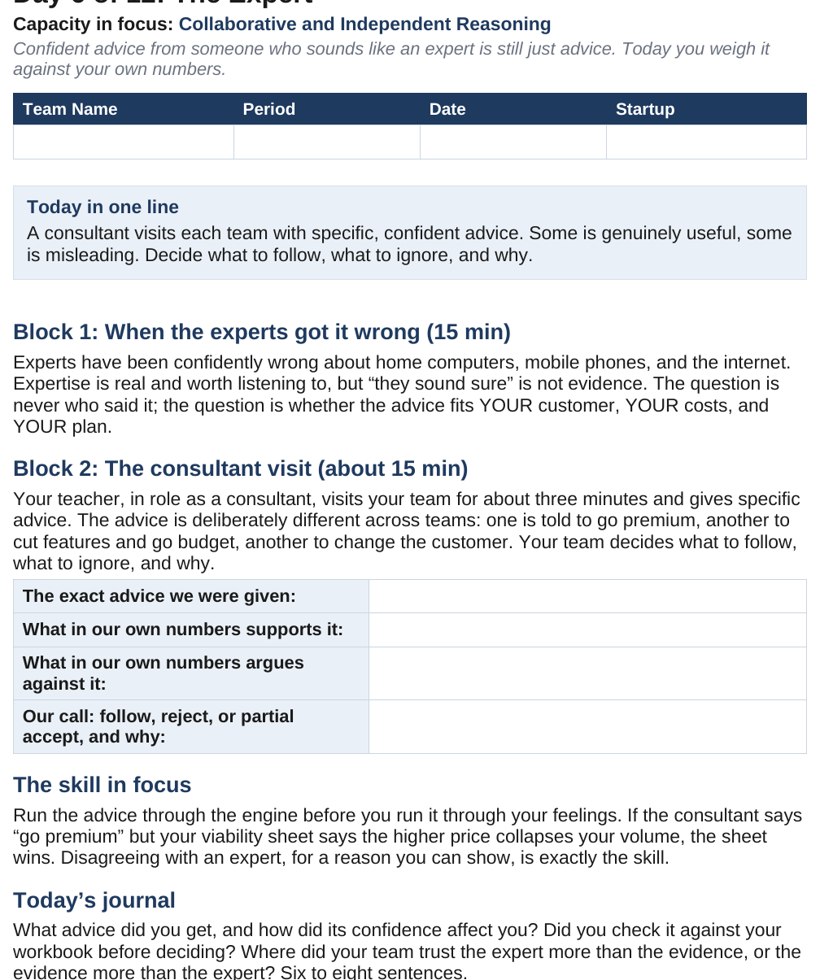
Your students are not answering questions. They are running a startup.
Each day opens with a situation and a curveball: a cost spikes, demand drops, an investor makes an offer. Your students do not fill in a blank. They confront the change, update the inputs in their team workbook, and read the live viability verdict the financial engine returns. Then they debate what to do and log the call with the actual numbers in their journal. The case page hands them real conditions and a real decision under real stakes. Every team starts with $15,000 in capital, so the choice to overspend or hold the line costs something they can watch drain. This is what makes the simulation land. Your students are making founder decisions from evidence, not recalling definitions for a test.
Tap to see a student case page
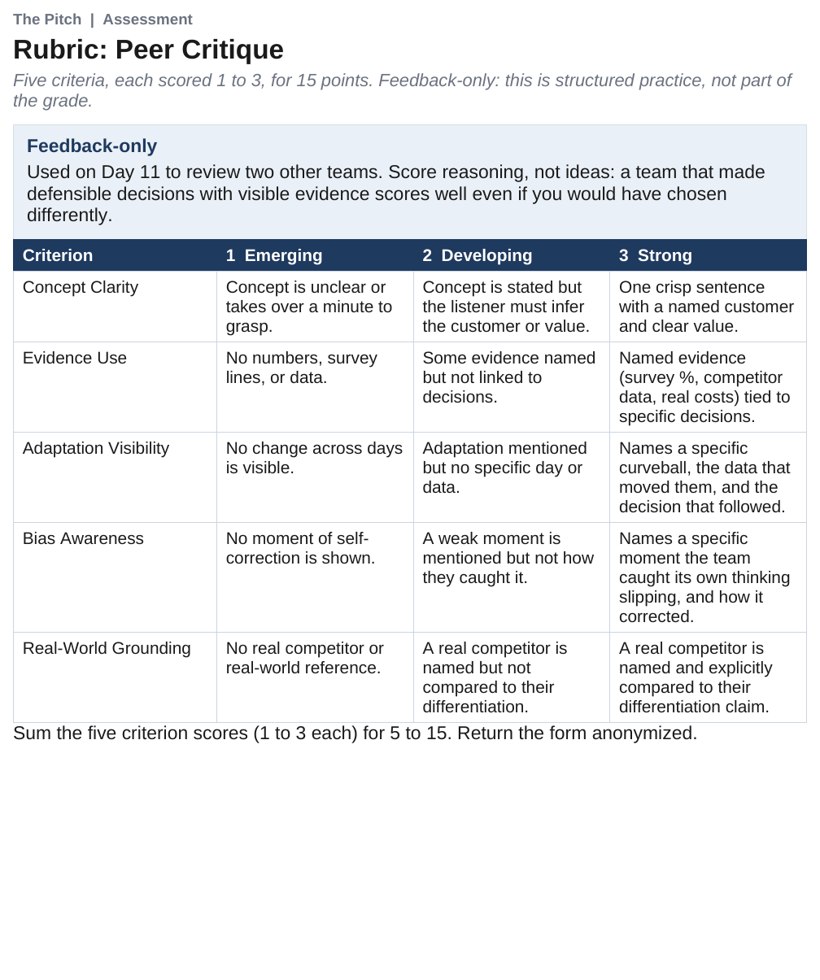
They are graded on how they reason, not on whether their idea wins.
The rubric scores diagnostic precision, the ability to pinpoint exactly what changed in the numbers and defend the call on evidence. It does not score the quality of the business idea. A student who reads a 25% demand drop, rebuilds the model line by line, and explains why the new course is sound earns full marks even if the venture is modest. A student who protects a flashy idea on a hunch does not. Individual grades total 72 points: 48 from the daily journal, scored on three randomly selected days out of ten, and 24 from the final Founders' Philosophy Statement. The random draw keeps every day honest without burying you in grading. A sound process behind a cautious call beats a confident guess.
Tap to read the grading rubric
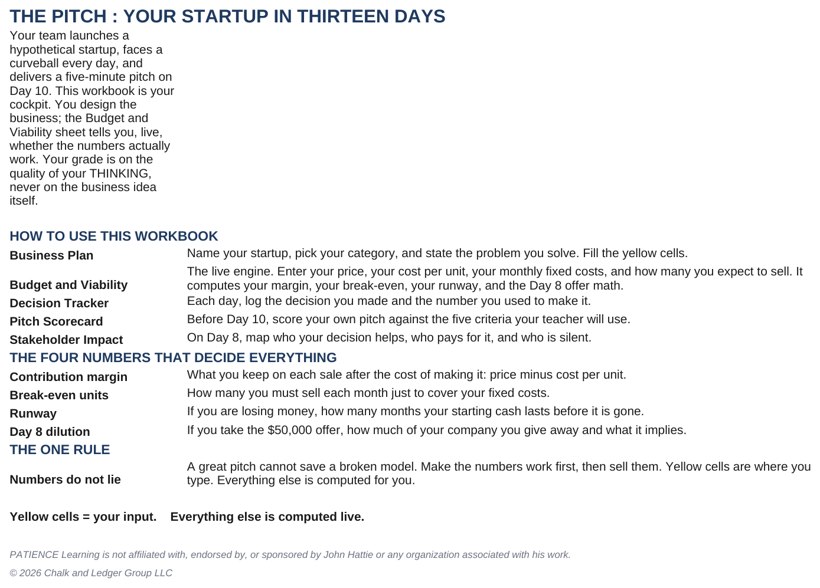
Let the workbook hold the math so students spend their energy on the judgment.
The team workbook is a live financial engine. Students enter price, costs, and volume, and it returns four metrics instantly: contribution margin, break-even units, runway in months, and the dilution from the Day 8 investor offer of $50,000 for 20% equity. No spreadsheets to wire by hand, no arithmetic errors to chase. When a team underprices to win customers, the engine shows the required volume exceeds capacity and the business never breaks even. When a team overspends on a fancy launch, runway collapses to a few months. The calculation is automatic so the conversation can be about strategy. Your students argue over what the numbers mean and what to change, which is exactly where the learning lives.
Tap to see the tracker
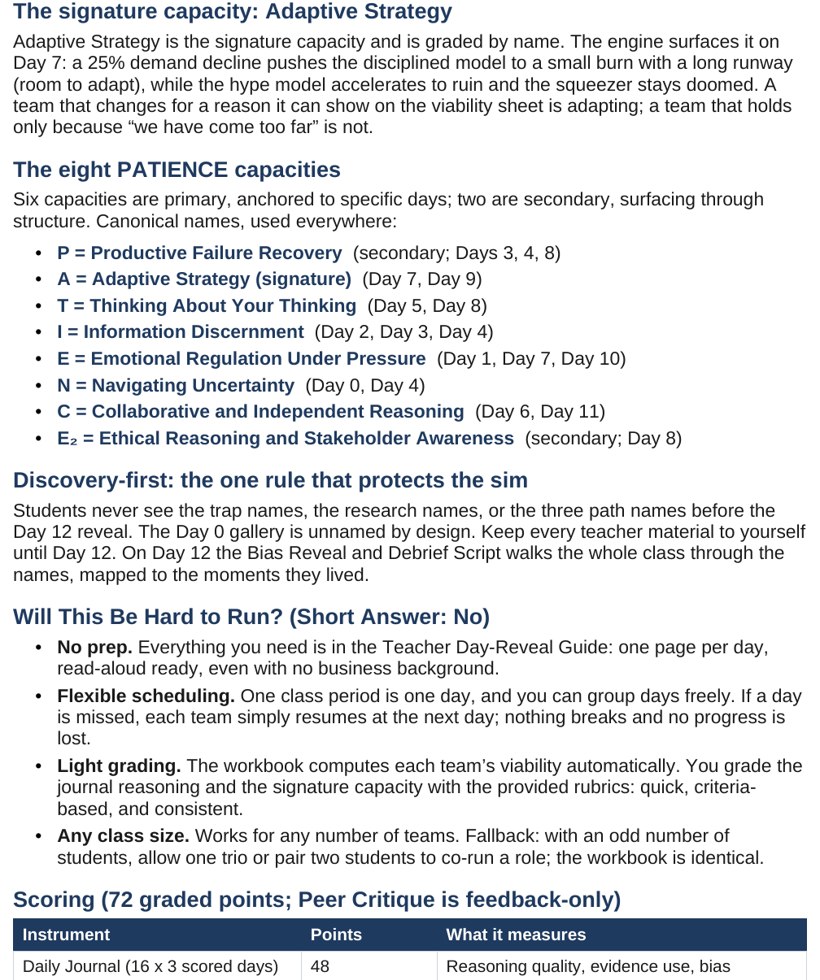
Every day is already scripted. You bring the facilitation.
The Teacher Day-Reveal Guide scripts all 13 sessions. It gives you read-aloud text for each day's situation and curveball, the mechanical steps to run the loop, and the reveal armor you need to keep the bias names hidden until Day 12. You do not need a business background to lead with authority. The guide tells you what to say, what to surface, and what to hold back. Prep is light because the simulation carries the structure and you carry the room. When a team anchors to a wrong cost estimate or refuses to pivot, the guide shows you the question that pushes them back to the evidence without handing them the answer.
Tap to read the teacher guide
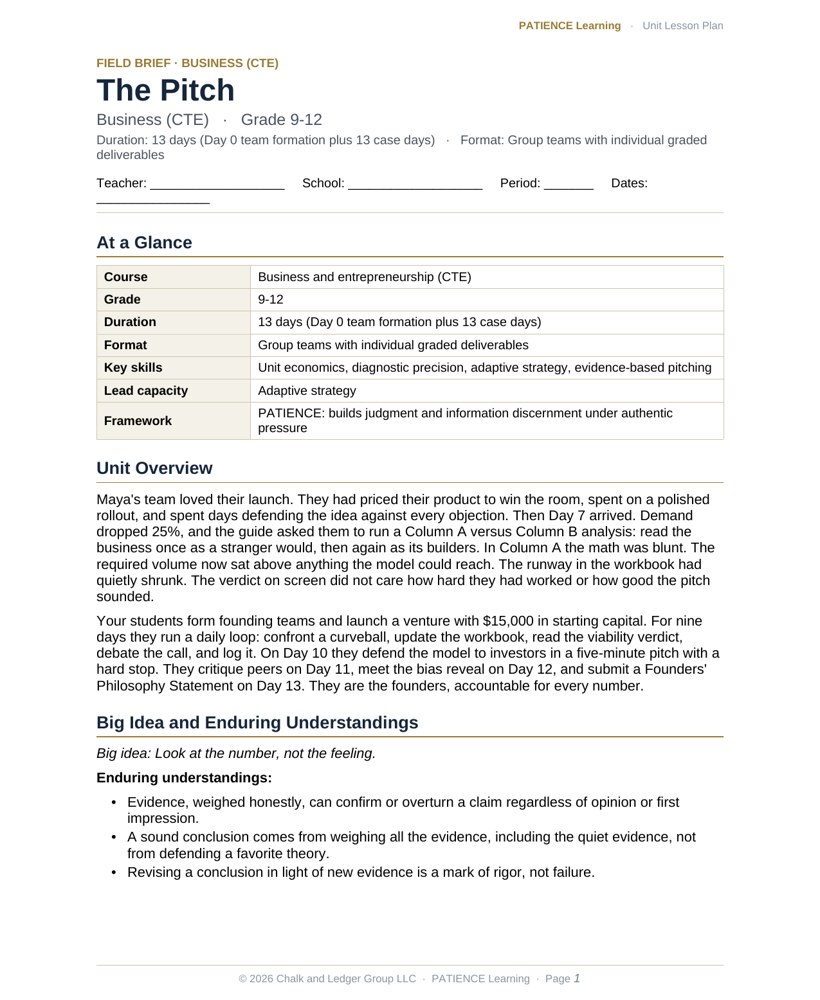
The lesson plan is already written.
Every simulation comes with a fully editable, admin-ready lesson plan. Standards alignment, daily pacing, learning objectives, differentiation, and an assessment plan are already done, so you can hand it to an administrator or adapt it to your district template in minutes.
Tap to preview the lesson plan
Close
Close
Close
Close
The day the numbers stopped agreeing with the founder.
Maya's team loved their launch. They had priced their product to win the room, spent on a polished rollout, and spent days defending the idea against every objection. Then Day 7 arrived. Demand dropped 25%, and the guide asked them to run a Column A versus Column B analysis: read the business once as a stranger would, then again as its builders. In Column A the math was blunt. The required volume now sat above anything the model could reach. The runway in the workbook had quietly shrunk. The verdict on screen did not care how hard they had worked or how good the pitch sounded.
Maya wanted to argue the engine was wrong. Her teammate read the contribution margin aloud, then the break-even units, then the months of runway left. The choice was clear and uncomfortable. They could protect the launch they were proud of, or they could trust the numbers and rebuild. They chose the numbers. They cut the costly launch, repriced to a margin the model could carry, and watched break-even fall back into reach. What they saw was simple. The pride was the thing that had been lying to them, and the evidence was the thing that had been telling the truth.
Thirteen days from team formation to founders' philosophy.
Your students form founding teams and launch a venture with $15,000 in starting capital. For nine days they run a daily loop: confront a curveball, update the workbook, read the viability verdict, debate the call, and log it. On Day 10 they defend the model to investors in a five-minute pitch with a hard stop. They critique peers on Day 11, meet the bias reveal on Day 12, and submit a Founders' Philosophy Statement on Day 13. They are the founders, accountable for every number.
| Grade level | 9-12 |
| Course | Business and entrepreneurship (CTE) |
| Duration | 13 days (Day 0 team formation plus 13 case days) |
| Format | Group teams with individual graded deliverables |
| Key skills | Unit economics, diagnostic precision, adaptive strategy, evidence-based pitching |
Engineering better thinkers.
Entrepreneurship rewards confidence, which is exactly why discernment is scarce here. Each day pairs one named thinking trap with the capacity that defeats it, so your students feel the trap in their own decision before they ever learn its name.
| Bias targeted | The remedy, built into the work |
|---|---|
| Anchoring | Productive failure recoveryWhen a cost estimate is wrong, students ignore the old total and rebuild the line item from new data rather than nudging the original number they were stuck on. |
| Confirmation bias | MetacognitionStudents read the negatives aloud and build for the objection, checking their thinking against what the evidence says instead of only what they hoped to find. |
| Sunk cost fallacy | Adaptive strategyStudents ask only whether the next hour is worth its cost, pivoting on the signal in the numbers rather than holding a losing model out of pride in past effort. |
| Availability bias | Information discernmentStudents triage feedback and advice by evidence, weighing what the engine shows over the loudest or most recent voice in the room. |
| Planning fallacy | Navigating uncertaintyStudents rebuild the budget line by line and add a 20 to 30 percent buffer, planning for the conditions they cannot yet see rather than the smooth path they imagined. |
| Overconfidence | Emotional regulationStudents rewrite the investor offer in numbers only and run the stranger analysis, separating the feeling of certainty from what the model can actually carry. |
Thirteen days of evidence under pressure.
Day 0 sets a baseline of predictions the class will revisit later. Days 1 through 9 run the daily loop, surfacing one thinking trap at a time. The arc climbs to the Day 10 pitch, a peer critique, the Day 12 bias reveal, and an individual philosophy statement that asks each student to defend how they decided.
| Day | What lands | Capacity in focus |
|---|---|---|
| 0 | Teams form and lock in their Day 0 predictions, a baseline they will measure themselves against later. | Metacognition |
| 1 | Optimism bias hits. Students learn to revise on evidence, not excitement. | Information discernment |
| 2 | Confirmation bias. Teams read the negatives aloud and build for the objection. | Metacognition |
| 4 | Planning fallacy and anchoring compound into a budget shock. Teams rebuild line by line (critical pivot). | Productive failure recovery |
| 5 | Groupthink. Members are polled for reservations before any vote. | Collaborative reasoning |
| 6 | Authority bias. Students check advice against their own data. | Independent reasoning |
| 7 | A 25% demand drop forces the stranger versus builder analysis, exposing sunk cost and the IKEA effect (critical pivot). | Adaptive strategy |
| 8 | The investor offer of $50,000 for 20% equity. Students rewrite the deal in numbers only. | Navigating uncertainty |
| 9 | Social proof. Teams triage feedback by evidence before the final build. | Information discernment |
| 10 | The pitch. Teams defend the model to investors in five minutes with a hard stop. | Emotional regulation |
| 11 | Peer critique. Students practice structured, evidence-based evaluation of others. | Collaborative reasoning |
| 12 | The bias reveal and debrief connect lived decisions to the formal research behind them. | Metacognition |
| 13 | Final deliverable. Each student submits an individual Founders' Philosophy Statement. | Independent reasoning |
Standards alignment.
The Pitch aligns to the Common Career Technical Core for the Business Management and Administration and the Marketing career clusters, with direct coverage of entrepreneurship and finance pathway expectations: analyzing unit economics, evaluating venture viability, and managing capital. It builds the Career Ready Practices, including applying appropriate academic and technical skills, using technology to enhance productivity, and making decisions grounded in evidence. The simulation develops the employability skills districts ask for: critical thinking, communication, collaboration, and adaptability under uncertainty. Because deliverables are scored on reasoning and defense of evidence, alignment is concrete rather than nominal. No CCSS codes are claimed, since this is a CTE business simulation rather than an ELA or math course.
The hidden architecture.
The engine is rigged toward discipline, and that is the point. Three founder paths exist, but only one survives. The Disciplined Builder, who prices honestly and seeks realistic volume, reaches break-even. The Hype Founder, who overspends on a launch the volume cannot cover, runs out of money in 3.5 to 4.7 months. The Margin-Squeezer, who underprices to win customers, never breaks even because required volume exceeds capacity. Your students are pulled toward the failing paths by design: Day 4 compounds planning fallacy with anchoring, Day 7 compounds builder's bias with sunk cost, Day 8 compounds framing with authority. The bias names stay hidden until Day 12. The contradiction that forces the sound conclusion is the live engine itself, which keeps returning a cold verdict no amount of enthusiasm can talk past.
Turnkey, classroom-ready.
- An admin-ready lesson plan. A fully editable plan with standards alignment, daily pacing, differentiation, and assessment, ready to adapt to your district template. Included with every purchase.
- A 13-day teacher day-reveal guide. Read-aloud scripts and mechanical steps for every session, with the reveal armor that keeps the bias names hidden until Day 12.
- A tech-enabled team workbook. A live financial engine that calculates contribution margin, break-even units, runway, and dilution as students change their inputs.
- Turnkey student files. Daily case pages, curveballs, the stranger versus builder analysis, and the daily journal, ready to hand out.
- A dual deliverable system. The 48-point daily journal and the 24-point Founders' Philosophy Statement, graded on diagnostic precision, not whether the idea wins.
- The bias and capacity map. Ten thinking traps with their research citations and the disciplined move that cures each one.
Bring the founder's discipline to your classroom.
Give your students 13 days where the numbers do not lie, the pitch cannot fake the model, and the careful builder is the one who survives.
Get this simulationPreview real pages from the simulation before you spend a dollar. No guessing, no surprises.