The Memoir
The boring, documented choice survives the edit. The cinematic invention does not.
See what your students get, and why it lands.
No mockups. Every page below is real, pulled straight from the files you download. Tap any one to see it full size.
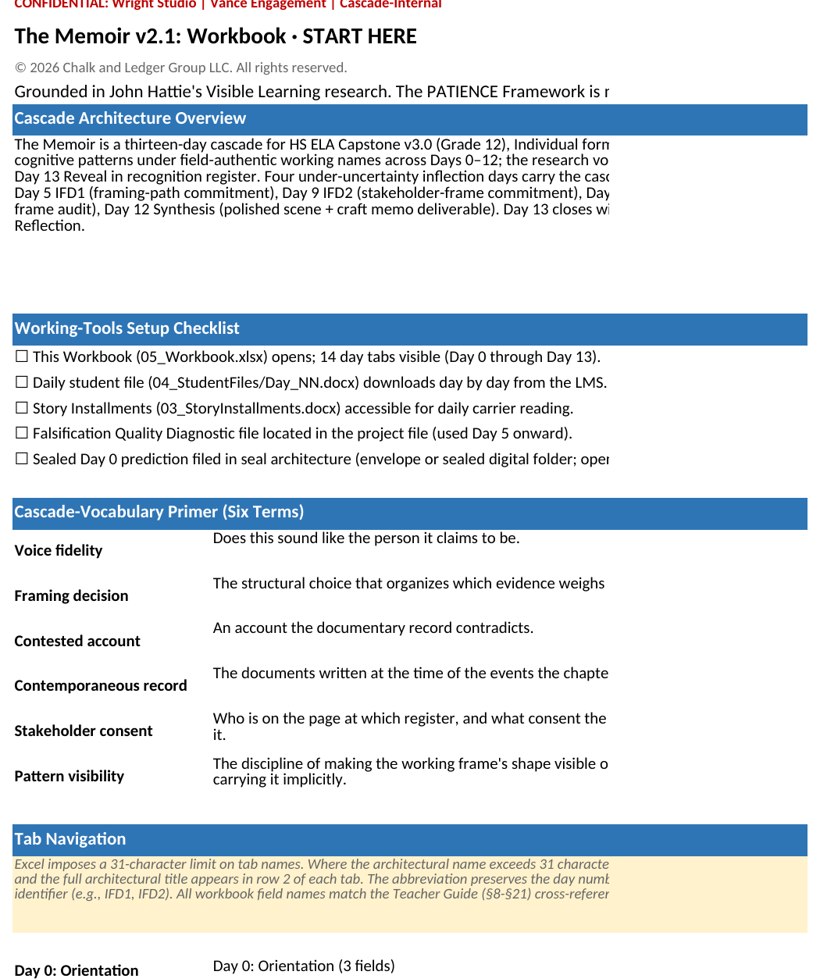
Your students are not answering questions. They are filing an editorial decision under a no-spin clause.
This Workbook page is where the case lives. Your students step in as a junior ghostwriter at the Wright Studio, tasked with polishing the climax chapter of a high-profile manuscript. They are not summarizing a passage. They log first-account claims, onboard the counterparty account, and tier each piece of evidence by how much weight it can carry. When Day 5 arrives, the page asks them to commit to a path and name the falsification condition that would force them to abandon it. The 2023 contemporaneous record and the 2024 reflective account do not agree. Your students decide which register the scene serves, and they put their reasoning on the line.
Tap to see the case page
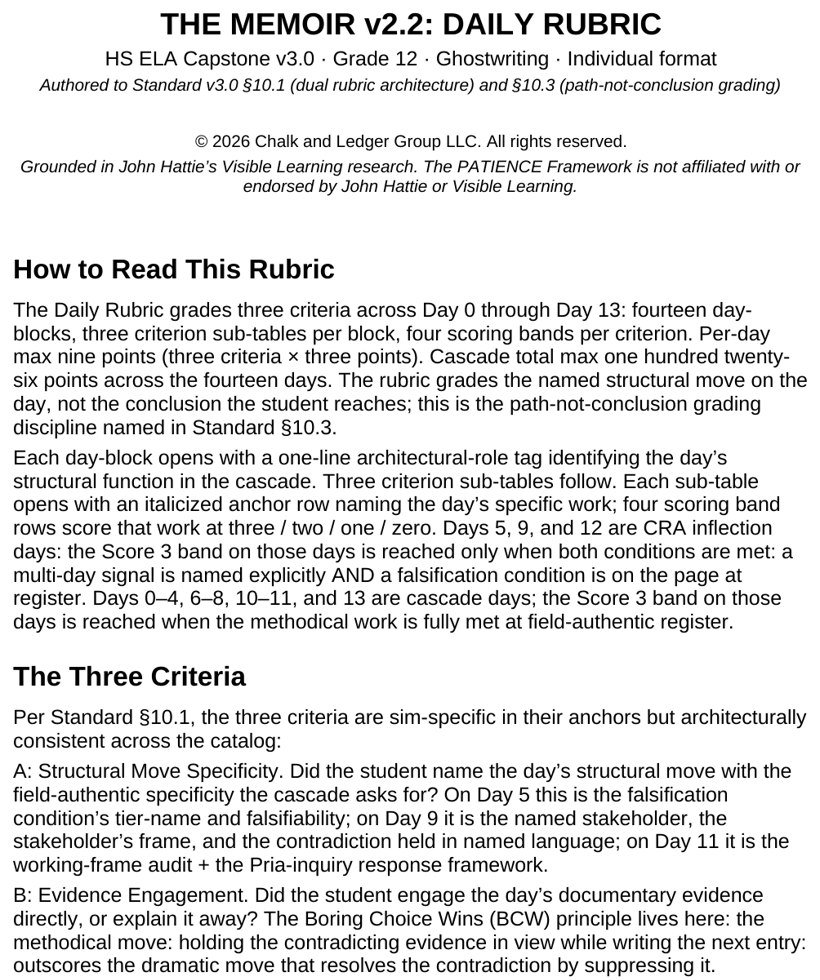
A sound process behind a discarded draft beats a lucky guess that survives.
The Daily Rubric grades the quality of the reasoning, not whether your students reach a tidy answer. On the inflection days, Days 5, 9, and 12, the scoring tightens. A top-band score is only available to a student who names a multi-day signal, citing the specific carriers from the documentary record they have been building, and who names a tier-named falsification condition that would change the call. A response that happens to be accurate but skips those structural moves lands at the methodical band. The rubric rewards students who can explain why a choice was made and what would unmake it. That is the discipline the workplace actually pays for.
Tap to read the grading rubric
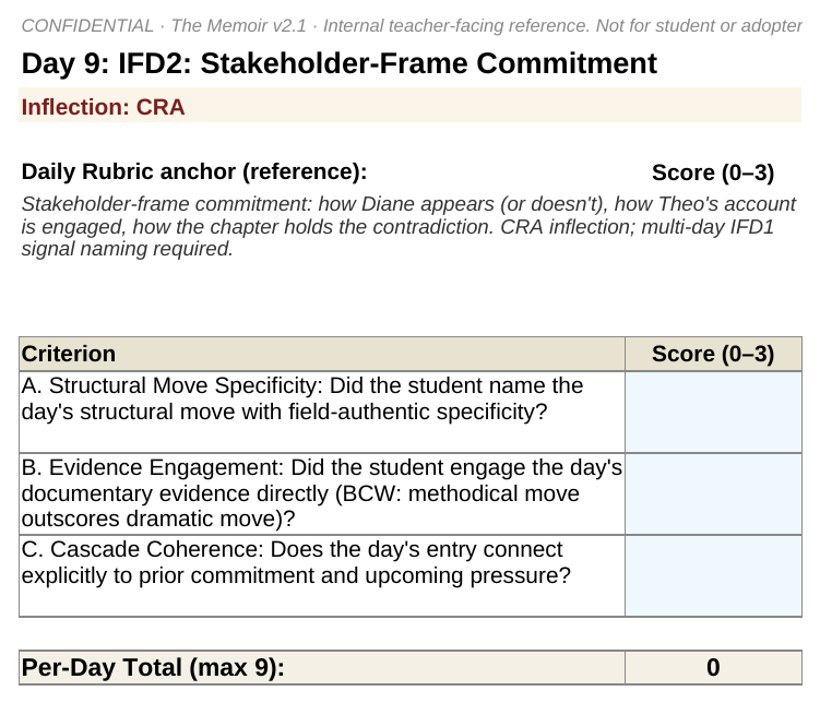
Let the Tracker hold the bookkeeping so your students spend their energy on judgment.
The Tracker is a recalc-validated spreadsheet that carries the busywork. Your students log evidence, register reads, and path commitments into it across the 13 days, and it keeps the documentary record straight so nobody loses the thread under deadline. It does the counting and the cross-referencing. That leaves your students free to do the part that matters: deciding whether the page borrows Marcus Vance's analytic founder register or his son Theo's personal account, and naming the stakeholder whose voice each line is drawing on. The tool handles the load order. Your students handle the call. Their energy goes to discernment, not to formatting.
Tap to see the tracker
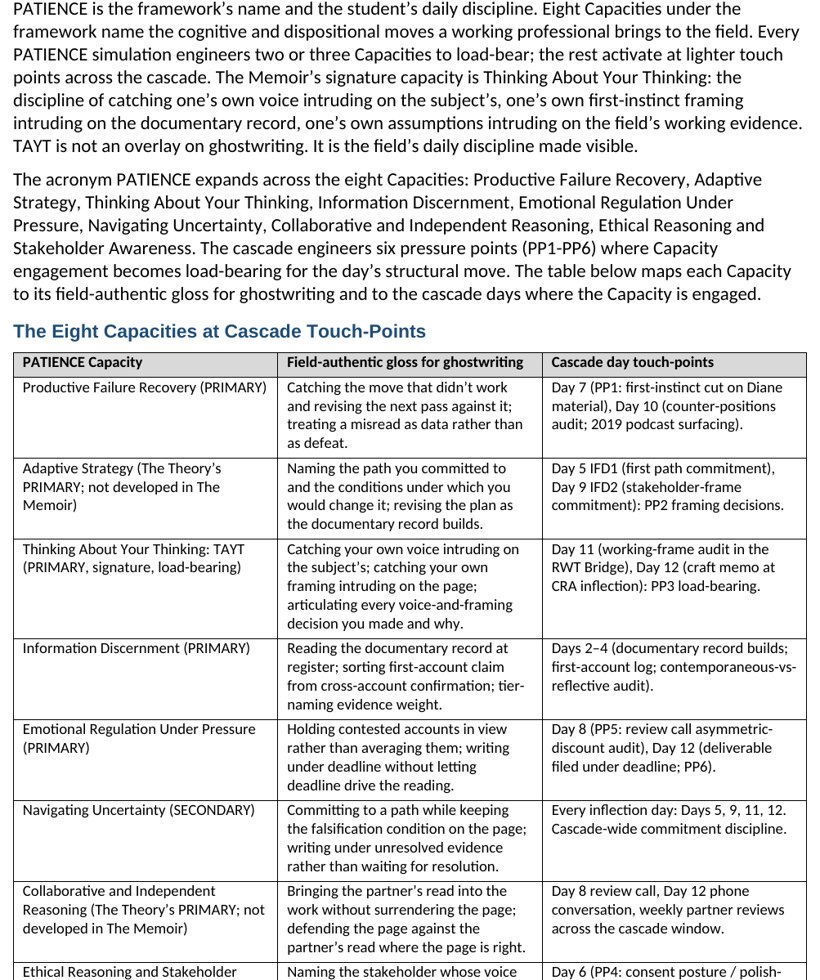
Every day is already scripted. You bring the facilitation, the simulation brings everything else.
The Teacher Guide is a roughly 70-page playbook with day-by-day facilitation notes, so your prep stays light. Each session arrives with clear patterns to watch and substance-check authority at three bands: top-band, methodical, and flag-for-feedback. You do not need to be a publishing professional to run this. The guide tells you what a strong path commitment looks like, where students tend to warm up a subject's flat prose against the evidence, and how to score the inflection days with the falsification diagnostic. A one-page pacing card sits on your desk for classroom management. You read the room and ask the questions. The structure is already there.
Tap to read the teacher guide
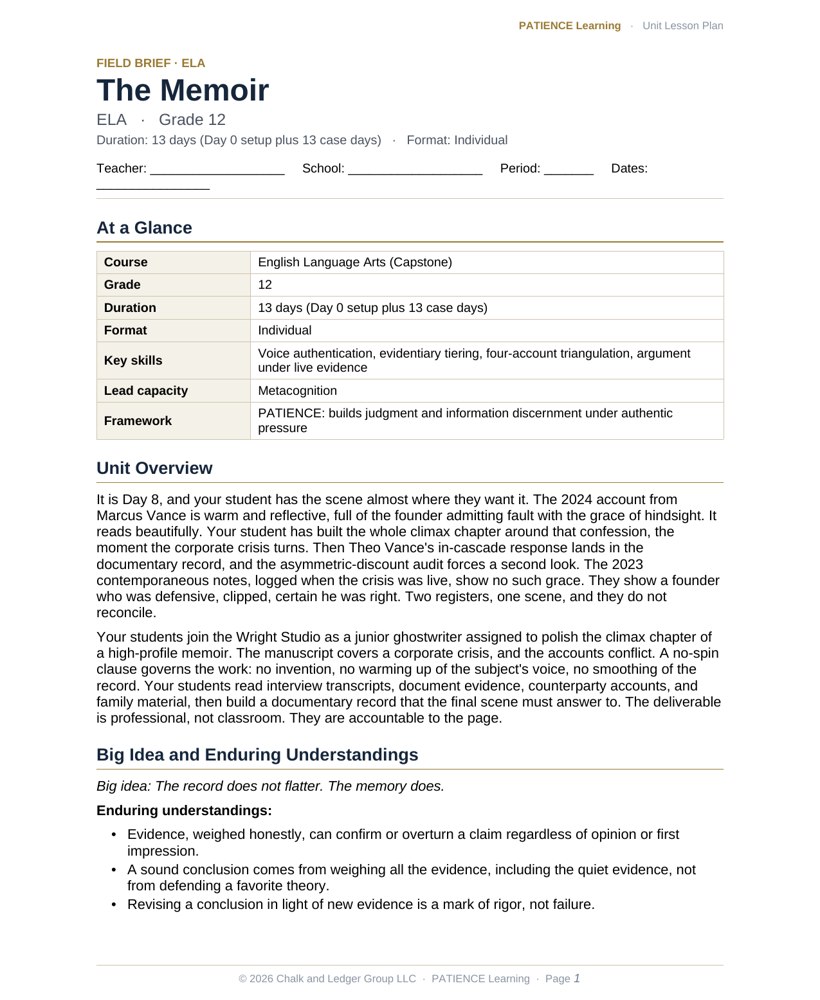
The lesson plan is already written.
Every simulation comes with a fully editable, admin-ready lesson plan. Standards alignment, daily pacing, learning objectives, differentiation, and an assessment plan are already done, so you can hand it to an administrator or adapt it to your district template in minutes.
Tap to preview the lesson plan
Close
Close
Close
Close
The day the better story loses to the record.
It is Day 8, and your student has the scene almost where they want it. The 2024 account from Marcus Vance is warm and reflective, full of the founder admitting fault with the grace of hindsight. It reads beautifully. Your student has built the whole climax chapter around that confession, the moment the corporate crisis turns. Then Theo Vance's in-cascade response lands in the documentary record, and the asymmetric-discount audit forces a second look. The 2023 contemporaneous notes, logged when the crisis was live, show no such grace. They show a founder who was defensive, clipped, certain he was right. Two registers, one scene, and they do not reconcile.
Here is the choice. Your student can protect the version they have already drafted, the cinematic confession that makes the chapter sing, or they can trust the contemporaneous record over the polished memory. Protecting the draft means inventing a grace that the no-spin clause forbids. Trusting the evidence means cutting the best lines they wrote. Your student names the falsification condition, tiers the two accounts, and chooses the 2023 register. The scene goes flatter. It also goes true. What they see is that the documentary record was never theirs to improve, only to render honestly.
A junior ghostwriter at the Wright Studio, one chapter from publication.
Your students join the Wright Studio as a junior ghostwriter assigned to polish the climax chapter of a high-profile memoir. The manuscript covers a corporate crisis, and the accounts conflict. A no-spin clause governs the work: no invention, no warming up of the subject's voice, no smoothing of the record. Your students read interview transcripts, document evidence, counterparty accounts, and family material, then build a documentary record that the final scene must answer to. The deliverable is professional, not classroom. They are accountable to the page.
| Grade level | 12 |
| Course | English Language Arts (Capstone) |
| Duration | 13 days (Day 0 setup plus 13 case days) |
| Format | Individual |
| Key skills | Voice authentication, evidentiary tiering, four-account triangulation, argument under live evidence |
Engineering better thinkers.
Discernment matters here because the better-sounding account is often the less reliable one. Each day pairs a named bias with the capacity that defeats it, working in field-authentic terms until the Day 13 reveal, so your students feel the load before they get the labels.
| Bias targeted | The remedy, built into the work |
|---|---|
| Anchoring | Productive failure recoveryYour students fix on the first vivid account they read and build the scene around it. The case forces a revised pass when the counterparty account lands, treating the early misread as data, not defeat. |
| Confirmation bias | MetacognitionOnce a student favors a register, every transcript seems to confirm it. They catch their own framing intruding on the page and articulate each voice decision and the reason behind it. |
| Sunk cost fallacy | Adaptive strategyAfter drafting the polished confession, students resist cutting it. They name the path they committed to and the falsification condition that would force a change, then revise as the record builds. |
| Availability bias | Information discernmentThe most recent, reflective account feels truest because it reads best. Students sort first-account claim from cross-account confirmation and tier each piece by the weight it can actually carry. |
| Tunnel vision | Navigating uncertaintyLocked on one stakeholder's frame, students miss the others. They commit to a path while keeping the falsification condition on the page, writing under unresolved evidence rather than waiting for resolution. |
| Overconfidence | Emotional regulationUnder deadline, students want to settle the contested accounts by averaging them. They hold the conflicting registers in view and write without letting the deadline drive the reading. |
13 days of building a record the scene must answer to.
Day 0 orients your students to the studio and primes the vocabulary. The early days establish a voice baseline and open the documentary record. Pressure compounds as counterparty and family material arrive, the inflection days gate the high-stakes commitments, and Day 12 files the deliverable before the Day 13 reveal maps field terms to research names.
| Day | What lands | Skill in focus |
|---|---|---|
| 1 | Voice baseline established; the Session 2 transcript register audit. | Voice authentication |
| 2 | First-account log entry opened; the peak bias quietly activated. | Information discernment |
| 3 | Counterparty account onboarded; evidentiary tier work introduced. | Evidentiary tiering |
| 4 | Contemporaneous-versus-reflective audit; the four-uses mapping. | Register discrimination |
| 5 | First path commitment, a CRA-gated decision with a falsification condition (critical pivot). | Adaptive strategy |
| 6 | Polish-as-evidence audit; engaging the Ines Calderon standards memo. | Argument under pressure |
| 7 | Family material onboarded; the first-instinct cut audit. | Productive failure recovery |
| 8 | Theo Vance's in-cascade response; the asymmetric-discount audit. | Navigating uncertainty |
| 9 | Stakeholder commitment, a binding stakeholder-frame decision (critical pivot). | Stakeholder awareness |
| 10 | Pattern-as-clarity audit; the 2019 podcast surfacing. | Confirmation control |
| 11 | Working-frame audit; the Pria Mehta fact-check inquiry response. | Research synthesis |
| 12 | The deliverable filed: a 2,500-word polished scene and a 1,500-word craft memo. | Metacognition |
| 13 | The bias cross-reference table revealed; field-to-research mapping. | Reflection and transfer |
Standards alignment.
The Memoir is a 13-day intensive in close reading and evidence-based argument, aligned to CCSS-ELA for Grades 11-12. Voice fidelity work targets RI.11-12.4, determining how word choice shapes meaning and tone, and RL.11-12.6, distinguishing what is stated from what is meant, as your students separate Marcus Vance's 2024 reflective register from his 2023 contemporaneous one. The Day 12 craft memo is a W.11-12.1 argument built on valid reasoning and sufficient evidence, revised for the no-spin clause under W.11-12.5. Four-account triangulation hits W.11-12.8, assessing the strengths and limits of sources, and the documentary record build hits W.11-12.7, sustained research to solve a problem.
The hidden architecture.
The pivot is engineered. Early in the case your students read the 2024 reflective account first, written with the grace of hindsight, and it reads as the obvious spine for the climax. That is the planted contradiction. The 2023 contemporaneous record, logged while the crisis was live, tells a flatter, more defensive story, and the two cannot both anchor the scene. Anchoring and availability push your students toward the version that reads best, which is the less reliable one. The asymmetric-discount audit on Day 8 and the inflection gates on Days 5, 9, and 12 force the issue: a top-band score requires naming a multi-day signal and a falsification condition, which a student can only do by trusting the tiered record over the better story. Boring choice wins.
Turnkey, classroom-ready.
- An admin-ready lesson plan. A fully editable plan with standards alignment, daily pacing, differentiation, and assessment, ready to adapt to your district template. Included with every purchase.
- A 13-day playbook. The roughly 70-page Teacher Guide gives day-by-day facilitation notes, patterns to watch, and a one-page pacing card for the desk.
- A tech-enabled workbook. The student Workbook is the primary working surface for logging the documentary record and drafting the scene.
- A recalc-validated tracker. The Tracker carries the scoring and cross-referencing so your students keep their energy on the judgment.
- Turnkey student files. Per-day carriers from Day 0 through Day 13, the story installments source-of-truth, and a world bible for context.
- A dual rubric system. The Daily Rubric and the falsification diagnostic grade the quality of reasoning, with answer-key authority at three bands.
- A ninety-second orientation. A read-me-first file gets you running without studying the whole package.
Give your seniors a deadline that grades their reasoning.
Bring The Memoir to your Grade 12 ELA room and let your students leave high school knowing how to defend a choice, not just make one.
Get this simulationPreview real pages from the simulation before you spend a dollar. No guessing, no surprises.