The Market
The cheapest vendor loses. The disciplined one survives.
See what your students get, and why it lands.
No mockups. Every page below is real, pulled straight from the files you download. Tap any one to see it full size.
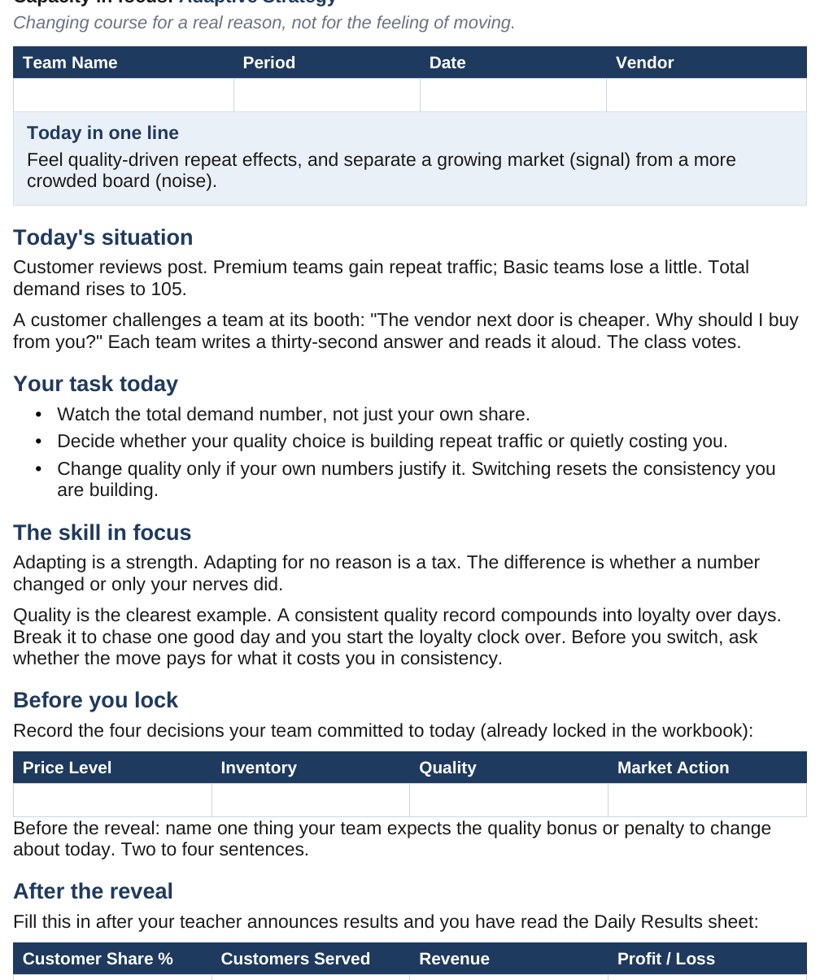
Your students are not answering questions. They are running a vendor.
Every trading day, each team of three to four students sits with the same four levers and one hard rule: lock your decisions before the day reveals what happens. They set price, inventory, quality, and a market action, then commit. No hindsight. No reacting to the situation after they see it. They weigh the visible board data and the total demand numbers against the rumors and the competitor chatter, and they make a call they have to live with. The next day they see the consequence land on the leaderboard, and they decide again. This is not a worksheet about supply and demand. It is a standing decision under pressure, made on evidence, repeated until the habit sticks.
Tap to read a student case page
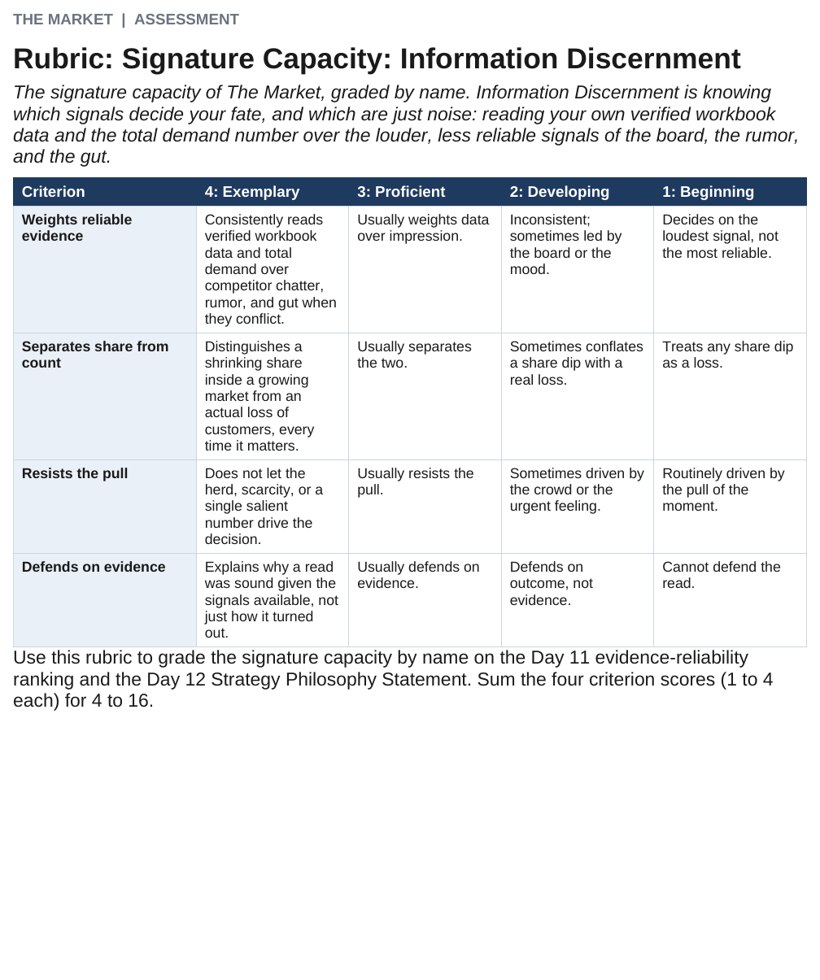
They are graded on how they thought, not on how much cash they kept.
A team can lose money on a sound, documented process and still earn top marks. The rubric scores the Team Daily Log on the quality of strategy reasoning, on whether students cite demand and cash figures from their own workbook, and on how they record their Named Disagreements when the team splits. Productive failure counts as real learning here. The capstone, an Individual Strategy Philosophy Statement, asks each student to name the technical biases they fell into, cite workbook evidence, and point to a real brand that made the same move. A lucky team that guessed right with no reasoning scores below a careful team that lost with a clear, evidence-led case.
Tap to read the grading rubric
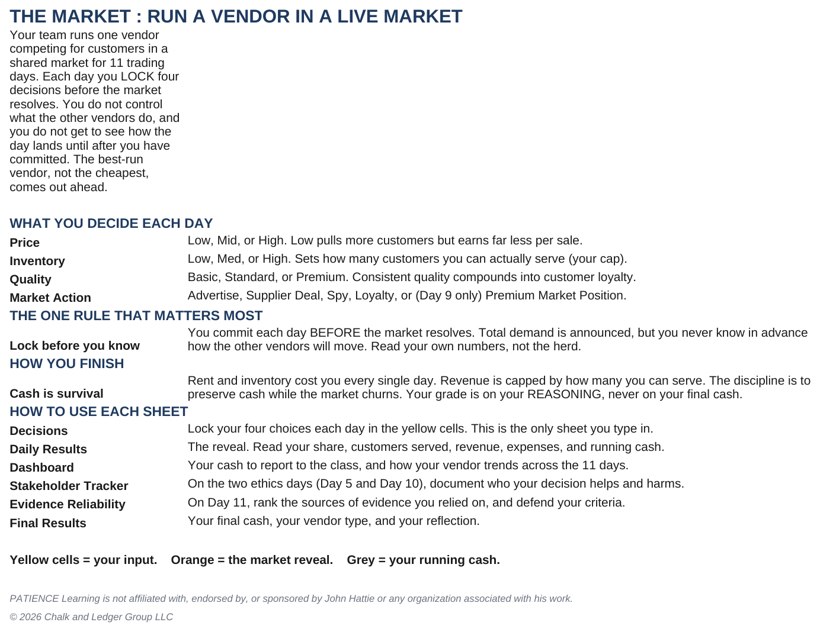
Let the workbook hold the math so students spend their energy on the call.
The tech-enabled workbook carries the arithmetic that would otherwise eat the period. Students enter their four locked decisions, and the tracker handles shares, revenue, and the running cash total against the attractiveness formula, where price weighs forty percent, quality thirty-five, and marketing twenty-five. No one is hand-computing margins while the discussion moves on without them. What stays with the student is the judgment: read total demand, weigh verified data over noise, decide whether to hold a sound plan or pivot. The tracker also surfaces the signals a disciplined team watches, competitor cash depletion, a quality moat, supply caps, so the thinking stays visible and the busywork stays automated.
Tap to see the tracker
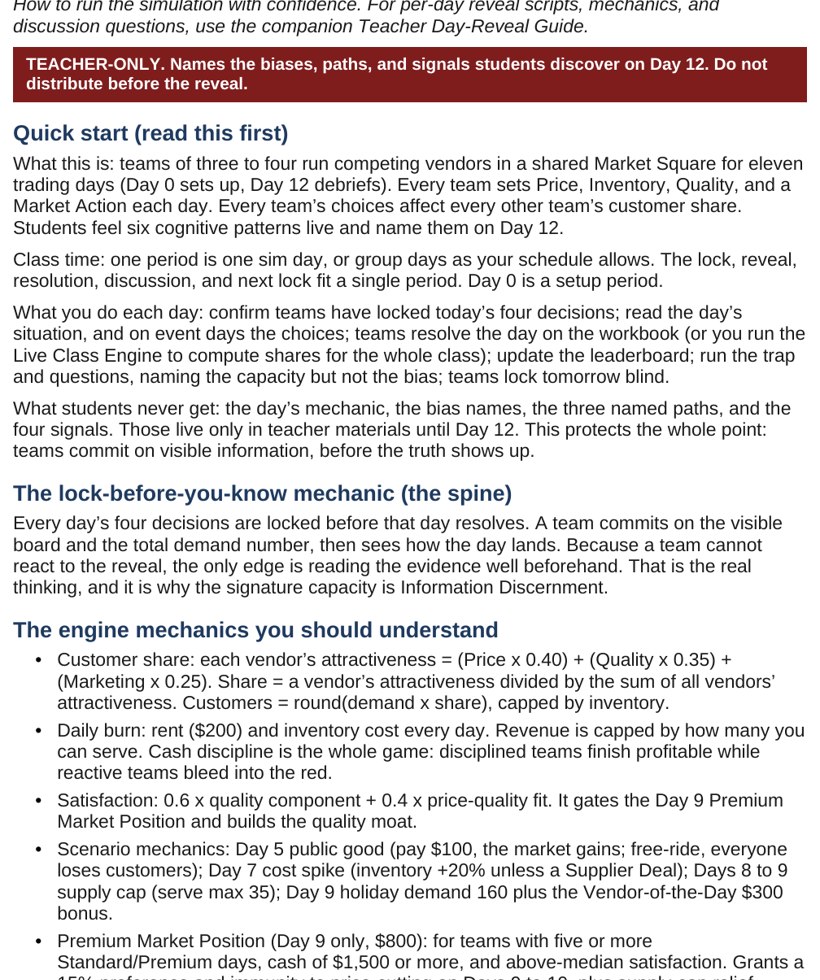
Every day is already scripted. You bring the room, the simulation brings the rest.
You do not need a business background to run this. The Teacher Day-Reveal Guide gives you one read-aloud-ready page per day that names the day's mechanic, the bias it exposes, and the disciplined move, so you have instant expertise the moment you open it. A Pacing Card maps the fifty-minute Daily Loop, Lock, Reveal, Resolve, Leaderboard, Discuss, Next Lock, so the period runs itself. The Live Class Engine computes shares, revenue, and rankings for you, which removes the manual calculation entirely. If a day gets missed, nothing breaks; teams resume at the next lock. Your job shifts from lecturing to facilitating, and the guide hands you the questions that make students defend their reasoning.
Tap to read the teacher guide
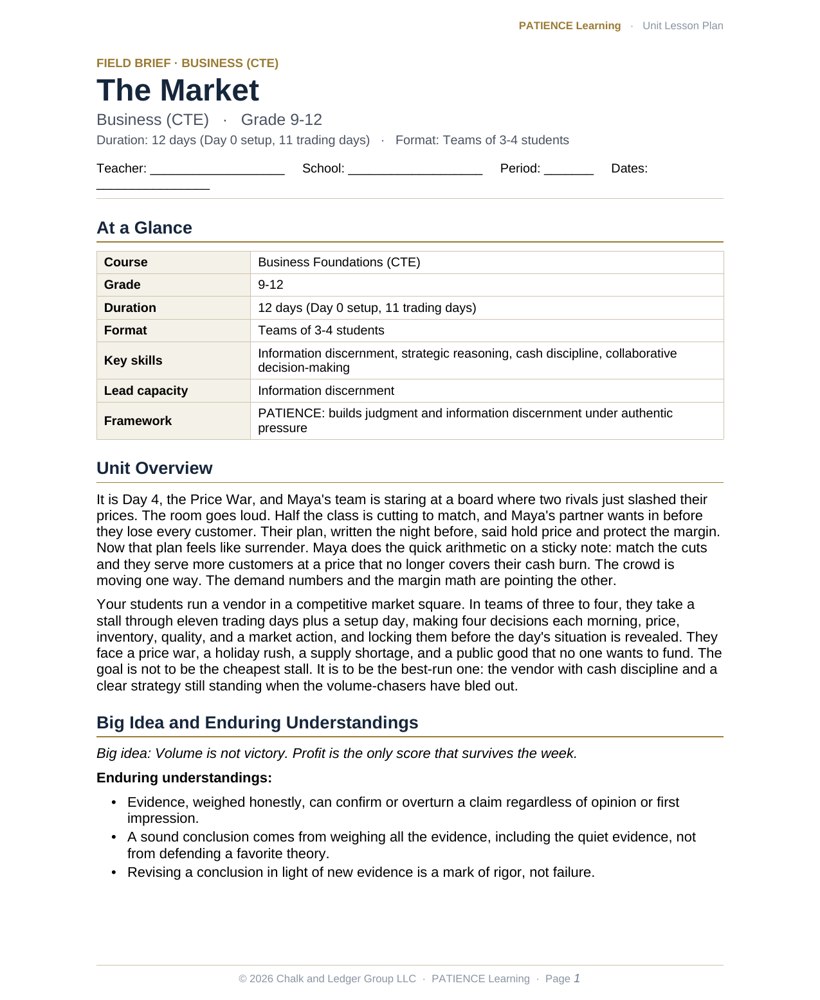
The lesson plan is already written.
Every simulation comes with a fully editable, admin-ready lesson plan. Standards alignment, daily pacing, learning objectives, differentiation, and an assessment plan are already done, so you can hand it to an administrator or adapt it to your district template in minutes.
Tap to preview the lesson plan
Close
Close
Close
Close
The day the price war makes the math the only thing worth trusting.
It is Day 4, the Price War, and Maya's team is staring at a board where two rivals just slashed their prices. The room goes loud. Half the class is cutting to match, and Maya's partner wants in before they lose every customer. Their plan, written the night before, said hold price and protect the margin. Now that plan feels like surrender. Maya does the quick arithmetic on a sticky note: match the cuts and they serve more customers at a price that no longer covers their cash burn. The crowd is moving one way. The demand numbers and the margin math are pointing the other.
At the lock, Maya holds. She does not match. It feels wrong, because everyone else is acting and her team is just sitting on a number. The next day the reveal lands, and the teams that chased the cuts come back with full order books and bleeding cash. Maya's team kept its margin and its cash position intact. What she sees, once she trusts the evidence over the crowd, is that the loud move was the trap, and the quiet dissenter who ran the math is the one still standing. The discipline was not caution. It was the read.
Eleven trading days in a market square that punishes the cheap.
Your students run a vendor in a competitive market square. In teams of three to four, they take a stall through eleven trading days plus a setup day, making four decisions each morning, price, inventory, quality, and a market action, and locking them before the day's situation is revealed. They face a price war, a holiday rush, a supply shortage, and a public good that no one wants to fund. The goal is not to be the cheapest stall. It is to be the best-run one: the vendor with cash discipline and a clear strategy still standing when the volume-chasers have bled out.
| Grade level | 9-12 |
| Course | Business Foundations (CTE) |
| Duration | 12 days (Day 0 setup, 11 trading days) |
| Format | Teams of 3-4 students |
| Key skills | Information discernment, strategic reasoning, cash discipline, collaborative decision-making |
Engineering better thinkers.
A market punishes the wrong impulse fast, which makes it the ideal place to feel a bias before you can name it. Each trading day pairs one psychological trap, peaking on a specific day, with the capacity that defeats it, so the lesson is tethered to a moment students lived, not a vocabulary list.
| Bias targeted | The remedy, built into the work |
|---|---|
| Anchoring | Productive failure recoveryWhen a team anchors on its opening price and the market shifts, the daily log forces them to revisit the decision on evidence, and a documented loss still earns full marks for sound process. |
| Confirmation bias | MetacognitionTeams that only count the data confirming their plan are pushed by the discuss phase to state what would prove them wrong, weighing verified demand numbers over their own hopeful read. |
| Sunk cost fallacy | Adaptive strategyA team that has poured cash into a losing price position must decide each morning whether to keep funding it, and the lock format rewards changing course over defending the spend. |
| Availability bias | Information discernmentCompetitor chatter and rumors are vivid and loud, so students learn to weight the quiet, verified workbook data and total demand over whatever is easiest to recall. |
| Tunnel vision | Navigating uncertaintyLocking before the reveal means committing without knowing the day's events, which trains teams to position for a range of outcomes instead of fixating on one expected result. |
| Overconfidence | Emotional regulationDuring the Day 9 Holiday Rush, leaderboard pride tempts teams to overspend to win volume, and the disciplined baseline holds them to cash and satisfaction targets over ego. |
12 days of locked decisions and live consequences.
Day 0 sets up the stalls, teaches the four decisions, and runs the Lock, Reveal, Resolve loop once with no stakes. From there, eleven trading days each drop a named event that pulls students toward a specific trap, building toward the peer critique and the individual reveal where the hidden mechanics finally have names.
| Day | What lands | Bias in focus |
|---|---|---|
| 0 | Setup, the four decisions, and one no-stakes practice loop | Decision discipline |
| 1 | First live trading day; teams feel the weight of locking blind | Navigating uncertainty |
| 2 | An early urge to act when holding is the stronger move | Action bias |
| 3 | Teams settle into the loop and read the demand board | Information discernment |
| 4 | The Price War; matching the crowd bleeds your margin (critical pivot) | Herd mentality |
| 5 | A public good needs funding and everyone waits for someone else | Diffusion of responsibility |
| 6 | A rival's gain feels like your loss, even as total demand grows | Zero-sum thinking |
| 7 | A second pull to pivot off a sound plan under pressure | Action bias |
| 8 | A supply shortage tempts overspending on scarce customers | Scarcity bias |
| 9 | The Holiday Rush; winning the leaderboard can drain your cash (critical pivot) | Winner's curse |
| 10 | Teams consolidate strategy and defend their cash position | Adaptive strategy |
| 11 | Peer critique; teams score another team's log on evidence and clarity | Independent reasoning |
| 12 | The reveal; mechanics and bias names are finally exposed, plus the capstone statement | Metacognition |
Standards alignment.
The Market aligns to the Common Career Technical Core for the Business Management and Administration and Marketing clusters, building competencies in strategic decision-making, financial literacy, market analysis, and ethical reasoning. It also targets the Career Ready Practices, including applying appropriate academic and technical skills, using technology to enhance productivity, working productively in teams, and demonstrating creativity in solving problems. The daily logs, peer critique, and capstone statement develop the employability skills districts ask for: evidence-based reasoning, communication, and self-reflection. Because the simulation grades the quality of reasoning, it builds the critical-thinking and information-discernment habits that transfer directly to college and the workplace.
The hidden architecture.
The engine is built so the loud move is the wrong one. Each trading day plants an event that pulls students toward a specific bias: the Day 4 Price War makes matching cuts feel necessary even though it bleeds margin, and the Day 9 Holiday Rush makes leading the leaderboard feel like winning even as it drains cash. The contradiction is structural. The attractiveness formula rewards quality and steady positioning, while the visible competition rewards reacting, so students who chase volume produce the price-competitive mirage that ends in a loss. The One Rule keeps the day mechanics, bias names, and strategic paths hidden until the Day 12 reveal, which prevents playing to the rubric. What forces the sound conclusion is the cash ledger: the disciplined Steady Vendor and Market Maker paths end in profit, and the cheap path does not.
Turnkey, classroom-ready.
- An admin-ready lesson plan. A fully editable plan with standards alignment, daily pacing, differentiation, and assessment, ready to adapt to your district template. Included with every purchase.
- A 12-day playbook. One read-aloud-ready Teacher Day-Reveal page per day, naming the mechanic, the bias, and the disciplined move.
- A tech-enabled workbook and tracker. Students log their four locked decisions while the tool computes shares, revenue, and running cash.
- The Live Class Engine. Automatically calculates shares, revenue, and rankings so no one is doing math by hand.
- The Pacing Card. Maps the fifty-minute Daily Loop, Lock, Reveal, Resolve, Leaderboard, Discuss, Next Lock, so every period runs clean.
- Turnkey student files. Daily logs, the peer critique sheet, and the Individual Strategy Philosophy Statement, ready to print.
- A dual rubric system. Grades the quality of reasoning and evidence, not whether a team kept the most cash.
Put your students in the market square.
Bring The Market to your classroom and let your students learn, on their own cash ledger, that disciplined reasoning beats the cheapest guess every time.
Get this simulationPreview real pages from the simulation before you spend a dollar. No guessing, no surprises.