The Long Game
Time in the market beats timing the market. Your students will feel why, not just hear it.
See what your students get, and why it lands.
No mockups. Every page below is real, pulled straight from the files you download. Tap any one to see it full size.
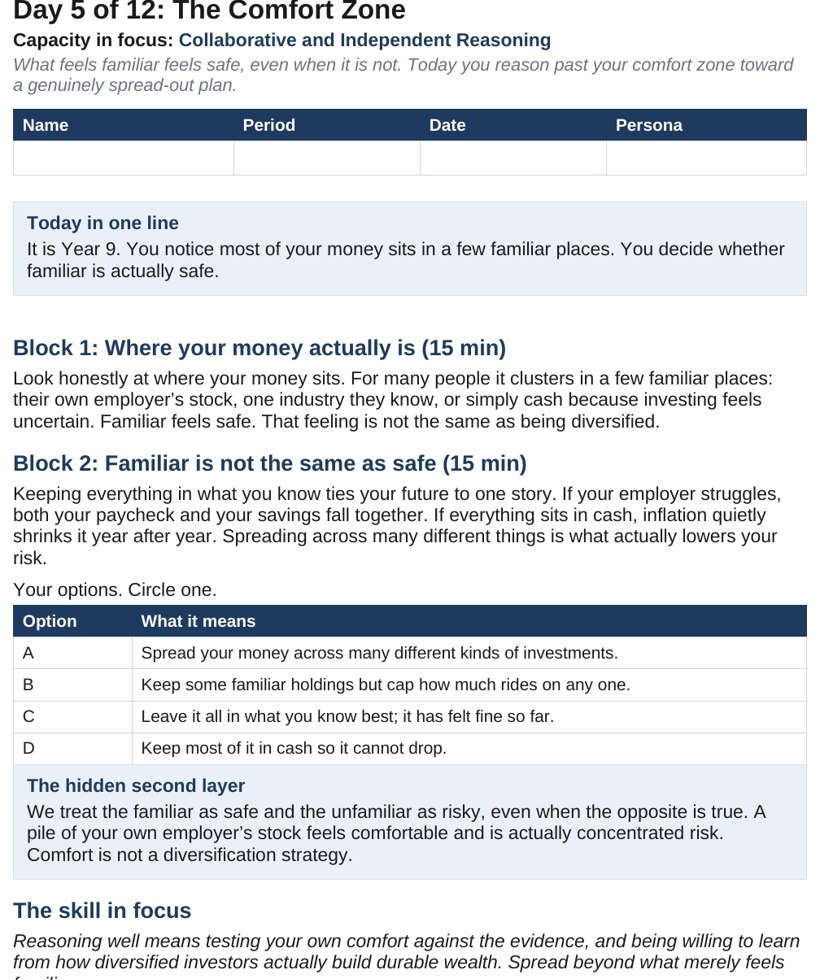
A worksheet never taught anyone to hold their nerve in a crash.
Your students are not defining "diversification" on a vocabulary quiz. They are sitting inside one simulated year of a 20-year horizon, looking at their own balance, their employer match, and a market that just moved. On Day 7 the market drops 37 percent and they have to decide, with real numbers in front of them, whether to sell or stay in their seat. Each choice goes into a Decision Log where they cite the workbook figure behind it. They are playing one of four investors, Marcus, Dani, Tyler, or Priya, each with a different starting balance, and they make the call the way a real investor would, under pressure, before they know how it turns out.
Tap to see a student case page
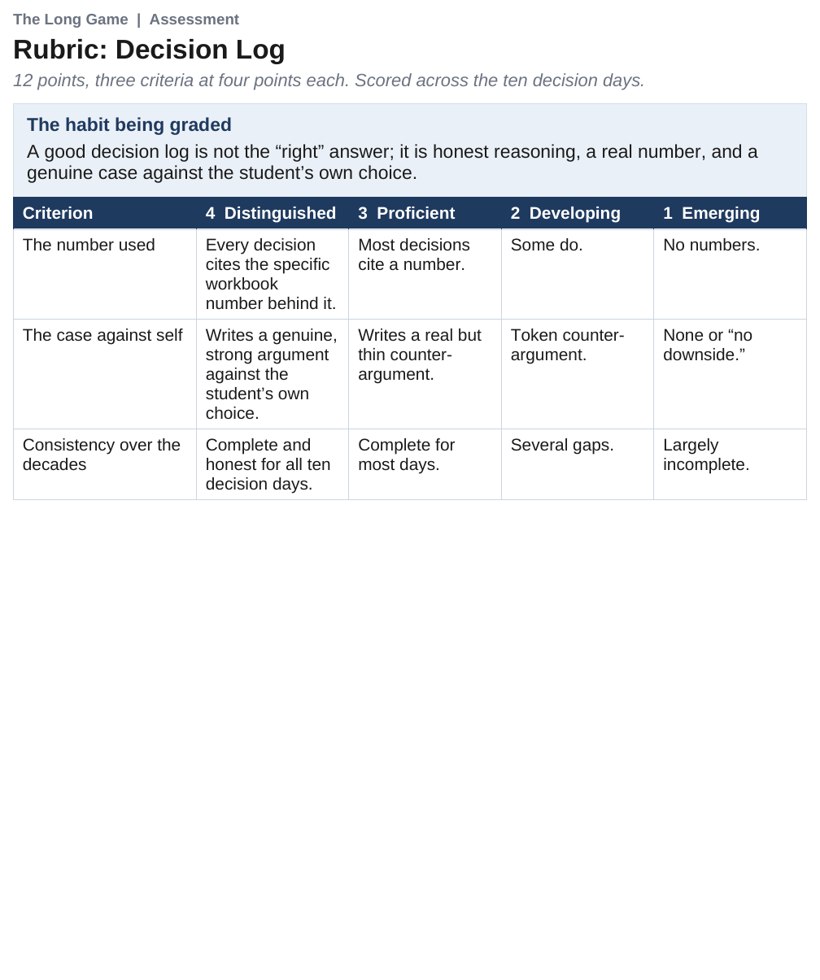
They are graded on their reasoning, not on whether they got rich.
The rubric rewards a sound process, not a lucky guess. To earn a Distinguished rating, a student keeps an honest Daily Journal across all simulated years, cites the specific workbook number behind every choice in the Decision Log, and writes a genuine, strong argument against their own decision to prove they considered the other side. The Day 12 capstone, My Long-Game Plan, asks for at least ten sentences and one concrete, actionable rule they will use with real money. The signature capacity, navigating uncertainty, is assessed hardest on Day 7, where students must name the fear and hold their plan through the 37 percent drop. A careful thinker who got an unlucky outcome scores well. A guesser who got lucky does not.
Tap to read the grading rubric
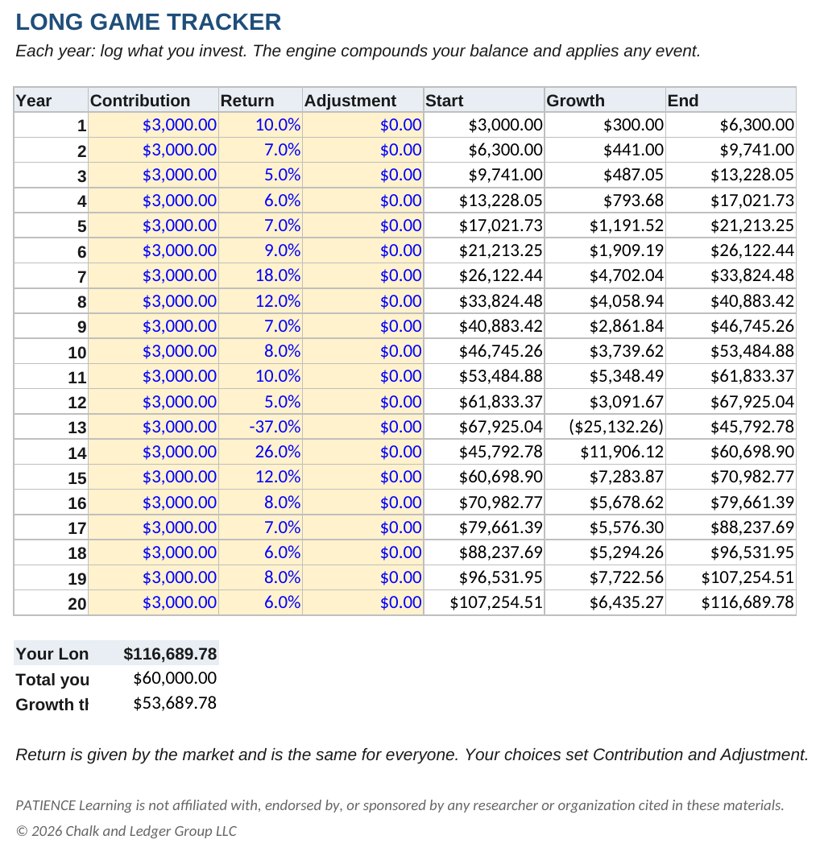
Let the Live Workbook do the math so students spend their energy on the judgment.
Twenty years of compounding involves a lot of arithmetic, and none of it is the point. The Live Workbook handles the calculations, tracking balances, contributions, the employer match, fees, and growth across every simulated year, so a student is never stuck with a calculator while the real decision waits. The numbers update as they choose, which means they see the consequence of staying steady versus drifting or chasing in plain figures. With the busywork automated, student attention goes where it belongs, to reading the situation, weighing the risk, and defending the call in the Decision Log. If devices are short, two students share one machine and the workbook logic stays identical.
Tap to see the tracker
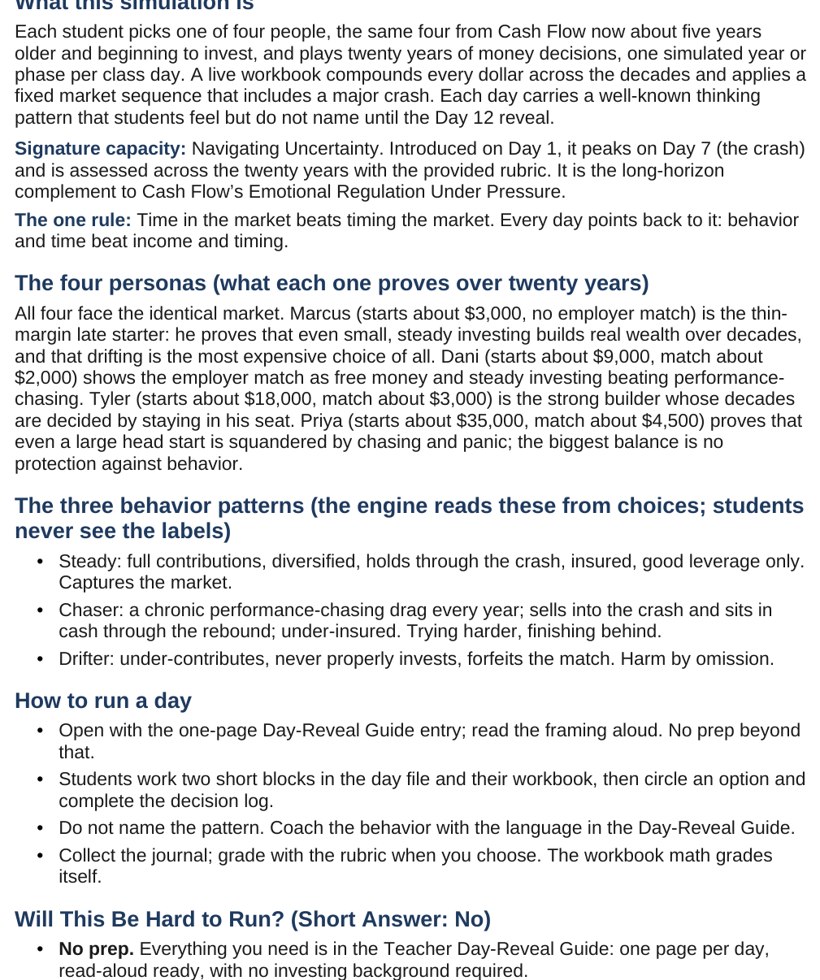
Every day is already scripted. You bring the room, the simulation brings the rest.
You do not need a background in investing to run this. The Day-Reveal Guide is read-aloud ready, so you open the day by reading the scenario, students work in the Live Workbook, they reflect in the Decision Log, and you collect the journal to close the loop. The teacher materials include scripts, pacing cards, answer keys, and the Hidden-Patterns Handout that powers the Day 12 reveal. One class period equals one simulated year, so the pacing is predictable, and if a student is absent nothing breaks, they resume at the next year. Prep stays light because the structure is built in. You facilitate the discussion, the simulation supplies the case, the math, and the script.
Tap to read the teacher guide
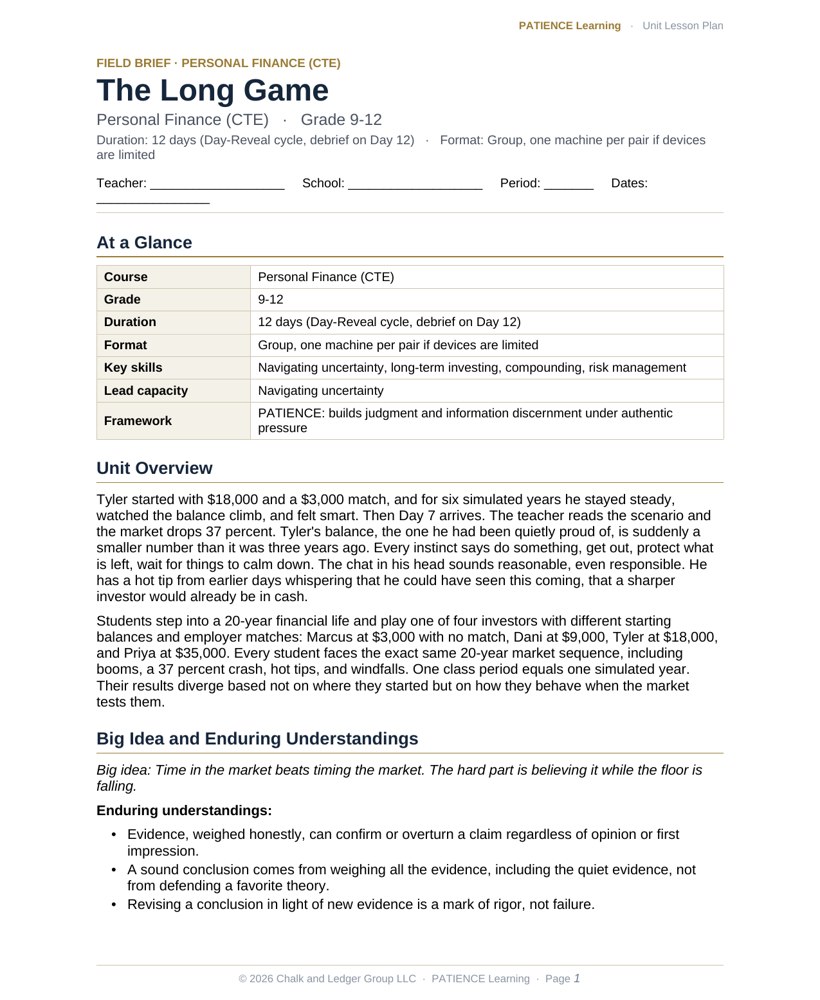
The lesson plan is already written.
Every simulation comes with a fully editable, admin-ready lesson plan. Standards alignment, daily pacing, learning objectives, differentiation, and an assessment plan are already done, so you can hand it to an administrator or adapt it to your district template in minutes.
Tap to preview the lesson plan
Close
Close
Close
Close
The day the market falls 37 percent and the spreadsheet stops being a game.
Tyler started with $18,000 and a $3,000 match, and for six simulated years he stayed steady, watched the balance climb, and felt smart. Then Day 7 arrives. The teacher reads the scenario and the market drops 37 percent. Tyler's balance, the one he had been quietly proud of, is suddenly a smaller number than it was three years ago. Every instinct says do something, get out, protect what is left, wait for things to calm down. The chat in his head sounds reasonable, even responsible. He has a hot tip from earlier days whispering that he could have seen this coming, that a sharper investor would already be in cash.
He looks at the Live Workbook and at the One Rule that has shaped every choice: time in the market beats timing the market. The number on the screen is real, but only if he sells. Hold, and a paper drop stays paper. He writes the argument against himself first, then he decides. He stays in his seat. When the rebound comes in the following years, he is still holding the position that captures it, while the version of him that panicked would have been sitting in cash, watching the recovery happen to someone else.
Twenty years of investing, lived in twelve class periods.
Students step into a 20-year financial life and play one of four investors with different starting balances and employer matches: Marcus at $3,000 with no match, Dani at $9,000, Tyler at $18,000, and Priya at $35,000. Every student faces the exact same 20-year market sequence, including booms, a 37 percent crash, hot tips, and windfalls. One class period equals one simulated year. Their results diverge based not on where they started but on how they behave when the market tests them.
| Grade level | 9-12 |
| Course | Personal Finance (CTE) |
| Duration | 12 days (Day-Reveal cycle, debrief on Day 12) |
| Format | Group, one machine per pair if devices are limited |
| Key skills | Navigating uncertainty, long-term investing, compounding, risk management |
Engineering better thinkers.
Investing fails most people not on the math but on the nerves. Each simulated year drops your students into a real money decision under pressure, names no biases out loud, and pairs the trap they are about to feel with the capacity that defeats it. They live the pull first, then learn its name.
| Bias targeted | The remedy, built into the work |
|---|---|
| Anchoring | Productive failure recoveryAnchoring to the old high makes a student measure today against a number the market has forgotten. They learn to decide from today's balance, recover the plan, and stop grieving a peak that is gone. |
| Confirmation bias | MetacognitionA hot tip feels like proof when it agrees with what they already wanted. Writing a genuine argument against their own choice forces them to watch their own thinking before they commit money to it. |
| Sunk cost fallacy | Adaptive strategyPast contributions and old positions tempt students to defend a path because they already paid for it. They learn to ask what they own at the end, an asset that lasts or only the debt, and adapt. |
| Availability bias | Information discernmentRecent headlines and the last twelve months loom largest. Students learn to ask what the last ten years looked like and to check the cost to get in, not just the story that is loudest right now. |
| Tunnel vision | Navigating uncertaintyWhen the crowd piles into one bet, a student narrows to it too. Diversification looks slow in a boom and smart in a bust, so they spread beyond the familiar and hold a plan through what they cannot control. |
| Overconfidence | Emotional regulationBelieving they can time the market sends students chasing and panic-selling. Bound to a rule, invest now or spread in equal steps, they slow down and let a paper drop stay paper instead of a real loss. |
12 days of decisions under live market pressure.
Each of the first ten days hands students a new simulated year and a new pressure: compounding, fees, a boom, a crash, a windfall, an insurance choice. They feel ten hidden patterns without names. Day 11 and Day 12 pull the camera back, name the patterns from their own lived choices, and turn the experience into a plan.
| Day | What lands | Capacity in focus |
|---|---|---|
| 1 | Start the clock and claim the match; the future self gets concrete | Thinking about your thinking |
| 2 | Doing nothing on purpose; let a good plan compound | Adaptive strategy |
| 3 | Check the last ten years, not the last twelve months, and the cost to get in | Information discernment |
| 4 | Diversify while the crowd chases; slow in a boom, smart in a bust | Navigating uncertainty |
| 5 | Spread beyond the familiar; familiar is not the same as safe | Collaborative and independent reasoning |
| 6 | Bind to a rule because nobody reliably times the market | Thinking about your thinking |
| 7 | The market drops 37 percent; hold the plan or sell (critical pivot) | Navigating uncertainty |
| 8 | Decide from today's balance; the market has no memory of the old high | Emotional regulation under pressure |
| 9 | Insure the ruinous, not the routine; weigh a small certain cost | Information discernment |
| 10 | Ask what you own at the end, an asset or only the debt | Adaptive strategy |
| 11 | Synthesis: trace twenty years of choices against the One Rule | Metacognition |
| 12 | The reveal: the ten patterns are named and the Long-Game Plan is written (capstone pivot) | Navigating uncertainty |
Standards alignment.
The Long Game is built as a CTE Personal Finance simulation and maps to the National Standards for Personal Financial Education from the Council for Economic Education and Jump$tart, covering saving and investing, financial decision making, and managing risk. The day-by-day arc moves through compounding and the time value of money, fees, diversification and risk strategy, market crashes and recovery, and insurance and leverage, then synthesis. It also aligns to the Common Career Technical Core Finance standards and the Career Ready Practices, with emphasis on reasoning, evidence, and disciplined decision making. No Common Core codes are claimed, since this is a finance course, not an ELA course.
The hidden architecture.
The engine is a discovery-first design. For ten simulated years students feel ten behavioral traps without ever hearing their names, so their choices reflect genuine instinct rather than a lesson they are trying to perform. The 37 percent crash on Day 7 is the engineered pivot, the peak emotional moment, built so that the comfortable move, selling to feel safe, is the costly one, while the boring move, holding, captures the rebound that comes later. Underneath, the software reads each student as Steady, Chaser, or Drifter from their actual choices, and the four personas prove that behavior, not starting balance, decides the outcome. Students never see those labels until the Day 12 reveal, when the patterns are finally named and the debrief becomes a mirror of their own twenty years.
Turnkey, classroom-ready.
- An admin-ready lesson plan. A fully editable plan with standards alignment, daily pacing, differentiation, and assessment, ready to adapt to your district template. Included with every purchase.
- 12-day Day-Reveal playbooks. Read-aloud-ready scripts and pacing cards for every simulated year, no investing background required.
- A tech-enabled Live Workbook. Automates balances, contributions, the match, fees, and compounding so student energy goes to judgment.
- Turnkey student files. Four investor personas, the Decision Log, the Daily Journal, and the My Long-Game Plan capstone.
- The Hidden-Patterns Handout. Powers the Day 12 reveal that names all ten behavioral traps from students' own lived choices.
- A four-part rubric system. Grades the quality of reasoning, with the signature capacity assessed hardest on the Day 7 crash.
Give them twenty years before it counts.
Bring The Long Game to your classroom and let your students survive a crash on paper, so they hold their plan when the money is real.
Get this simulationPreview real pages from the simulation before you spend a dollar. No guessing, no surprises.