The Launch
A brand can be famous and failing. Your students learn to tell the difference.
See what your students get, and why it lands.
No mockups. Every page below is real, pulled straight from the files you download. Tap any one to see it full size.
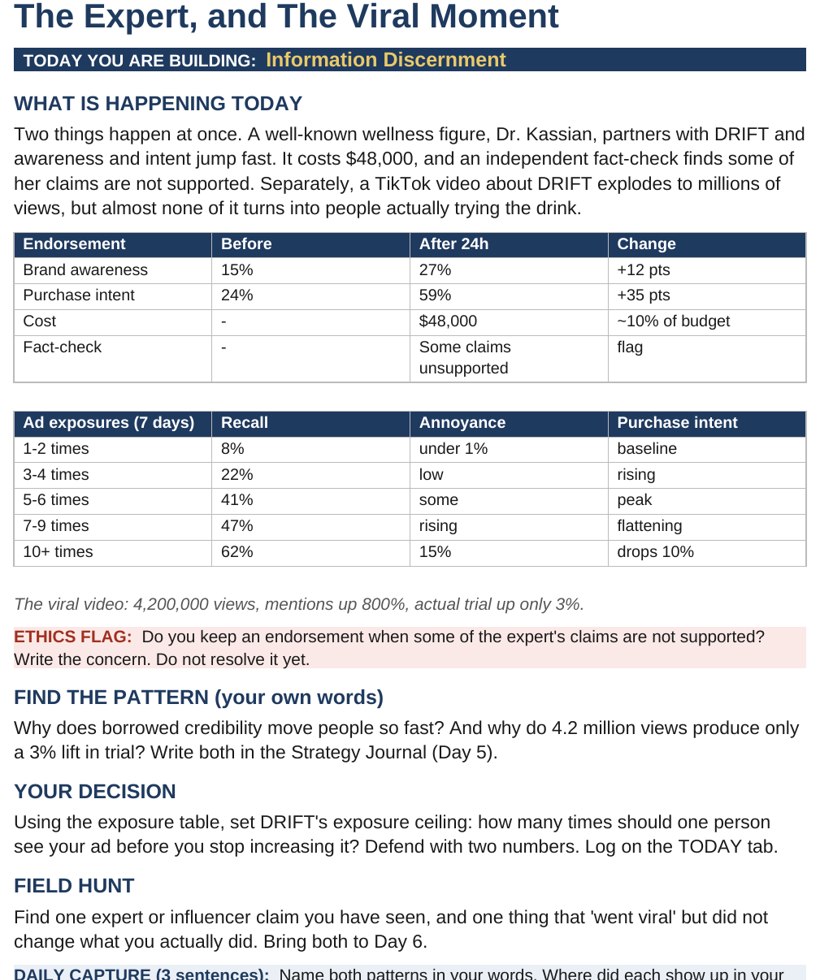
Your students are not answering questions. They are making a real call.
This is the page a student team faces on a Strategy Window day. The brand is DRIFT, a functional wellness beverage going national against VitalWave, an incumbent with 24 times the marketing budget. On the screen sits real evidence: a 4.2 million view viral moment that produced only a 3 percent lift in trial, a 12-flavor menu that drives more walk-aways than a 3-flavor set, a critic whose attack made loyal fans defend harder. No worksheet asks them to define a term. The team has to read the numbers, pick a direction, and commit. The choice moves the simulation. A worksheet was never going to teach this.
Tap to see a student case page
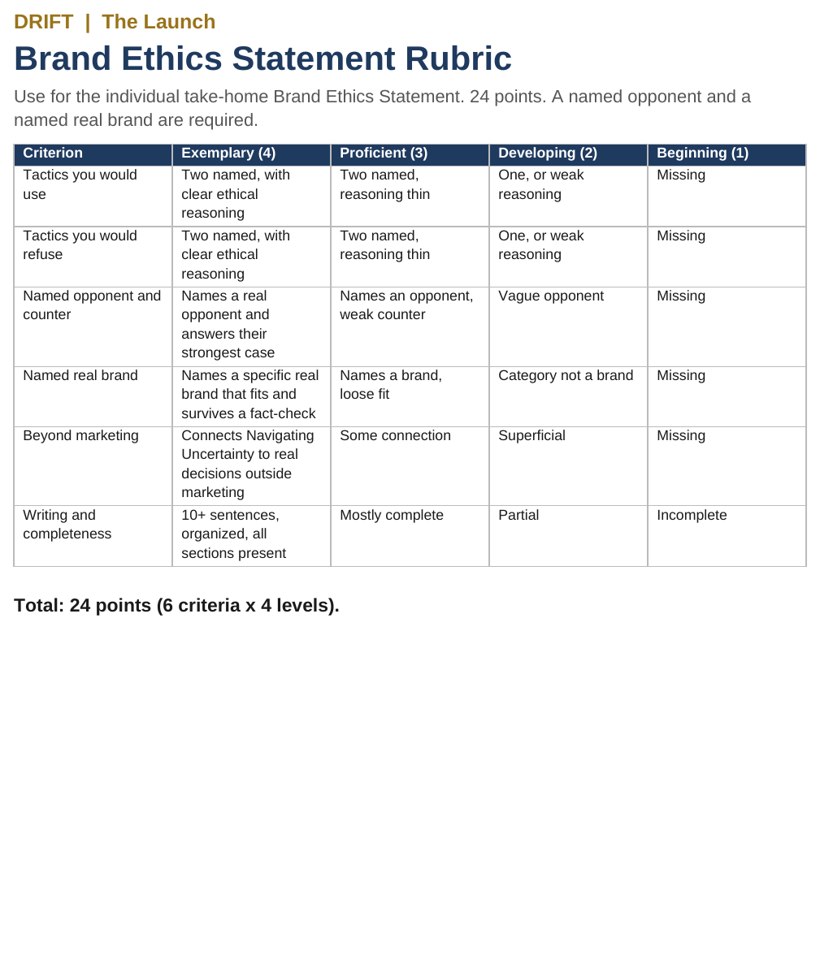
They are graded on the reasoning, not on whether the market rewards them.
The simulation models real uncertainty, so a team can argue brilliantly from the data and still land in a lower market tier. The rubric is built for that. Daily Captures on Days 1, 2, 3, and 5 are scored on data citation and on whether students named the pattern in their own words. Strategy Window Writes on Days 4, 6, 8, and 9 are scored on how well a binding choice is defended with specific evidence. A Day 10 Peer Critique worth 20 points and an individual Brand Ethics Statement worth 24 points close the assessment. A sound process behind a wrong market call outscores a lucky guess, and your students learn that fast.
Tap to read the grading rubric
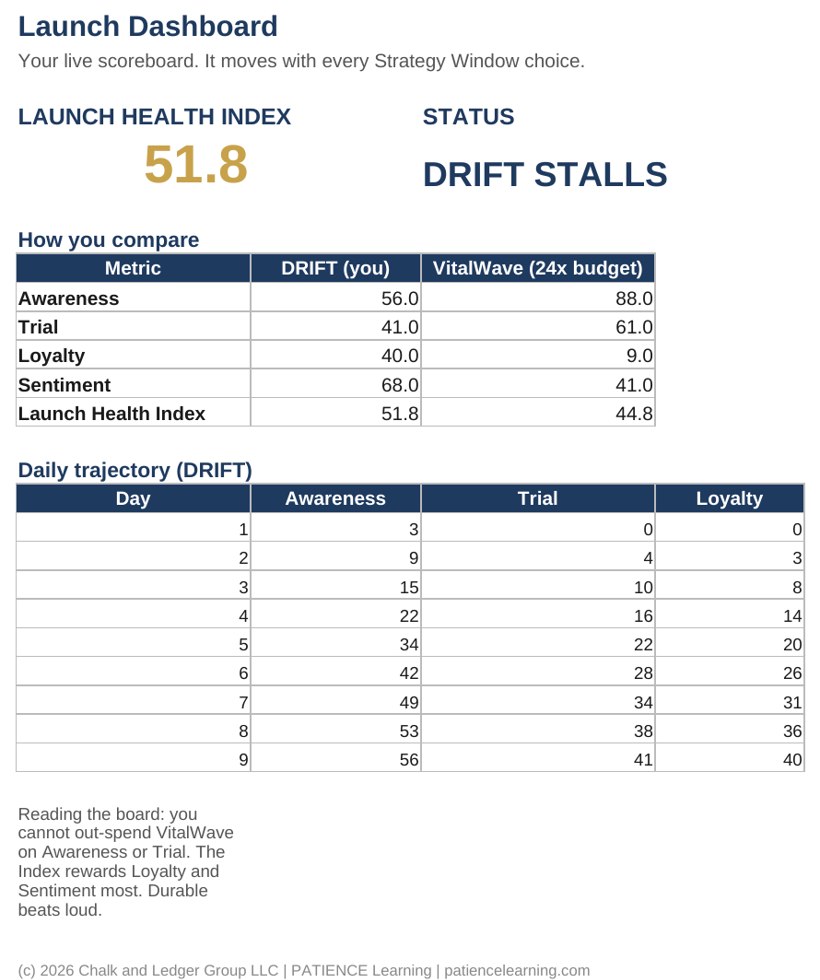
Let the Workbook hold the busywork so students spend their energy on the judgment.
The Workbook is the cockpit. It is an Excel-based engine that runs every calculation behind the scenes and feeds a live dashboard, so no class period is lost to arithmetic. At the center is the Launch Health Index, a 0 to 100 score that weights Awareness at 20 percent, Trial at 20 percent, Loyalty at 30 percent, and Sentiment at 30 percent. The moment a team locks a Strategy Window, the dashboard updates and shows the consequence. That is how students see a competitor like VitalWave post a high Awareness of 88 and a dismal Loyalty of 9, landing at a loud but unhealthy 44.8. The number does the bookkeeping. The student does the thinking.
Tap to see the tracker
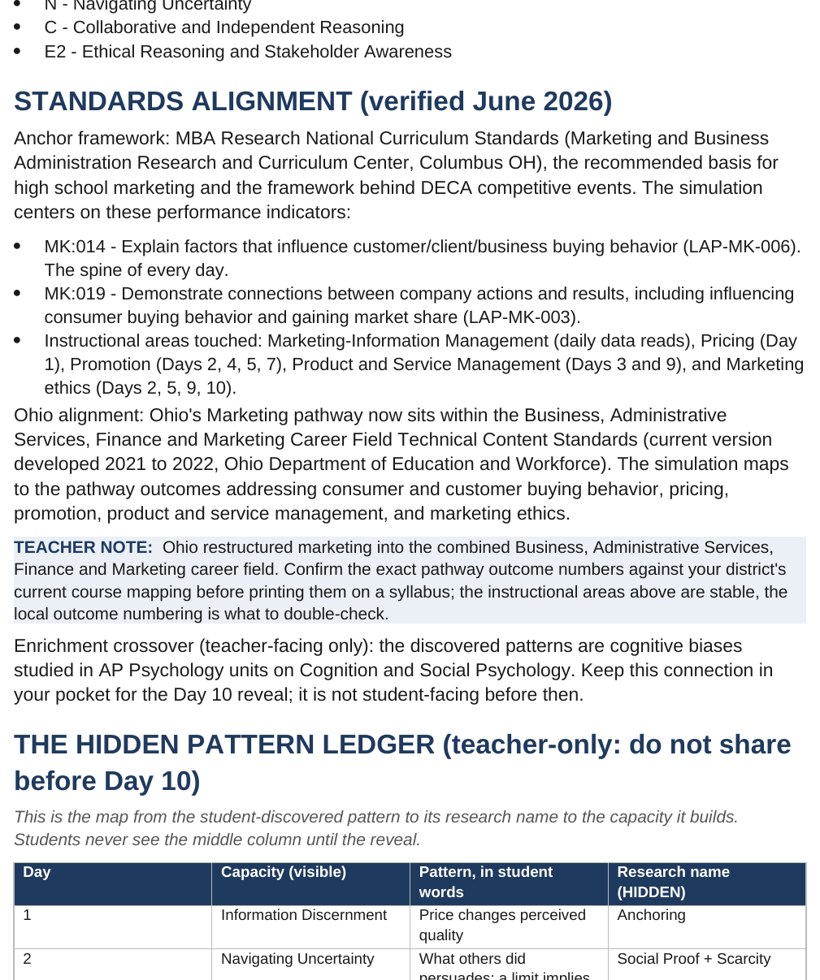
Every day is already scripted. You bring the facilitation, the simulation brings the rest.
The Teacher Guide is a full facilitation manual with Quick Start scripts for each session and a Hidden Pattern Ledger that tells you exactly which pattern each day is engineering. A Folder Guide gives you an upload schedule for Google Classroom or any LMS. A Data Reference, drawn from the scoreboard oracle, acts as an answer key so you can coach reasoning without doing the math yourself. Setup runs under 30 minutes. Your role shifts from answer source to facilitator, and the guide hands you the move for an ambiguous moment: point the team back to the data and ask what the number tells them. Prep is light. The heavy lifting stays with your students.
Tap to read the teacher guide
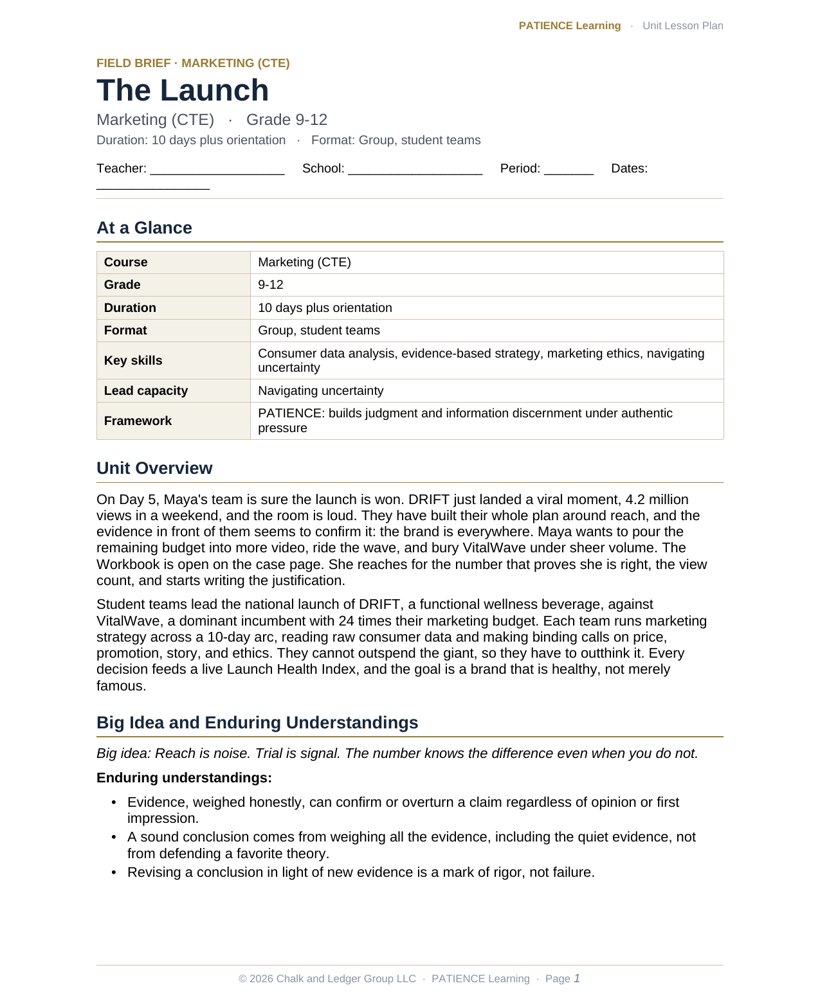
The lesson plan is already written.
Every simulation comes with a fully editable, admin-ready lesson plan. Standards alignment, daily pacing, learning objectives, differentiation, and an assessment plan are already done, so you can hand it to an administrator or adapt it to your district template in minutes.
Tap to preview the lesson plan
Close
Close
Close
Close
The day the viral moment stopped being the answer.
On Day 5, Maya's team is sure the launch is won. DRIFT just landed a viral moment, 4.2 million views in a weekend, and the room is loud. They have built their whole plan around reach, and the evidence in front of them seems to confirm it: the brand is everywhere. Maya wants to pour the remaining budget into more video, ride the wave, and bury VitalWave under sheer volume. The Workbook is open on the case page. She reaches for the number that proves she is right, the view count, and starts writing the justification.
Then she reads the next line. The 4.2 million views produced a 3 percent lift in trial. Almost nobody who watched actually tried the drink. Maya can protect the theory and call the views a win, or she can trust the number that contradicts her. She rereads the loyalty and trial columns, sees the noise for what it is, and changes the play. Once she separates reach from intent, the rest of the board reorganizes itself. The loud signal was never the real one.
Launch DRIFT against a giant 24 times your size.
Student teams lead the national launch of DRIFT, a functional wellness beverage, against VitalWave, a dominant incumbent with 24 times their marketing budget. Each team runs marketing strategy across a 10-day arc, reading raw consumer data and making binding calls on price, promotion, story, and ethics. They cannot outspend the giant, so they have to outthink it. Every decision feeds a live Launch Health Index, and the goal is a brand that is healthy, not merely famous.
| Grade level | 9-12 |
| Course | Marketing (CTE) |
| Duration | 10 days plus orientation |
| Format | Group, student teams |
| Key skills | Consumer data analysis, evidence-based strategy, marketing ethics, navigating uncertainty |
Engineering better thinkers.
Marketing tactics expire fast, but the architecture of human desire holds. The Launch teaches discernment under pressure: each day drops your students into a real consumer pattern and pairs the bias that distorts the read with the capacity that corrects it, so judgment is what gets practiced.
| Bias targeted | The remedy, built into the work |
|---|---|
| Anchoring | Productive failure recoveryDay 1 opens on price, where the same drink is rated better simply because it costs more. Students recover from the anchor by tracing perceived quality back to the actual taste-test data. |
| Confirmation bias | MetacognitionOn Day 5 the viral moment seems to confirm that reach equals success. Students catch themselves reaching for the flattering number and check the 3 percent trial lift against their own assumption. |
| Sunk cost fallacy | Adaptive strategyDay 3 shows a 12-flavor menu losing to a 3-flavor set on conversion. Students drop the bigger-is-better plan they came in with and adapt to what the conversion data actually rewards. |
| Availability bias | Information discernmentA 4.2 million view clip is vivid and easy to recall. Students separate that noise from the quiet signal of real trial and intent before they commit a single dollar. |
| Tunnel vision | Navigating uncertaintyFour binding Strategy Windows force choices with incomplete information. Students widen their view, weigh loss against gain framing and mass against tribal plays, and commit without certainty. |
| Overconfidence | Emotional regulationDay 6 hands students a critic and a backlash. They hold objective, data-driven reasoning through the heat instead of overreacting, noting that fans defend harder after an attack. |
10 days of evidence, then the reveal.
Orientation sets up the teams, the Workbook, and the DRIFT versus VitalWave matchup. Then the case runs Discovery-First: students meet each consumer pattern in raw data and describe it in their own words before any research term is named. Four binding Strategy Windows drive the final brand outcome, and Day 10 reveals what the patterns were called all along.
| Day | What lands | Capacity in focus |
|---|---|---|
| 1 | The Price Point: price alone shifts perceived quality in taste-test data | Information discernment |
| 2 | The Limit: a 340 percent lift from social signals, an 86 percent lift from scarcity | Navigating uncertainty |
| 3 | The Menu: 3 flavors outperform 12 on conversion | Adaptive strategy |
| 4 | Strategy Window 1: loss framing for the short term or gain framing for loyalty (critical pivot) | Metacognition |
| 5 | The Viral Moment: 4.2M views, only a 3 percent lift in trial | Information discernment |
| 6 | Strategy Window 2: respond to a critic as fans defend harder (critical pivot) | Emotional regulation |
| 7 | The Story: build a 30-second brand origin with a high-retention ending | Collaborative reasoning |
| 8 | Strategy Window 3: mass play or tribal play, where 12 percent of buyers drive 41 percent of revenue | Adaptive strategy |
| 9 | Strategy Window 4: the inertia trap, with 68 percent of subscribers under-consuming | Ethical reasoning |
| 10 | The Reveal: name the patterns and audit hindsight bias in the predictions | Productive failure recovery |
Standards alignment.
The Launch is built for CTE Marketing. It centers on MBA Research National Marketing Standards, anchored on indicators MK:014, the factors that influence buying behavior, and MK:019, the connections between company actions and results, which lay direct groundwork for DECA events. The simulation maps to Career Cluster and Marketing pathway standards, with deep coverage of Marketing-Information Management, Pricing, Promotion, and Marketing Ethics. It reinforces Career Ready Practices through evidence-based decision making and ethical reasoning. As enrichment, it doubles as a working laboratory for cognition and social psychology units. No CCSS codes are claimed here, the alignment is vocational and career-technical.
The hidden architecture.
The simulation is tuned so that the exciting play loses. There are 54 distinct decision paths, but the road to the THRIVES tier, an LHI of 70 or higher, is narrow. The winning signature is a specific Balanced Ethical sequence: Gain, then Engage, then Hybrid-specific, then Honest. The Scale Chase, the path most students instinctively want, manipulates reach and short-term volume and reliably tanks sentiment and loyalty into a STALLS outcome. The math earns this on purpose by weighting Loyalty and Sentiment at a combined 60 percent, which is why VitalWave can hold an Awareness of 88 and still sit at 44.8. Every planted contradiction, the viral dud, the menu paradox, the inertia trap, pulls students toward scale and lets the scoreboard prove why patience wins.
Turnkey, classroom-tested.
- An admin-ready lesson plan. A fully editable plan with standards alignment, daily pacing, differentiation, and assessment, ready to adapt to your district template. Included with every purchase.
- 10-day playbooks. Quick Start scripts and minute-by-minute facilitation for every session, plus orientation.
- The Workbook, your cockpit. An Excel-based data engine that runs every calculation and drives the live Launch Health Index dashboard.
- Turnkey student files. Case pages, Strategy Window writes, and a Folder Guide with an upload schedule for Google Classroom or any LMS.
- A Hidden Pattern Ledger. Tells you exactly which cognitive pattern each day is engineering, so you can coach without spoiling the discovery.
- A Data Reference answer key. Drawn from the scoreboard oracle to help you coach student reasoning at any point.
- A dual rubric system. Grades the quality of reasoning and evidence, not whether the team wins the market.
Give your students a launch worth defending.
Bring The Launch to your classroom and let your students outthink a giant, learning to trust the evidence when the loudest signal is the wrong one.
Get this simulationPreview real pages from the simulation before you spend a dollar. No guessing, no surprises.