The Lab
Run a product-testing lab for a week, and learn that a big number is not the same as good evidence.
An impressive number is not the same as good evidence.
The Lab puts your fifth graders in charge of a product-testing lab hired by the city safety board. They read company claims and decide what holds up under real testing. On Day 3 a medicine arrives with a glowing study, and the teams who check how the data was collected catch what the impressive numbers hide. It is scientific reasoning with real consequences.
See what your students get, and why it lands.
No mockups. Every page below is real, pulled straight from the files you download. Tap any one to see it full size.
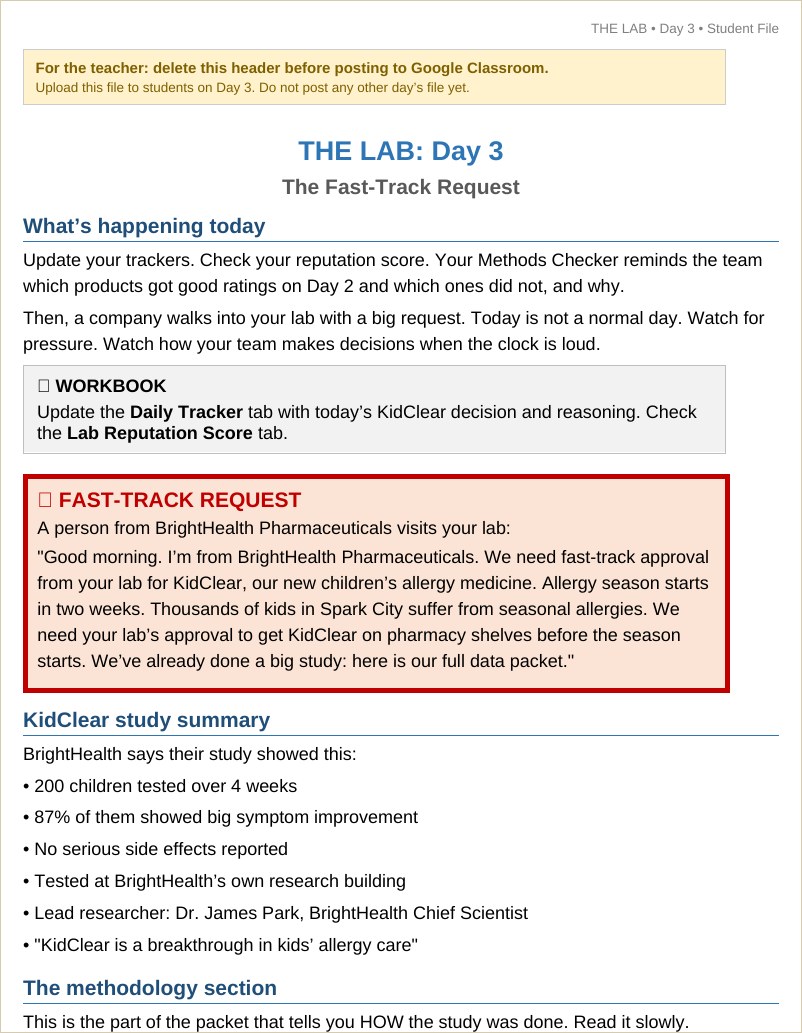
A worksheet cannot do what a real decision does.
Your fifth graders are not labeling the steps of the scientific method. They are running a testing lab, deciding which product claims survive a real look at the evidence. On Day 3 a company asks them to fast-track a medicine, waving a study that sounds airtight: 200 children, 87 percent improvement. The teams who read how the study was actually run notice the biased sample and the missing control group. That is evidence evaluation, with a certification on the line.
Tap to read the Day 3 request
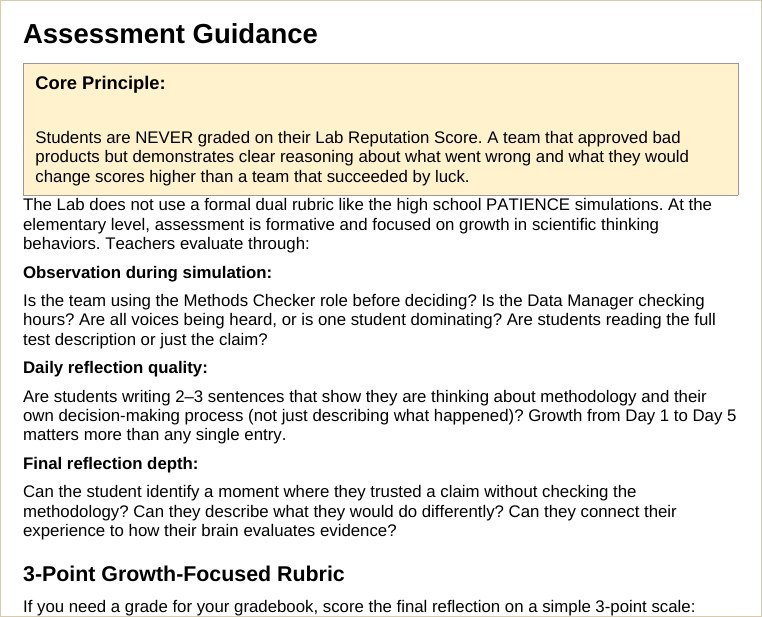
They are graded on their thinking, not on the call.
Here is what surprises teachers. A team that certified the right products is not graded higher than a team that did not. There is no answer key to win. Students are graded on the quality of their reasoning, written in their own reflection. A team that made a careful call that turned out wrong scores higher than a team that guessed right. That is how a fifth grader learns to value sound reasoning over a lucky verdict.
Tap to read the grading note
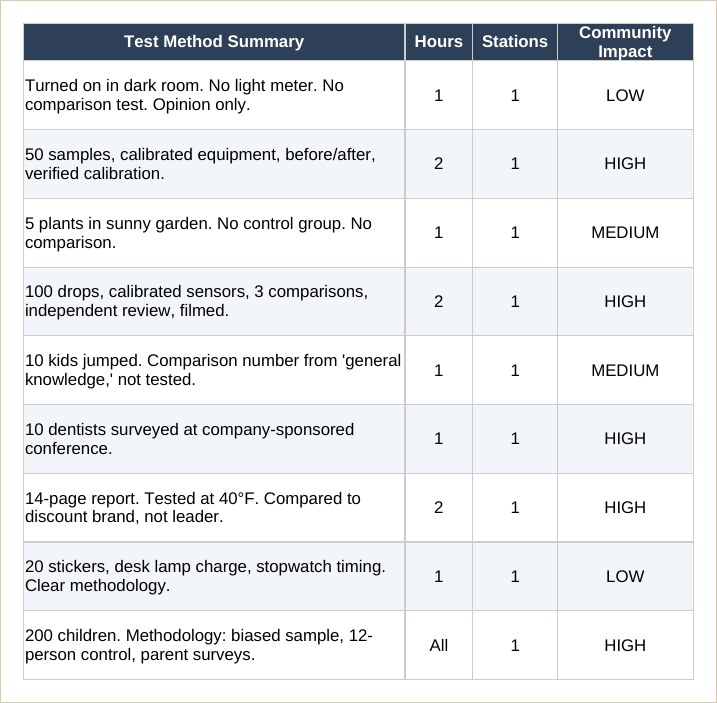
Let the workbook organize the evidence.
The Lab comes with a workbook that lays out every test method, its sample size, and whether it used a real comparison. The team logs what they find, and the structure keeps the evidence straight. Their attention stays on the hard part, which claims are actually supported, instead of on keeping track of the details.
Tap to see the evidence sheet
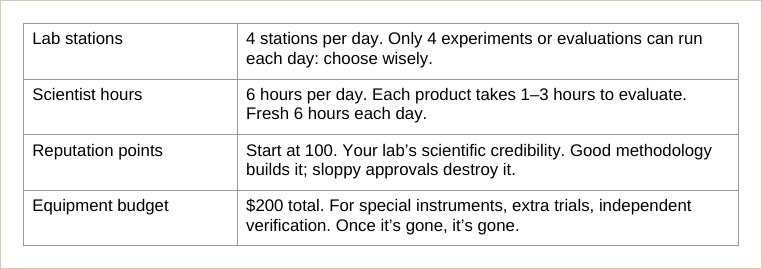
Five days, already scripted. You just run the room.
You do not need a science background to teach this. The guide scripts every day, tells you what students will likely say, and gives you exactly how to respond, including the fast-track pressure. The claims, the medicine twist, and the Day 5 certification are all written for you. You bring the facilitation. The mission brings everything else.
Tap to read the teacher guide
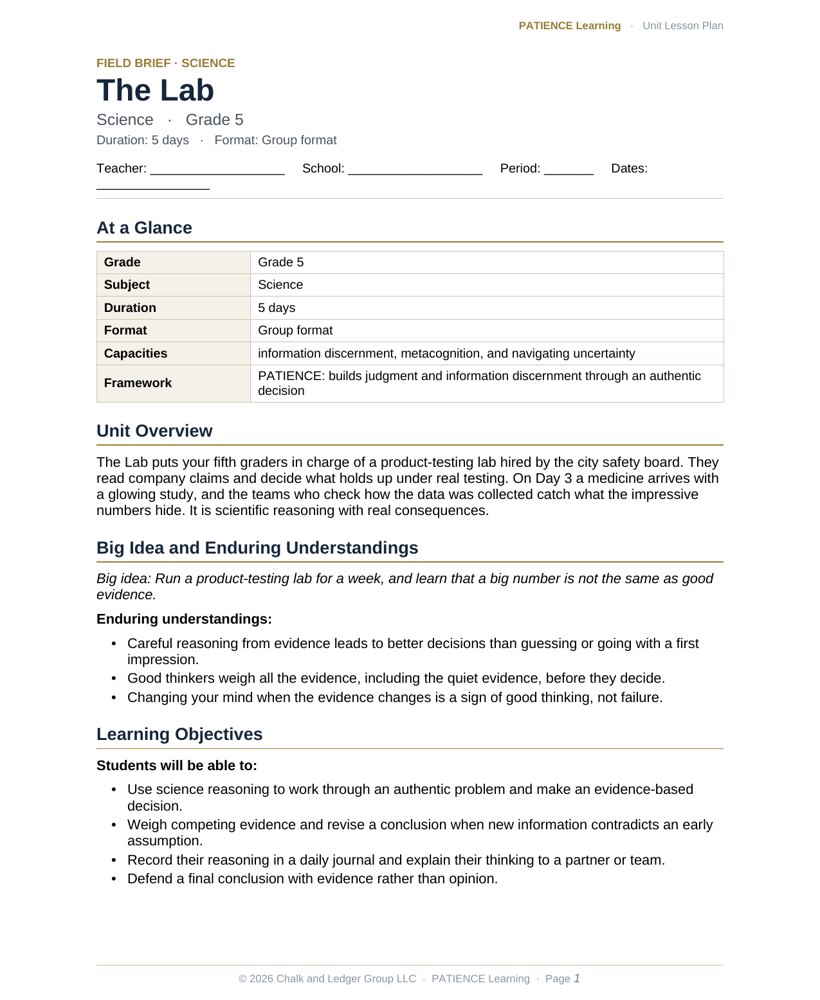
The lesson plan is already written.
Every simulation comes with a fully editable, admin-ready lesson plan. Standards alignment, daily pacing, learning objectives, differentiation, and an assessment plan are already done, so you can hand it to an administrator or adapt it to your district template in minutes.
Tap to preview the lesson plan
Close
Close
Close
Close
Everything you need to run it.
- An admin-ready lesson plan. A fully editable plan with standards alignment, daily pacing, differentiation, and assessment, ready to adapt to your district template. Included with every purchase.
- Five daily playbooks that script every day, including the Day 3 fast-track pressure.
- A student workbook that lays out test methods, sample sizes, and comparisons.
- Scenario cards with company claims, data packets, and the medicine request.
- Daily reflection prompts and a simple rubric that grades thinking, not the verdict.
- A full Student Activity Packet, plus a connection map and pacing card for you.
- Aligned to the Next Generation Science Standards for Grade 5 (Science and Engineering Practices, Nature of Science).
Bring The Lab to your classroom.
Five days, fully planned, and a week of real scientific reasoning your students will not forget.
Get this simulationPreview real pages from the simulation before you spend a dollar. No guessing, no surprises.