The Inbox
The loud item begs for attention. The quiet one decides your week.
See what your students get, and why it lands.
No mockups. Every page below is real, pulled straight from the files you download. Tap any one to see it full size.
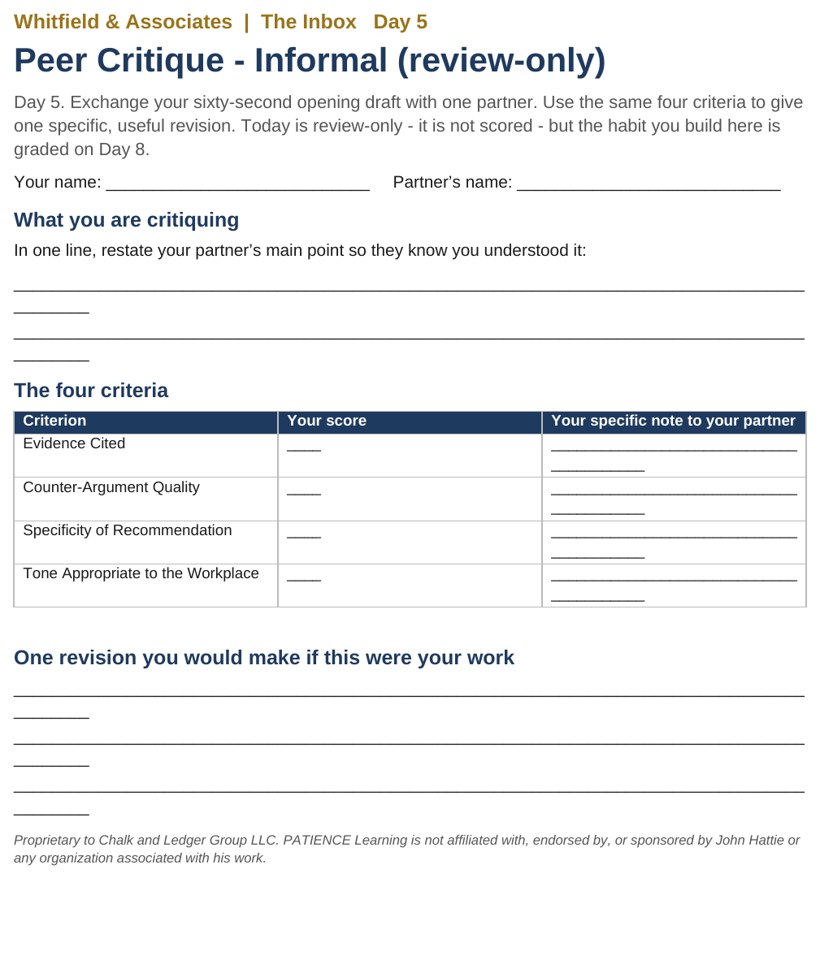
A worksheet was never going to teach this.
Your students do not label workplace terms or match vocabulary to definitions. They inherit an over-capacity inbox at Whitfield and Associates and run it as the new Office Coordinator. Each item carries a real stakeholder, a deadline, and a cost in focus blocks. The student picks one of four actions, Act Now, Schedule, Delegate, or Defer, and lives with what follows. The Reyes access card looks like a quiet one-block task on Day 2. Defer it to Day 6 and the engine hits it with a 4.0x multiplier, plus an outside audit firm and a managing partner now copied on the thread. This is a real call from evidence, made under pressure, with consequences that compound.
Tap to open a student case page
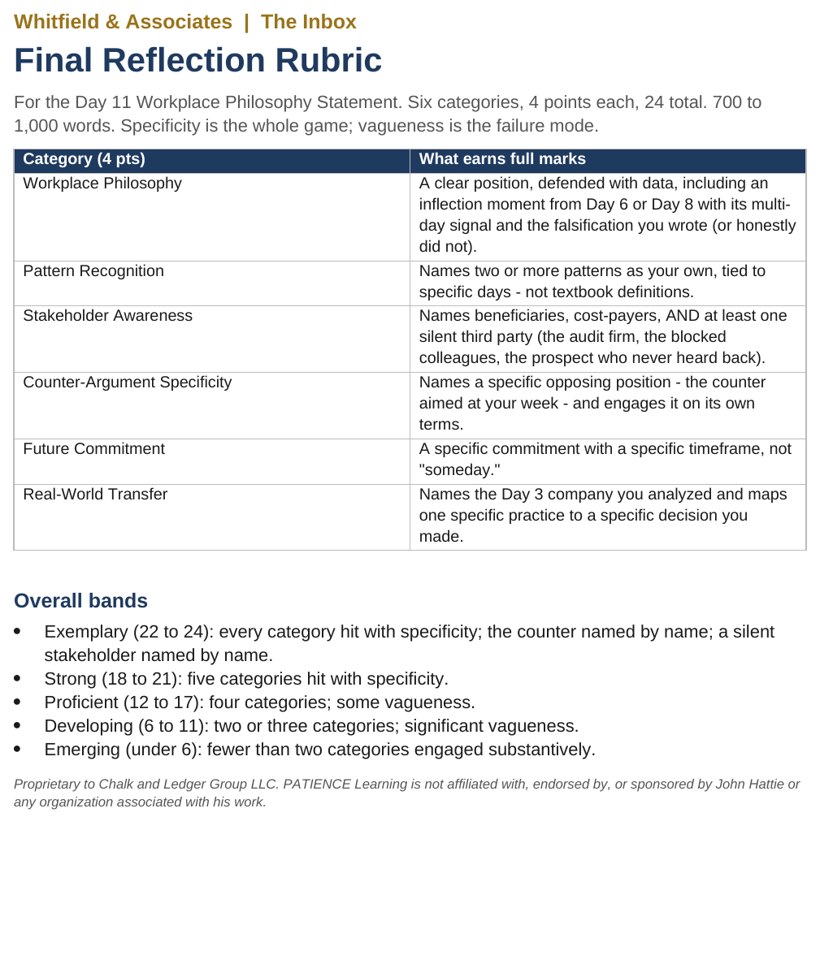
They are graded on their reasoning, not on getting it right.
The Inbox rejects traditional scoring in favor of a Calculated Risk Architecture, where the quality of the decision matters more than the outcome. A live scoreboard tracks four counters: Deliverables Protected, Crises Created, Trust Balance, and Budget Discipline. The 120-point assessment puts 80 points into daily journals that capture reasoning behind each triage call. On inflection days, a bold non-methodical move only earns credit if the student writes a Falsification, a clear statement of what evidence would prove the decision wrong. A bold move with no stated falsification is scored as Reckless. A sound process behind a costly choice beats a lucky guess every time.
Tap to read the grading rubric
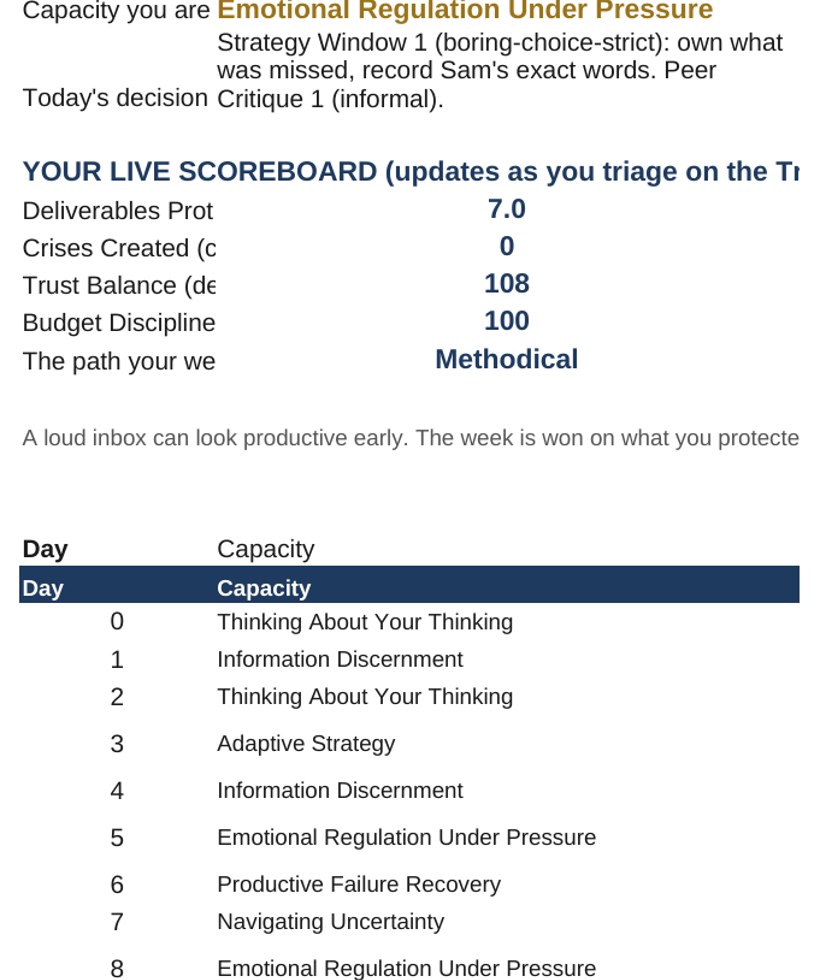
Let the workbook hold the busywork.
The simulation runs on a self-calculating, Excel-based cockpit that reproduces the answer key live. It tracks the daily focus budget, six to eight fifteen-minute blocks set deliberately below total demand, and applies the Compounding Decay Curve when items get deferred. Students do not hand-tally multipliers or reconcile carry-over loads by hand. The tracker does the arithmetic so their energy goes to the judgment: which stakeholders to satisfy, which to intentionally fail, and which quiet items to clear before they grow teeth. When the Day 4 show-of-hands lands, the tracker shows four or more open crises against a student who still feels successful. The numbers, not the feeling, drive the next decision.
Tap to see the tracker
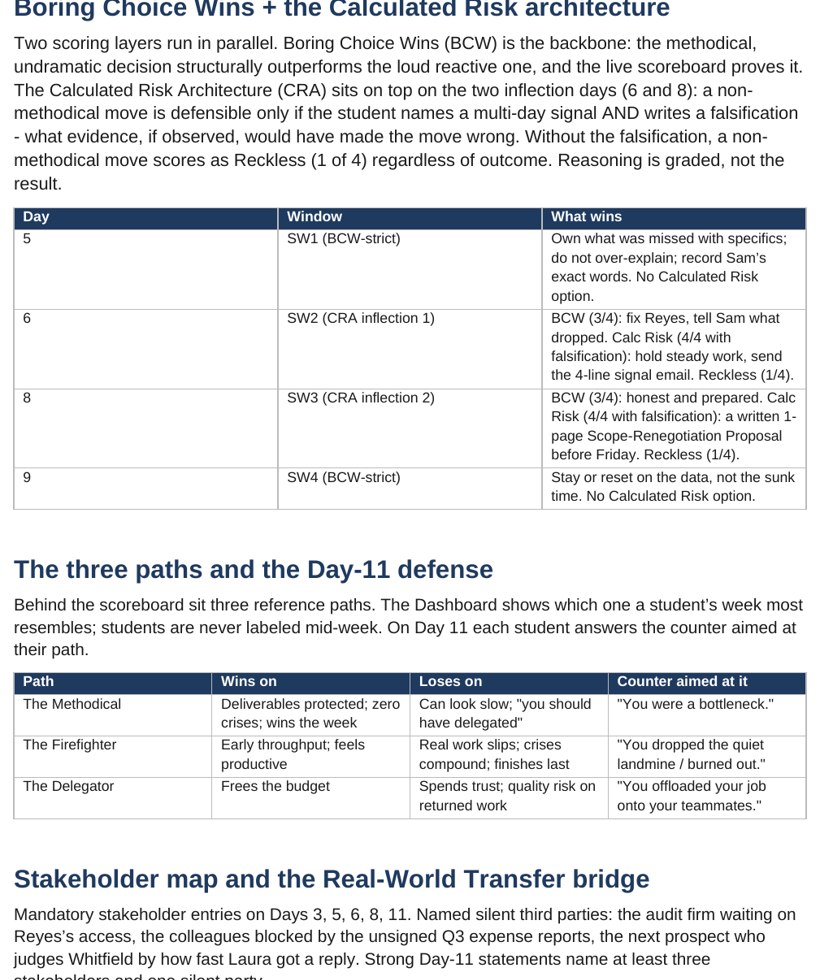
Every day is already scripted.
This simulation is built to carry the teacher and needs no prior expertise in cognitive science. The guide hands you diagnosis say-scripts with specific opening lines and redirect scripts to manage student resistance in the moment. A one-page landscape pacing card maps the full 12-day journey at a glance. The self-calculating workbook reproduces the answer key live, so you are never the bottleneck on the math. You bring the facilitation, the conversation, and the read of the room. The simulation brings the case, the mechanics, the scoring, and the day-by-day arc. Prep stays light, and the heavy lifting of design is already done.
Tap to read the teacher guide
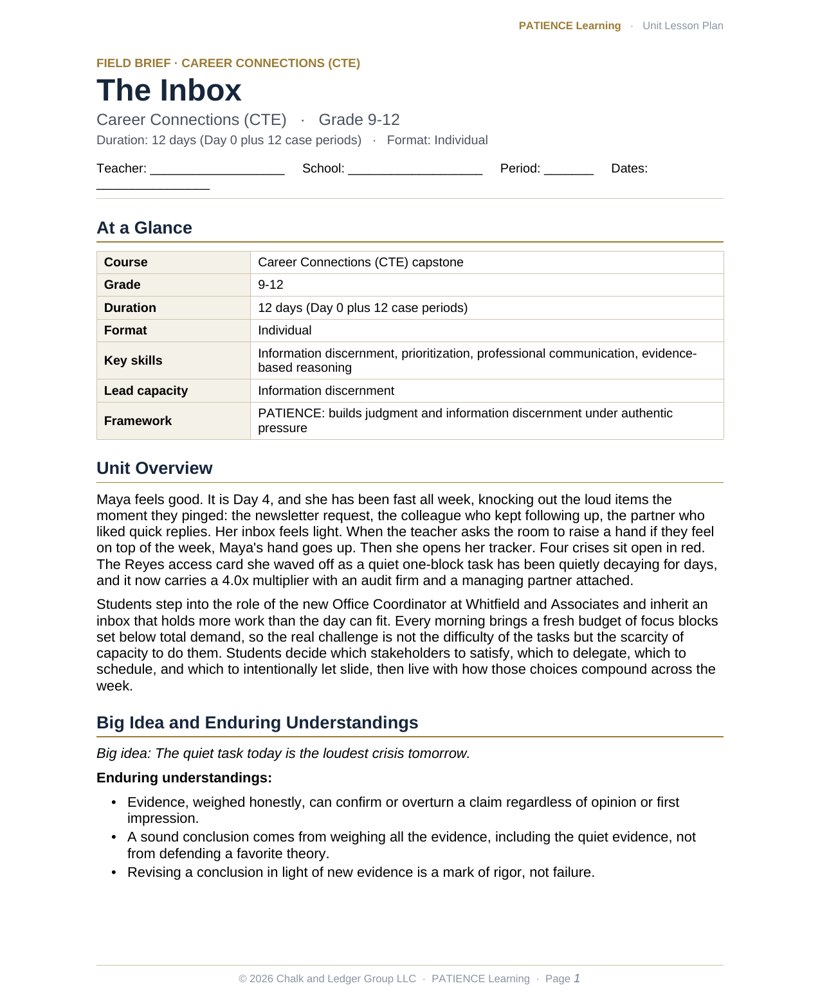
The lesson plan is already written.
Every simulation comes with a fully editable, admin-ready lesson plan. Standards alignment, daily pacing, learning objectives, differentiation, and an assessment plan are already done, so you can hand it to an administrator or adapt it to your district template in minutes.
Tap to preview the lesson plan
Close
Close
Close
Close
The day the confident student meets the tracker.
Maya feels good. It is Day 4, and she has been fast all week, knocking out the loud items the moment they pinged: the newsletter request, the colleague who kept following up, the partner who liked quick replies. Her inbox feels light. When the teacher asks the room to raise a hand if they feel on top of the week, Maya's hand goes up. Then she opens her tracker. Four crises sit open in red. The Reyes access card she waved off as a quiet one-block task has been quietly decaying for days, and it now carries a 4.0x multiplier with an audit firm and a managing partner attached.
At the pivot, Maya has to choose between protecting the story she told herself, that staying busy meant staying productive, and trusting the scoreboard in front of her. She can keep chasing the loud items that feel like progress, or she can accept that her methodical, unglamorous classmates were right. She chooses the evidence. She starts clearing the quiet, decaying tasks first and protecting the core deliverables, even though it feels slower. By Day 6 the firefighters around her are drowning in self-inflicted crises, and her once-boring strategy is the one still standing.
An over-capacity inbox at Whitfield and Associates.
Students step into the role of the new Office Coordinator at Whitfield and Associates and inherit an inbox that holds more work than the day can fit. Every morning brings a fresh budget of focus blocks set below total demand, so the real challenge is not the difficulty of the tasks but the scarcity of capacity to do them. Students decide which stakeholders to satisfy, which to delegate, which to schedule, and which to intentionally let slide, then live with how those choices compound across the week.
| Grade level | 9-12 |
| Course | Career Connections (CTE) capstone |
| Duration | 12 days (Day 0 plus 12 case periods) |
| Format | Individual |
| Key skills | Information discernment, prioritization, professional communication, evidence-based reasoning |
Engineering better thinkers.
In a real workplace, the volume of incoming work outruns the time to do it, and discernment is the skill that separates signal from urgent noise. Each day in The Inbox names a pattern of professional failure and pairs it with the capacity that defeats it.
| Bias targeted | The remedy, built into the work |
|---|---|
| Planning fallacy | Productive failure recoveryStudents under-estimate the time to clear the inbox on Day 1. The Day 4 gap between their guess and the empirical 55-plus minutes teaches them to recover and re-plan from real data. |
| Mere urgency effect | MetacognitionThe loud item begs to be answered first. Students learn to notice the pull of urgency and ask whether the noisy task actually protects a deliverable. |
| Loss aversion | Adaptive strategyThe fear of missing out drives students to grab every item. They learn to let low-value tasks go on purpose and reallocate scarce focus blocks to what matters. |
| Dunning-Kruger effect | Information discernmentEarly confidence outruns competence. The live scoreboard forces students to weigh how they feel against the crises and trust balance the data actually shows. |
| Availability heuristic | Navigating uncertaintyThe freshest message feels most important. Students learn to look past what is top of mind and weigh decaying items they cannot see in the inbox right now. |
| Hyperbolic discounting | Emotional regulationNow-over-later thinking makes deferral feel painless. Students sit with the discomfort of doing quiet, slow work today to avoid a 4.0x crisis tomorrow. |
12 days of triage under pressure.
Day 0 sets up the firm, the cockpit, and the rules of the focus budget. From there the case builds: students triage a live inbox, watch deferred items decay, hit the Day 4 confidence gap, take falsified calculated risks on the inflection days, and finally earn the names of the patterns they have been living.
| Day | What lands | Skill in focus |
|---|---|---|
| 0 | Onboarding at Whitfield and Associates: the cockpit, the focus budget, the four actions | Orientation |
| 1 | Students estimate the time to clear the inbox and start their first triage | Planning fallacy |
| 2 | The Reyes access card arrives as a quiet one-block task; the newsletter arrives loud | Mere urgency effect |
| 3 | Real-world transfer: Zappos, Stripe, and Patagonia response standards inform strategy | Information discernment |
| 4 | The show-of-hands moment: confidence meets a tracker showing open crises (critical pivot) | Metacognition |
| 5 | Decaying items compound; students re-plan around the scoreboard | Adaptive strategy |
| 6 | First inflection day: a calculated risk is only creditable with a written falsification (critical pivot) | Navigating uncertainty |
| 7 | Trust balance tightens as delegation and silent parties come due | Emotional regulation |
| 8 | Second inflection day plus formal peer critiques of each other's reasoning | Independent and collaborative reasoning |
| 9 | Students protect core deliverables as firefighter paths collapse | Adaptive strategy |
| 10 | The full week's data comes into view across all four scoreboard counters | Information discernment |
| 11 | The reveal: students learn the research names behind the patterns they lived | Metacognition |
| 12 | Workplace Philosophy Statement: a capstone defense built on stakeholder data | Evidence-based reasoning |
Standards alignment.
The Inbox aligns to the Career Ready Practices and the Common Career Technical Core (CCTC), the cross-cutting CTE standards that define what every career-ready learner should know and do. It targets the practices for applying appropriate academic and technical skills, communicating clearly and effectively, using critical thinking to make sense of problems, and managing resources to plan and achieve goals. The simulation builds the employability and professional communication competencies districts expect from a CTE capstone: prioritization under constraint, stakeholder awareness, and evidence-based decision making. There are no CCSS codes attached, because this is a Career Connections experience rather than an academic ELA or math unit.
The hidden architecture.
The whole simulation is engineered around one planted contradiction: the daily focus budget is set below total demand, so students cannot win by working hard or working fast. The loud items, the newsletter, the persistent colleague, the partner who likes quick replies, are bait. They feel like progress and reward the firefighter path with early throughput on Days 1 through 3. Meanwhile the quiet decaying items, like the Reyes access card, carry a 1.5x to 4.0x multiplier that turns a one-block task into a 90-minute crisis with an audit firm and a managing partner attached. The methodical path that feels unproductive is the one that wins. The Day 4 confidence gap and the falsification requirement force students to confront the difference between feeling successful and being successful, which is exactly where the sound conclusion lives.
Turnkey, classroom-tested.
- An admin-ready lesson plan. A fully editable plan with standards alignment, daily pacing, differentiation, and assessment, ready to adapt to your district template. Included with every purchase.
- 12-day playbooks. Day-by-day facilitation for every period, from Day 0 onboarding through the Day 12 capstone defense.
- A self-calculating workbook. An Excel-based cockpit that tracks focus blocks, applies the decay curve, and reproduces the answer key live.
- Diagnosis say-scripts and redirect scripts. Specific opening lines and responses to manage student resistance without prior cognitive-science expertise.
- A one-page pacing card. A landscape overview of the full 12-day journey you can keep on the desk.
- A 120-point assessment structure. Daily journals, Day 8 peer critiques, and the Workplace Philosophy Statement, all graded on reasoning rather than outcome.
Give your students the week that changes how they work.
Bring The Inbox to your classroom and let your students learn discernment the only way it sticks, by living the friction before they get the words for it.
Get this simulationPreview real pages from the simulation before you spend a dollar. No guessing, no surprises.