The Homefront
No single rung looks like the unthinkable step. That is exactly how the ladder works.
See what your students get, and why it lands.
No mockups. Every page below is real, pulled straight from the files you download. Tap any one to see it full size.
A worksheet was never going to teach this.
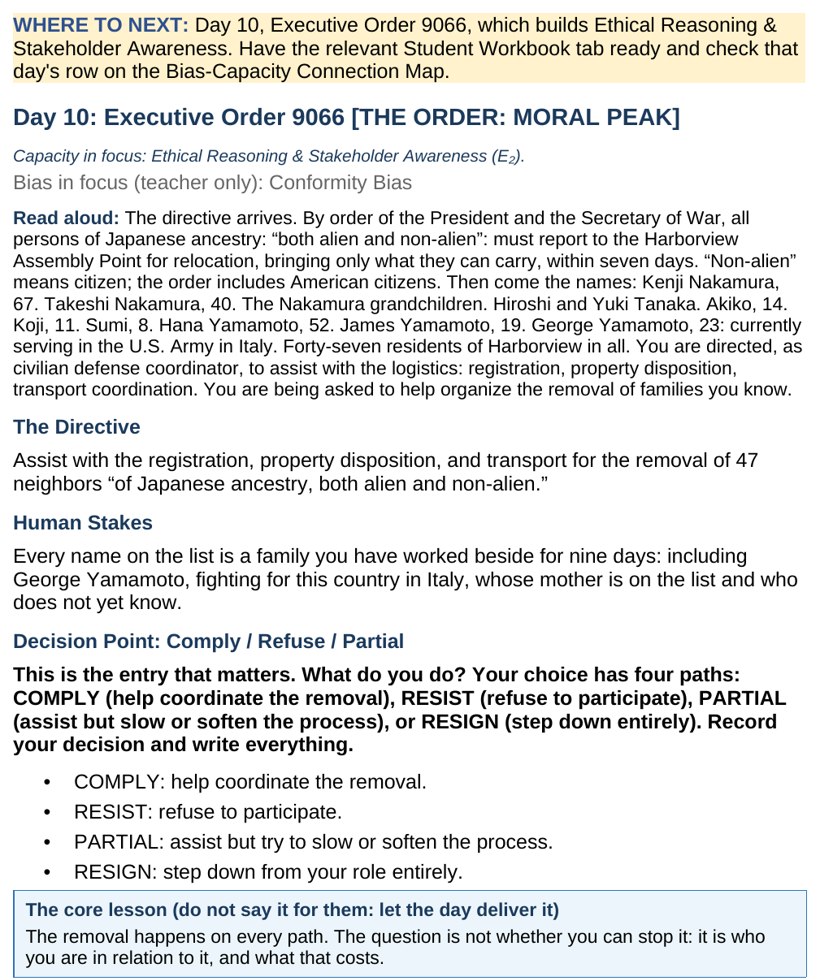
Your students are not answering questions about 1942. They are sitting in the chair of the Civilian Defense Coordinator in Harborview, California, reading the directive that just landed on the desk. The Daily Briefing hands them a real federal order, sugar rationing one day, an ancestry-based curfew the next, property liquidation after that, and asks for a call: comply, refuse, or partial. The Nakamura, Tanaka, and Yamamoto families are named, not abstract. Kenji Nakamura's 320-acre farm is on the line. George Yamamoto serves in the U.S. Army while his mother faces a curfew based on ancestry. Students weigh the evidence in front of them, then commit the decision to their journal. The order is reasonable today, which is the whole point.
Tap to read a Daily Briefing
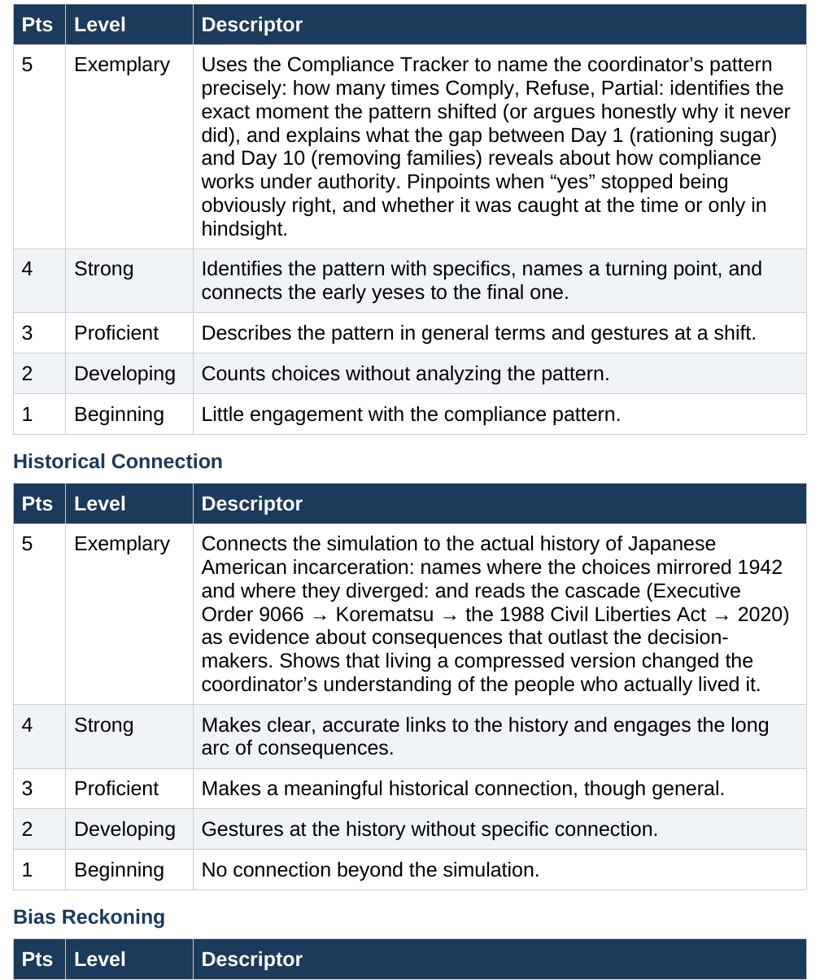
They are graded on their reasoning, not on what they chose.
The Hybrid-100 rubric runs on a mirror, not an answer key. A student who complies with every order can still earn full marks by writing a rigorous, honest audit of why. A student who resists and skips the self-examination cannot. Sixty points reward daily journal engagement: naming the evidence, naming the families, getting specific. Twenty points go to holistic quality, bias awareness, and the depth of self-honesty. The final twenty cover pattern analysis, the historical connection, and modern transfer. Assessment is decoupled from the decision on purpose, so students can look squarely at their own compliance pattern without fearing an academic penalty for it. The grade rewards the intellectual courage to study your own reflection.
Tap to read the grading rubric
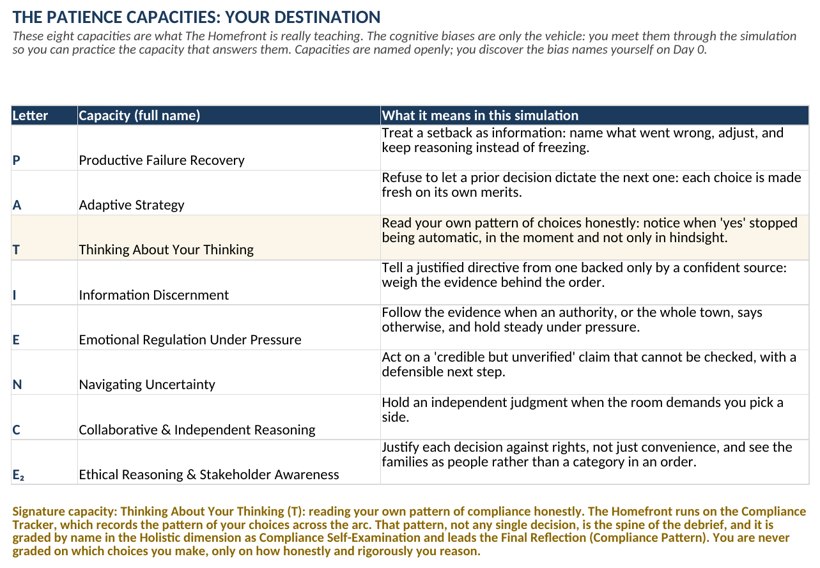
Let the workbook hold the busywork.
The student Workbook is a self-tallying spreadsheet, the Compliance Tracker, that records every Comply, Refuse, or Partial across all fifteen days. Students do not hand-count anything. The tracker quietly assembles their choices into a visible pattern, the Compliance Ladder, so that by the reckoning they are reading their own behavior back to themselves rather than reconstructing it from memory. That frees their energy for the part that matters: the judgment behind each call and the honest journal entry that explains it. When a student is absent, the workbook keeps the simulation's logic intact. They read the missed briefing, journal, and catch up without breaking the sequence. The mechanical work is automated so the thinking is not.
Tap to see the tracker
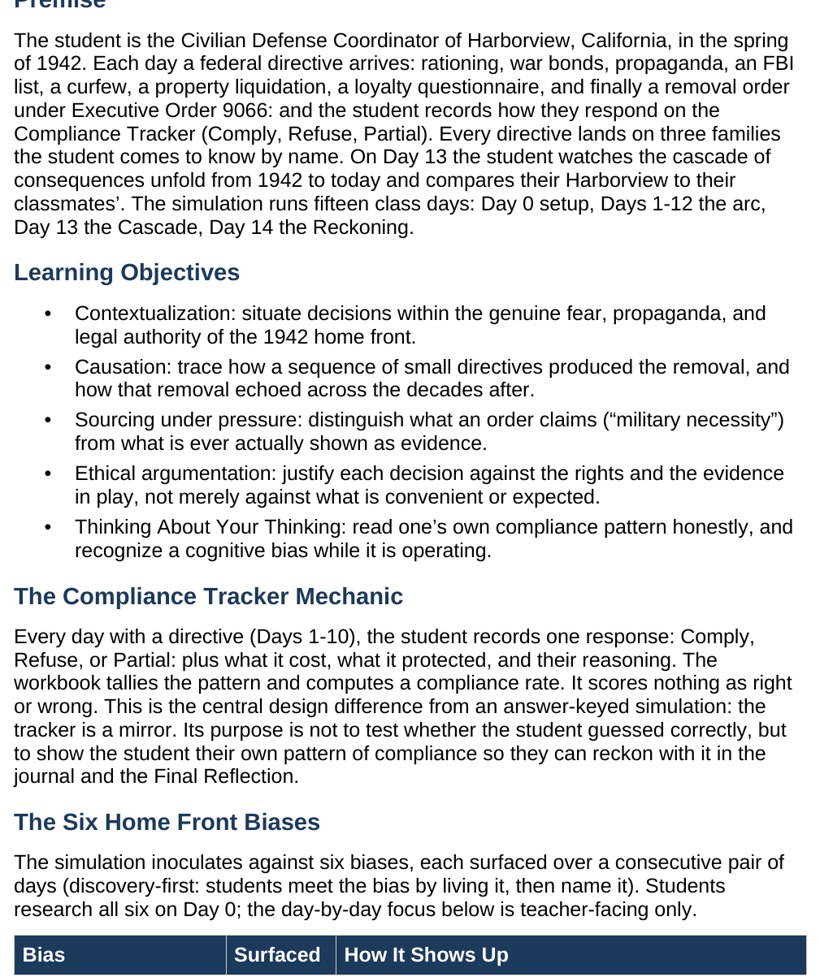
Every day is already scripted.
The Teacher Guide carries the narrative weight so you can carry the room. Each of the fifteen days arrives with a scripted briefing, the facilitation moves, and the design notes you need to run it cold. The no-prep philosophy is real: self-tallying workbooks, turnkey student files, and a built-in absence fallback mean you are not assembling materials the night before. The guide also includes a mandatory sensitivity protocol, with private outreach to Japanese American students, so the unit stays safe and professional given the history it confronts. You bring the facilitation and your read of the class. The simulation brings the structure, the evidence, the families, and the scaffolding for a debrief students will remember.
Tap to read the teacher guide
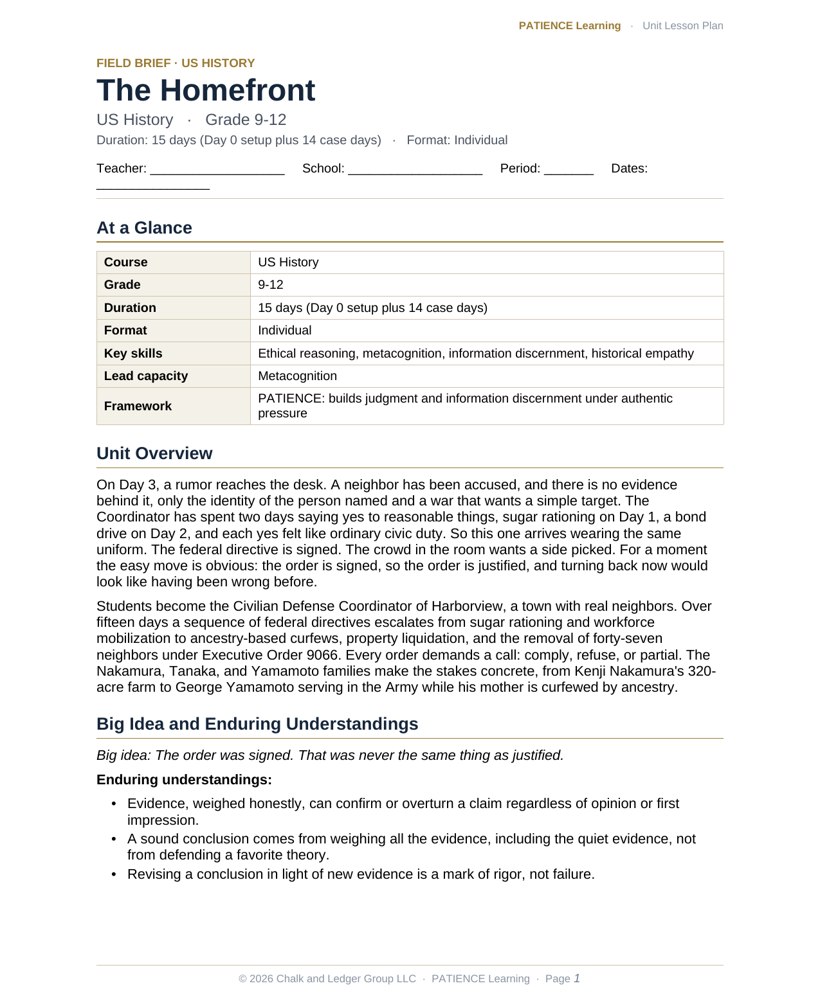
The lesson plan is already written.
Every simulation comes with a fully editable, admin-ready lesson plan. Standards alignment, daily pacing, learning objectives, differentiation, and an assessment plan are already done, so you can hand it to an administrator or adapt it to your district template in minutes.
Tap to preview the lesson plan
Close
Close
Close
Close
The day the signature stopped being enough.
On Day 3, a rumor reaches the desk. A neighbor has been accused, and there is no evidence behind it, only the identity of the person named and a war that wants a simple target. The Coordinator has spent two days saying yes to reasonable things, sugar rationing on Day 1, a bond drive on Day 2, and each yes felt like ordinary civic duty. So this one arrives wearing the same uniform. The federal directive is signed. The crowd in the room wants a side picked. For a moment the easy move is obvious: the order is signed, so the order is justified, and turning back now would look like having been wrong before.
Then the student looks at what they actually have. A confident source. A signature. No facts. They notice the curfew on Day 6 is built on ancestry, that the Day 7 liquidation only makes sense if the earlier compliance is treated as proof. At the pivot the choice is bare: protect the pattern of yeses, or trust the evidence in front of them. The student who chooses the evidence sees the ladder for the first time. No single rung looked like the unthinkable step, and that is precisely how they climbed it.
Harborview, California, spring 1942.
Students become the Civilian Defense Coordinator of Harborview, a town with real neighbors. Over fifteen days a sequence of federal directives escalates from sugar rationing and workforce mobilization to ancestry-based curfews, property liquidation, and the removal of forty-seven neighbors under Executive Order 9066. Every order demands a call: comply, refuse, or partial. The Nakamura, Tanaka, and Yamamoto families make the stakes concrete, from Kenji Nakamura's 320-acre farm to George Yamamoto serving in the Army while his mother is curfewed by ancestry.
| Grade level | 9-12 |
| Course | US History |
| Duration | 15 days (Day 0 setup plus 14 case days) |
| Format | Individual |
| Key skills | Ethical reasoning, metacognition, information discernment, historical empathy |
Engineering better thinkers.
Compliance does not arrive as one dramatic choice. It accumulates through small administrative yeses, each defensible on its own. The Homefront uses a discovery-first design so students live a bias before it is named, then pairs each one with the capacity built to defeat it.
| Bias targeted | The remedy, built into the work |
|---|---|
| Authority bias | Information discernmentEarly reasonable orders train the habit of obeying a signature without demanding evidence. Students practice separating a justified directive from one backed only by a confident federal source. |
| Scapegoat bias | Navigating uncertaintyA complex war collapses into one identifiable target, and evidence-free rumors get treated as actionable fact. Students learn to act under credible but unverified claims without naming a culprit the facts do not. |
| Fear-based reasoning | Emotional regulationFear arrives before evidence, and a corrected rumor still hardens into policy when not acting feels too costly. Students practice holding steady and following the evidence when the stakes feel too high to wait. |
| Sunk cost bias | Adaptive strategyHaving enforced curfews, turning back can feel like admitting earlier guilt, so liquidation follows to justify what came before. Students learn to refuse prior compliance as a reason for the next decision. |
| Conformity bias | Collaborative reasoningA room demanding that one pick a side attaches a visible social cost to dissent. Students practice holding independent judgment when the group rewards agreement over honesty. |
| Moral disengagement | MetacognitionEuphemisms like relocation and non-alien distance the conscience from the act. Students audit their own compliance pattern honestly and name the reality the language was built to hide. |
15 days down the Compliance Ladder.
Day 0 sets the table: students research the biases and meet the Harborview families as people, not categories. From there the directives escalate one defensible step at a time, building to a moral peak on Day 10 and a long-arc reckoning that connects 1942 to the present.
| Day | What lands | Capacity in focus |
|---|---|---|
| 0 | Setup: research the six biases and meet the Nakamura, Tanaka, and Yamamoto families. | Stakeholder awareness |
| 1 | Sugar rationing. The first reasonable yes, signed and routine. | Information discernment |
| 2 | A war bond drive deepens the habit of compliance with federal directives. | Adaptive strategy |
| 3 | An evidence-free accusation arrives. The signature is real, the facts are not (critical pivot). | Navigating uncertainty |
| 6 | An ancestry-based curfew lands. The order now targets people by who they are. | Emotional regulation |
| 7 | Property liquidation. Turning back starts to feel like admitting earlier guilt. | Adaptive strategy |
| 10 | Removal of 47 neighbors under Executive Order 9066. The Four-Path engine forces a choice (critical pivot). | Ethical reasoning |
| 11 | The weight: students receive the specific consequences of the Day 10 choice. | Productive failure recovery |
| 12 | The empty spaces: a community audit of what was gained and what was lost. | Stakeholder awareness |
| 13 | The Cascade: 1944 to today, from Korematsu to redress to modern transfer. | Metacognition |
| 14 | The reckoning: final reflection and cross-student comparison of trackers. | Metacognition |
Standards alignment.
The Homefront is built for US History and grounded in the C3 Framework for Social Studies inquiry and NCSS standards. Students evaluate primary directives and credibility (D3.1.9-12, D3.2.9-12), weigh causation and contingency in the run-up to Executive Order 9066 (D2.His.14.9-12, D2.His.16.9-12), and analyze the perspectives of the Nakamura, Tanaka, and Yamamoto families against the historical record (D2.His.4.9-12, D2.His.6.9-12). The Cascade and final reflection carry students into civic application and reasoned argument (D4.1.9-12, D4.6.9-12). For APUSH classrooms it supports Period 7 content and the historical reasoning skills of contextualization, causation, and use of evidence.
The hidden architecture.
The simulation is engineered so the biases lead students astray on purpose. Days 1 and 2 are deliberately reasonable, building authority bias so that by Day 3 a signed but evidence-free order wears the same uniform as legitimate ones. The planted contradiction is the gap between signature and evidence, made visible only if a student stops to look. The real trap is on Day 10. The Four-Path Consequence Engine offers Comply, Resist, Partial, or Resign, and the removal happens on every path. Students who Resist discover their replacement was more brutal, giving families 48 hours instead of seven days. That defeats the instinct to win the simulation and forces the true reckoning: not whether the town was saved, but who the student became. The Compliance Tracker then turns their own pattern into the evidence.
Turnkey, classroom-ready.
- An admin-ready lesson plan. A fully editable plan with standards alignment, daily pacing, differentiation, and assessment, ready to adapt to your district template. Included with every purchase.
- 15-day scripted playbooks. Minute-by-minute facilitation and design notes for every briefing, ready to run cold.
- A self-tallying Workbook. The Compliance Tracker records every comply, refuse, or partial and builds the pattern automatically.
- Turnkey student files. Daily Briefings, family profiles, and journals, with an absence fallback that keeps the sequence intact.
- A Hybrid-100 rubric. Grades the honesty and rigor of reasoning, never the decisions a student made.
- A mandatory sensitivity protocol. Private outreach guidance for Japanese American students to keep the unit safe and professional.
Let your students climb down it before the stakes are real.
Bring The Homefront to your US History classroom and give your students fifteen days to practice the difficult, necessary work of seeing their own compliance clearly.
Get this simulationPreview real pages from the simulation before you spend a dollar. No guessing, no surprises.