The Hire
The polished interview lies. The work sample does not.
See what your students get, and why it lands.
No mockups. Every page below is real, pulled straight from the files you download. Tap any one to see it full size.
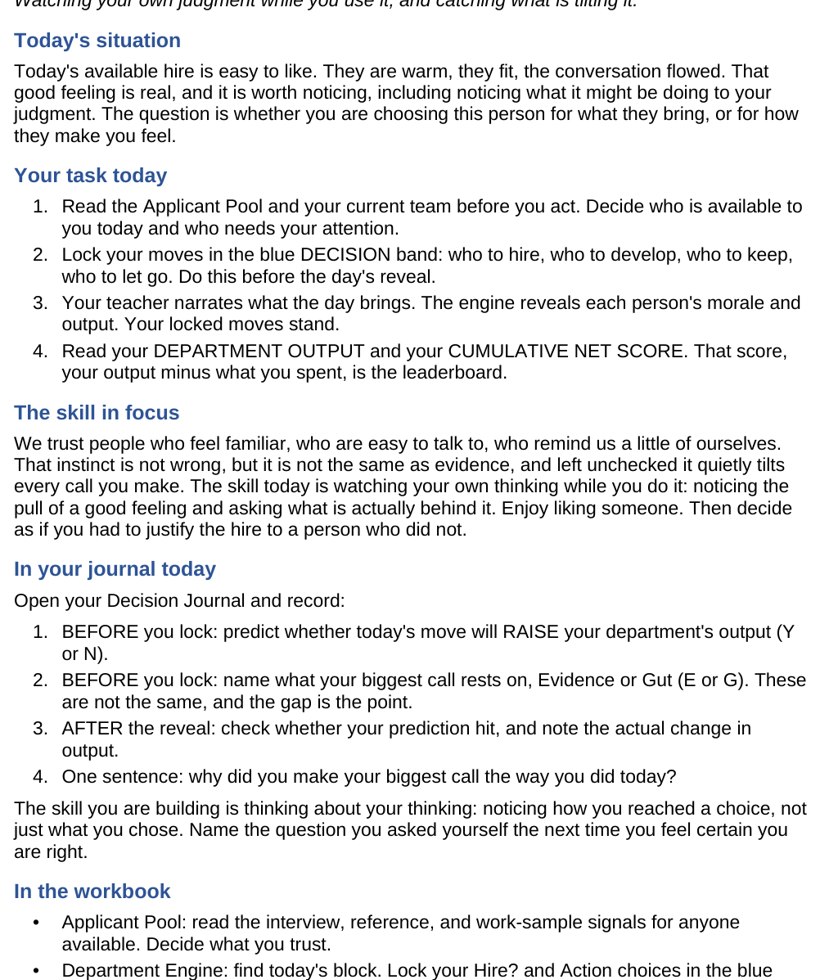
A worksheet was never going to teach a hiring call.
On Day 1, your students do not answer questions about hiring. They make the call. Two candidates sit on the page. One dazzled the interview. The other left strong work samples and references but read nervous in the room. Your students weigh the conflicting signals, then commit their move before the day's outcome is revealed. That commitment is the point. Under the Lock-Before-You-Know rule, a team cannot wait to see what happens and then claim they knew it all along. They have to back a decision from the evidence in front of them, defend it in writing, and live with the result. This is a real management call with a budget and a roster on the line, not a fill-in-the-blank.
Tap to open a student decision page
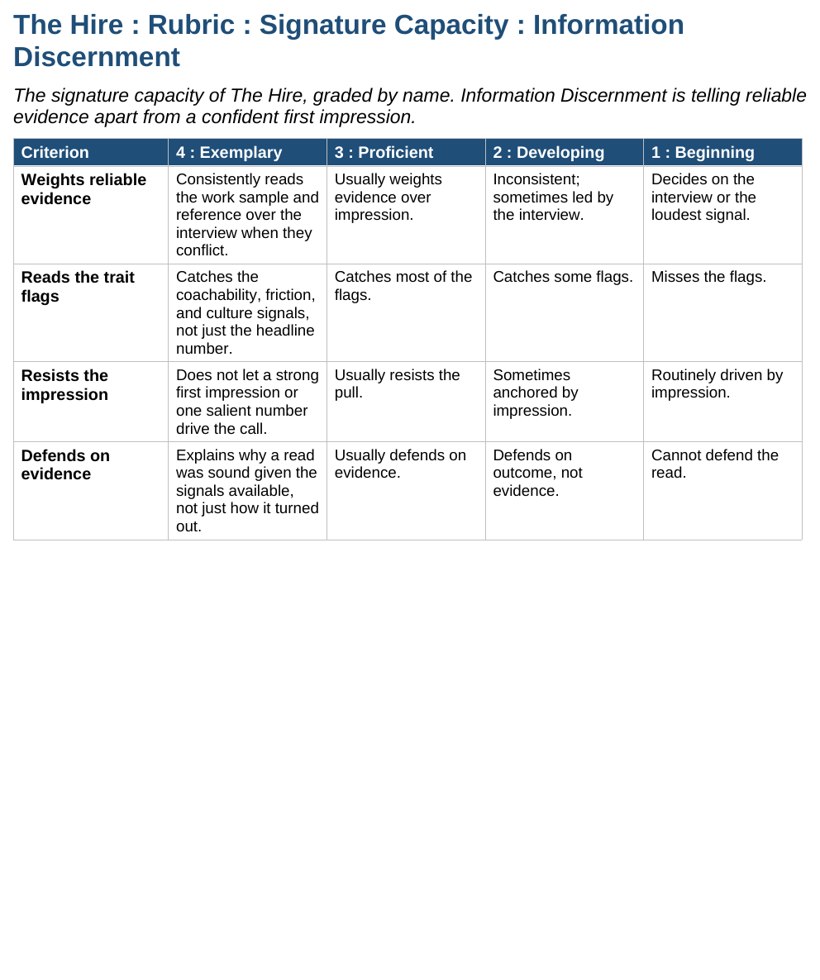
They are graded on the reasoning, not the leaderboard.
A team can guess the flashy hire on Day 1, get lucky on a wobble in the engine, and still post a strong score. That does not earn the grade here. The rubric grades the quality of the reasoning behind every move. The daily decision journal scores whether a student used evidence over gut and committed a disciplined prediction before the reveal. The final reflection scores whether they used real team data to explain what happened. A dedicated Information Discernment rubric grades how well a student weighted reliable evidence against impressions. A sound process behind a hire that did not pan out beats a lucky pick with no thinking under it. That is the lesson your students carry out of the room.
Tap to read the grading rubric
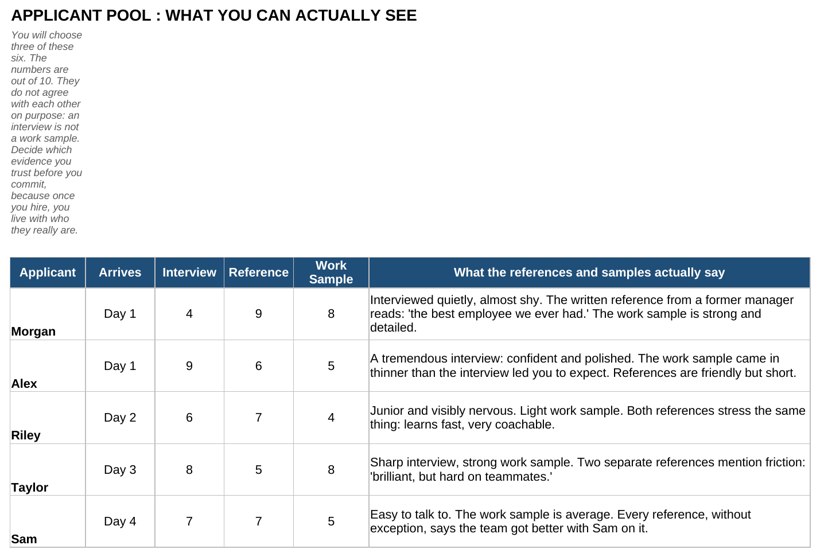
Let the workbook carry the math so students carry the judgment.
The engine behind The Hire is real. Output equals skill times a morale factor, honeymoon bumps fade, and morale taxes compound across a five-seat department. You do not want your students buried in that arithmetic. The tech-enabled workbook holds it for them. It tracks each employee's skill and morale row by row, watches the 1,500 dollar budget cell as training, raises, and severance draw it down, and feeds the class leaderboard, which runs the net score calculations automatically. When a quiet performer's morale row ticks down day after day, students see it on the tracker instead of computing it. Their energy goes where it belongs, into reading the signals and defending the call, while the workbook handles the busywork.
Tap to see the tracker
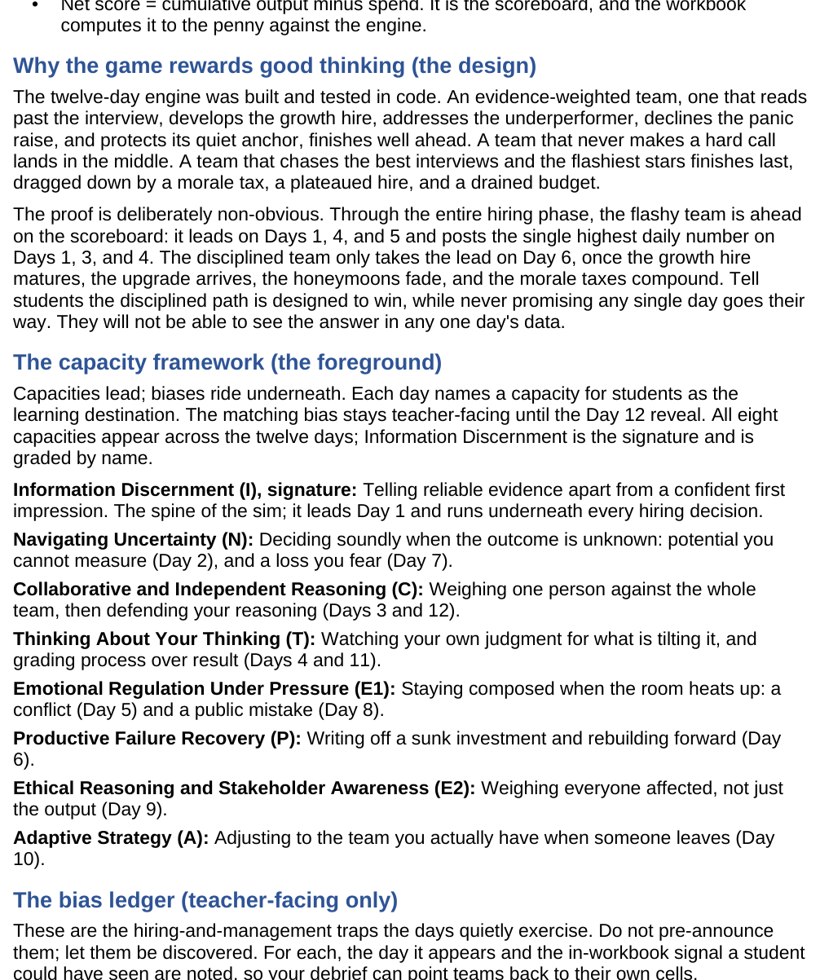
Every day is already scripted. You bring the facilitation.
You do not need an HR or business background to run this. The Teacher Day-Reveal Guide scripts every session. For each of the twelve days it gives you a read-aloud, a plain explanation of the mechanics in play, and the discerning move the evidence supports, so you can lead the discussion with authority. The simulation is modular. Run one day per period or group days into blocks. If a class is missed, teams simply resume at the next lock. The leaderboard does the net-score math, so your time goes to the high-level conversation about evidence versus gut. Prep is light because the design did the heavy lifting. You facilitate the thinking, the simulation brings everything else.
Tap to read the teacher guide
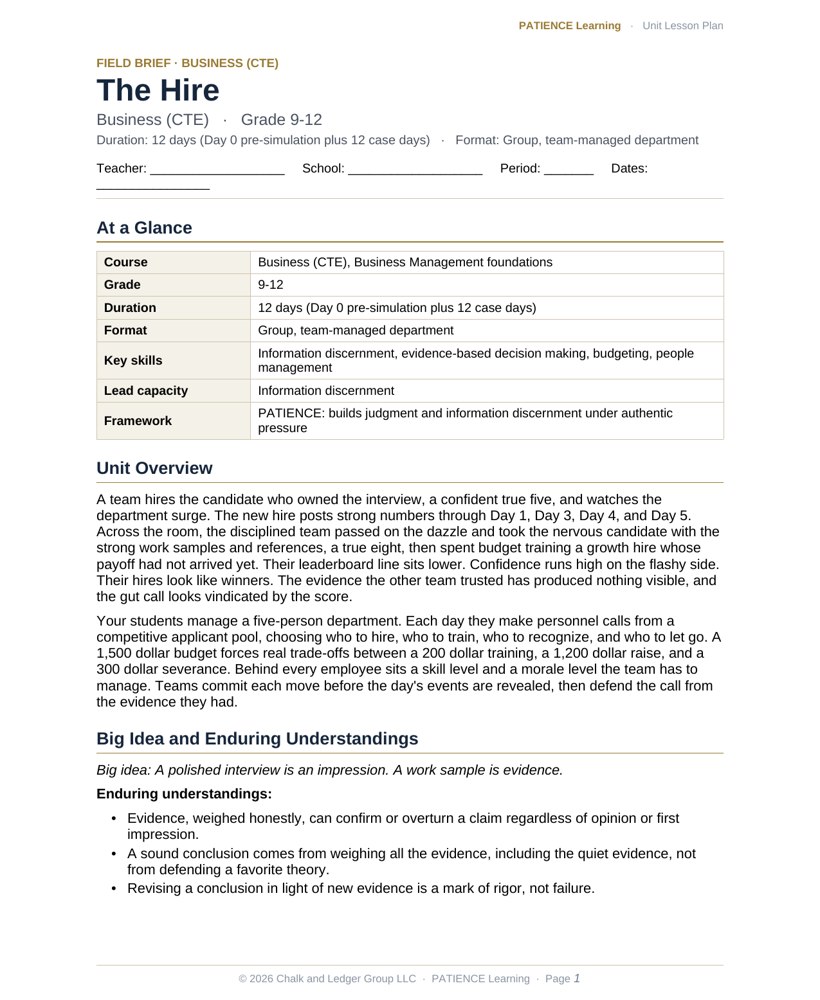
The lesson plan is already written.
Every simulation comes with a fully editable, admin-ready lesson plan. Standards alignment, daily pacing, learning objectives, differentiation, and an assessment plan are already done, so you can hand it to an administrator or adapt it to your district template in minutes.
Tap to preview the lesson plan
Close
Close
Close
Close
The day the flashy team stops winning.
A team hires the candidate who owned the interview, a confident true five, and watches the department surge. The new hire posts strong numbers through Day 1, Day 3, Day 4, and Day 5. Across the room, the disciplined team passed on the dazzle and took the nervous candidate with the strong work samples and references, a true eight, then spent budget training a growth hire whose payoff had not arrived yet. Their leaderboard line sits lower. Confidence runs high on the flashy side. Their hires look like winners. The evidence the other team trusted has produced nothing visible, and the gut call looks vindicated by the score.
Then Day 6 lands. The honeymoon bump fades and the flashy hire settles to a true five. The morale tax on a team built for show compounds. The disciplined team's quiet investments mature on the same day. Their roster pulls ahead and stays ahead. The pivot is the moment a student has to choose between protecting the theory that a good interview predicts a good hire and trusting the evidence that said otherwise from the start. The students who trusted the evidence see that the leaderboard was always going to turn. The signals were there on Day 1.
Run a five-seat department on a 1,500 dollar budget.
Your students manage a five-person department. Each day they make personnel calls from a competitive applicant pool, choosing who to hire, who to train, who to recognize, and who to let go. A 1,500 dollar budget forces real trade-offs between a 200 dollar training, a 1,200 dollar raise, and a 300 dollar severance. Behind every employee sits a skill level and a morale level the team has to manage. Teams commit each move before the day's events are revealed, then defend the call from the evidence they had.
| Grade level | 9-12 |
| Course | Business (CTE), Business Management foundations |
| Duration | 12 days (Day 0 pre-simulation plus 12 case days) |
| Format | Group, team-managed department |
| Key skills | Information discernment, evidence-based decision making, budgeting, people management |
Engineering better thinkers.
Hiring is a daily fight against first impressions. The Hire engineers that fight into twelve days. Each day names a cognitive trap that pulls managers toward the flashy guess, then pairs it with the capacity that defeats it, so discernment is practiced under pressure, not lectured.
| Bias targeted | The remedy, built into the work |
|---|---|
| Anchoring | Productive failure recoveryOn Day 6 a manager fixated on the investment already sunk into an underperformer learns to write it off, fire the seat, hire the nine, and delegate before resignation hits. |
| Confirmation bias | MetacognitionOn Day 11 students audit their own process, evidence versus gut, instead of the score, so a lucky result cannot quietly confirm a flawed habit of mind. |
| Sunk cost fallacy | Adaptive strategyKeeping an underperformer to honor past investment drags the whole department's morale down. Day 10 rewards investing in the quiet anchor early and adapting when a seat empties. |
| Availability bias | Information discernmentThe vivid interview crowds out the quieter work samples and references. Day 1 forces students to weight reliable evidence over the impression that is easiest to recall. |
| Tunnel vision | Navigating uncertaintyLoud problems pull all the attention while steady performers go invisible. Days 2 and 7 train students to commit under uncertainty and protect the quiet contributor. |
| Overconfidence | Emotional regulationA clash on Day 5 and a mistake on Day 8 tempt a public, reactive response. Students learn to regulate, address the root cause directly, and correct in private. |
12 days of evidence over impression.
Day 0 sets the foundation. Teams complete vocabulary and engine-math tasks and write a formal hiring philosophy before a single move. From there the case runs twelve days, each one a named decision, building from the first interview call to the Day 12 debrief where students defend the philosophy they actually lived.
| Day | What lands | The discerning move |
|---|---|---|
| 0 | Vocabulary, engine math, and a written hiring philosophy | Commit to a process before the first move |
| 1 | The Interview (critical pivot) | Hire the strong work samples over the flashy interviewer |
| 2 | The Underdog | Hire and train the growth candidate early for a compounding payoff |
| 3 | The Talent | Pass on the high-friction star or build a concrete morale plan |
| 4 | The Energy | Test the affinity pull against objective evidence before hiring |
| 5 | The Clash | Address the root cause of conflict directly, not by safe email |
| 6 | The Upgrade (critical pivot) | Write off the sunk cost, hire the nine, delegate within five days |
| 7 | The Ask | Deny the budget-busting raise, use non-cash recognition |
| 8 | The Mistake | Respond to the error privately and constructively |
| 9 | The Crunch | Make the humane call on a leave request to build durable trust |
| 10 | The Exit | Invest in the quiet anchor early to prevent a resignation |
| 11 | The Review | Audit the decision process, evidence versus gut, not the score |
| 12 | The Debrief | Synthesize the twelve days and defend a final philosophy |
Standards alignment.
The Hire aligns to the Common Career Technical Core for the Business Management and Administration cluster, including the analysis of information to make management decisions and the management of human capital and resources. It builds the Career Ready Practices, notably applying appropriate academic and technical skills, using critical thinking to make sense of problems, and modeling integrity and ethical leadership. It maps to MBA Research business administration standards in management and human resources, and it develops the employability skills employers name first, sound judgment, problem solving, budgeting, and communication. No CCSS math or ELA codes are claimed, the work is business and career technical by design.
The hidden architecture.
Here is the design secret. The flashy team is built to win early. The candidate who owns the interview is a true five wearing a honeymoon bump, and that bump, plus the visible energy of show-hiring, keeps the show team ahead through Days 1, 3, 4, and 5. The evidence-led team's investments, the true eight, the trained growth hire, the protected quiet anchor, pay off later by design. On Day 6 the honeymoon fades, the morale tax on the show team compounds, and the disciplined roster takes the lead and holds it. The engine forces the sound conclusion, students cannot argue the leaderboard into validating the gut call. Lock-Before-You-Know strips out hindsight, so the only defensible move is the one the evidence supported at the moment of decision.
Turnkey, classroom-tested.
- An admin-ready lesson plan. A fully editable plan with standards alignment, daily pacing, differentiation, and assessment, ready to adapt to your district template. Included with every purchase.
- A 12-day teacher day-reveal guide. Read-aloud scripts and mechanical explanations for every session, so any instructor can lead with authority.
- A tech-enabled workbook and tracker. Holds the skill-morale engine, watches the 1,500 dollar budget, and feeds the leaderboard automatically.
- An automated class leaderboard. Runs the net-score calculations so your time goes to discussion, not arithmetic.
- Turnkey student files. Day 0 vocabulary, engine-math tasks, candidate cases, and the daily decision journal, ready to hand out.
- A dual rubric system. Grades the quality of reasoning and information discernment, not whether a team tops the leaderboard.
- A Day 12 debrief pack. Six real-world management models, from the Keeper Test to First Who Then What, for students to pressure-test their philosophy against.
Teach the call that data, not charisma, should make.
Bring The Hire to your classroom and let your students learn, across twelve real decisions, that disciplined evidence beats the flashy first impression every time.
Get this simulationPreview real pages from the simulation before you spend a dollar. No guessing, no surprises.