The Gauntlet
Most bills die. That is not the failure. That is the lesson.
See what your students get, and why it lands.
No mockups. Every page below is real, pulled straight from the files you download. Tap any one to see it full size.
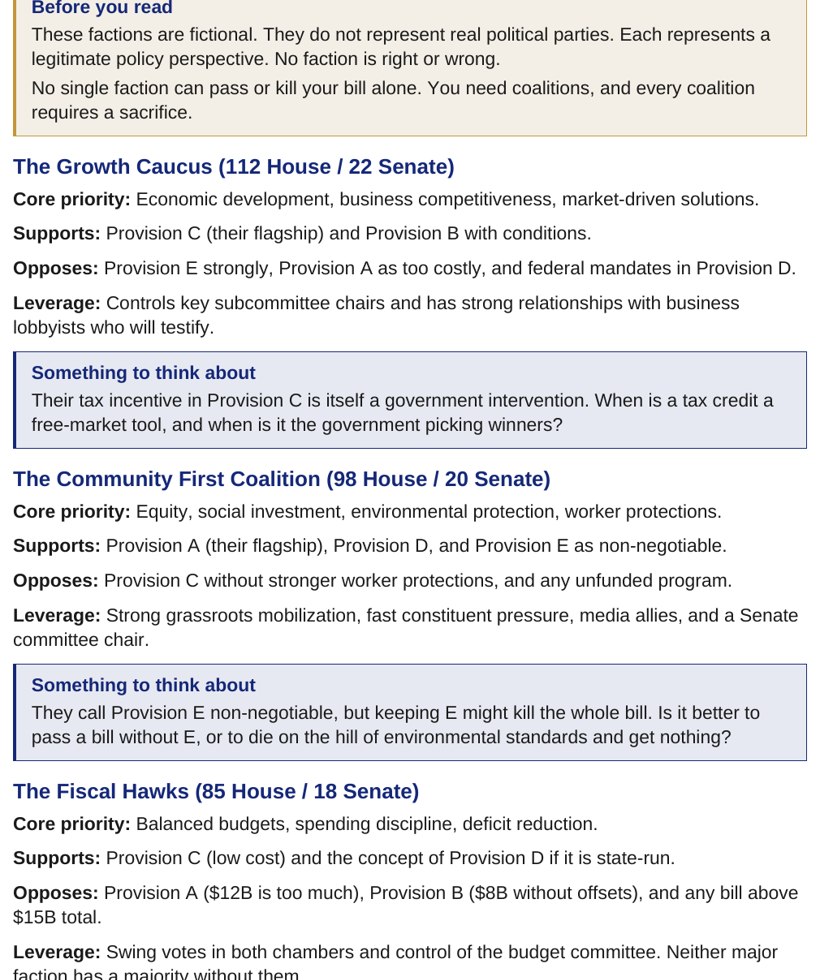
Your students are not answering questions. They are counting votes.
This is a faction profile, one of four blocs your students study before they trade a single provision. The Growth Caucus holds 112 seats. Community First holds 98. Neither pairing reaches the 218 needed to pass the House. Your students read each faction's red lines, see that no two-faction coalition can win, and start doing the math of compromise. They are not recalling the steps of how a bill becomes a law. They are deciding which of their own priorities to sacrifice to get the votes, and which faction to bring in third. The page hands them the real pressures of the floor, the seat counts, the poison pill, the chair who will turn hostile, and asks them to make a call that compounds for two more weeks.
Tap to read a student case file
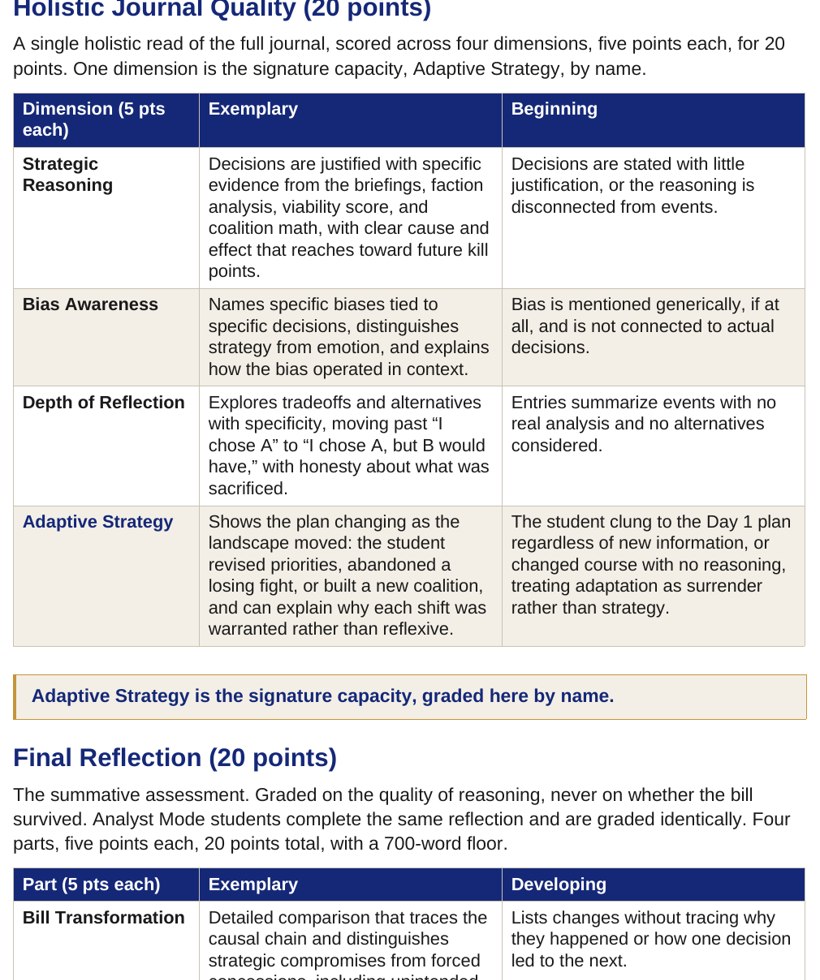
A dead bill with a brilliant reflection is the highest score in the room.
Here is the rubric, and it never asks whether the bill passed. The Hybrid-100 scale puts 60 points on twelve daily journal entries scored against the seven kill points and five high-stakes decisions, 20 points on a holistic read of strategic reasoning and bias awareness, and 20 points on a final reflection with a 700-word floor. A student whose bill died on the Senate floor can earn full marks by tracing exactly why, what they anchored on, where they should have abandoned a provision sooner. The rubric is also AI-proof by design. To score well, a student must cite their own viability score history, the exact 1.8 billion dollar figure for the small business credit, and the seat counts they actually negotiated. Generic answers cannot fake a path that was lived.
Tap to read the grading rubric
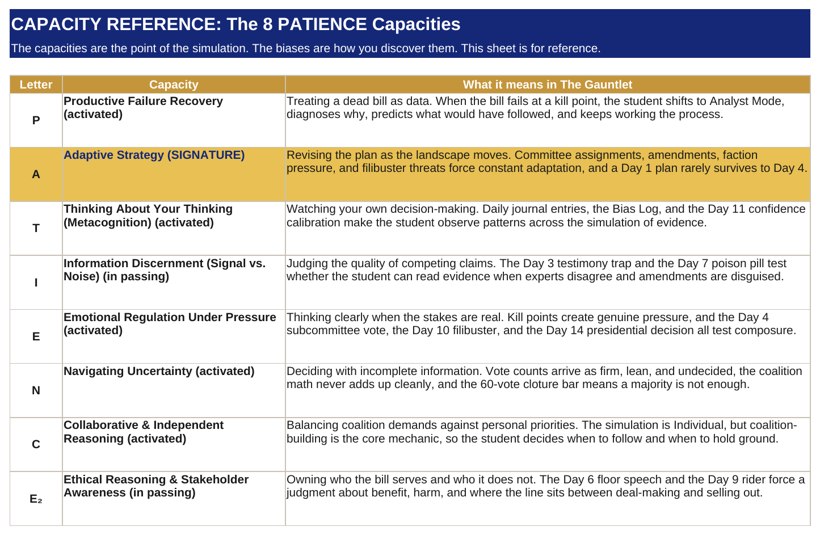
Let the workbook hold the vote math so your students hold the strategy.
The viability score starts at 10 and moves with every choice. Court a committee chair, accept a hostile amendment, strip a provision, the number shifts, and the workbook tracks it in real time. Your students do not hand-tabulate faction support or recompute thresholds at each of the seven kill points. The spreadsheet carries that load. What it surfaces is the consequence: the score sitting just above or just below the survival line on Day 7, the Day 11 cloture bar at its highest. With the arithmetic handled, your students spend their energy where it matters, on whether to call a bluff, which coalition to build, what to give up next. The tool does the bookkeeping. The judgment stays with the student, recorded and visible day by day.
Tap to see the student workbook
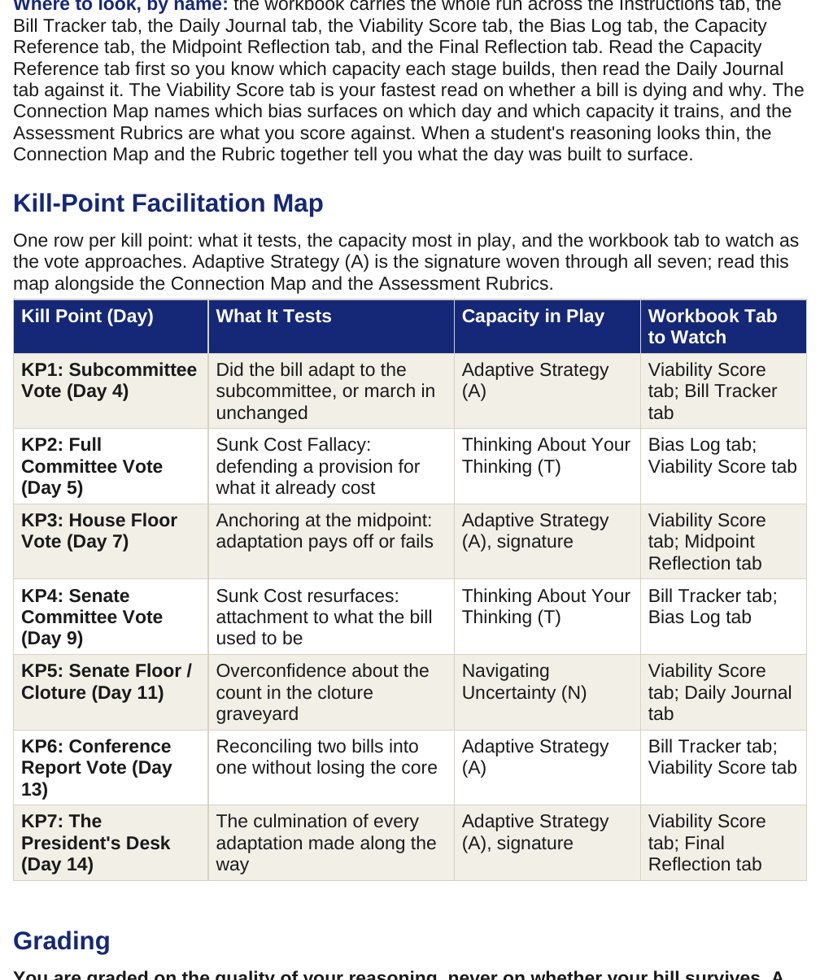
Every day is already scripted. You bring the room, the simulation brings the rest.
The Kill Point Floor Script walks you through all 15 days session by session. It tells you when to trigger the Day 4 subcommittee vote, how to run the Day 10 filibuster threat from Senator Caldwell, and the exact words that move a defeated student into Analyst Mode with dignity: your bill is dead, but you are not done. You do not need to be a parliamentary expert. The guide names the pivot each day, the threshold the bill must clear, and the journal prompt that follows. Prep stays light because the facilitation is written out. You read the room, you push the questions, you keep the pressure honest, and the structure underneath, the factions, the scores, the kill points, is already built.
Tap to read the teacher guide
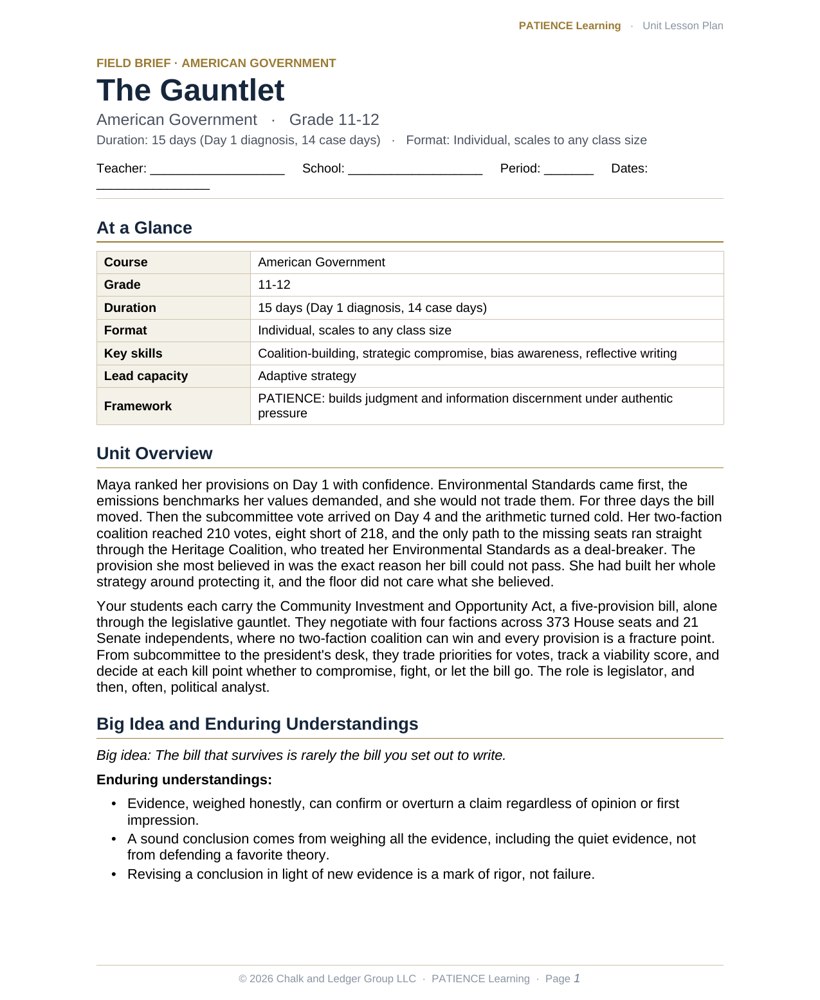
The lesson plan is already written.
Every simulation comes with a fully editable, admin-ready lesson plan. Standards alignment, daily pacing, learning objectives, differentiation, and an assessment plan are already done, so you can hand it to an administrator or adapt it to your district template in minutes.
Tap to preview the lesson plan
Close
Close
Close
Close
The day the favored bill meets the math that will not bend.
Maya ranked her provisions on Day 1 with confidence. Environmental Standards came first, the emissions benchmarks her values demanded, and she would not trade them. For three days the bill moved. Then the subcommittee vote arrived on Day 4 and the arithmetic turned cold. Her two-faction coalition reached 210 votes, eight short of 218, and the only path to the missing seats ran straight through the Heritage Coalition, who treated her Environmental Standards as a deal-breaker. The provision she most believed in was the exact reason her bill could not pass. She had built her whole strategy around protecting it, and the floor did not care what she believed.
She sat with it. Strip the provision and she might survive the House, but she would trigger a hostile chair in the Senate who shared her own values. Keep it and the bill dies here. Maya stopped defending her Day 1 ranking and started reading the landscape as it actually was. She stripped Provision E, logged exactly why in her journal, and watched her viability score climb back above the line. The bill she carried forward was not the one she wanted. It was the one the votes allowed. She could see, for the first time, the difference between what she valued and what she could pass.
One bill, four factions, seven places it can die.
Your students each carry the Community Investment and Opportunity Act, a five-provision bill, alone through the legislative gauntlet. They negotiate with four factions across 373 House seats and 21 Senate independents, where no two-faction coalition can win and every provision is a fracture point. From subcommittee to the president's desk, they trade priorities for votes, track a viability score, and decide at each kill point whether to compromise, fight, or let the bill go. The role is legislator, and then, often, political analyst.
| Grade level | 11-12 |
| Course | American Government |
| Duration | 15 days (Day 1 diagnosis, 14 case days) |
| Format | Individual, scales to any class size |
| Key skills | Coalition-building, strategic compromise, bias awareness, reflective writing |
Engineering better thinkers.
Legislation is where good reasoning meets brutal constraint. Most bills fail, so discernment matters more than enthusiasm. Each day pairs a legislative bias with the capacity that defeats it, activated at the exact moment the case puts that bias under pressure.
| Bias targeted | The remedy, built into the work |
|---|---|
| Anchoring | Productive failure recoveryOn Day 7 the House coalition tests whether students cling to their Day 1 provision ranking. Recovering from a defeated approach, they rebuild around the votes they can actually reach. |
| Confirmation bias | MetacognitionOn Day 5 the full committee markup forces students to examine their own logic, naming where they sought only the faction support that confirmed the plan they already favored. |
| Sunk cost fallacy | Adaptive strategyBy Day 5 students have invested days in a coalition. The committee vote asks whether to keep pouring resources into a failing path or adapt to the landscape as it now stands. |
| Availability bias | Information discernmentFaction profiles and seat counts replace gut feel. Students weigh the actual 218 threshold and exact provision figures rather than the most vivid recent argument they heard. |
| Status quo bias | Navigating uncertaintyOn Day 7 the floor vote rewards students who can move off the comfortable original bill and tolerate the uncertainty of an untested compromise to gain the votes they need. |
| Action bias | Emotional regulationOn Day 10 Senator Caldwell threatens a filibuster. Caldwell is bluffing. Students must regulate the urge to make a costly concession and sit with the discomfort until the threat resolves. |
15 days through the legislative gauntlet.
Day 1 sets the diagnosis: students research biases and rank the five provisions by personal value. From there the bill runs the gauntlet, seven kill points across two chambers, each demanding a fresh coalition and a costly decision. The Day 4 choice compounds for the rest of the run.
| Day | What lands | Capacity in focus |
|---|---|---|
| 1 | Diagnosis: research biases, rank the five provisions by value | Metacognition |
| 4 | Subcommittee vote and the poison-pill decision on Provision E (critical pivot) | Adaptive strategy |
| 5 | Full committee vote after markups tests faction support | Metacognition |
| 7 | House floor vote tests the durability of the coalition | Navigating uncertainty |
| 9 | Senate committee vote and the hostile-chair consequence | Information discernment |
| 10 | Caldwell's filibuster threat, a bluff that tests nerve (critical pivot) | Emotional regulation |
| 11 | Senate floor cloture, the 60-vote graveyard | Navigating uncertainty |
| 12 | Conference committee reconciles the House and Senate versions | Adaptive strategy |
| 14 | The president's desk, final alignment with executive priorities | Information discernment |
| 15 | Final reflection compares Day 1 priorities to the bill's outcome | Adaptive strategy |
Standards alignment.
The Gauntlet is built for the rigor of high-school civics. It maps to the C3 Framework inquiry arc and the NCSS Civic Ideals and Practices strand, and it carries the analytic demands of AP United States Government and Politics, the legislative process, committee system, coalition-building, and checks and balances between Congress and the executive. Students analyze the structure and function of the legislative branch, evaluate why most legislation does not advance, explain the role of compromise in a representative democracy, and assess how the Senate filibuster and conference committee shape outcomes. The writing load, twelve graded journal entries and a 700-word final reflection, meets disciplinary literacy expectations for evidence-based argument in social studies.
The hidden architecture.
The whole machine turns on the Day 4 decision over Provision E, the Environmental Standards poison pill. Strip it to survive the House subcommittee and you guarantee a hostile encounter on Day 9 with a Senate chair from Community First. Restore it in the Senate to win that chair and you manufacture a reconciliation crisis at the Day 12 conference. There is no clean path, which is the point. The seat math is rigged so no two-faction coalition can pass, forcing students off their Day 1 anchor and into real compromise. The Day 10 filibuster is a bluff, planted to catch students who act from anxiety rather than evidence. Failure is engineered to be common, because the reflection on a dead bill is richer than a lucky win, and the rubric pays for that reflection.
Turnkey, classroom-ready.
- An admin-ready lesson plan. A fully editable plan with standards alignment, daily pacing, differentiation, and assessment, ready to adapt to your district template. Included with every purchase.
- The Kill Point Floor Script. Session-by-session facilitation for all 15 days, including the exact language for moving defeated students into Analyst Mode.
- A tech-enabled workbook. Tracks the viability score, faction support, and every threshold in real time so students focus on strategy, not arithmetic.
- Faction and provision files. Four faction profiles with seat counts and red lines, plus the five-provision Community Investment and Opportunity Act.
- The Hybrid-100 rubric. Grades the quality of reasoning across daily journals, holistic quality, and a final reflection, never whether the bill passed.
- Analyst Mode protocol. Predict, analyze, journal, and reflect prompts that keep every student engaged after a bill dies.
- The daily journal system. Twelve graded prompts tied to the seven kill points and five high-stakes decisions, AI-proof by design.
Put your students inside the math of governance.
Bring The Gauntlet to your American Government classroom and let your students learn why most bills fail, and what sound reasoning under pressure actually looks like.
Get this simulationPreview real pages from the simulation before you spend a dollar. No guessing, no surprises.