The Galley
The writer who sounds right is not the same as the file that proves it.
See what your students get, and why it lands.
No mockups. Every page below is real, pulled straight from the files you download. Tap any one to see it full size.
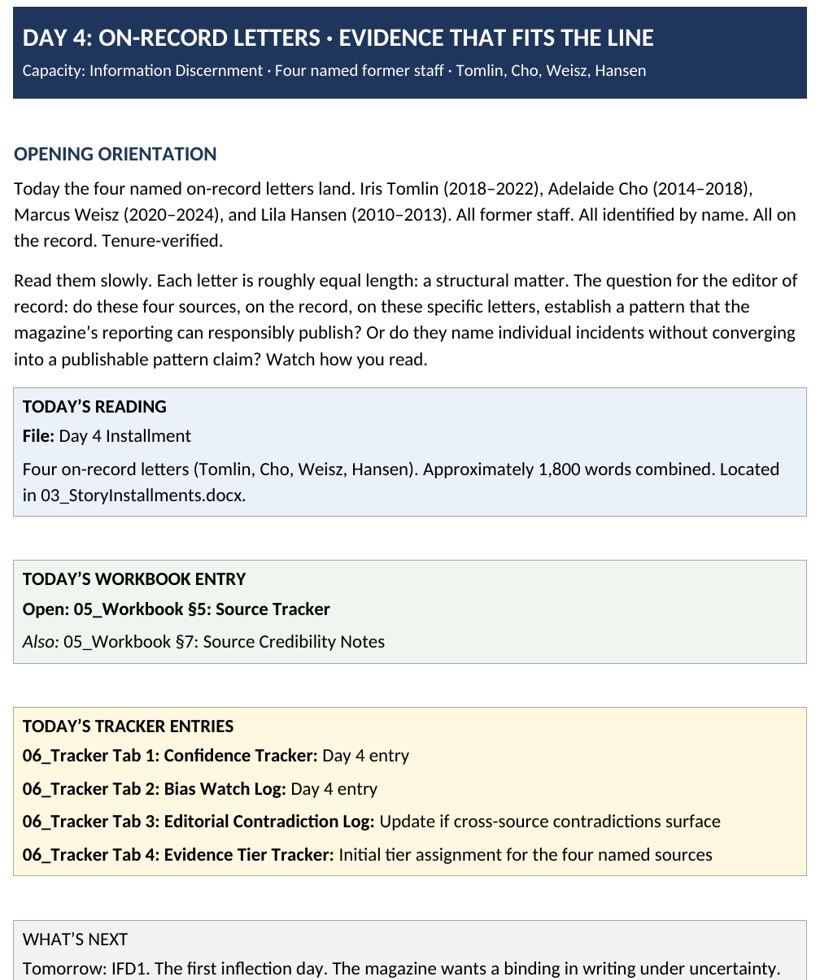
Your students are not answering questions. They are making a call.
This is a real case day from the student files. Your students sit as the editor of record at Loose Leaf magazine, holding a contested longform feature called "Stocked Without Compromise: The Long Reckoning at Marrow Books." The prose is propulsive. The evidence underneath it is uneven. On the page in front of them are Sasha Petrov's polished narrative, on-record letters from former employees Tomlin and Cho, a fact-check return, and a legal threat from the owner's counsel. There is no comprehension worksheet here. Your students have to decide what each source actually proves, whose framing is doing the argumentative work, and whether the file can carry the claim. They read inside the file, not above it, and the decision is theirs.
Tap to see a real case day
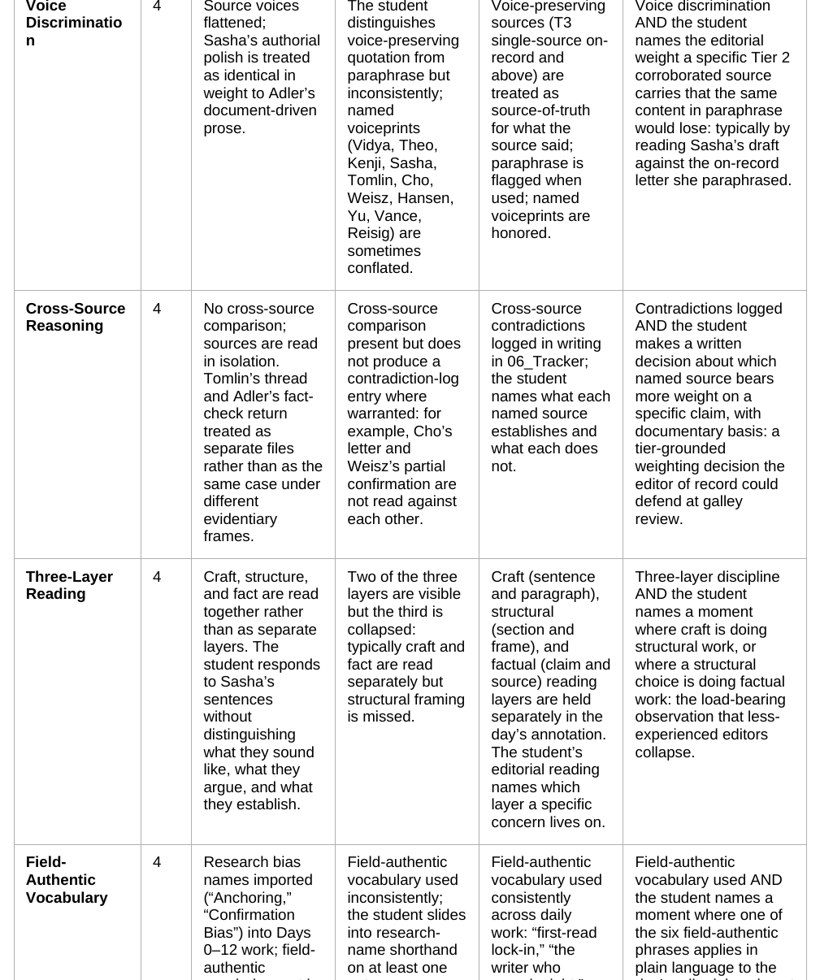
They are graded on their reasoning, not on getting it right.
Your students are not scored on whether they run the story or kill it. They are scored on the rigor and honesty of the path they took to the decision. The Daily Rubric carries 24 points and looks at evidence use, depth of analysis, and what we call world authenticity, the discipline of reading from inside the editor's chair rather than reaching for a clever take. A sound process behind a wrong call beats a lucky guess every time. To reach the top band, a student has to write a falsification condition that could actually be tested, naming the specific document that would change their mind, not a vague promise to reconsider later. The rubric rewards the careful path and refuses to reward bluffing.
Tap to read the grading rubric
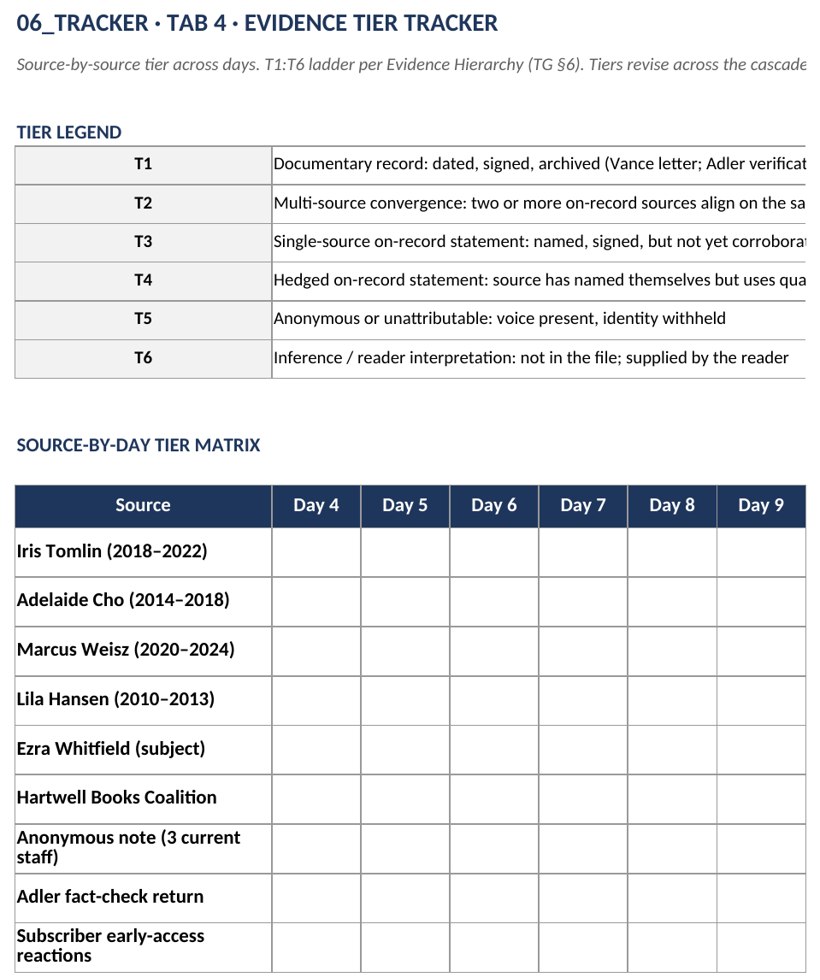
Let the workbook hold the busywork so judgment gets the energy.
The Tracker carries the record so your students do not have to. It holds every source in the file, tags each one against the six-tier evidence hierarchy, and follows tier movement as the case develops. A claim that starts as a social media thread at the bottom tier can climb when an on-record letter arrives, then climb again when a second source corroborates it. The spreadsheet keeps the day count, the confidence ratings, and the running notes in one place, so your students are not copying source names or hunting for what they wrote on Day 2. Their energy goes where it matters, into weighing what each piece of evidence is worth and noticing when their own read is drifting ahead of the file.
Tap to see the tracker
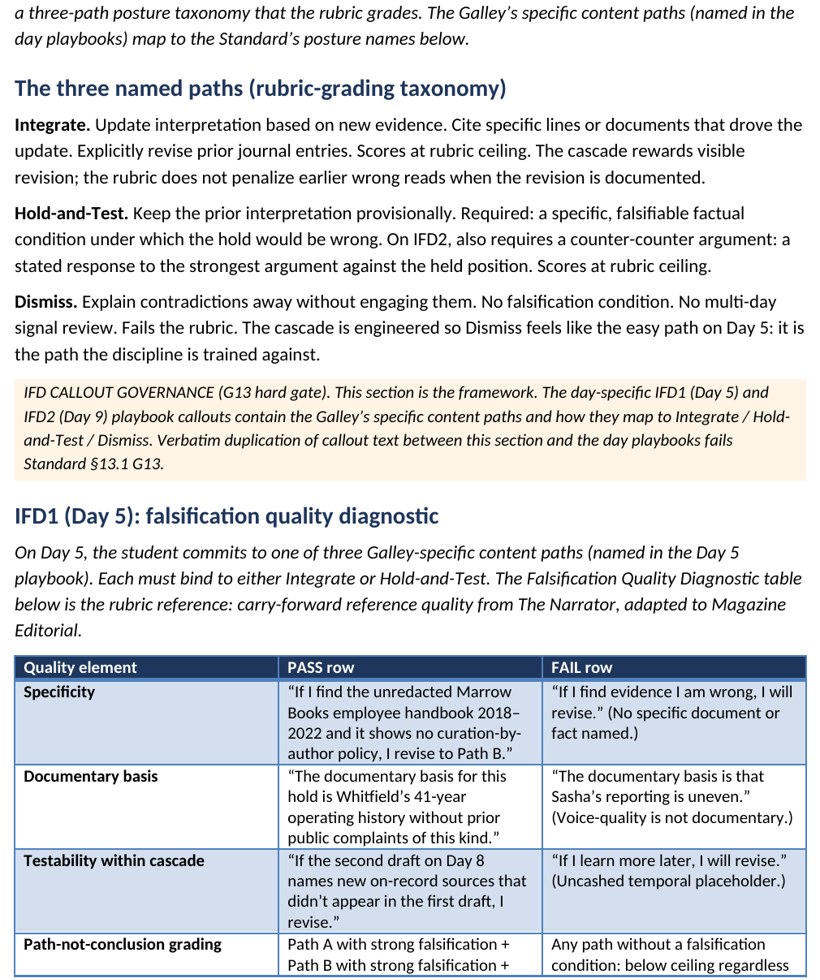
Every day is already scripted. You bring the facilitation.
The Teacher Guide runs each session to the minute and fits a standard 50-minute period. Every day follows the same clear arc: a short opening to surface what your students arrived with, a stretch where the new artifact lands and gets examined, a discussion block where they defend or revise their reading out loud, and a closing workbook entry that produces the day's written record. The guide tells you what to say, what to hand out, where students predictably stumble, and how to steer the conversation without giving the answer away. You do not build any of it. You bring the facilitation and the room, the simulation brings the case, the timing, and the script. Prep stays light.
Tap to read the teacher guide
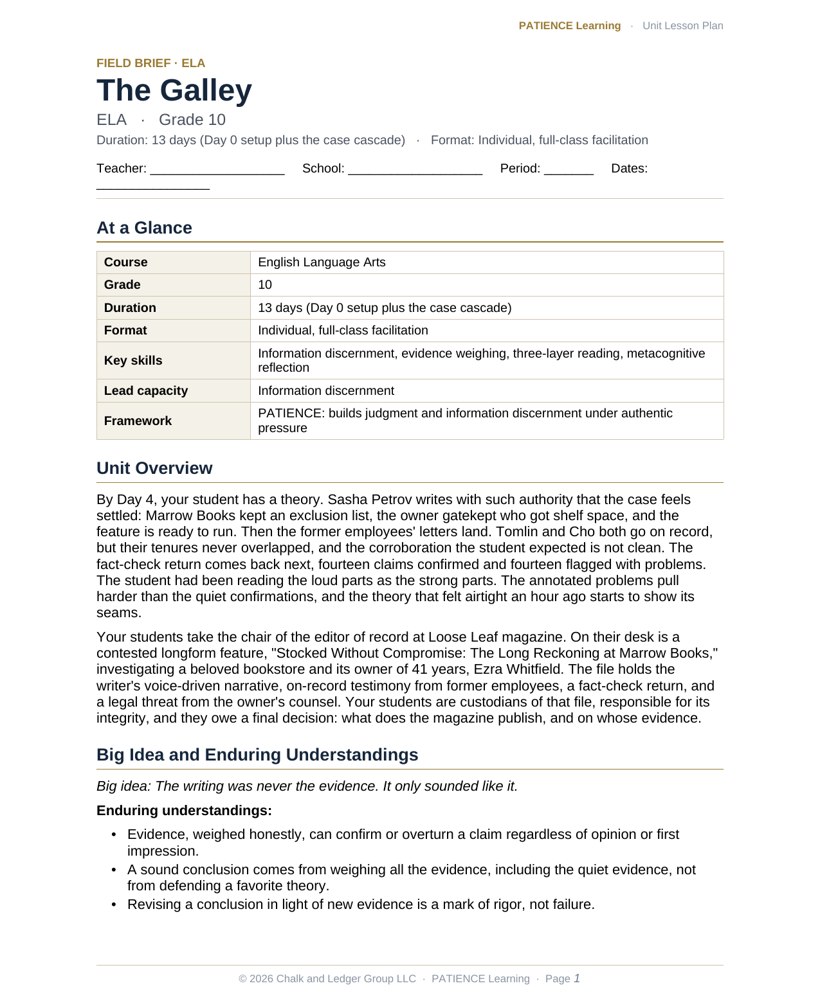
The lesson plan is already written.
Every simulation comes with a fully editable, admin-ready lesson plan. Standards alignment, daily pacing, learning objectives, differentiation, and an assessment plan are already done, so you can hand it to an administrator or adapt it to your district template in minutes.
Tap to preview the lesson plan
Close
Close
Close
Close
The day the better-written version turns out to be the thinner one.
By Day 4, your student has a theory. Sasha Petrov writes with such authority that the case feels settled: Marrow Books kept an exclusion list, the owner gatekept who got shelf space, and the feature is ready to run. Then the former employees' letters land. Tomlin and Cho both go on record, but their tenures never overlapped, and the corroboration the student expected is not clean. The fact-check return comes back next, fourteen claims confirmed and fourteen flagged with problems. The student had been reading the loud parts as the strong parts. The annotated problems pull harder than the quiet confirmations, and the theory that felt airtight an hour ago starts to show its seams.
Now the student has to choose. The propulsive narrative is still the easiest thing to believe, and protecting it means explaining the contradictions away. Trusting the evidence means slowing down, separating Petrov's polish from what the record actually establishes, and admitting the file does not yet carry the claim the way it is written. When the student stops defending the theory and starts weighing the tiers, the case reorganizes. The strongest sentences were never the strongest evidence. What the file proves and what it merely asserts finally pull apart, and the student can see the difference.
Editor of record at Loose Leaf magazine.
Your students take the chair of the editor of record at Loose Leaf magazine. On their desk is a contested longform feature, "Stocked Without Compromise: The Long Reckoning at Marrow Books," investigating a beloved bookstore and its owner of 41 years, Ezra Whitfield. The file holds the writer's voice-driven narrative, on-record testimony from former employees, a fact-check return, and a legal threat from the owner's counsel. Your students are custodians of that file, responsible for its integrity, and they owe a final decision: what does the magazine publish, and on whose evidence.
| Grade level | 10 |
| Course | English Language Arts |
| Duration | 13 days (Day 0 setup plus the case cascade) |
| Format | Individual, full-class facilitation |
| Key skills | Information discernment, evidence weighing, three-layer reading, metacognitive reflection |
Engineering better thinkers.
Discernment matters here because the file rewards the wrong instinct. The most persuasive prose sits on the thinnest evidence, so each day pairs a predictable bias with the capacity that defeats it, training your students to weigh what kind of evidence a source is before deciding what it says.
| Bias targeted | The remedy, built into the work |
|---|---|
| Anchoring | Productive failure recoveryA forced confidence rating on Day 2 locks in the first read, then later evidence pulls against it, so students practice updating a view they have already committed to rather than defending it. |
| Confirmation bias | MetacognitionSymmetric letters from Tomlin and Cho expose whether a student only weights the evidence that fits their opening theory, forcing them to watch their own reading for selective attention. |
| Sunk cost fallacy | Adaptive strategyDays of investment in one theory tempt students to keep it. The binding decision on Day 5 lets them integrate, hold and test, or dismiss, and rewards changing course when the file demands it. |
| Availability bias | Information discernmentThe fact-check return delivers fourteen confirmations and fourteen flagged problems. The loud, annotated problems feel weightier, and the six-tier hierarchy teaches students to rank evidence by kind, not by volume. |
| Tunnel vision | Navigating uncertaintyStudents must document what the file does not establish alongside what it does, writing observable falsification conditions instead of filling gaps with speculation or a single fixed storyline. |
| Overconfidence | Emotional regulationPetrov's authoritative tone invites a reactive read. Students learn to notice when a writer's polish is steering them and to hold that polish at arm's length to keep an objective editorial standard. |
13 days of evidence under deadline.
The early days set the file in front of your students and force a first read they have to own. From there the cascade builds: testimony arrives, the fact-check returns, two binding decisions land, and the case reorganizes. The final days turn the lens back on the students' own thinking and name what they have been doing all along.
| Day | What lands | Skill in focus |
|---|---|---|
| 1 | The file opens. Students meet the feature and the role of editor of record. | Reading from within the role |
| 2 | A forced confidence rating locks in the first read. | Naming an anchor |
| 3 | The writer's authority gets separated from her evidence. | Craft versus fact |
| 4 | On-record letters and the fact-check return land together. | Weighing testimony |
| 5 | The first binding decision: integrate, hold and test, or dismiss (critical pivot). | Updating under evidence |
| 6 | The loudest claims get re-weighed against the quiet confirmations. | Resisting volume |
| 7 | Source motive and tier movement get tracked across the file. | Evidence hierarchy |
| 8 | Gaps in the record get documented as gaps, not filled. | Naming uncertainty |
| 9 | The frame decision: whose story the magazine is publishing (critical pivot). | Owning the frame |
| 10 | A quote-yourself audit tests whether students think they saw it coming. | Intellectual honesty |
| 11 | The full file is reconciled toward a publishable decision. | Synthesis |
| 12 | The final Galley Letter decision and reflection are drafted. | Defending the path |
| 13 | The reveal: the research names behind each day's work are unveiled. | Metacognitive transfer |
Standards alignment.
The Galley targets the core of the Grade 10 reading and writing standards. Students cite strong textual evidence and weigh what the file supports under CCSS.ELA-LITERACY.RI.9-10.1, evaluate an author's argument and the sufficiency of evidence under RI.9-10.8, and analyze how Petrov's word choice and structure shape meaning and tone under RI.9-10.4 and RI.9-10.5. The daily workbook and final letter build argument writing under W.9-10.1, where students support a claim with reasoning and relevant evidence and acknowledge counterclaims. Daily discourse develops collaborative reasoning under SL.9-10.1, and close attention to the writer's framing supports language analysis under L.9-10.3.
The hidden architecture.
The case is built as a symmetry test. The narrative is propulsive and the evidence is deliberately balanced, so the feature reads as settled while the record stays uneven. The polish is the trap. Petrov's authority is engineered to do argumentative work the sources cannot sustain, which is what pulls a confident first read off course. The contradictions are planted to surface after students commit: the Day 2 confidence rating anchors them, then Tomlin and Cho's non-overlapping tenures and the split fact-check return strain the theory they have invested in. The dismiss posture is designed to fail the rubric because it explains contradictions away instead of engaging the file. What forces the sound conclusion is the evidence hierarchy. Once students rank sources by kind rather than by how loud or well-written they are, the boring, methodical path produces the stronger read, and the exciting guess collapses.
Turnkey, classroom-ready.
- An admin-ready lesson plan. A fully editable plan with standards alignment, daily pacing, differentiation, and assessment, ready to adapt to your district template. Included with every purchase.
- 13-day playbooks. Minute-by-minute facilitation for every session, built to fit a standard 50-minute period.
- A tech-enabled tracker. The student workbook holds every source, tags it against the six-tier evidence hierarchy, and follows tier movement across the case.
- Turnkey student files. The full editorial dossier: the contested feature, on-record letters, the fact-check return, and the legal threat, ready to hand out.
- A dual rubric system. A 24-point Daily Rubric and a 30-point Final Reflection Rubric grade the quality of reasoning, not whether students solve it.
- The Day 13 reveal. A discovery-first close that names the cognitive biases behind each day only after students have met them in the wild of the file.
Bring the editor's chair to your room.
Give your Grade 10 readers 13 days inside a real editorial file, where careful evidence work beats the persuasive guess and they learn to tell the difference.
Get this simulationPreview real pages from the simulation before you spend a dollar. No guessing, no surprises.