The Fix
The confident story is not the same as the correct one. Your students learn to tell the difference.
See what your students get, and why it lands.
No mockups. Every page below is real, pulled straight from the files you download. Tap any one to see it full size.
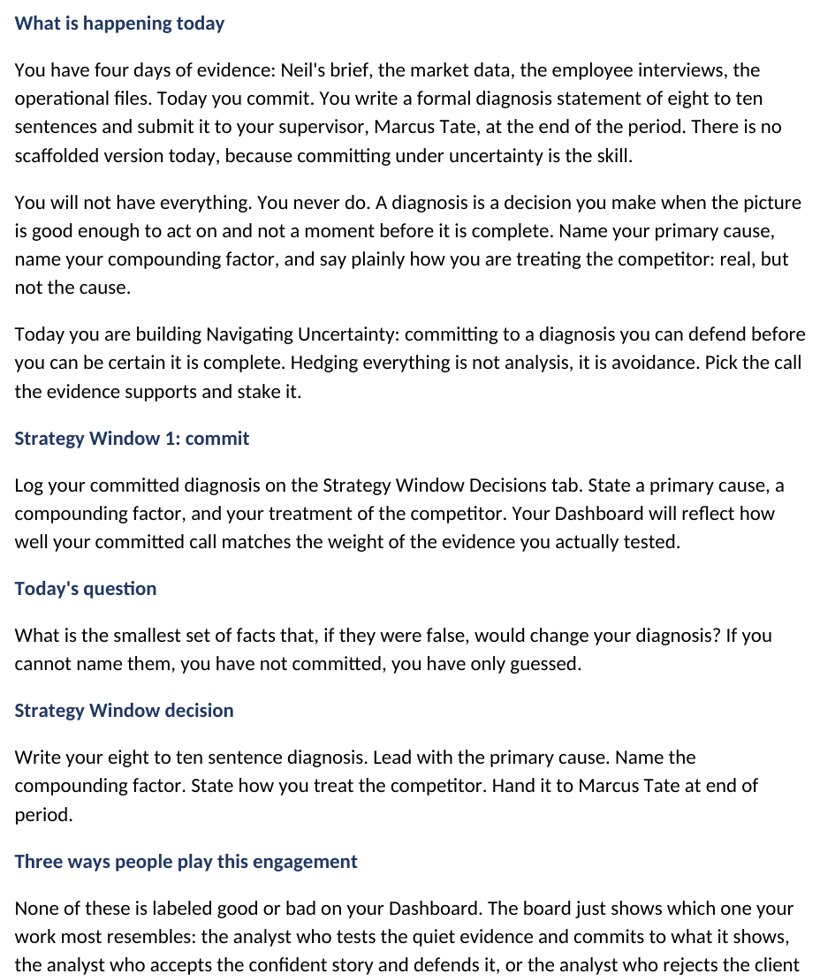
Your students are not answering questions. They are making a real call.
On this page your students are junior analysts at Meridian Consulting Group, and the client is in front of them. Neil, the founder of Bridgewater Brewing, has a clean story for why his revenue is sliding: a new competitor called Ironside. The page does not ask students to summarize his explanation. It asks them to act on it. They have the client's claim on one side and the operational files on the other, and the quality scores below 80 for fourteen of eighteen months do not match the story they are being told. Students decide what to trust, name what they would test next, and commit a diagnosis in writing. The call is theirs.
Tap to see a student case page
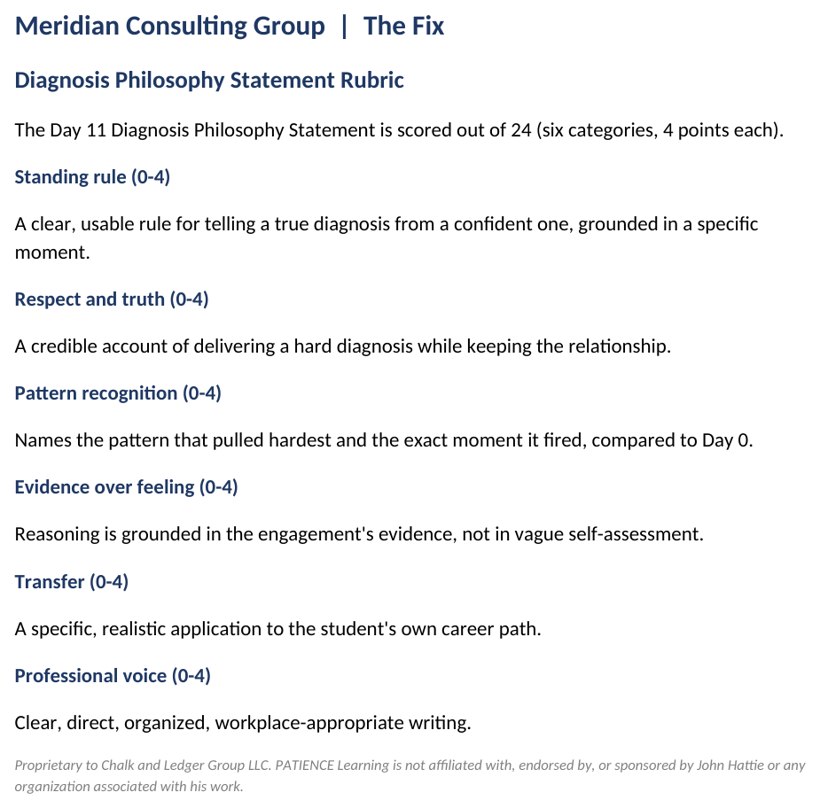
They are graded on how they reasoned, not on whether they were lucky.
This is the rubric, and it is built to reward the boring, careful path. Daily journals across Days 1 through 10 carry 80 points, scored on reasoning specificity, evidence citation, and whether the day's capacity actually landed. The formal peer critique on Day 8 carries 16 points. The capstone Diagnosis Philosophy Statement carries 24 points. Underneath sits the Four Counters, Diagnostic Accuracy, Evidence Tested, Stakeholder Respect, and Reasoning Discipline, so a student who tests more evidence before committing scores higher than one who guesses well. A sound process behind a wrong call beats a lucky hit. Students stop chasing the answer and start defending the work that produced it.
Tap to read the grading rubric
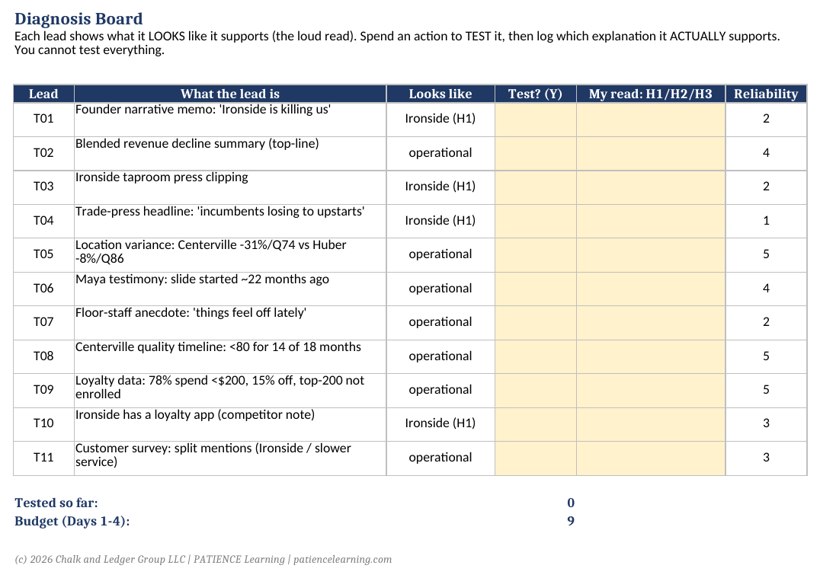
Let the workbook hold the busywork so the energy goes to judgment.
This is the student cockpit, an automated workbook and dashboard that carries the administrative weight. The scoreboard tracks the Four Counters in real time, so a student can see whether they are testing evidence or swallowing the story before the day is over. Each day is self-contained, meaning every fact a student needs for that session is packaged in front of them, with no outside research required. The dashboard logs progress, flags thin reasoning, and totals the journal work, which removes the manual grading drag for you. What the tool does not do is decide. It clears the clutter so your students spend their attention on the call that matters, weighing Neil's confident narrative against the cold math of his own files.
Tap to see the tracker
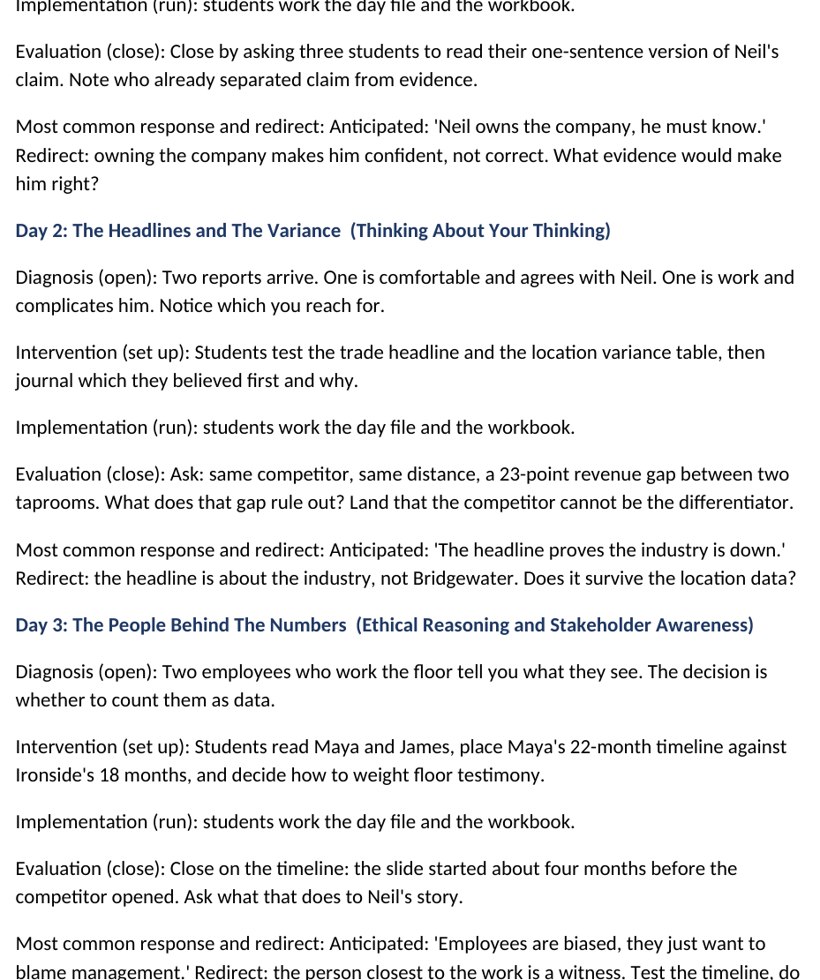
Every day is already scripted. You bring the facilitation, the sim brings the rest.
This is the teacher guide, and it is written so prep stays light. Every one of the twelve days carries DIIE say-scripts, exact language for Diagnosis, Intervention, Implementation, and Evaluation, so you always have a line ready when a student drifts. When a class starts trusting Neil because he owns the company, the guide hands you the redirect: owning the company makes Neil confident, not correct. Self-contained day files mean you are not hunting for materials between sessions. You act as a high-level coach, using the provided language to nudge the student who is swallowing the story or burning the client. The guide does the planning. You do the coaching, and that is where your time should go.
Tap to read the teacher guide
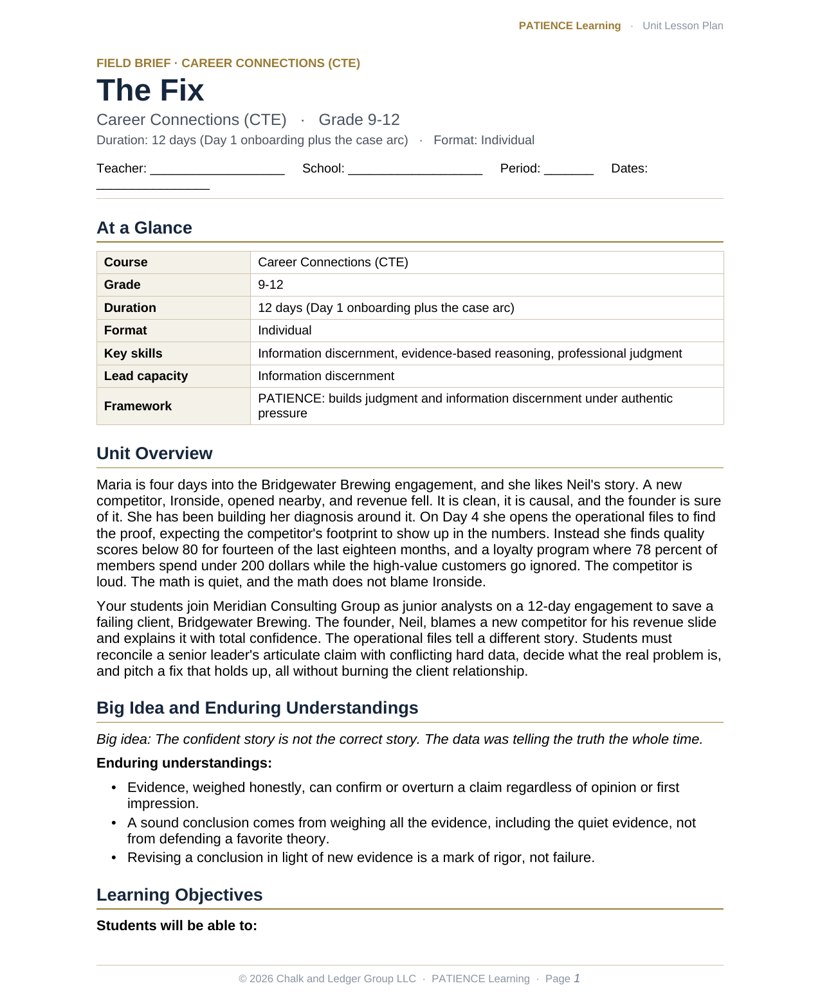
The lesson plan is already written.
Every simulation comes with a fully editable, admin-ready lesson plan. Standards alignment, daily pacing, learning objectives, differentiation, and an assessment plan are already done, so you can hand it to an administrator or adapt it to your district template in minutes.
Tap to preview the lesson plan
Close
Close
Close
Close
The day the easy story stops adding up.
Maria is four days into the Bridgewater Brewing engagement, and she likes Neil's story. A new competitor, Ironside, opened nearby, and revenue fell. It is clean, it is causal, and the founder is sure of it. She has been building her diagnosis around it. On Day 4 she opens the operational files to find the proof, expecting the competitor's footprint to show up in the numbers. Instead she finds quality scores below 80 for fourteen of the last eighteen months, and a loyalty program where 78 percent of members spend under 200 dollars while the high-value customers go ignored. The competitor is loud. The math is quiet, and the math does not blame Ironside.
Here is her pivot. She can keep the competitor story, because Neil believes it and it is easy to write up, or she can follow the operational math that points back inside the business. Protecting the story means a confident diagnosis that treats the wrong problem. Trusting the evidence means telling the founder something he does not want to hear. Maria chooses the math. Once she does, the real fix comes into focus: the decline is a quality and loyalty problem, not a marketing one, and no amount of fighting Ironside would have touched it.
Twelve days inside a struggling brewery.
Your students join Meridian Consulting Group as junior analysts on a 12-day engagement to save a failing client, Bridgewater Brewing. The founder, Neil, blames a new competitor for his revenue slide and explains it with total confidence. The operational files tell a different story. Students must reconcile a senior leader's articulate claim with conflicting hard data, decide what the real problem is, and pitch a fix that holds up, all without burning the client relationship.
| Grade level | 9-12 |
| Course | Career Connections (CTE) |
| Duration | 12 days (Day 1 onboarding plus the case arc) |
| Format | Individual |
| Key skills | Information discernment, evidence-based reasoning, professional judgment |
Engineering better thinkers.
Discernment matters here because the loudest voice in the room is the client, and he is wrong. Each day pairs a named pull with the capacity that defeats it, so students feel the bias before they can name it, then build the discipline that beats it.
| Bias targeted | The remedy, built into the work |
|---|---|
| Anchoring | Productive failure recoveryNeil's competitor story anchors the whole class on Day 5. Students must commit a written diagnosis, then recover when the operational math drags the anchor loose and forces a rethink. |
| Confirmation bias | MetacognitionOn Day 2 a comfortable industry headline sits beside a complicating location-variance table. Students watch themselves reach for the headline, then choose the table that complicates their case. |
| Sunk cost fallacy | Adaptive strategyBy Day 7 students have invested days in a theory. The Held Bet tempts them to defend it. Adaptive strategy lets them drop sunk work and treat the root cause, not the symptom. |
| Availability bias | Information discernmentLoud leads grab attention while quiet operational math sits ignored. On Day 4 students rank data reliability and choose the unglamorous numbers over the vivid competitor narrative. |
| Tunnel vision | Navigating uncertaintyOn Day 5 the data still feels incomplete, but a diagnosis is due. Students commit under uncertainty instead of waiting for perfect information that never arrives. |
| Overconfidence | Emotional regulationA 50,000 dollar funding cap on Day 8 forces one high-leverage choice under pressure. Students regulate the urge to overreach and back the fix the evidence supports. |
Twelve days of evidence over narrative.
The opening days teach students to rank reliability and separate loud leads from quiet math. From there the case climbs: a diagnosis under pressure, a root-cause fix, a funding constraint, peer critique, a rehearsal, and finally the Reveal where the patterns they felt get named.
| Day | What lands | Capacity in focus |
|---|---|---|
| 1 | Onboarding at Meridian and ranking data reliability against the Authority Pull | Information discernment |
| 2 | A comfortable industry headline set against a complicating location-variance table | Metacognition |
| 3 | Weighing floor testimony from employees like Maya and James against executive claims | Ethical reasoning and stakeholder awareness |
| 4 | Choosing the quiet operational math over the loud competitor lead (critical pivot) | Information discernment |
| 5 | Committing a written diagnosis while the data still feels incomplete | Navigating uncertainty |
| 6 | Designing a fix that treats the root cause, quality and loyalty, not the symptom | Adaptive strategy |
| 7 | Facing the Held Bet and the pull to defend an already-invested theory | Adaptive strategy |
| 8 | Making one high-leverage choice under a 50,000 dollar funding cap, plus peer critique | Emotional regulation |
| 9 | Integrating or declining peer critique based on the evidence | Collaborative and independent reasoning |
| 10 | A rehearsal built to expose weak seams in the pitch while they are cheap to fix | Productive failure recovery |
| 11 | The Reveal, where the 10-pattern glossary names the pulls students already felt | Metacognition |
| 12 | The Diagnosis Philosophy Statement, turning the experience into a Standing Rule | Information discernment |
Standards alignment.
The Fix is a Career Connections (CTE) simulation aligned to the Career Ready Practices and the Common Career Technical Core (CCTC). It develops the employability skills employers ask for directly: critical thinking, problem solving, and creativity, mapped to the Career Ready Practices of the Common Career Technical Core. Students apply academic and technical knowledge in a workplace context, attend to detail and accuracy in analyzing data, communicate a diagnosis professionally, and act as responsible contributors who weigh stakeholder claims against evidence. Because this is a CTE Career Connections sim, it does not target CCSS-ELA or mathematics codes. The alignment is to career readiness and employability, where the work belongs.
The hidden architecture.
The design secret is the Discovery-First build. Students are never told the names of the cognitive biases until the Day 11 Reveal, because naming a bias early creates a defensive posture where students produce inauthentic data to pass the test. So the sim lets them feel the pull first. Neil's competitor story is the planted contradiction: it is articulate, confident, and false, while the truth sits in the operational files, quality scores below 80 for fourteen of eighteen months and a top-heavy loyalty program. The Authority Pull and confirmation bias lead students to trust the founder. Day 4 forces the choice between the loud lead and the quiet math. The math is what forces the sound conclusion, and the Day 11 glossary becomes a post-game film review of what they already lived.
Turnkey, classroom-ready.
- An admin-ready lesson plan. A fully editable plan with standards alignment, daily pacing, differentiation, and assessment, ready to adapt to your district template. Included with every purchase.
- 12-day playbooks. DIIE say-scripts for Diagnosis, Intervention, Implementation, and Evaluation give you exact redirect language for every session.
- A tech-enabled workbook. An automated student cockpit and dashboard tracks the Four Counters in real time and removes manual grading.
- Self-contained student day files. Every fact a student needs for the day is packaged in front of them, with no outside research required.
- A dual rubric system. Grades the quality of reasoning, evidence tested, and stakeholder respect, not whether they reach the right answer.
- The Day 11 pattern glossary. A 10-pattern reveal that turns the engagement into a post-game film review and a permanent professional toolkit.
- The capstone assignment. The Diagnosis Philosophy Statement, where students turn 12 days into a usable Standing Rule for the workplace.
Teach the call before they have to make it for real.
Bring The Fix to your classroom and give your students twelve days of practice telling a confident story from a correct one, before a real boss tells them theirs.
Get this simulationPreview real pages from the simulation before you spend a dollar. No guessing, no surprises.