The Expedition
The flashy mine site is a trap. The boring baselines hold the answer.
See what your students get, and why it lands.
No mockups. Every page below is real, pulled straight from the files you download. Tap any one to see it full size.
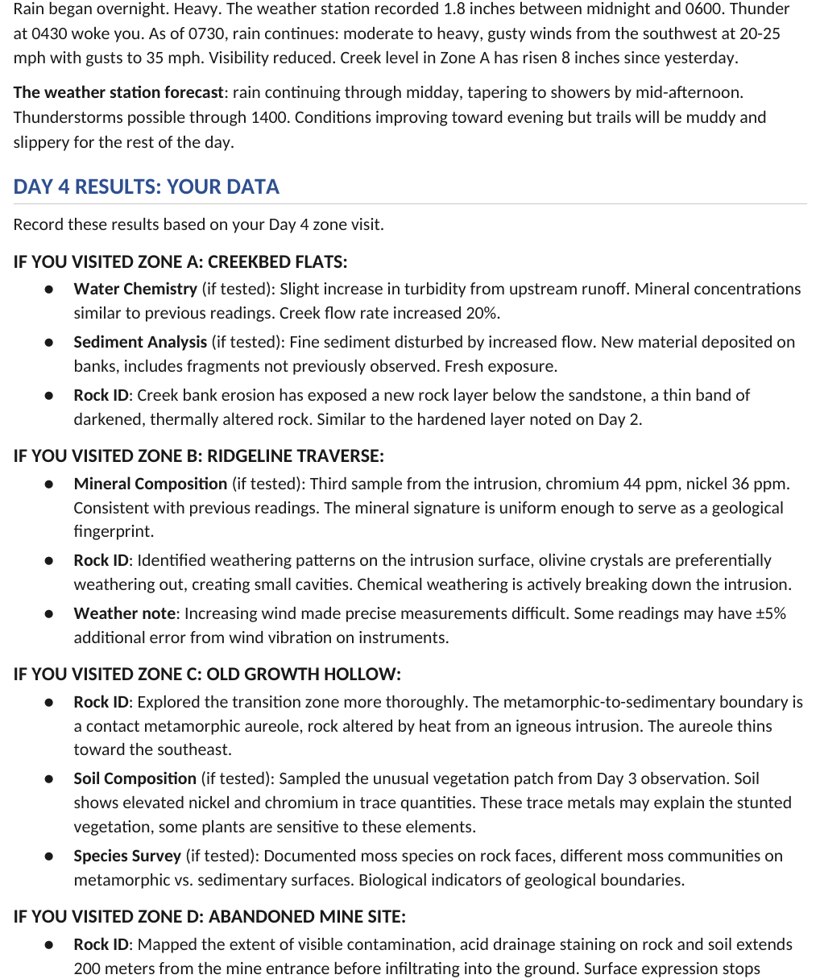
Your students are not answering questions. They are spending a real day at Harmon Ridge.
Each day opens with a field briefing, not a worksheet. Students read the morning conditions, weigh which of the five survey zones to enter, and commit batteries, sample containers, and water against what they hope to learn. Zone D, the abandoned mine, looks dramatic and contaminated. Zone A, a quiet creekbed, looks like nothing. The page hands students the readings and the costs, then asks them to make the call alone. Do they chase the spectacle or build the broad baseline that connects the ridge to the creek? There is no menu of correct steps. There is a landscape, a finite supply pack, and a decision that the next day will judge.
Tap to see a survey day
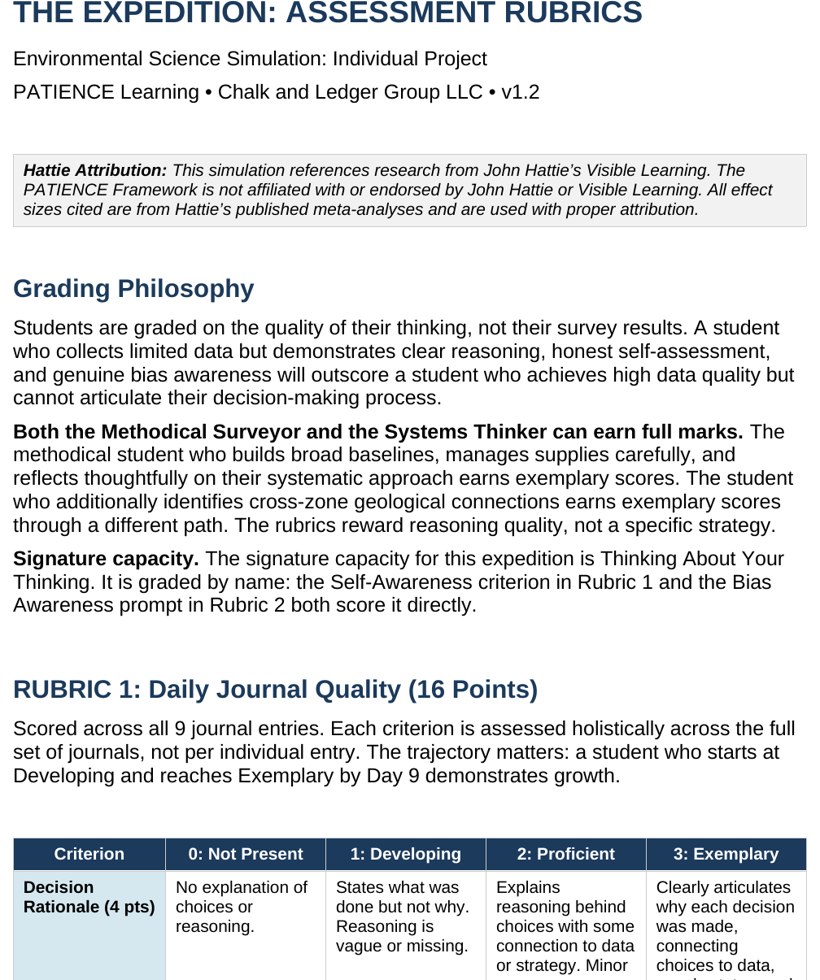
A sound survey behind exhausted supplies beats perfect data with a shallow reason.
Two rubrics, and both grade the thinking. The 16-point Daily Journal scores how a student justifies each zone choice, names the bias pulling at them, and adjusts when a reading does not fit. The 20-point Final Reflection scores whether they can step back and explain their own path. A student who burns through supplies but writes an honest account of chasing the mine outscores a student with clean numbers and a thin reflection. The Mine Explorer is graded on the honesty of recognizing their framing bias. The Weather Refugee is graded on naming the availability heuristic in their own choices. Getting the geology right helps, but it never carries a weak reason.
Tap to read the grading rubric
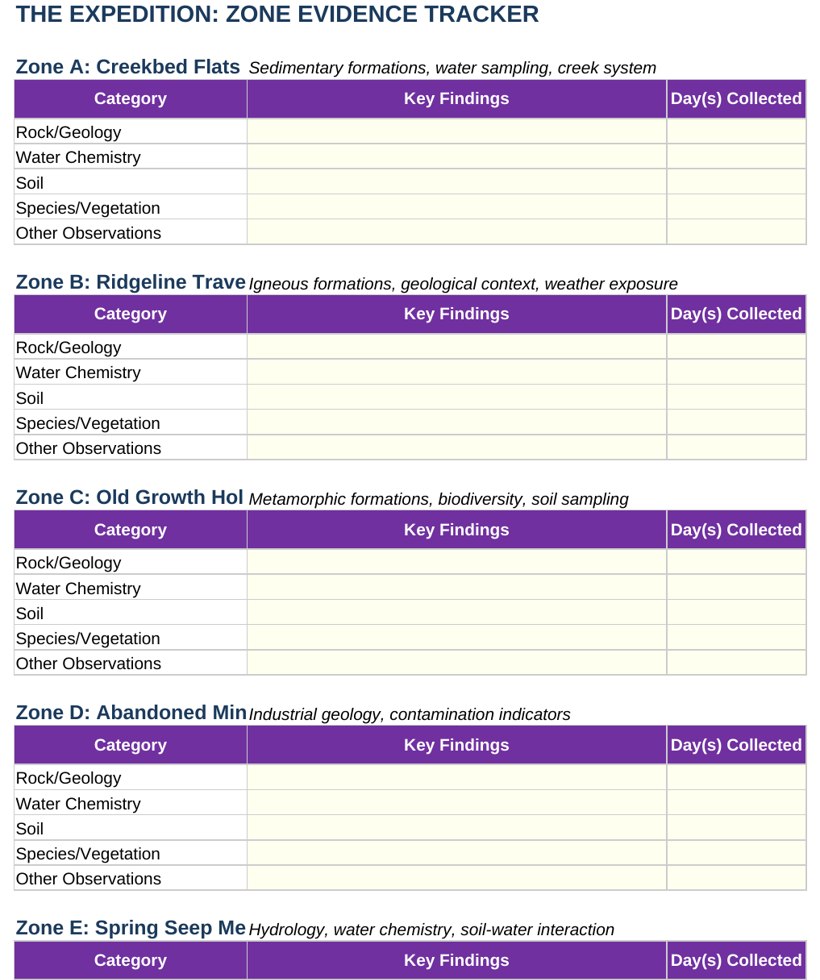
Let the workbook hold the supply math so your students spend their energy on the judgment.
The field workbook is a spreadsheet that does the bookkeeping. It tracks the battery, container, and water balance after every zone, logs each Chromium and Nickel reading, and keeps the running data set in one place so nobody loses a number. Students are not adding columns or hunting for last Tuesday's value. The workbook frees them to do the part that matters: compare the 45 ppm source at the ridge against the 15 ppm signature in the creek and ask what moved between them. When the Day 7 equipment failure hits, the workbook still holds every prior reading, which is exactly what a systems thinker needs to keep going. The tool carries the busywork; the student carries the reasoning.
Tap to see the tracker
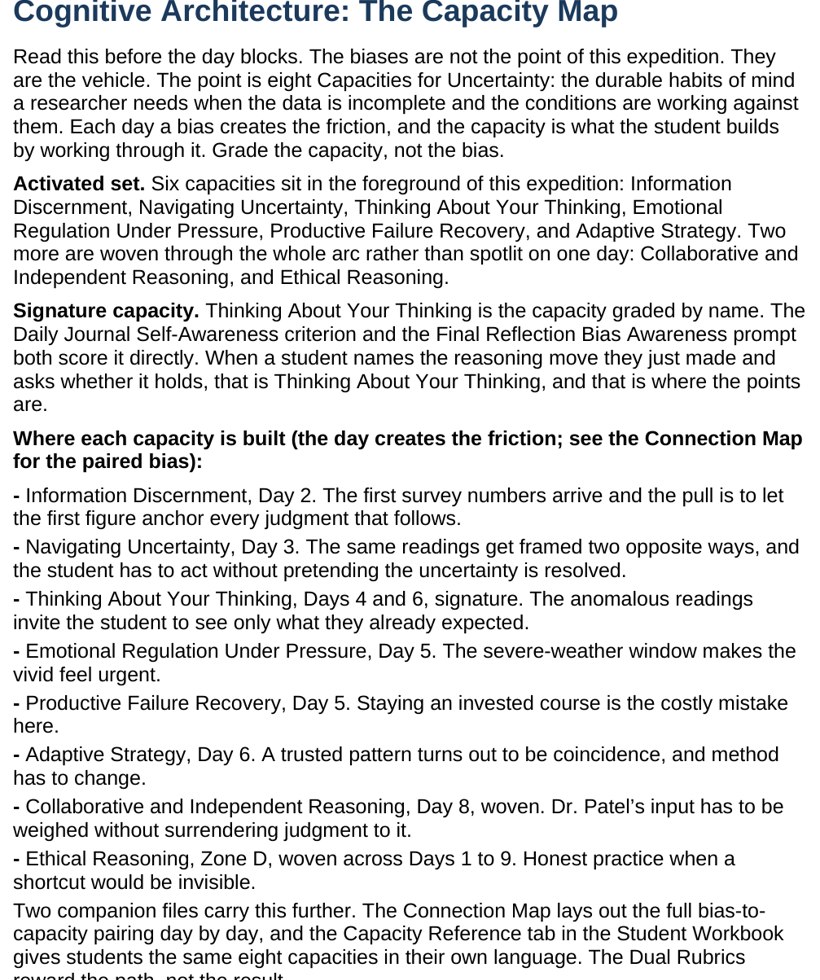
Every day is already scripted. You bring the facilitation; the simulation brings everything else.
The teacher guide scripts Day 0 through Day 9 with exact timing and lines to read aloud. You do not need to know mineralogy or the Appalachian lithosphere. Each page tells you what to say, what students are deciding, and what to watch for, including a Bias-Watch box that names the cognitive trap each day is built to spring. The release pages, the anomalous data alert, the storm, and the equipment failure are all pre-built and dropped in on cue. The guide flexes around a fire drill or a snow day without losing momentum. Read the day's page and run it. Your job is to facilitate the conversation, not to author the science or the schedule.
Tap to read the teacher guide
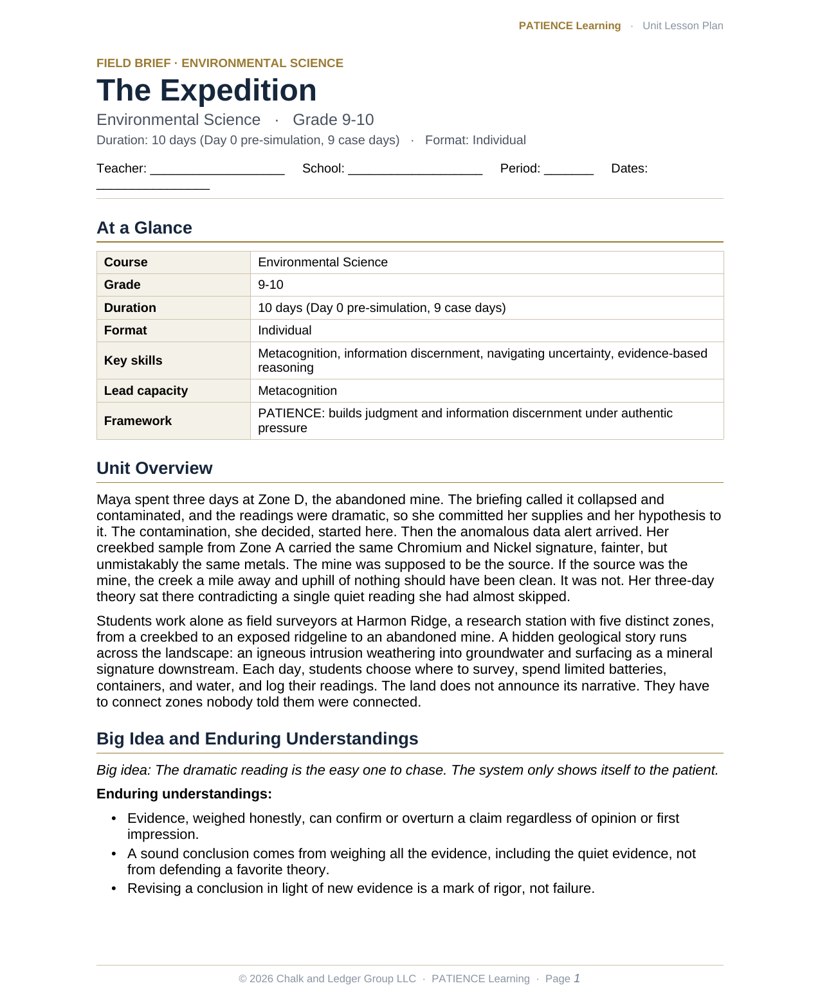
The lesson plan is already written.
Every simulation comes with a fully editable, admin-ready lesson plan. Standards alignment, daily pacing, learning objectives, differentiation, and an assessment plan are already done, so you can hand it to an administrator or adapt it to your district template in minutes.
Tap to preview the lesson plan
Close
Close
Close
Close
The moment the mine stops being the story.
Maya spent three days at Zone D, the abandoned mine. The briefing called it collapsed and contaminated, and the readings were dramatic, so she committed her supplies and her hypothesis to it. The contamination, she decided, started here. Then the anomalous data alert arrived. Her creekbed sample from Zone A carried the same Chromium and Nickel signature, fainter, but unmistakably the same metals. The mine was supposed to be the source. If the source was the mine, the creek a mile away and uphill of nothing should have been clean. It was not. Her three-day theory sat there contradicting a single quiet reading she had almost skipped.
Maya had a choice. She could explain the creek away, protect the days she had already spent, and keep the tidy story. Or she could trust the reading and start over. She pulled up the ridge data she had filed and forgotten: 45 ppm at the igneous intrusion, weathering downhill. She traced it through the spring seep, into the groundwater, down to the 15 ppm in the creek. The mine was loud and local. The real story ran across the whole landscape, and it had been in her workbook the entire time. She had been surveying a red herring.
A remote research station at 1,840 feet.
Students work alone as field surveyors at Harmon Ridge, a research station with five distinct zones, from a creekbed to an exposed ridgeline to an abandoned mine. A hidden geological story runs across the landscape: an igneous intrusion weathering into groundwater and surfacing as a mineral signature downstream. Each day, students choose where to survey, spend limited batteries, containers, and water, and log their readings. The land does not announce its narrative. They have to connect zones nobody told them were connected.
| Grade level | 9-10 |
| Course | Environmental Science |
| Duration | 10 days (Day 0 pre-simulation, 9 case days) |
| Format | Individual |
| Key skills | Metacognition, information discernment, navigating uncertainty, evidence-based reasoning |
Engineering better thinkers.
Real field science is noisy, resources run out, and the loudest data point is rarely the most important. Discernment is the whole job. Each day at Harmon Ridge triggers a specific bias on purpose, then pairs it with the capacity that defeats it, so students practice catching their own thinking in motion.
| Bias targeted | The remedy, built into the work |
|---|---|
| Anchoring | Productive failure recoveryThe first big reading, 45 ppm at the ridge, becomes the number every later sample is judged against. Students learn to recover when that anchor stops fitting the landscape and a fresh baseline is needed. |
| Confirmation bias | MetacognitionThe Day 4 anomalous data alert drops a reading that contradicts a student's working hypothesis. The journal asks them to notice whether they dismissed it, and to question their own mental model before it hardens. |
| Sunk cost fallacy | Adaptive strategyAfter a severe storm, students must decide whether to abandon a three-day investment in a failing zone or force the data to justify the time already spent. Adapting the plan beats defending it. |
| Availability bias | Information discernmentVivid storm memories push students to overrate weather risk and avoid the exposed ridge even when the forecast is clear. They learn to weigh the actual data over the memory that feels loudest. |
| Tunnel vision | Navigating uncertaintyLoaded language at the mine, words like collapsed and contaminated, lures students into a dramatic local story. Holding uncertainty lets them keep surveying the wider landscape instead of locking in early. |
| Overconfidence | Emotional regulationThe Day 7 equipment failure tests whether students panic or stay rational. Regulating that stress lets them reach for lab analysis and cross-correlate the readings they already hold. |
10 days of evidence at Harmon Ridge.
Day 0 sets the station, the zones, and the supply system so students start ready to survey. From there the case builds a landscape: early baselines, a planted contradiction, a storm that forces a hard choice, an equipment crisis, and a final reconstruction of the geological story across all five zones.
| Day | What lands | Skill in focus |
|---|---|---|
| 0 | Station orientation, the five zones, and how supplies work | Setup and framing |
| 1 | First survey day; students pick a zone and spend their first supplies | Independent reasoning |
| 2 | The first major reading anchors all later comparison | Information discernment |
| 3 | Loaded language frames the mine as the obvious culprit | Navigating uncertainty |
| 4 | The anomalous data alert contradicts the working hypothesis (critical pivot) | Metacognition |
| 5 | A severe storm forces a choice between sunk cost and safety | Productive failure recovery |
| 6 | Co-occurring readings tempt a false causal link | Adaptive strategy |
| 7 | Systemic equipment failure; lab analysis becomes the way through (critical pivot) | Emotional regulation |
| 8 | Students cross-correlate prior readings to keep building the picture | Information discernment |
| 9 | Final reconstruction of the ridge-to-creek mineral pathway | Evidence-based synthesis |
Standards alignment.
The Expedition supports the Next Generation Science Standards for high school Earth and environmental science. It targets the HS-ESS2 Earth's Systems expectations: reconstructing igneous and metamorphic processes including schist, gneiss, and aureole formations (lithosphere); mapping groundwater and surface water flow (hydrosphere); and interpreting the movement of matter across the integrated landscape. It runs squarely through the Science and Engineering Practices: students design and conduct investigations, collect empirical evidence, and formulate explanations using logic. The work also maps cleanly onto NGSS HS-ESS science and engineering practices, particularly analyzing and interpreting data, constructing explanations, and engaging in argument from evidence.
The hidden architecture.
The whole landscape is one engineered logic puzzle. The real story is a mineral tracer pathway: an igneous intrusion at the ridge, 45 ppm Chromium, weathers into the spring seep, dissolves into groundwater, and surfaces as an attenuated 15 ppm signature in the creek. The mine at Zone D is a deliberate red herring, dramatic, loaded with framing language, and entirely local. Students who fixate on it for three days miss the system. The planted contradiction is the creekbed reading that cannot be explained by a mine source, which only surfaces if a student built broad baselines instead of chasing spectacle. The Day 7 equipment failure is the proof: a systems thinker can cross-correlate existing Chromium, Nickel, and Magnesium data and succeed without working instruments, which rewards the patient survey the design was steering them toward all along.
Turnkey, classroom-ready.
- An admin-ready lesson plan. A fully editable plan with standards alignment, daily pacing, differentiation, and assessment, ready to adapt to your district template. Included with every purchase.
- Day 0 through Day 9 scripted playbooks. Minute-by-minute facilitation with exact timing, lines to read aloud, and Bias-Watch boxes for every session.
- A tech-enabled field workbook. A spreadsheet that tracks supplies, logs every reading, and keeps the data set in one place so students reason instead of bookkeep.
- Turnkey student files. Daily field briefings, zone data releases, the anomalous data alert, and the equipment-failure event, all pre-built and dropped in on cue.
- A dual rubric system. A 16-point Daily Journal and a 20-point Final Reflection that grade the quality of reasoning, not whether students solve the puzzle.
- Flexible delivery. Works in Google Classroom or as printed packets, scales to any class size, and withstands a fire drill or snow day without losing momentum.
Hand your students a real expedition.
Bring The Expedition to your classroom and give your students ten days to learn what a worksheet never could: how to trust the evidence over the spectacle.
Get this simulationPreview real pages from the simulation before you spend a dollar. No guessing, no surprises.