The Cut
Inherit a director's vision, then decide whether the evidence will let you keep it.
See what your students get, and why it lands.
No mockups. Every page below is real, pulled straight from the files you download. Tap any one to see it full size.
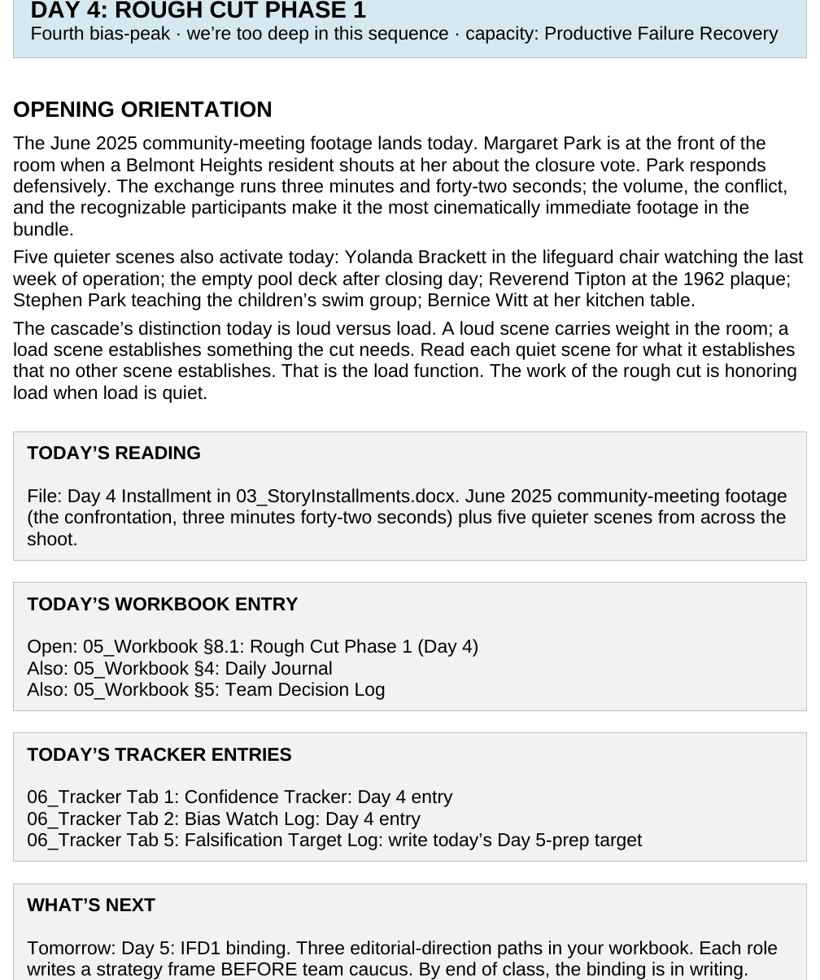
Your students are not answering questions. They are making the call.
On this case day, the team inherits 67 hours of raw footage from a documentary filmmaker who has walked off the project. The commissioning editor wants 28 minutes by deadline. Your students are the Editor of Record. They sit with interview transcripts, a contested engineering report, and the director's original elegy for a closing neighborhood pool, and they have to bind to one frame: Elegy, Accountability, or Generational Story. Nothing on the page tells them which is correct. The footage points in three directions at once, and the team has to weigh evidence against intent and commit. This is a real editorial call with a deadline behind it, not a worksheet with a key.
Tap to see a real case day
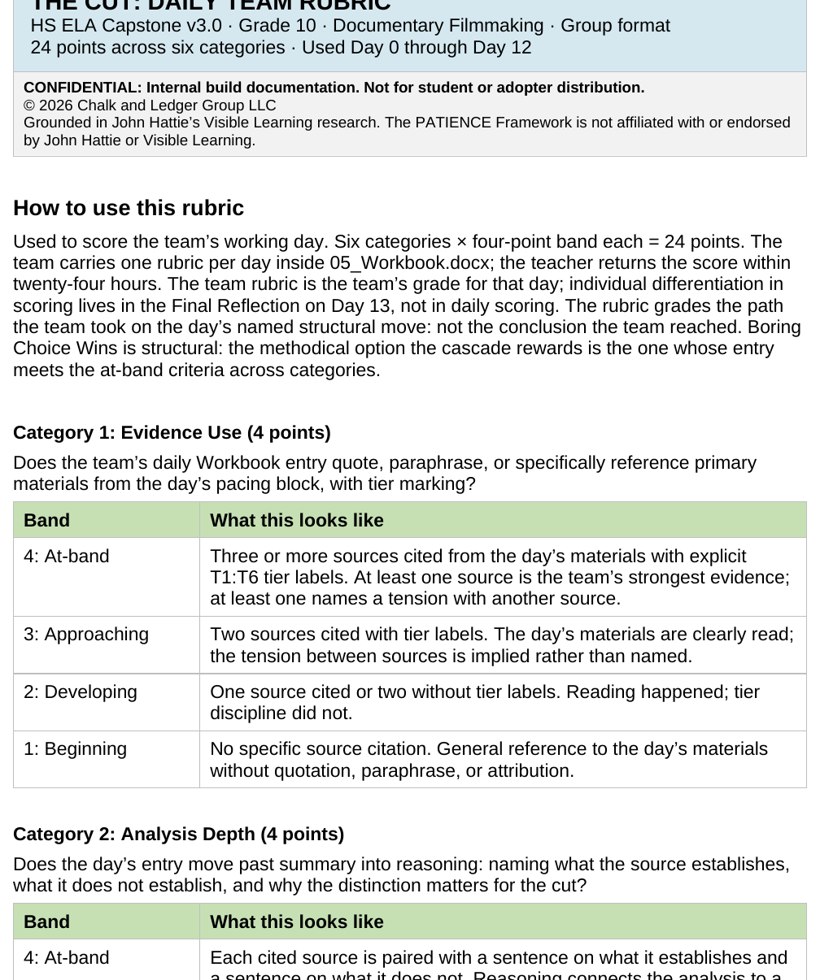
A sound process behind a wrong cut beats a lucky guess.
The Daily Team Rubric grades what the team did with the evidence, not whether they landed on the frame you would have chosen. It scores Evidence Use, Analysis Depth, Critical Thinking, and World Authenticity across every session. The simulation calls this the Boring Choice Wins mandate. A team that builds a rough string-out early, runs the Day 7 test screening with genuine openness, and re-reads its Day 1 log against its Day 5 commitment will out-score a team that locked into a strong reading on Day 2 and spent two weeks defending it. Reasoning that updates when the record demands it is the thing being measured, and students can see exactly where the points live.
Tap to read the grading rubric
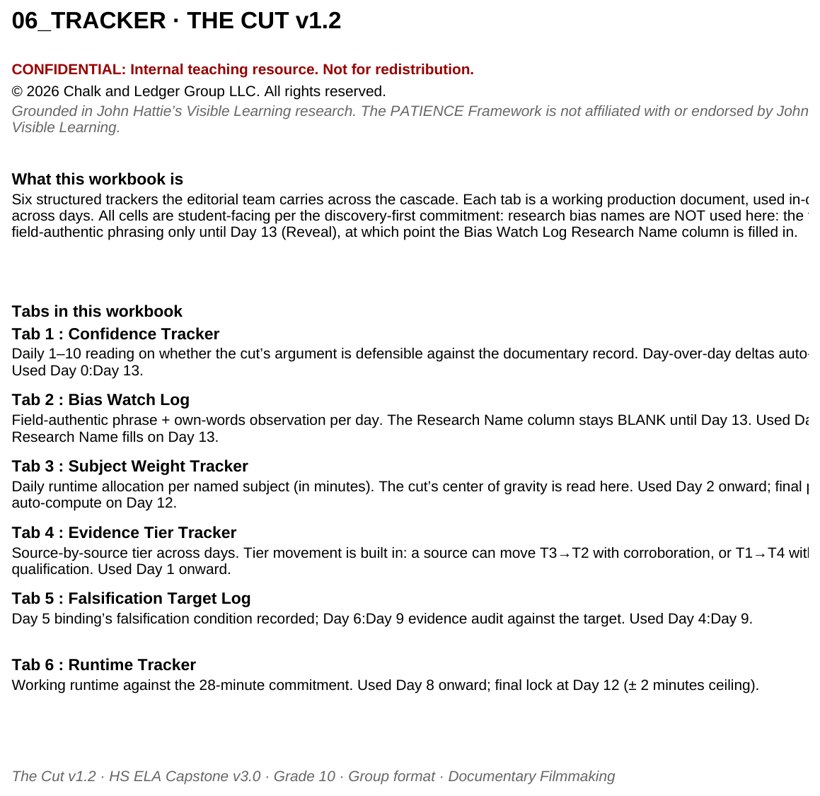
Let the tracker hold the busywork so judgment gets the energy.
Editing 67 hours of footage by hand would bury your students in logging before they reached a single decision. The Tracker carries that load. It holds the footage index, the running interview log, and the Evidence Hierarchy that ranks every source by epistemic weight, from the documentary record at Tier 1 down to the director's shooting notes at Tier 6. The Team Decision Log captures each binding commitment with a timestamp, so the team can quote its own past calls during the Day 10 drift audit. When a researcher needs to know whether a claim rests on the engineering report or on a stakeholder's memory, the answer is one row away. The spreadsheet manages the record so students can argue about what it means.
Tap to see the tracker
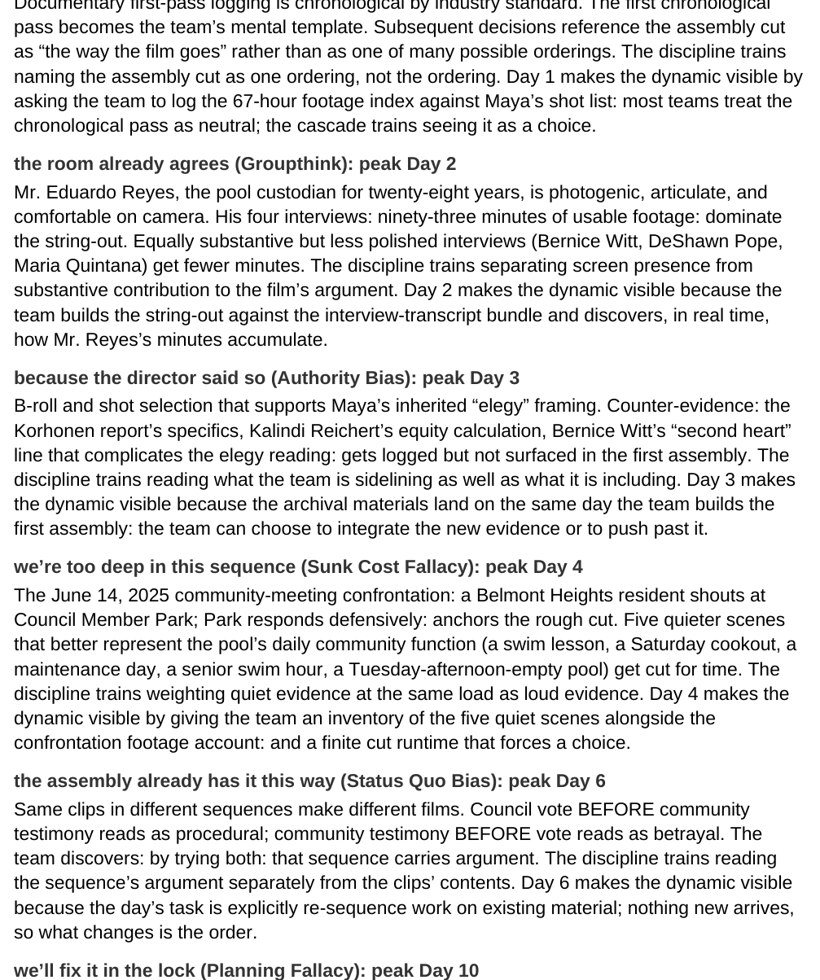
Every day is already scripted. You bring the facilitation.
The Teacher Guide paces all 14 days for a standard 50-minute period. The DIIE rhythm of diagnosis, intervention, implementation, and evaluation is built straight into the block timestamps, so there is no separate footer to track and no second document to juggle. Mandatory Touch Points tell you exactly when to pause the room and name a bias dynamic. The Bias Watch system gives you observable signals for groupthink and sunk cost so you know when to redirect a team that is settling too fast. The contradictions, the inflection days, and the deadline are all engineered into the materials. You facilitate the conversation. The simulation brings the case, the evidence, and the pressure.
Tap to read the teacher guide
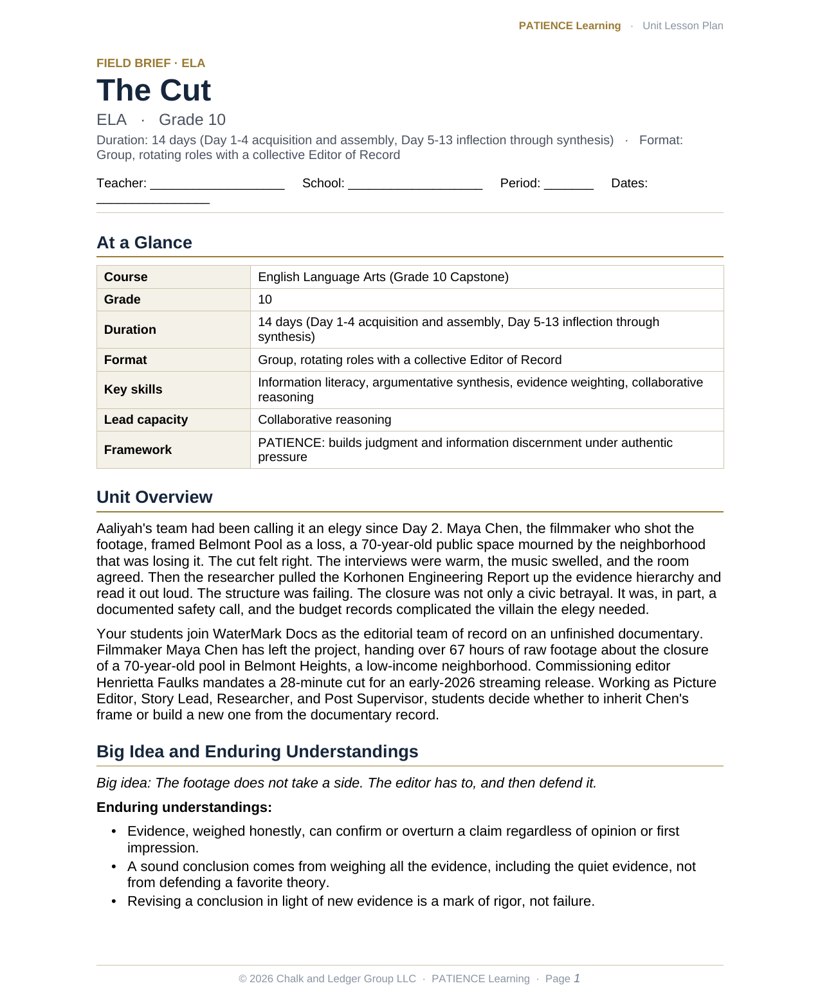
The lesson plan is already written.
Every simulation comes with a fully editable, admin-ready lesson plan. Standards alignment, daily pacing, learning objectives, differentiation, and an assessment plan are already done, so you can hand it to an administrator or adapt it to your district template in minutes.
Tap to preview the lesson plan
Close
Close
Close
Close
The day the record outweighs the director.
Aaliyah's team had been calling it an elegy since Day 2. Maya Chen, the filmmaker who shot the footage, framed Belmont Pool as a loss, a 70-year-old public space mourned by the neighborhood that was losing it. The cut felt right. The interviews were warm, the music swelled, and the room agreed. Then the researcher pulled the Korhonen Engineering Report up the evidence hierarchy and read it out loud. The structure was failing. The closure was not only a civic betrayal. It was, in part, a documented safety call, and the budget records complicated the villain the elegy needed.
Aaliyah felt the cut she loved start to come apart. She could keep the elegy and bury the report at the bottom of the tier list where Maya had left it. She could trust the Tier 1 record over the director's intent and rebuild the frame around what the footage actually supported. The team chose the record. The new cut was harder to make and less comfortable to watch, and it was defensible. Once they stopped protecting Maya's frame, they could finally see which scenes had been carrying sentiment instead of evidence.
Last Summer at Belmont Pool, 67 hours and a 28-minute deadline.
Your students join WaterMark Docs as the editorial team of record on an unfinished documentary. Filmmaker Maya Chen has left the project, handing over 67 hours of raw footage about the closure of a 70-year-old pool in Belmont Heights, a low-income neighborhood. Commissioning editor Henrietta Faulks mandates a 28-minute cut for an early-2026 streaming release. Working as Picture Editor, Story Lead, Researcher, and Post Supervisor, students decide whether to inherit Chen's frame or build a new one from the documentary record.
| Grade level | 10 |
| Course | English Language Arts (Grade 10 Capstone) |
| Duration | 14 days (Day 1-4 acquisition and assembly, Day 5-13 inflection through synthesis) |
| Format | Group, rotating roles with a collective Editor of Record |
| Key skills | Information literacy, argumentative synthesis, evidence weighting, collaborative reasoning |
Engineering better thinkers.
In a media landscape that rewards the loud, reactive cut, The Cut rewards the methodical one. Each case day pairs a named bias with the capacity that defeats it, so students feel the trap before they learn its name on Day 13. Discernment is the whole job of an editor of record.
| Bias targeted | The remedy, built into the work |
|---|---|
| Anchoring | Productive failure recoveryStudents cling to the first chronological ordering of the footage as if it were the only one. When that assembly buckles under the test screening, the team has to recover and re-sequence rather than defend a broken cut. |
| Confirmation bias | MetacognitionThe Day 10 Quote-Yourself audit forces the team to re-read its own Day 1 log against its current frame, exposing the moments it kept evidence that fit and quietly sidelined the footage that did not. |
| Sunk cost fallacy | Adaptive strategyAfter hours refining a sequence, teams refuse to cut it. The path-posture taxonomy of Integrate, Hold-and-Test, and Dismiss makes abandoning sunk work a graded, deliberate move instead of a loss. |
| Availability bias | Information discernmentThe most vivid interview is not the strongest source. The tiered Evidence Hierarchy ranks the documentary record above stakeholder and director voice, so weight follows epistemic standing, not emotional pull. |
| Tunnel vision | Navigating uncertaintyOn Day 9 a stakeholder pushback decision drops new pressure into a settled cut. The team must hold its argument open under uncertainty rather than tunnel on the frame it already committed to. |
| Overconfidence | Emotional regulationLocking into a strong reading early feels like progress. The rubric rewards the team that stays open through the Day 7 screening over the one that defends an early call, so confidence has to be earned against the record. |
14 days from acquisition to a locked cut.
The opening days build the team's command of the footage and the evidence hierarchy before any frame is bound. From Day 5 forward the case becomes a cascade, where each binding commitment narrows the next, mirroring a real edit from rough assembly to picture lock and a defensible memo.
| Day | What lands | Skill in focus |
|---|---|---|
| 1 | The team ingests the footage index and logs interview transcripts; the first ordering starts to feel like the only one | Information discernment |
| 2 | A string-out takes shape and the room agrees too quickly | Collaborative reasoning |
| 3 | Footage that contradicts the director's pitch deck surfaces and tests the team's deference | Evidence weighting |
| 4 | Teams confront a scene they have over-refined and feel the pull to keep it | Adaptive strategy |
| 5 | First binding commitment to Elegy, Accountability, or Generational Story (critical pivot) | Navigating uncertainty |
| 6 | The team re-sequences and questions whether order is kept only because it came first | Metacognition |
| 7 | The test screening runs and the cut meets an outside reaction | Productive failure recovery |
| 9 | Stakeholder pushback forces a defense or a revision under new pressure | Navigating uncertainty |
| 10 | The Quote-Yourself audit checks the team against its own earlier log for drift (critical pivot) | Metacognition |
| 11 | The Act of Killing bridge transfers editorial discipline to a real film | Information discernment |
| 12 | Picture lock; the team drafts the Locked-Cut Memo to the commissioning editor | Argumentative synthesis |
| 13 | The bias reveal names the six traps; students draft the individual Final Reflection | Metacognition |
Standards alignment.
The Cut targets the Grade 10 ELA anchor standards through authentic editorial work. Students cite strong textual and documentary evidence and weigh source reliability under CCSS.ELA-LITERACY.RI.9-10.1 and RI.9-10.8, evaluating the engineering report, civic budget records, and interviews as competing claims. The Locked-Cut Memo builds a defensible argument with clear reasoning under W.9-10.1, and the Final Reflection draws on W.9-10.9. Rotating-role teamwork and the test screening exercise SL.9-10.1, while the cross-film transfer to The Act of Killing analyzes how structure and frame shape an argument under RI.9-10.5 and RI.9-10.6.
The hidden architecture.
The case is rigged so the comfortable frame cannot survive the record. Maya Chen's elegy is genuinely moving, and the early footage rewards inheriting it, which is exactly why most teams bind to it on Day 5. The contradiction is planted in the evidence hierarchy: the Korhonen Engineering Report and the budget analysis sit at Tier 1, but Maya has buried them beneath her own shooting notes at Tier 6. A team running on availability and authority bias keeps the warm interviews on top and the report out of sight. The Day 10 Quote-Yourself audit and the Day 7 screening are the forcing functions. They make the team confront its own filing, and the only defensible memo is one that weighs the record above the director's intent.
Turnkey, classroom-ready.
- An admin-ready lesson plan. A fully editable plan with standards alignment, daily pacing, differentiation, and assessment, ready to adapt to your district template. Included with every purchase.
- A 14-day playbook. Minute-by-minute facilitation for every 50-minute session, with the DIIE rhythm built into the pacing blocks.
- A tech-enabled Tracker. Holds the footage index, the tiered evidence hierarchy, and the timestamped Team Decision Log so logging never crowds out judgment.
- Turnkey student files. The Story Bible, 67 hours of indexed footage, interview transcripts, the engineering report, and the budget records, all ready to hand out.
- A dual rubric system. The Daily Team Rubric grades the quality of reasoning, not whether the team reaches the cut you would have chosen.
- The real-world transfer bridge. A guided study of The Act of Killing that carries the editorial discipline into professional media.
- A Bias Watch toolkit. Observable signals and Mandatory Touch Points that tell you exactly when to pause the room and name a bias.
Hand your students the footage and the deadline.
Bring The Cut to your Grade 10 classroom and let your students learn what it costs, and what it earns, to trust the record over the story they wanted to tell.
Get this simulationPreview real pages from the simulation before you spend a dollar. No guessing, no surprises.