The Crisis
The student who triggered nuclear war but can diagnose why outscores the one who reached peace by luck.
See what your students get, and why it lands.
No mockups. Every page below is real, pulled straight from the files you download. Tap any one to see it full size.
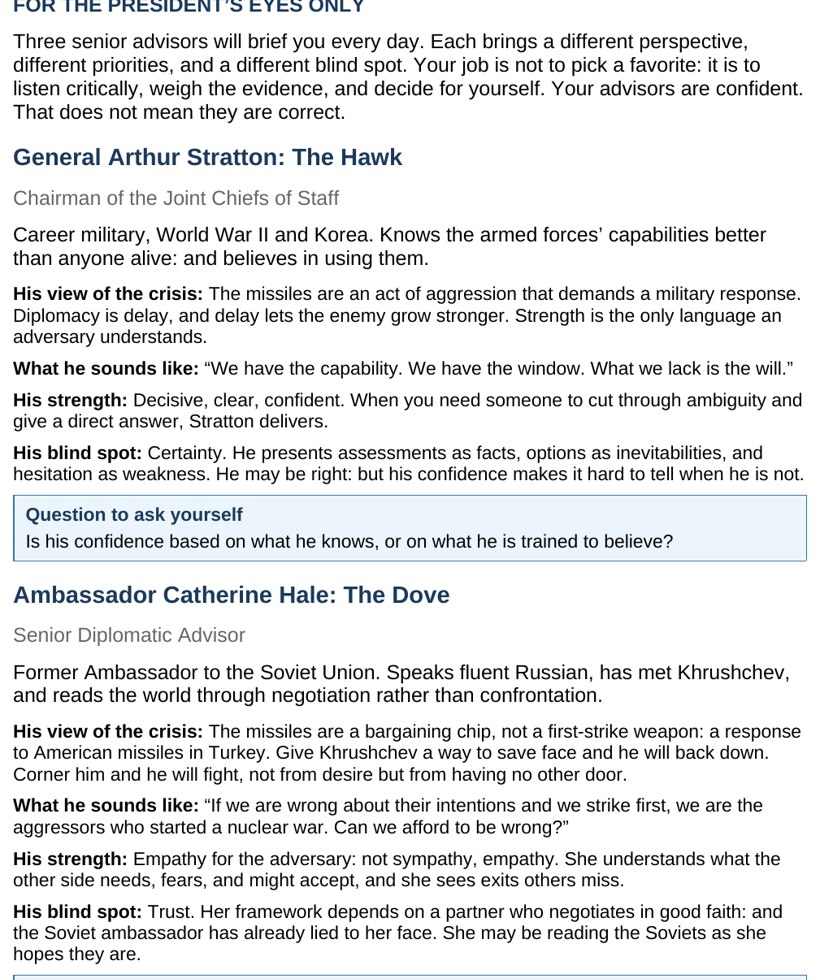
Your students are not answering questions. They are making the call.
This is the Advisor Dossier your students work from each day of the crisis. It hands them the situation as the President actually saw it in October 1962: fragmentary intelligence, advisors pulling in opposite directions, and a clock running. They do not pick the textbook answer because there is no textbook in the room. They rate each intelligence report on a four-point scale, Confirmed, Likely, Uncertain, or Unreliable, then weigh a hawkish general against a cautious diplomat and commit to a course. A worksheet asks what happened. This asks what you would do when you cannot yet know what is true, which is the only question the real advisors got to answer.
Tap to see the Advisor Dossier
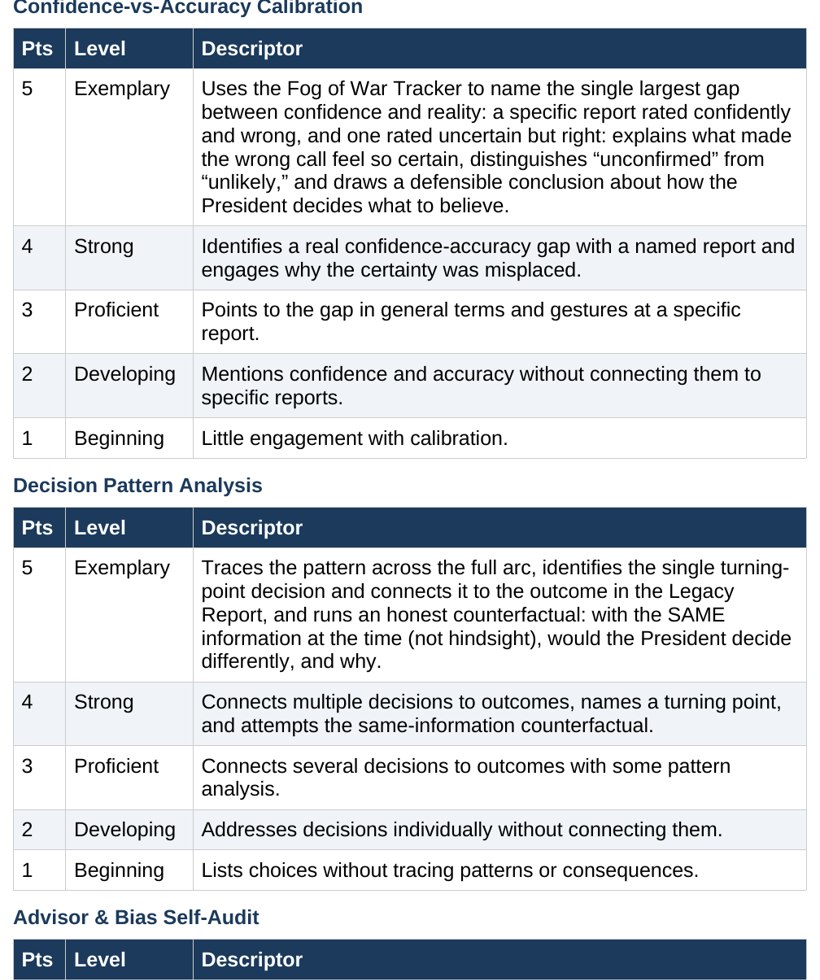
They are graded on their reasoning, not on whether they save the world.
Here is the rubric, and it scores process, not outcome. Daily journal engagement is 60 percent, marked on a 0 to 5 scale for substance, specificity, and evidence of bias-checking. Holistic journal quality is 20 percent, reading the long-term pattern in how a student weighed sources and calibrated confidence. The final 750-word reflection is the last 20 percent, where a student audits their own confidence-accuracy gap. The outcome is never scored. A student who triggers nuclear war but can accurately diagnose their miscalibration outscores a student who reaches peace through unexamined luck. The grade rewards a sound process behind a wrong call over a lucky guess, every time.
Tap to read the grading rubric
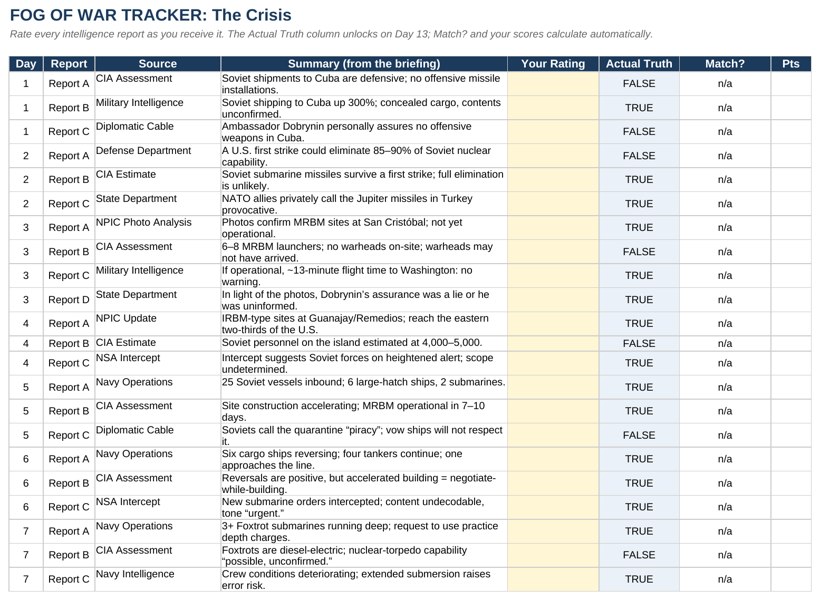
Let the workbook hold the busywork so students spend their energy on the judgment.
The Excel Student Workbook carries the mechanics so your students think instead of tally. Each day they log every intelligence report, attach a reliability rating, and record how confident they feel in their read. The workbook auto-calculates accuracy and calibration as the crisis runs, which is grading you do not have to do by hand for a class of 40 or for a single student making up the unit. One column stays hidden, a pale-blue field holding the actual truth, sealed until Day 13. When it unhides, the sheet computes each student's confidence-accuracy gap automatically. The tool turns a humanities assessment that used to be subjective into a number a student cannot argue with.
Tap to see the tracker
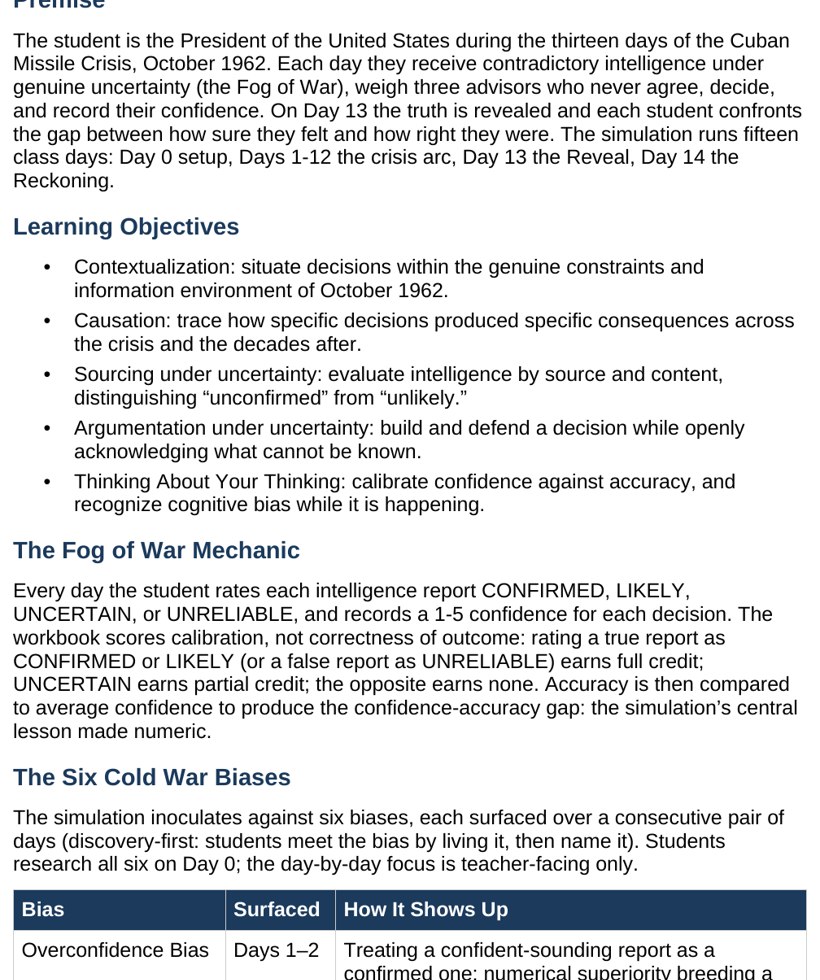
Every day is already scripted. You bring the facilitation, the simulation brings 1962.
The Teacher Guide scripts every session through its Daily Dispatches. You do not need to be a Cold War subject-matter expert. You read the situational brief, run the decision point, and let your students argue. Each module is self-contained, so the simulation can be paused, doubled, or skipped to fit a shifting calendar without breaking the pedagogical logic. The guide includes a Quick Start Brief and the full assessment rubrics so the grading scheme is decided before day one. Prep stays light because the architecture is already built. Your job is the facilitation in the room, the part no file can do for you, and the simulation handles everything around it.
Tap to read the teacher guide
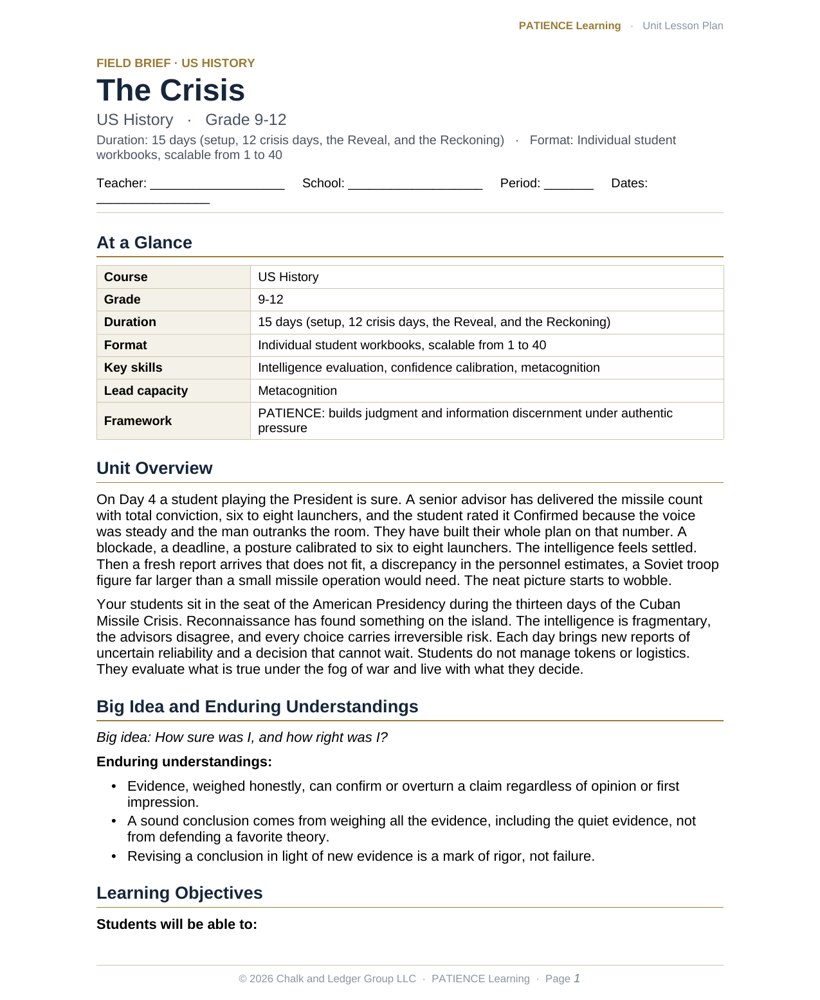
The lesson plan is already written.
Every simulation comes with a fully editable, admin-ready lesson plan. Standards alignment, daily pacing, learning objectives, differentiation, and an assessment plan are already done, so you can hand it to an administrator or adapt it to your district template in minutes.
Tap to preview the lesson plan
Close
Close
Close
Close
The moment a confident report turns out to be a guess.
On Day 4 a student playing the President is sure. A senior advisor has delivered the missile count with total conviction, six to eight launchers, and the student rated it Confirmed because the voice was steady and the man outranks the room. They have built their whole plan on that number. A blockade, a deadline, a posture calibrated to six to eight launchers. The intelligence feels settled. Then a fresh report arrives that does not fit, a discrepancy in the personnel estimates, a Soviet troop figure far larger than a small missile operation would need. The neat picture starts to wobble.
Here is the pivot. The student can defend the Confirmed rating they already committed to, or they can admit the report that sounded certain was never confirmed at all. Protecting the rating protects their plan. Trusting the contradiction means reopening a decision they thought was closed. When they choose the evidence and downgrade the report, the crisis reopens. They start asking who could realistically know the missile count, and how sure that person actually was, which is the discipline the real advisors needed and mostly lacked.
October 1962, and the decision is yours.
Your students sit in the seat of the American Presidency during the thirteen days of the Cuban Missile Crisis. Reconnaissance has found something on the island. The intelligence is fragmentary, the advisors disagree, and every choice carries irreversible risk. Each day brings new reports of uncertain reliability and a decision that cannot wait. Students do not manage tokens or logistics. They evaluate what is true under the fog of war and live with what they decide.
| Grade level | 9-12 |
| Course | US History |
| Duration | 15 days (setup, 12 crisis days, the Reveal, and the Reckoning) |
| Format | Individual student workbooks, scalable from 1 to 40 |
| Key skills | Intelligence evaluation, confidence calibration, metacognition |
Engineering better thinkers.
Discernment is the whole game here because the President of 1962 decided without knowing what was true. Each day surfaces one Cold War bias by making students live it, then pairs that bias with the capacity that corrects it in the debrief.
| Bias targeted | The remedy, built into the work |
|---|---|
| Overconfidence | MetacognitionA confident-sounding report is not a confirmed one. Students audit their own certainty against evidence quality and learn to rate the source, not the volume or tone, of the voice delivering it. |
| Hawkish bias | Emotional regulationActing can feel automatically safer than waiting. Students hold steady under the most aggressive voices in the room and recognize that immediate action carries its own irreversible risks. |
| Escalation commitment | Adaptive strategyA prior move like the blockade can feel like it mandates the next escalation. Students treat each new day as a fresh decision point rather than a debt owed to yesterday's choice. |
| Mirror imaging | Information discernmentAssuming the adversary thinks and fears as you do distorts every read. Students analyze the opponent's specific strategic fears instead of projecting their own onto the evidence. |
| Zero-sum thinking | Navigating uncertaintyTreating the crisis as scorekeeping makes any face-saving exit look like defeat. Students learn to seek stability over points and to weigh low-probability, high-impact risks honestly. |
| Groupthink | Independent and collaborative reasoningA loud, unanimous consensus is not proof. Students dissent to keep viable options on the table while still synthesizing conflicting expert counsel into one executive call. |
15 days of disciplined uncertainty.
Setup gives students the Cold War context and the rating system before the crisis begins. The twelve crisis days run the arc, surfacing a bias each day through lived decisions. Day 13 unhides the truth, and the final days turn the experience into a calibrated audit of their own thinking.
| Day | What lands | Capacity in focus |
|---|---|---|
| 0 | Setup. Cold War context, the advisor cast, and the four-point reliability scale. | Information discernment |
| 1 | First reconnaissance. Students rate fragmentary intelligence for the first time. | Information discernment |
| 2 | Advisors split hawk and diplomat. Students weigh conflicting counsel. | Independent reasoning |
| 3 | A confident missile count arrives. Students decide how much certainty to grant it. | Metacognition |
| 4 | A contradictory report breaks the neat picture (critical pivot). | Adaptive strategy |
| 5 | The blockade decision. Acting versus waiting, each with its own risk. | Emotional regulation |
| 6 | Pressure to escalate after the blockade is set. | Adaptive strategy |
| 8 | The adversary's motives read through their fears, not yours. | Information discernment |
| 10 | A submarine report rated unconfirmed forces a low-probability, high-stakes call. | Navigating uncertainty |
| 12 | Two letters from Khrushchev, one conciliatory, one hard. Which to trust. | Independent reasoning |
| 13 | The Reveal. The actual-truth column unhides and the confidence-accuracy gap is computed (critical pivot). | Metacognition |
| 14 | The Reckoning. A 750-word reflection auditing personal calibration and advisor weighting. | Metacognition |
Standards alignment.
The Crisis maps to the C3 Framework and NCSS standards for inquiry-driven social studies and to APUSH coursework on the Cold War. It builds C3 Dimension 2 disciplinary concepts in history and Dimension 3 work in evaluating sources and using evidence, since students rate the reliability of every report. C3 Dimension 4 is covered as students communicate and defend conclusions in the daily journal and final reflection. The simulation supports APUSH skills in sourcing, contextualization, and argumentation, and it counters the hindsight bias that treats the missile crisis as an inevitable outcome rather than a decision made under genuine uncertainty.
The hidden architecture.
The engine is the gap between what intelligence claimed and what was real, and it is engineered into the workbook. A pale-blue column holds the actual truth, sealed until Day 13. While it stays hidden, students rate reports and record their confidence, and their biases steer them wrong on purpose. The CIA estimated six to eight launchers when there were sixty missiles. Warheads were unconfirmed when 162 were already on the island. Troops were estimated at 4,000 to 5,000 against an actual 42,000. When the column unhides, the sheet computes each student's confidence-accuracy gap. A large positive gap, confident and wrong, becomes the lesson no amount of luck can hide. The planted contradictions force the sound conclusion, that certainty must be earned from evidence, not borrowed from a confident voice.
Turnkey, classroom-ready.
- An admin-ready lesson plan. A fully editable plan with standards alignment, daily pacing, differentiation, and assessment, ready to adapt to your district template. Included with every purchase.
- 15-day playbooks. Scripted Daily Dispatches give you a situational brief and decision point for every session, no Cold War expertise required.
- A tech-enabled Excel workbook. Logs intelligence, auto-calculates accuracy and calibration, and hides the actual-truth column until the Day 13 Reveal.
- Turnkey student files. Cold War context reading, Advisor Dossiers, Decision Guides, a Bias Research Template, and journal prompts.
- A 60/20/20 rubric system. Grades the quality of reasoning across daily journals, holistic patterns, and a final calibration audit, never the outcome.
- Teacher Confidential materials. An Architectural Connection Map, a Legacy Report, and the Intel Truth Key, kept separate from student files.
Put your students in the chair.
Bring the fog of war to your classroom and let your students learn what it costs to decide what is true before anyone can know for sure.
Get this simulationPreview real pages from the simulation before you spend a dollar. No guessing, no surprises.