The Crime Scene
The geometry does not lie. People do.
The geometry does not lie. People do.
The Crime Scene makes your students forensic analysts reconstructing a museum break-in with coordinate geometry, similar triangles, and formal proof. Over thirteen days the evidence drops one piece at a time, and a dramatic single-intruder theory keeps tempting them while the quiet math points elsewhere. On Day 8 a suspect's height — one the shadow already measured — refuses to fit the story they have built, and they must choose: protect their theory, or trust the geometry. It is mathematical proof versus cognitive bias, lived under pressure.
See what your students get, and why it lands.
No mockups. Every page below is real, pulled straight from the files you download. Tap any one to see it full size.
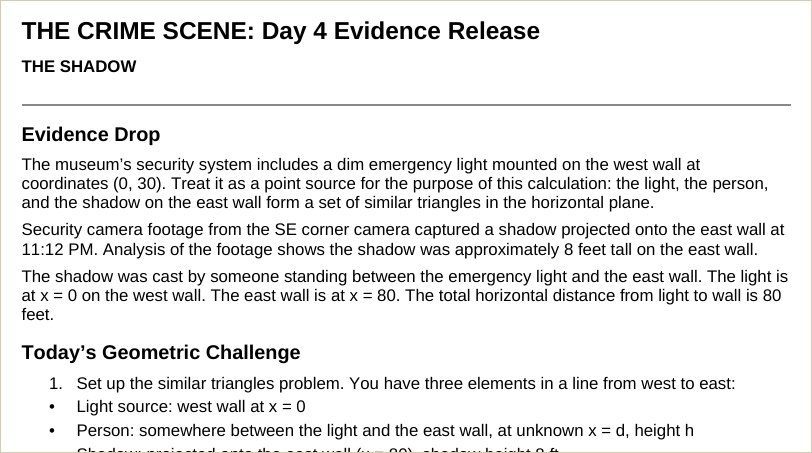
A worksheet was never going to teach this.
Your students can ace a worksheet and still freeze the moment a problem shows up with no instructions attached. That gap is the whole problem. Judgment, discernment, the nerve to act when the answer is not clear, none of it comes from one more page of practice problems. It comes from dropping a student inside a real decision and letting the stakes do the teaching. Here they are not answering questions about geometry. They are using geometry to prove what actually happened, and the math is the only thing that can settle it.
Tap to read a real evidence release
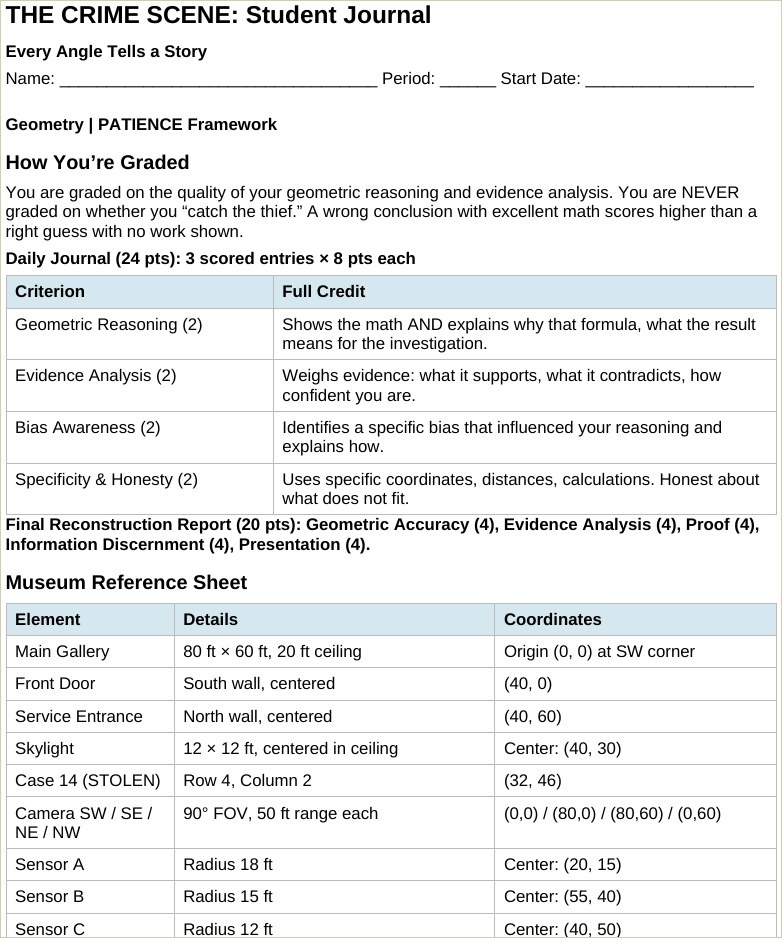
The boring choice wins.
This is the lesson hiding inside the case. The exciting move is to chase the dramatic clue and name a suspect. The boring move is to run every calculation, weigh the quiet evidence as carefully as the loud evidence, and follow the math even when it kills your favorite theory. Students are never graded on whether they catch the culprit. Rigorous reasoning behind a wrong conclusion scores higher than a lucky guess with no work shown. That is how a kid learns that being right the boring way beats being wrong the exciting way.
Tap to read the grading rubric
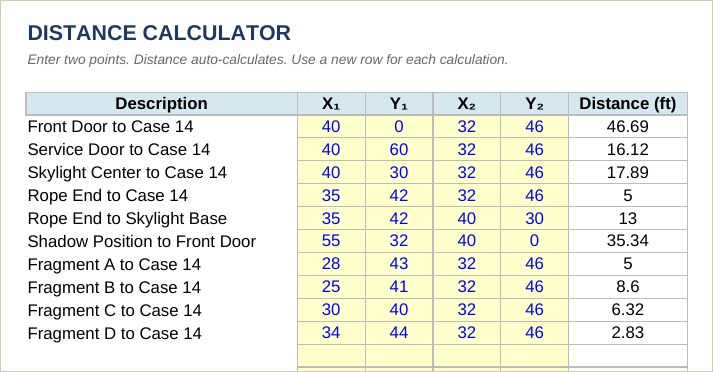
Let the workbook handle the math.
Nothing stalls a class faster than thirty students stuck on the same calculation. The Crime Scene ships with a workbook that does the routine math for them. They enter the coordinates, and the distance, the shadow, and the sensor checks all compute on their own. Their energy goes where it belongs, into deciding what the numbers actually mean, not into grinding the numbers out.
Tap to see the live calculator
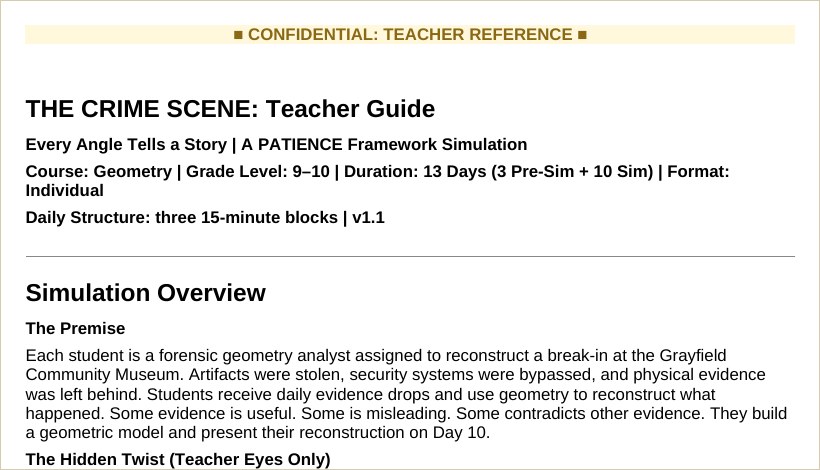
Every day is already planned. You just run the room.
You are not building this, the simulation is. All thirteen days are scripted into short blocks, with the evidence, the mini-lesson, and the journal prompt ready to run. The rubric is written. The answer key is written. The hidden twist is yours alone to see. Prep is reading the day's page, about twenty minutes the first time through. You bring the facilitation. The simulation brings everything else.
Tap to read the teacher guide
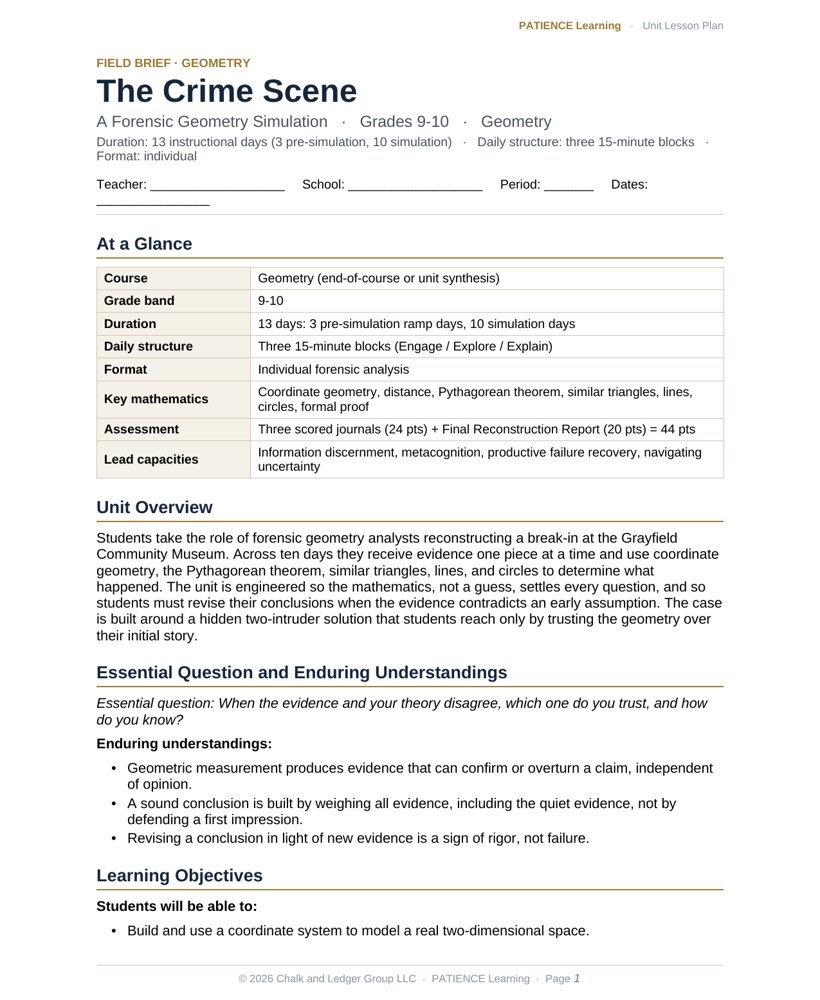
The lesson plan is already written.
Every simulation comes with a fully editable, admin-ready lesson plan. Standards alignment, daily pacing, learning objectives, differentiation, and an assessment plan are already done, so you can hand it to an administrator or adapt it to your district template in minutes.
Tap to preview the lesson plan
Close
Close
Close
Close
Everything you need to run it.
- An admin-ready lesson plan. A fully editable plan with standards alignment, daily pacing, differentiation, and assessment, ready to adapt to your district template. Included with every purchase.
- Thirteen days of playbooks (3 pre-simulation plus 10) that script every session in short blocks.
- A tech-enabled workbook where distance, shadow, and sensor-zone calculations compute automatically, so students focus on what the numbers mean.
- Seventeen ready-to-print student files, including the daily evidence releases and a 10-day student journal.
- A dual rubric that grades the quality of geometric reasoning and discernment, not whether they catch the culprit.
- Built on the PATIENCE framework: information discernment, and trusting the math over the story.
Bring The Crime Scene to your classroom.
Thirteen days, fully planned, and a case your students have to reason their way through.
Get this simulationPreview real pages from the simulation before you spend a dollar. No guessing, no surprises.