The Council
Same city. Same data. Same budget. Different decisions, different future.
See what your students get, and why it lands.
No mockups. Every page below is real, pulled straight from the files you download. Tap any one to see it full size.
A worksheet was never going to teach this.
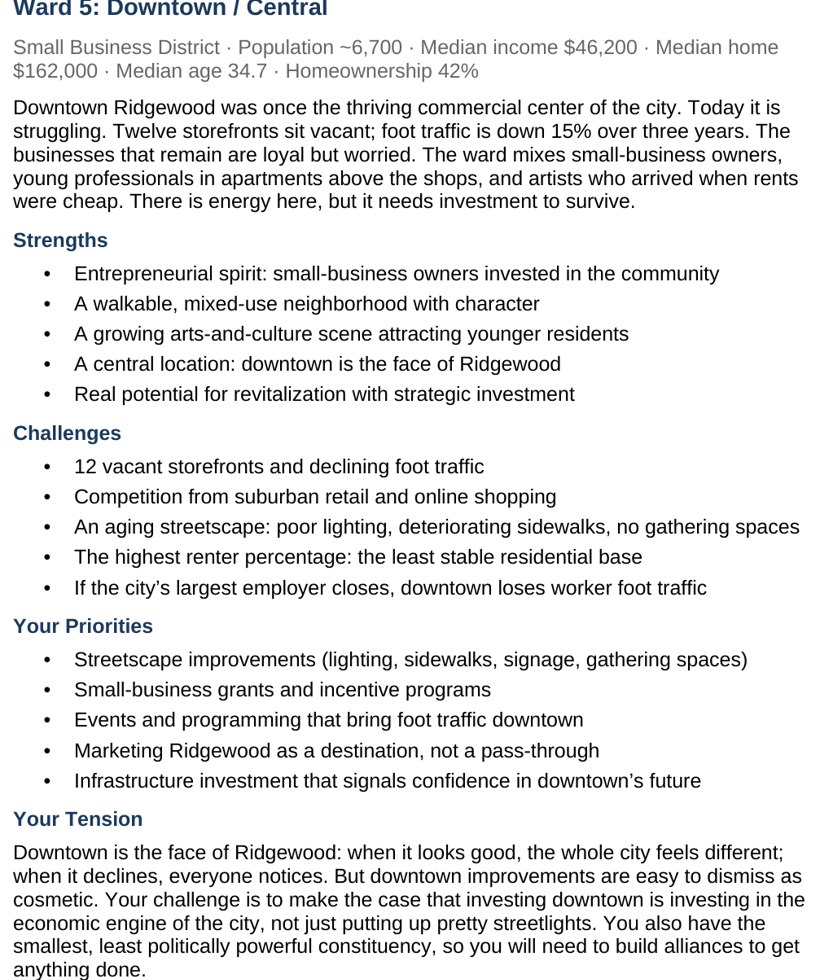
Your students are not labeling the three branches of government. They are sitting on the Ridgewood city council with a real ward to represent and a $42 million general fund that is already $39.5 million committed to fixed operations. That leaves $2.5 million in true discretionary room and a stack of requests that all sound reasonable. The ward profiles tell each student who they answer to, the seniors in Ward 3, the underserved families in Ward 2, the homeowners who vote. Then a vote comes due. Fund the photogenic playground or the 47-year-old water main nobody can see. They are not answering a question. They are making a call from evidence, and every dollar they spend is a dollar withheld from something else.
Tap to see the ward profiles
They are graded on the governing, not the budget.
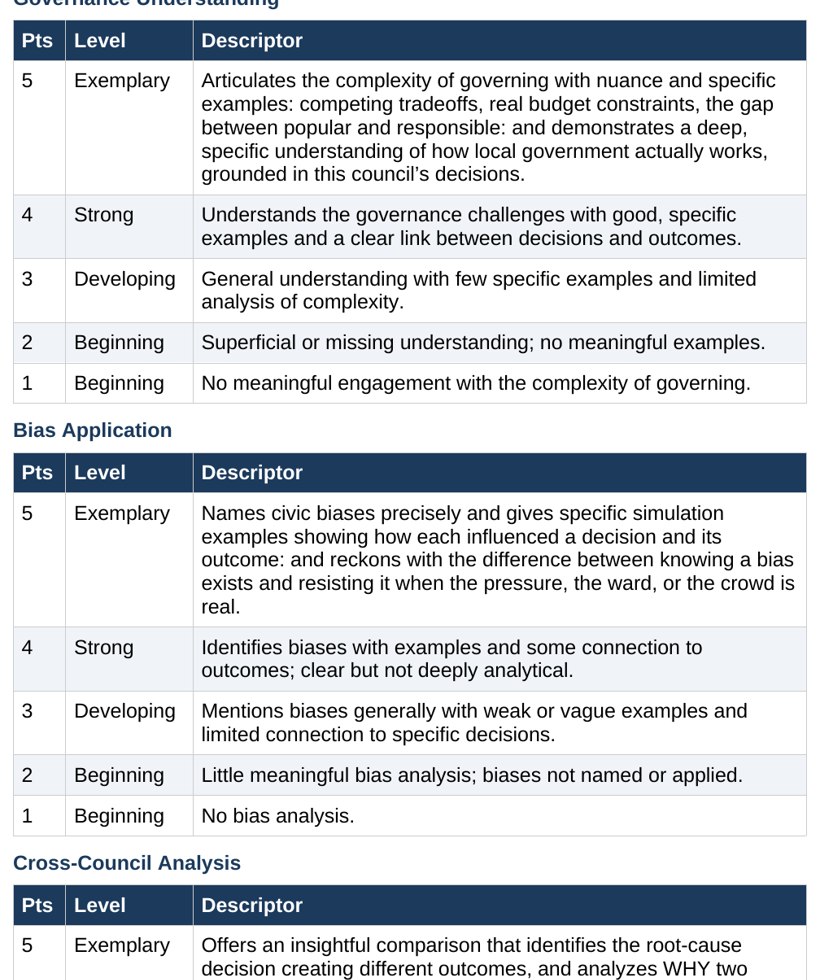
A balanced ledger and a sky-high approval rating earn nothing on their own. The rubric scores the quality of the reasoning behind every vote. A student who funds the water main and watches their approval dip, but who names the tradeoff in specific dollars and explains why prevention beats a crisis, outscores the one who chased the popular win and got lucky. The Hybrid-100 model uses a clean 0/2/4/6 scale on each cycle journal, rewarding the use of real figures, named evidence, and honest acknowledgment of where a bias pulled them. A sound process behind an unpopular call beats a lucky guess every time. Your feedback stays substantive and fast, because the scale tells you exactly what you are looking for.
Tap to read the grading rubric
Let the workbook hold the busywork.
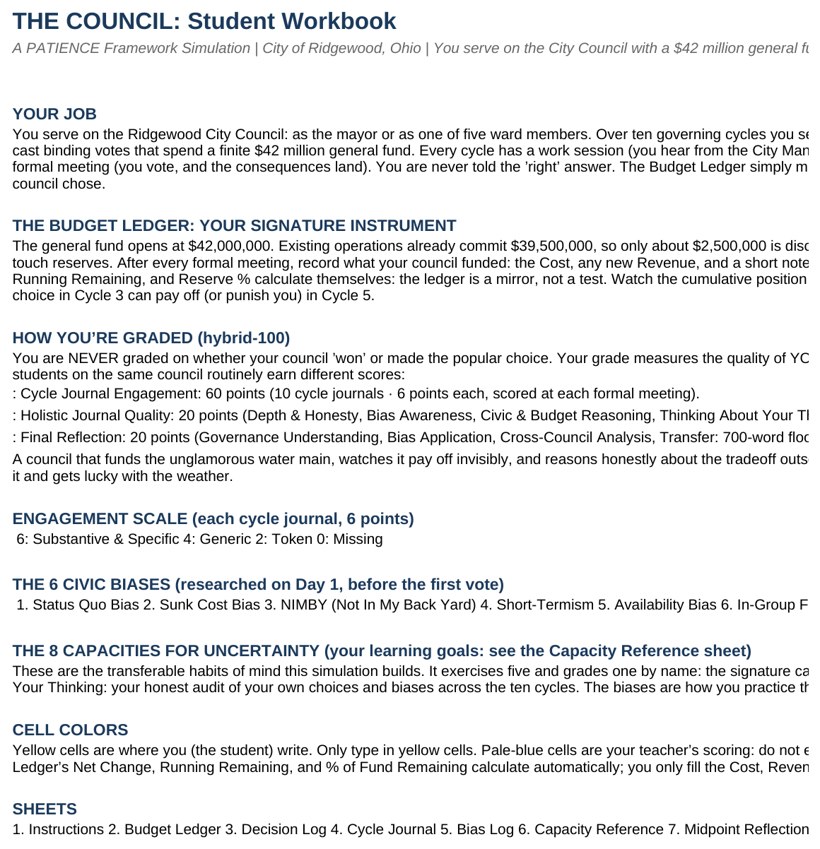
The student workbook is a spreadsheet that carries the Budget Ledger and the Decision Log across all ten governing cycles. It does the arithmetic so your students do the judgment. Every vote logs the dollars committed, the discretionary room left, and the downstream effect, so a choice made in Cycle 3 shows up again in Cycle 10 whether students remember it or not. The ledger becomes a mirror. By the capstone, students audit their own accumulated record, trace where a vote went sideways, and name the bias that drove it. No one is hand-tallying a $42 million fund or recopying figures between pages. The tool absorbs the clerical load, and the energy that would have gone to math goes to the call instead.
Tap to see the tracker
Every day is already scripted.
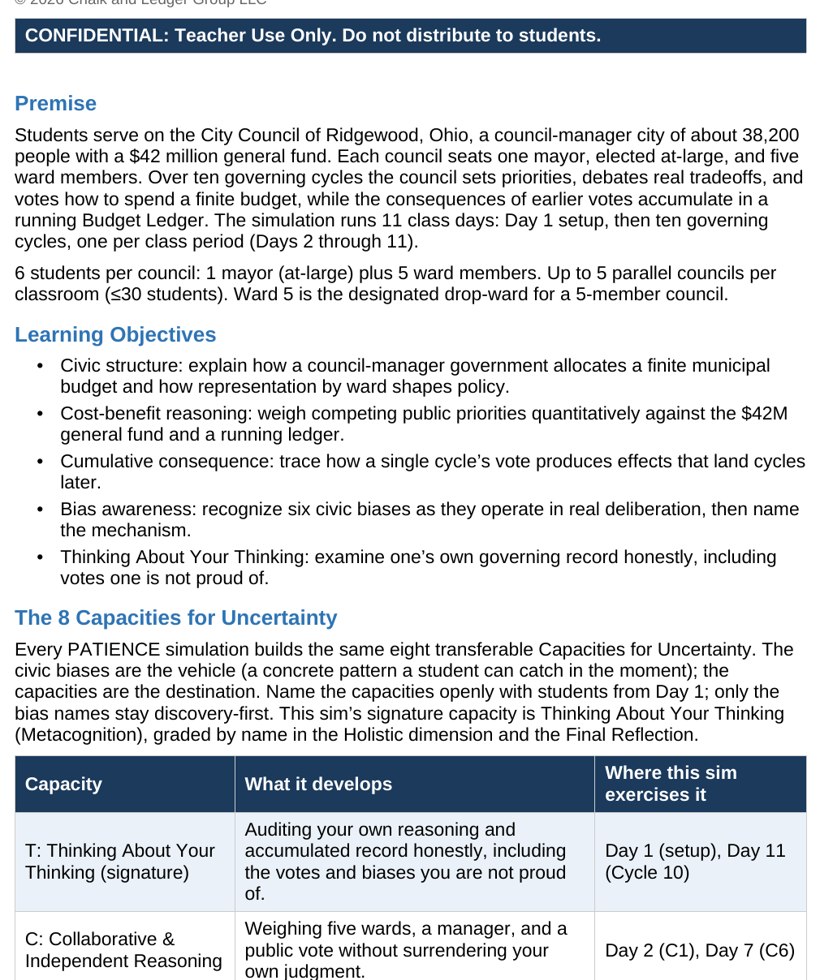
The teacher guide hands you exact read-aloud lines for all eleven days. It tells you when to open a work session, when to gavel in the formal meeting, and when to drop the crisis that turns the room. You do not pre-build the MeridianTech plant closure or the viral Facebook rumor in Cycle 8. The script stages each beat for you and tells you what to watch for as students react. You bring the facilitation, the questions, the read of the room. The simulation brings the city, the budget, the consequences, and the timing. Prep is light because the design already did the heavy lifting. Open the guide, find the day, run the council.
Tap to read the teacher guide
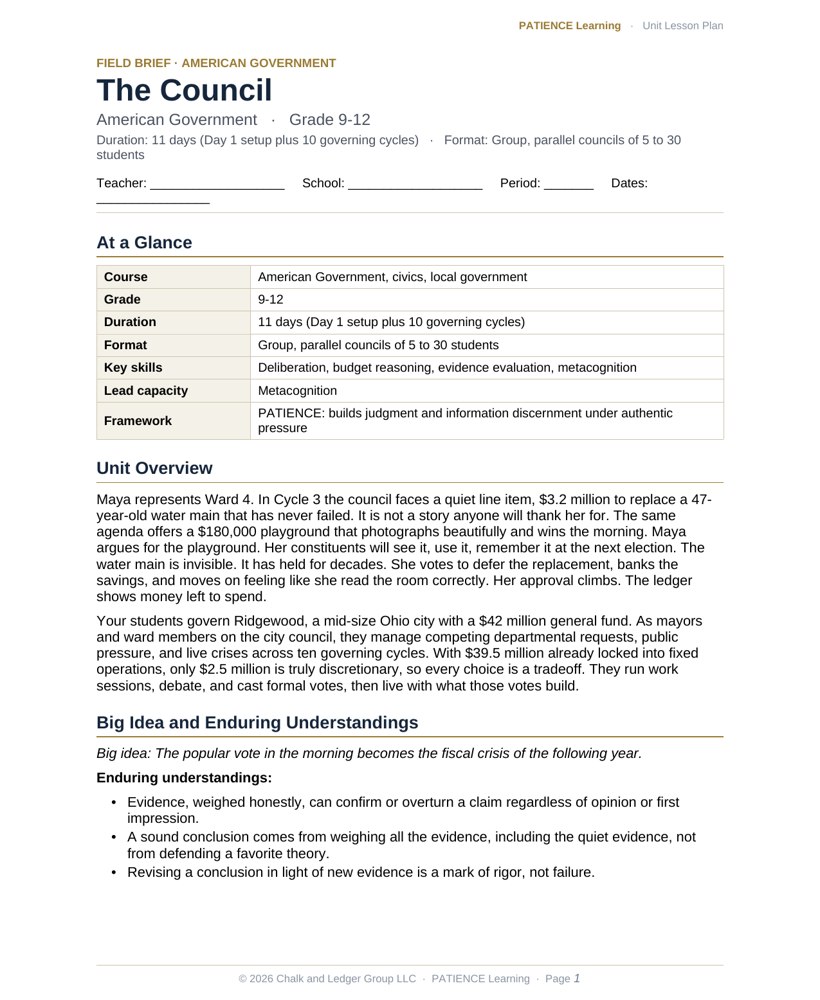
The lesson plan is already written.
Every simulation comes with a fully editable, admin-ready lesson plan. Standards alignment, daily pacing, learning objectives, differentiation, and an assessment plan are already done, so you can hand it to an administrator or adapt it to your district template in minutes.
Tap to preview the lesson plan
Close
Close
Close
Close
The cycle a popular vote becomes a bill the whole city pays.
Maya represents Ward 4. In Cycle 3 the council faces a quiet line item, $3.2 million to replace a 47-year-old water main that has never failed. It is not a story anyone will thank her for. The same agenda offers a $180,000 playground that photographs beautifully and wins the morning. Maya argues for the playground. Her constituents will see it, use it, remember it at the next election. The water main is invisible. It has held for decades. She votes to defer the replacement, banks the savings, and moves on feeling like she read the room correctly. Her approval climbs. The ledger shows money left to spend.
Then Cycle 10 arrives, and the storm hits. The deferred main ruptures. The emergency repair runs $4.8 million, $1.6 million more than prevention would have cost, and it comes with boil-water advisories and legal exposure. Maya pulls up her Decision Log and sees it plainly. The vote that felt safe in Cycle 3 built the crisis of Cycle 10. She has to choose whether to defend the call she made or admit the evidence had been on the table the whole time. She names the short-termism that drove her. Once she does, the whole arc of her record reads differently.
Ridgewood, Ohio. Population 38,200. One finite budget.
Your students govern Ridgewood, a mid-size Ohio city with a $42 million general fund. As mayors and ward members on the city council, they manage competing departmental requests, public pressure, and live crises across ten governing cycles. With $39.5 million already locked into fixed operations, only $2.5 million is truly discretionary, so every choice is a tradeoff. They run work sessions, debate, and cast formal votes, then live with what those votes build.
| Grade level | 9-12 |
| Course | American Government, civics, local government |
| Duration | 11 days (Day 1 setup plus 10 governing cycles) |
| Format | Group, parallel councils of 5 to 30 students |
| Key skills | Deliberation, budget reasoning, evidence evaluation, metacognition |
Engineering better thinkers.
Civic discernment decides whether a leader funds the visible win or the invisible necessity. Each cycle drops your students into a decision under pressure, then pairs the bias that ambushes them with the capacity that defeats it, so the lesson is earned in the room before it is named.
| Bias targeted | The remedy, built into the work |
|---|---|
| Status quo bias | Productive failure recoveryWhen the council refuses to replace a 47-year-old water main because it has not failed yet, students learn to treat a deferred vote as information to govern by once the rupture lands, not a verdict to defend. |
| Confirmation bias | MetacognitionStudents treat their Decision Log as a mirror, auditing their own accumulated votes to find where a favored theory survived only because they stopped looking for the evidence against it. |
| Sunk cost fallacy | Adaptive strategyWhen $2.3 million in MeridianTech incentives fails and the plant closes anyway, students practice revising the plan against the facts in front of them instead of throwing good money after bad. |
| Availability bias | Information discernmentA viral and false corruption rumor pulls 1,247 reactions, and 38 percent still believe it after corrections. Students learn to separate the signal of evidence from the noise of what is loud and recent. |
| In-group favoritism | Navigating uncertaintyIn the Cycle 7 squeeze, ward members fight for local projects while seniors in Ward 3 go unserved. Students commit to long-horizon, city-wide costs without knowing exactly when the bill comes due. |
| Short-termism | Emotional regulationWhen the hostile meeting and the live crisis raise the adrenaline, students hold judgment steady and decide on the merits of a policy rather than the photogenic project that wins the morning. |
11 days of governing under pressure.
Day 1 sets the city, assigns wards, and has students research the six civic biases before they meet a single trap. From there the council runs ten governing cycles, each a work session and a formal vote, with crises that land on a deliberate timeline so early choices return as late consequences.
| Day | What lands | Capacity in focus |
|---|---|---|
| 1 | Setup: welcome to Ridgewood, ward assignment, research the six civic biases | Information discernment |
| 2 | C1: learning to govern, the rhythm of work sessions and formal meetings | Adaptive strategy |
| 3 | C2: competing priorities, separating real problems from loud ones | Information discernment |
| 4 | C3: the unglamorous vote, the water main choice is set (critical pivot) | Navigating uncertainty |
| 5 | C4: plant closes, the MeridianTech crisis turns the room | Emotional regulation |
| 6 | C5: election plus emergency, the water main consequences land (critical pivot) | Productive failure recovery |
| 7 | C6: the developer, NIMBY housing tensions force a city-wide read | Collaborative reasoning |
| 8 | C7: the squeeze, deciding which ward loses in a budget gap | Ethical reasoning |
| 9 | C8: the rumor, managing viral misinformation against the record | Information discernment |
| 10 | C9: taxes or services, responding to a $1.4 million shortfall | Adaptive strategy |
| 11 | C10: storm plus legacy, audit the cumulative record through a final crisis | Metacognition |
Standards alignment.
The Council aligns to the C3 Framework for Social Studies and to NCSS civics and government standards. Students apply the Inquiry Arc throughout, developing questions, gathering and evaluating evidence, and communicating conclusions through deliberation and writing. The work maps to C3 dimensions for Civic and Political Institutions (D2.Civ.1, D2.Civ.5, D2.Civ.12), Participation and Deliberation (D2.Civ.9, D2.Civ.10), and Economic decision-making and scarcity (D2.Eco.1, D2.Eco.2). It aligns to the College, Career, and Civic Life (C3) Framework expectations for civic participation, local government, and public policy. The 700-word Final Reflection asks students to engage the strongest opposing view, meeting the framework's evidence and argumentation expectations.
The hidden architecture.
The whole simulation is engineered around the Water Main track. In Cycle 3 the proactive path costs $3.2 million for a replacement no one will applaud, and the design makes deferral feel obviously smart, the main has held 47 years and the savings are real. That is the planted trap. Status quo bias and short-termism push almost every council to defer. The consequence is pre-loaded to detonate in Cycle 5 and Cycle 10, where the reactive repair costs $4.8 million and fails again. The budget is built so the satisfying early vote becomes the crisis later, on a timeline students cannot see coming. The Decision Log preserves every choice, so the capstone forces the sound conclusion. The evidence was always there. The student simply governed past it.
Turnkey, classroom-ready.
- An admin-ready lesson plan. A fully editable plan with standards alignment, daily pacing, differentiation, and assessment, ready to adapt to your district template. Included with every purchase.
- An 11-day no-prep playbook. Exact read-aloud lines and minute-by-minute facilitation for the setup day and all ten governing cycles.
- A tech-enabled student workbook. A spreadsheet carrying the Budget Ledger and Decision Log that does the arithmetic and tracks every consequence across cycles.
- Turnkey student files. Ward profiles, cycle agendas, crisis briefs, and the Legacy Consequence Report that fast-forwards five years.
- The Hybrid-100 rubric system. A 0/2/4/6 scale that grades the quality of reasoning and use of specific evidence, not whether the budget balances.
- The capstone reflection prompt. A scaffolded 700-word Final Reflection on governance nuance, bias trace, root cause, and transfer to a real policy today.
Hand your students a city and let them feel the weight of it.
Bring The Council to your classroom and give your students eleven days of governing where their reasoning, not their luck, is what gets measured.
Get this simulationPreview real pages from the simulation before you spend a dollar. No guessing, no surprises.