The Cold Case
Polish is not proof. The quiet phone bill outranks the vivid witness.
See what your students get, and why it lands.
No mockups. Every page below is real, pulled straight from the files you download. Tap any one to see it full size.
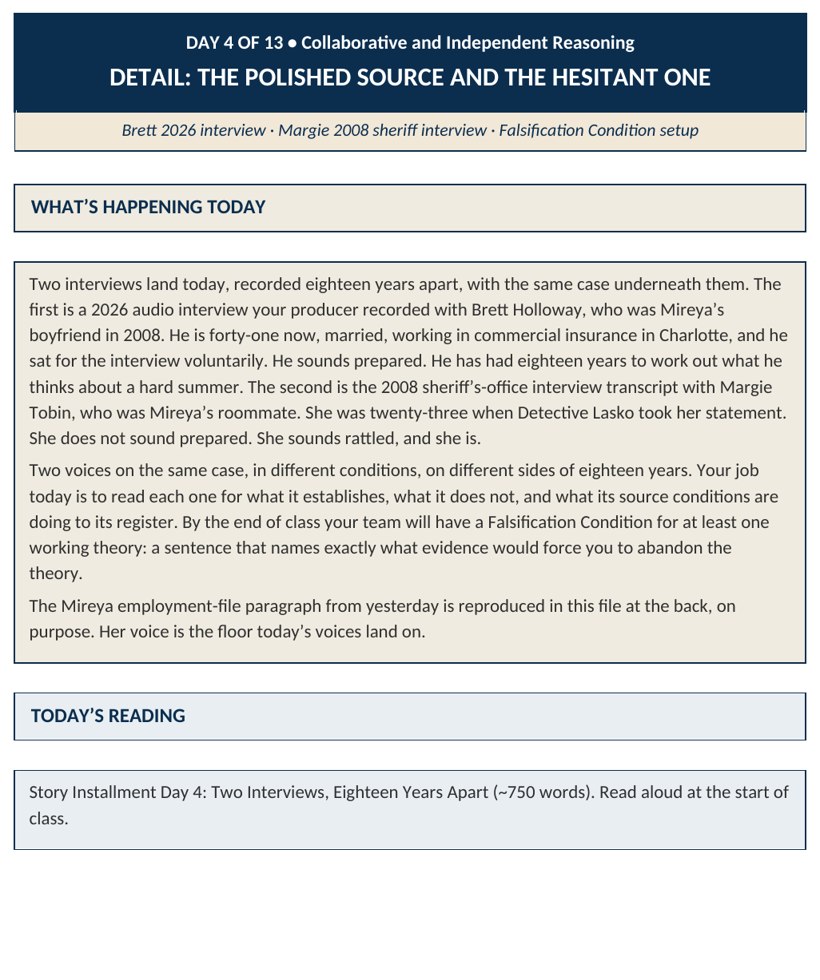
Your students are not answering questions. They are making a call from the record.
This is a real source interview from the case files, not a comprehension worksheet. Your students read Det. Lasko's confident 2026 retelling against Margie Tobin's quiet 2008 phone bill and decide which one carries weight. Nobody hands them the answer. They sit with a transcript that sounds certain and a document that says something quieter, and they have to commit to what the file actually establishes. Every interview in the docuseries Where Did She Go? was built to feel persuasive on the surface. The work is deciding what survives a second read, what stays a guess, and what gets to anchor the pilot. That is the call your students make, in writing, every day.
Tap to read a source interview
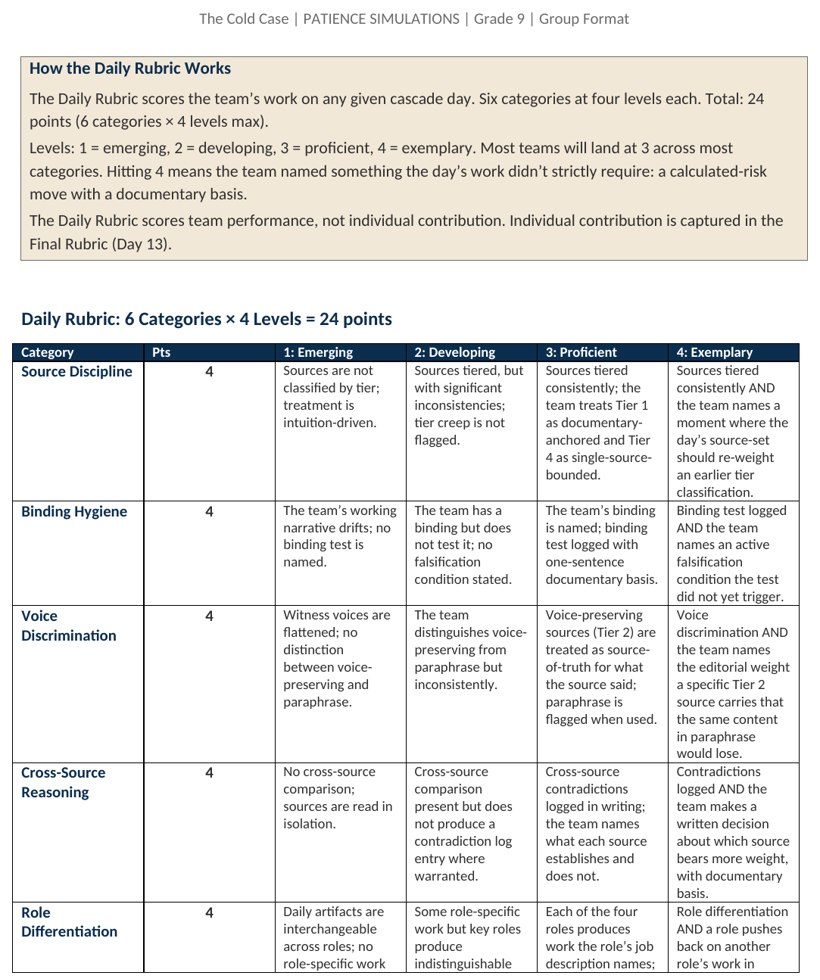
They are graded on the reasoning, not on guessing right.
The Daily Rubric scores how your students think, not whether they crack the case. A team that states a falsification posture, names the evidence tier, and commits to a documentable claim scores as Calculated Risk even when the file never resolves. A team that races to a verdict while ignoring a documentary contradiction scores as Reckless, no matter how dramatic the hook. Safe hedging that dodges any commitment lands as Methodical, adequate but not exceptional. The rubric rewards the boring, evidence-led choice over the true-crime guess, which is exactly the discipline the case is built to teach. Your students learn that a sound process behind an unresolved question beats a lucky verdict every time.
Tap to read the grading rubric
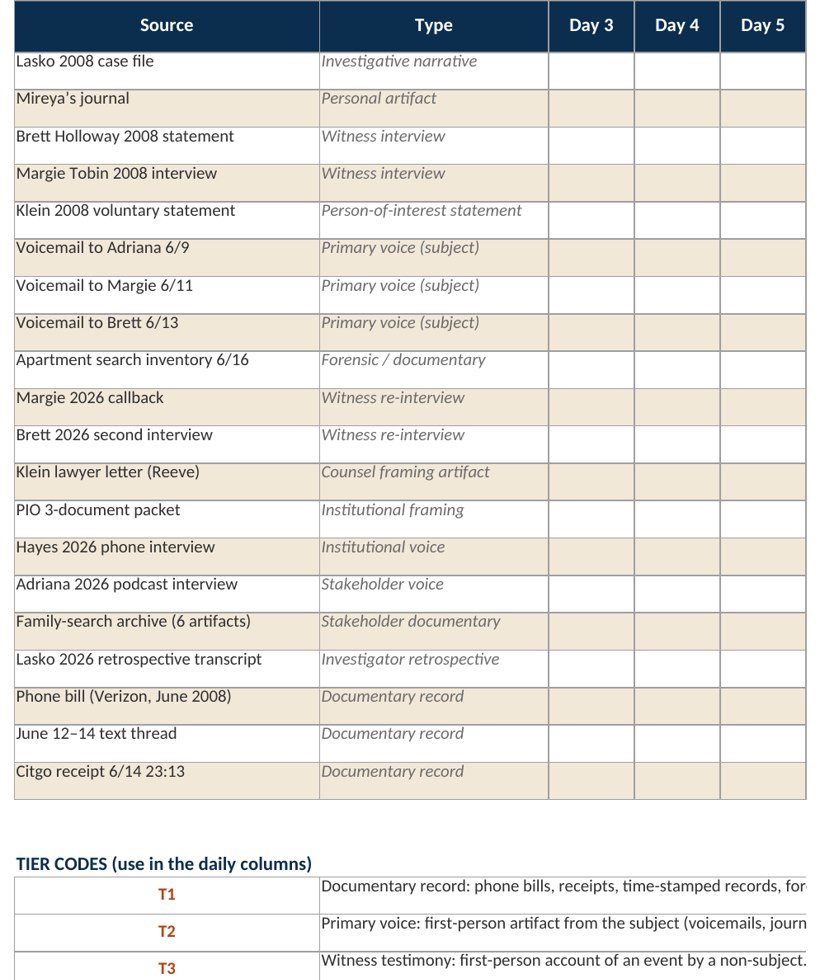
Let the Tracker hold the busywork so the energy goes to judgment.
The student Tracker carries the record-keeping so your students spend their time reasoning. A confidence log captures how sure each team is, day by day, so a shift in conviction becomes visible instead of forgotten. A bias watch log makes thinking visible, asking students to flag the moment they leaned on polish or ran with the popular theory. An evidence tier tracker sorts every source into the five-tier hierarchy, from a 2008 voicemail down to a team inference, so claims stay honest. The spreadsheet does the sorting and the logging. Your students do the deciding. That split is what keeps a thirteen-day case from collapsing into clerical work and keeps the focus where it belongs.
Tap to see the tracker
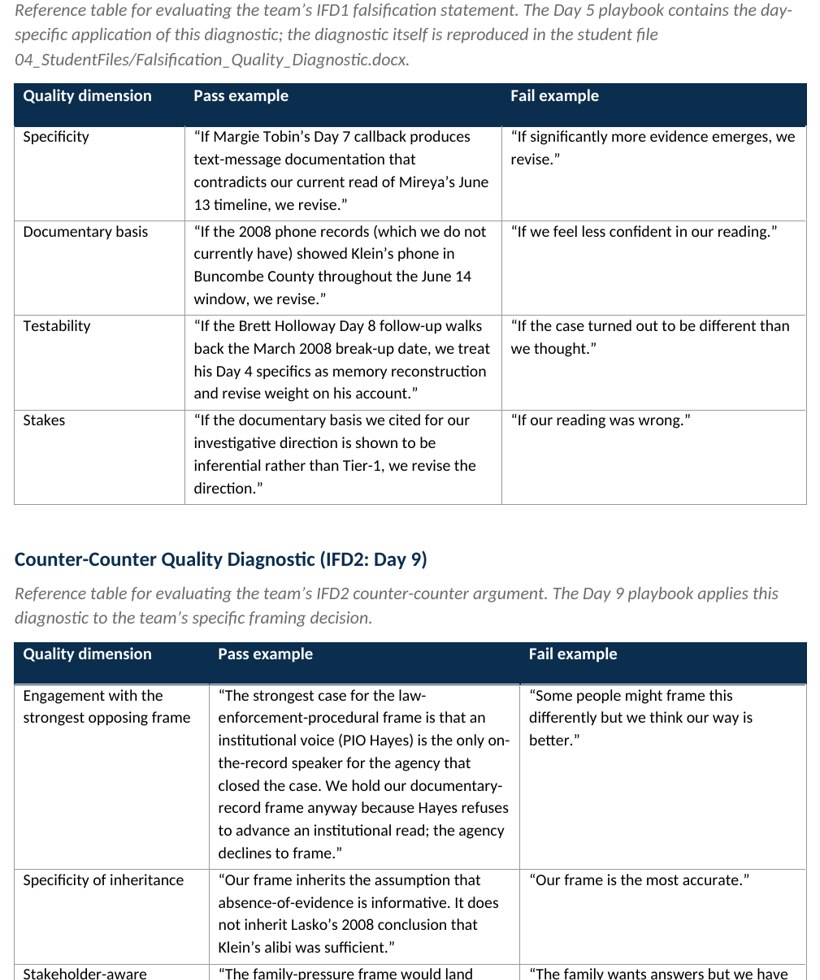
Every day is already scripted. You bring the facilitation.
The Teacher Guide scripts each 50-minute block so your prep stays light. Every session follows the same rhythm: your students diagnose the new evidence, decide on an editorial move, implement it through their production role, and evaluate the reasoning in the Tracker. The guide tells you when the Adriana Salinas-Pham interview lands, which contradiction to hold back, and how to run the Day 13 reveal where the research vocabulary finally gets named. You do not write a single discussion question or build a single handout. You facilitate the room while the simulation supplies the case, the timing, and the turns. That is the trade: you bring the judgment in the room, the box brings everything else.
Tap to read the teacher guide
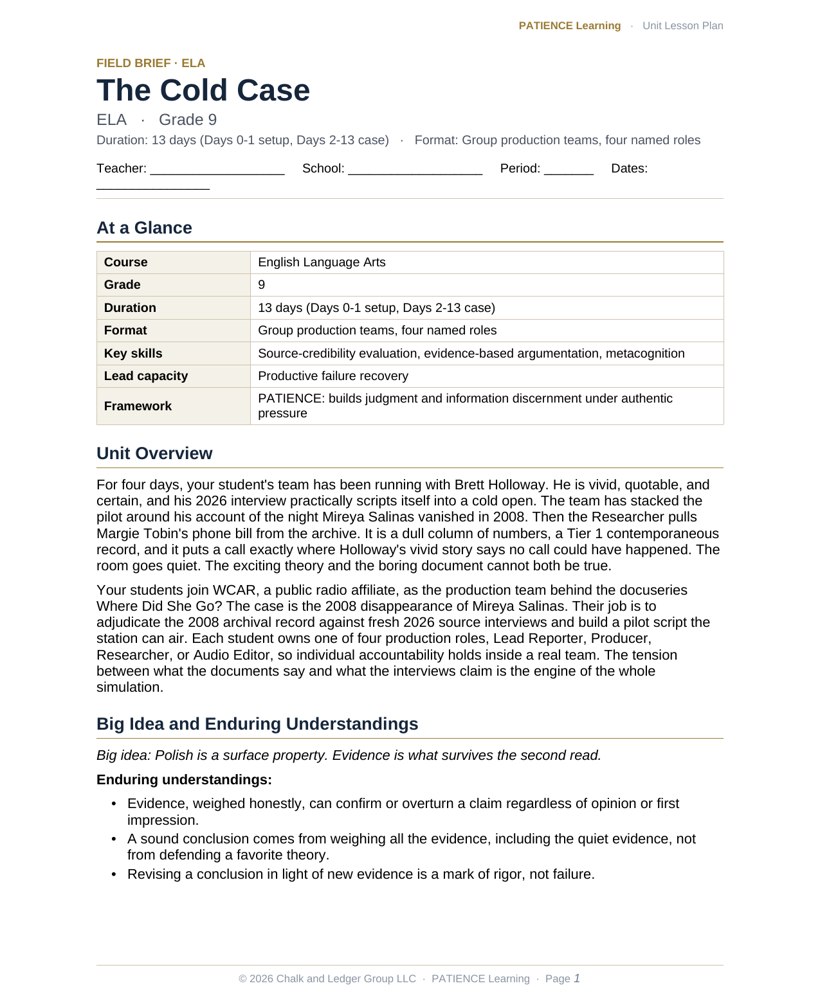
The lesson plan is already written.
Every simulation comes with a fully editable, admin-ready lesson plan. Standards alignment, daily pacing, learning objectives, differentiation, and an assessment plan are already done, so you can hand it to an administrator or adapt it to your district template in minutes.
Tap to preview the lesson plan
Close
Close
Close
Close
The day the favorite theory meets the phone bill.
For four days, your student's team has been running with Brett Holloway. He is vivid, quotable, and certain, and his 2026 interview practically scripts itself into a cold open. The team has stacked the pilot around his account of the night Mireya Salinas vanished in 2008. Then the Researcher pulls Margie Tobin's phone bill from the archive. It is a dull column of numbers, a Tier 1 contemporaneous record, and it puts a call exactly where Holloway's vivid story says no call could have happened. The room goes quiet. The exciting theory and the boring document cannot both be true.
Here is the choice. Your student can protect the theory the team has invested four days in, or trust the record that just contradicted it. Producer Lena Whitfield's editorial notes will not let them paper over the gap. So the team re-weights. They drop Holloway from the anchor slot, name the contradiction in writing, and rebuild the pilot around what the documents actually establish. Once they choose the evidence, the case stops being a mystery to solve and becomes a record to read honestly. The unresolved question gets sharper, not weaker, and the pilot finally tells the truth about what the file does and does not show.
Thirteen days as the production team at WCAR Radio.
Your students join WCAR, a public radio affiliate, as the production team behind the docuseries Where Did She Go? The case is the 2008 disappearance of Mireya Salinas. Their job is to adjudicate the 2008 archival record against fresh 2026 source interviews and build a pilot script the station can air. Each student owns one of four production roles, Lead Reporter, Producer, Researcher, or Audio Editor, so individual accountability holds inside a real team. The tension between what the documents say and what the interviews claim is the engine of the whole simulation.
| Grade level | 9 |
| Course | English Language Arts |
| Duration | 13 days (Days 0-1 setup, Days 2-13 case) |
| Format | Group production teams, four named roles |
| Key skills | Source-credibility evaluation, evidence-based argumentation, metacognition |
Engineering better thinkers.
Discernment matters here because every source is built to sound convincing, and convincing is not the same as documented. Each day pairs a named bias with the capacity that defeats it, so your students do not just notice the trap, they practice the move that gets them out of it.
| Bias targeted | The remedy, built into the work |
|---|---|
| Anchoring | Productive failure recoveryWhen the phone bill breaks the team's favorite theory, students recover by dropping the anchor and rebuilding the pilot around what the documentary record actually establishes. |
| Confirmation bias | MetacognitionThe bias watch log forces students to flag the moment they read a source as proof because it confirmed the story they already wanted to tell. |
| Sunk cost fallacy | Adaptive strategyAfter four days invested in a vivid witness, students re-weight him against a quiet documented source and adjust the frame rather than defend the time already spent. |
| Availability bias | Information discernmentThe five-tier evidence hierarchy stops students from letting the most memorable interview outrank a dull contemporaneous record that carries more weight. |
| Tunnel vision | Navigating uncertaintyOn the inflection days students choose to integrate, hold-and-test, or dismiss a lead, holding the case open instead of forcing one tidy verdict too early. |
| Overconfidence | Emotional regulationA confident detective's retelling tempts a fast call, so students slow down, separate polish from evidence, and state what they would need to change their minds. |
Thirteen days of evidence under pressure.
Days 0 and 1 set field-authentic vocabulary and capture each student's baseline reasoning. From there the case builds: archives collide with polished voices, teams commit to written editorial moves, a late interview reframes everything, and the pilot script gets built and defended. The research terminology lands only on the final day.
| Day | What lands | Skill in focus |
|---|---|---|
| 0-1 | Setup and diagnostic. The newsroom, the case, and a baseline read of each student's reasoning. | Orientation, self-assessment |
| 2 | The 2008 archive opens. First documents against first impressions. | Close reading of records |
| 3 | Polished 2026 voices arrive and tempt easy narratives. | Source-credibility evaluation |
| 4 | The phone bill contradicts the vivid witness. The favorite theory cracks. (critical pivot) | Productive failure recovery |
| 5 | First inflection day. Teams commit in writing to integrate, hold-and-test, or dismiss. | Adaptive strategy |
| 6 | Roles deepen as the Researcher tiers every source. | Evidence hierarchy |
| 7 | Conflicting retrospective accounts force re-weighting. | Information discernment |
| 8 | Teams test their working theory against documented gaps. | Falsification posture |
| 9 | Second inflection day. A sharper written commitment under pressure. | Navigating uncertainty |
| 10 | The Adriana Salinas-Pham interview lands and reveals the case is more complex than assumed. (critical pivot) | Productive failure recovery |
| 11 | The Real-World Transfer bridge maps team choices against a professional podcast. | Metacognition |
| 12 | Pilot script production. Evidence, the gap, the unresolvable question. | Argumentation and synthesis |
| 13 | The reveal. Research vocabulary finally gets named onto twelve days of lived experience. | Conceptual consolidation |
Standards alignment.
The Cold Case hits core Grade 9-10 CCSS-ELA anchors honestly. Students cite textual evidence and distinguish what a source explicitly states from what it leaves open under RI.9-10.1, and they evaluate an author's claims and reasoning for credibility under RI.9-10.8. The pilot script and daily commitments build argument writing with evidence and reasoning under W.9-10.1, and students conduct focused research that adjudicates conflicting sources under W.9-10.7 and W.9-10.8. Team production days develop collaborative discussion and the surfacing of minority views under SL.9-10.1. Precise, role-specific language work supports L.9-10.1 and L.9-10.6.
The hidden architecture.
The case is engineered so the exciting read is the wrong read. Brett Holloway is vivid and quotable, which is exactly why teams anchor on him, and the planted contradiction is Margie Tobin's Tier 1 phone bill, a boring document that quietly breaks his account on Day 4. The biases lead students astray because polish reads as proof and the popular theory feels safe. What forces the sound conclusion is the evidence hierarchy plus the written falsification posture: students cannot dismiss a documentary contradiction without naming it, and the rubric refuses to reward a dramatic verdict that ignores the record. Day 10's Adriana Salinas-Pham interview re-opens the case just when teams feel finished, so overconfidence gets one last test before the Day 13 reveal.
Turnkey, classroom-ready.
- An admin-ready lesson plan. A fully editable plan with standards alignment, daily pacing, differentiation, and assessment, ready to adapt to your district template. Included with every purchase.
- 13-day playbooks. Minute-by-minute facilitation for every 50-minute session, including when each interview lands and how to run the reveal.
- A tech-enabled Tracker. Confidence log, bias watch log, and five-tier evidence tracker that hold the record-keeping so student energy goes to judgment.
- Turnkey student files. The full 2008 archive and 2026 interview transcripts for the Where Did She Go? case, ready to hand out.
- Four production roles. Lead Reporter, Producer, Researcher, and Audio Editor, each with its own accountable lane inside the team.
- A dual rubric system. Grades the quality of reasoning, not whether students solve the case.
Give your students a call worth making.
Bring The Cold Case to your classroom and let your students learn, in thirteen days, that careful reasoning from the record beats the confident guess.
Get this simulationPreview real pages from the simulation before you spend a dollar. No guessing, no surprises.