The Code
The decimals are not noise. They are a message, and the algebra is the only key.
See what your students get, and why it lands.
No mockups. Every page below is real, pulled straight from the files you download. Tap any one to see it full size.
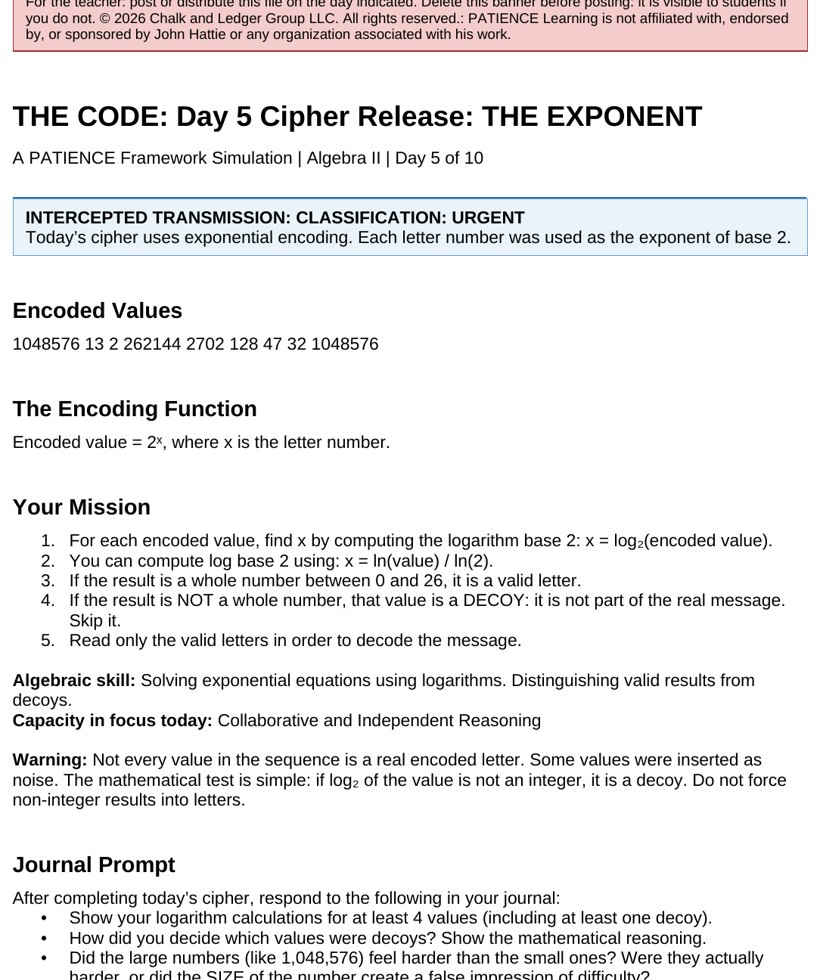
A worksheet was never going to teach this.
This is a real daily cipher release, the exact file your students open in class. They are not answering a list of practice problems. They are staring at a column of values like 2.28, 2.50, 2.21, 2.45, and deciding which algebraic tool unlocks them. On Day 3 the answer is the inverse of a rational function. Apply it correctly and a word surfaces from the data: SKYLIGHT. Apply the wrong tool and the letters never resolve. Each release is a working intelligence document for the NSIB Cipher Division, not a quiz. Your students choose a method, run it, and read the result against the heist they are slowly assembling. The math is the call they make, not the question they answer.
Tap to see a daily cipher release
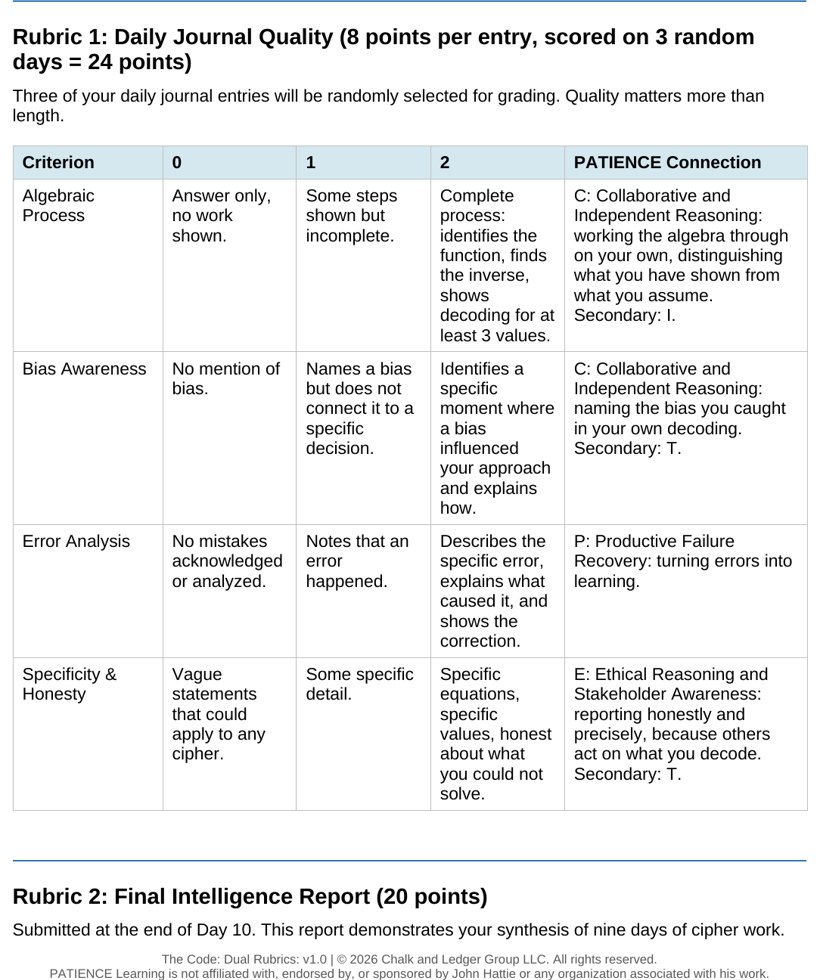
They are graded on the thinking, not the lucky answer.
This is the dual rubric, and it is where The Code makes its position clear. The 44 points split across two instruments. The daily journal carries 24 points, scored on algebraic process, bias awareness, error analysis, and specificity. The final intelligence report carries 20, scored on accuracy, process documentation, synthesis, bias awareness, and presentation. Speed is never graded, which strips out the time-pressure anxiety that pushes students to guess. A student who chooses a sound method, hits a wrong value, catches the error in writing, and corrects it scores higher than one who decoded fast with no record of how. The rubric rewards the careful, traceable reasoning that real analysis demands.
Tap to read the grading rubric
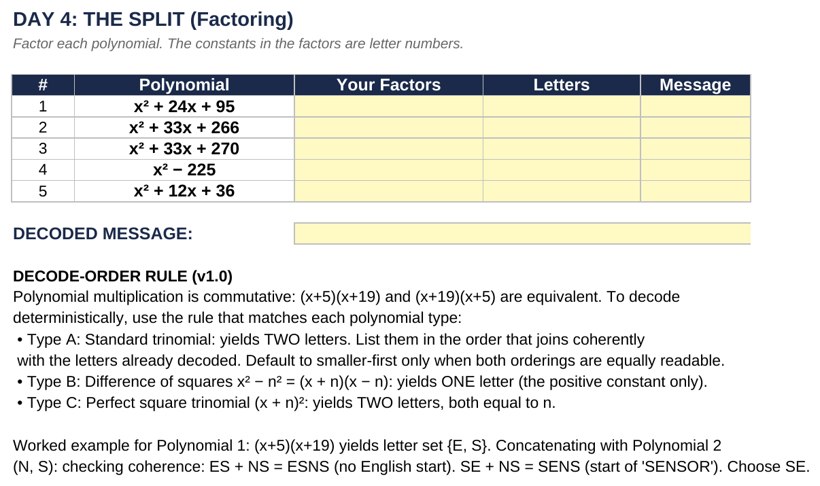
Let the workbook hold the busywork.
This is the student workbook, delivered in Excel and Google Sheets with every encoded value pre-loaded. Your students do not copy long decimal strings by hand or lose a digit transcribing the day's cipher. The values are already in the cells, ready for the inverse function, the logarithm, or the factoring step the day calls for. That design choice matters. When the arithmetic of setup is handled, student energy goes where it belongs, into deciding which tool the changed math now requires and checking whether the result actually decodes. The workbook keeps the record clean so the journal can focus on reasoning. Pre-loaded data also means a student who falls behind one day can rejoin the next without rebuilding everything from scratch.
Tap to see the tracker
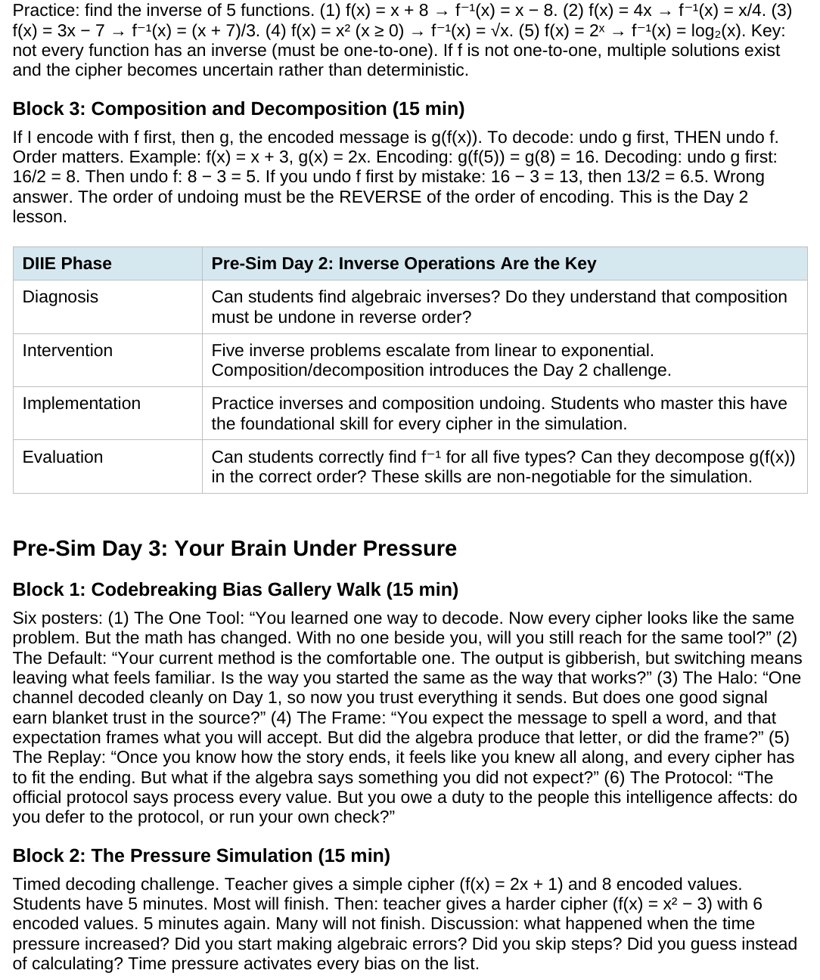
Every day is already scripted.
This is the teacher guide, and it carries the prep so you carry the room. Inside are 13 daily playbooks, 9 cipher data sheets, and a confidential reference key with step-by-step solutions to every cipher. Each session runs the same three-block, fifty-minute structure: a 15-minute mini-lesson on the day's skill, 15 minutes of individual decryption, and 15 minutes of journaling and pair-share. During decryption you circulate using the DIIE phase, diagnosing algebraic errors in real time and intervening before a student carries a mistake forward. You bring the facilitation and the questions. The simulation brings the narrative, the data, the answer key, and the minute-by-minute plan. Prep stays light because the script is already written.
Tap to read the teacher guide
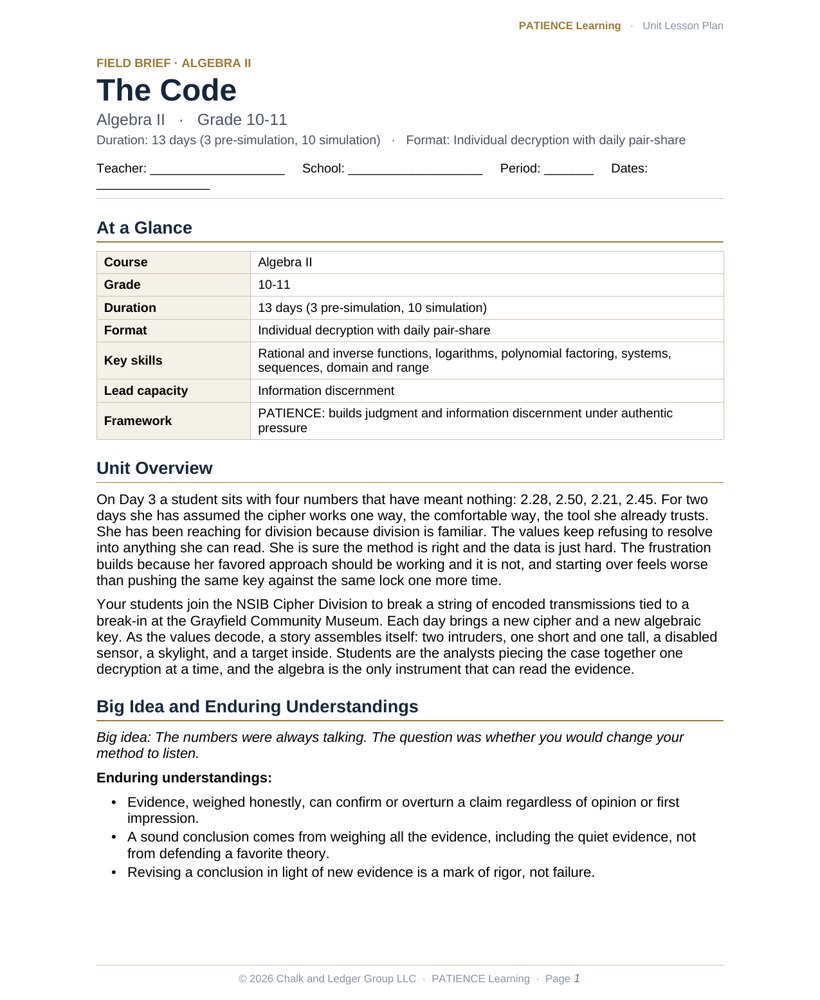
The lesson plan is already written.
Every simulation comes with a fully editable, admin-ready lesson plan. Standards alignment, daily pacing, learning objectives, differentiation, and an assessment plan are already done, so you can hand it to an administrator or adapt it to your district template in minutes.
Tap to preview the lesson plan
Close
Close
Close
Close
The moment the decimals become a message.
On Day 3 a student sits with four numbers that have meant nothing: 2.28, 2.50, 2.21, 2.45. For two days she has assumed the cipher works one way, the comfortable way, the tool she already trusts. She has been reaching for division because division is familiar. The values keep refusing to resolve into anything she can read. She is sure the method is right and the data is just hard. The frustration builds because her favored approach should be working and it is not, and starting over feels worse than pushing the same key against the same lock one more time.
Here is the pivot. She can keep forcing the comfortable method, or she can trust what the numbers are telling her and switch to the inverse of a rational function. She chooses the evidence. She applies the inverse, and the values turn into letters, and the letters spell SKYLIGHT. The heist sharpens into focus. In that instant she stops doing math and starts gathering intelligence. The lesson lands harder than any worksheet could: the tool has to fit the math, not the other way around.
Cryptanalyst for the NSIB Cipher Division.
Your students join the NSIB Cipher Division to break a string of encoded transmissions tied to a break-in at the Grayfield Community Museum. Each day brings a new cipher and a new algebraic key. As the values decode, a story assembles itself: two intruders, one short and one tall, a disabled sensor, a skylight, and a target inside. Students are the analysts piecing the case together one decryption at a time, and the algebra is the only instrument that can read the evidence.
| Grade level | 10-11 |
| Course | Algebra II |
| Duration | 13 days (3 pre-simulation, 10 simulation) |
| Format | Individual decryption with daily pair-share |
| Key skills | Rational and inverse functions, logarithms, polynomial factoring, systems, sequences, domain and range |
Engineering better thinkers.
Discernment matters here because the wrong tool produces a confident, clean, completely false answer. Each day pairs a named cognitive bias with the capacity that defeats it, so students learn to notice the pull of a comfortable method and choose the one the math actually requires.
| Bias targeted | The remedy, built into the work |
|---|---|
| Anchoring | Productive failure recoveryWhen an early signal decodes cleanly, students anchor on it and over-trust the source. The work forces them to re-verify each new value rather than extend blanket trust from one good result. |
| Confirmation bias | MetacognitionStudents accept letters that fit an expected word before the algebra confirms them. The daily journal makes them document the calculation behind every letter, so a guess cannot pass as proof. |
| Sunk cost fallacy | Adaptive strategyStaying with a failing method feels safer than starting over, so students keep forcing it. The cipher progression rewards switching tools the moment the math changes, as on Day 3 and Day 5. |
| Availability bias | Information discernmentReaching for the familiar tool, division, when the changed math now requires logarithms or inverses. Students learn to read the structure of the problem before choosing the operation. |
| Tunnel vision | Navigating uncertaintyForcing the algebra to fit a known or guessed conclusion. When a clue is intentionally fragmentary, students must hold the uncertainty instead of inventing an ending the data does not support. |
| Overconfidence | Emotional regulationDeferring to routine or official protocol instead of range-checking the data themselves. Under pressure, students learn to slow down and verify a result rather than trust that the procedure must be right. |
13 days of decryption.
Three pre-simulation days build the briefing on the NSIB Cipher Division, the six cognitive biases, and the bias research vocabulary students will use all unit. The 10 case days then escalate in technical difficulty, each unlocking one clue, until the Day 9 Master Cipher synthesizes every skill and the Day 10 report closes the file.
| Day | What lands | Skill in focus |
|---|---|---|
| Pre 1-3 | Briefing on the Cipher Division, the six biases, and bias research vocabulary | Metacognitive setup |
| 1 | The Shift decodes MUSEUM HEIST | Linear equations and inverse operations |
| 2 | The Swap decodes TWO ENTERED | Function composition and decomposition |
| 3 | The Mirror decodes SKYLIGHT (critical pivot) | Inverse of rational functions |
| 4 | The Split decodes SENSOR OFF | Polynomial factoring, trinomials and squares |
| 5 | The Exponent decodes TARGET (critical pivot) | Logarithmic equations |
| 6 | The System decodes SHORT TALL | Two-by-two systems of equations |
| 7 | The Sequence yields an intentionally fragmentary clue | Arithmetic and geometric sequences |
| 8 | The Broken Code decodes ALARM | Domain and range, square root functions |
| 9 | The Master Cipher decodes STOP THEM | Multi-step synthesis and composition |
| 10 | The Report closes the full case file | Synthesis and metacognitive reflection |
Standards alignment.
The Code maps to the most rigorous Algebra II expectations in the Common Core math standards. It hits Seeing Structure in Expressions (A-SSE), Arithmetic with Polynomials and Rational Expressions (A-APR), Creating Equations (A-CED), and Reasoning with Equations and Inequalities (A-REI). The function work spans Interpreting Functions (F-IF), Building Functions (F-BF), and Linear, Quadratic, and Exponential Models, including F-LE.A.4 on solving exponential equations with logarithms. Every day exercises the Standards for Mathematical Practice, especially MP.1 perseverance, MP.5 strategic use of tools, MP.6 precision, and MP.7 making use of structure. The alignment is honest because the algebra is the mechanism, not the decoration.
The hidden architecture.
The pivot is engineered. For the first two days the ciphers yield to straightforward inverse operations, so students build trust in one comfortable approach. Day 3 quietly changes the math: the values only resolve under the inverse of a rational function, and division, the tool they have leaned on, produces nonsense. That nonsense is the design. It manufactures the productive failure that forces a student to abandon a method and adapt. Day 5 repeats the move with logarithms. The biases lead students astray on purpose, because reaching for the familiar tool feels safe. What forces the sound conclusion is the data itself: a wrong method never decodes into readable English, so the evidence, not the teacher, corrects the error.
Turnkey, classroom-ready.
- An admin-ready lesson plan. A fully editable plan with standards alignment, daily pacing, differentiation, and assessment, ready to adapt to your district template. Included with every purchase.
- 13 daily playbooks. Minute-by-minute facilitation for every fifty-minute session, built on the three-block mini-lesson, decryption, and journal structure.
- A tech-enabled workbook. Excel and Google Sheets files with every encoded value pre-loaded so student energy goes to judgment, not transcription.
- Turnkey student files. Daily cipher releases in .docx for your LMS, a briefing packet, a reflection journal, and 9 cipher method reference cards.
- A dual rubric system. A 24-point daily journal and a 20-point final report that grade the quality of reasoning, not whether they solve it.
- A confidential teacher key. Step-by-step solutions to all 9 ciphers plus a legacy and consequence report for managing archetypes and running the debrief.
Hand your students the case.
Bring The Code to your classroom and watch Algebra II turn into the one tool that can read the evidence and stop the heist.
Get this simulationPreview real pages from the simulation before you spend a dollar. No guessing, no surprises.