The Client
The witness who sounds right is not the witness who is right.
See what your students get, and why it lands.
No mockups. Every page below is real, pulled straight from the files you download. Tap any one to see it full size.
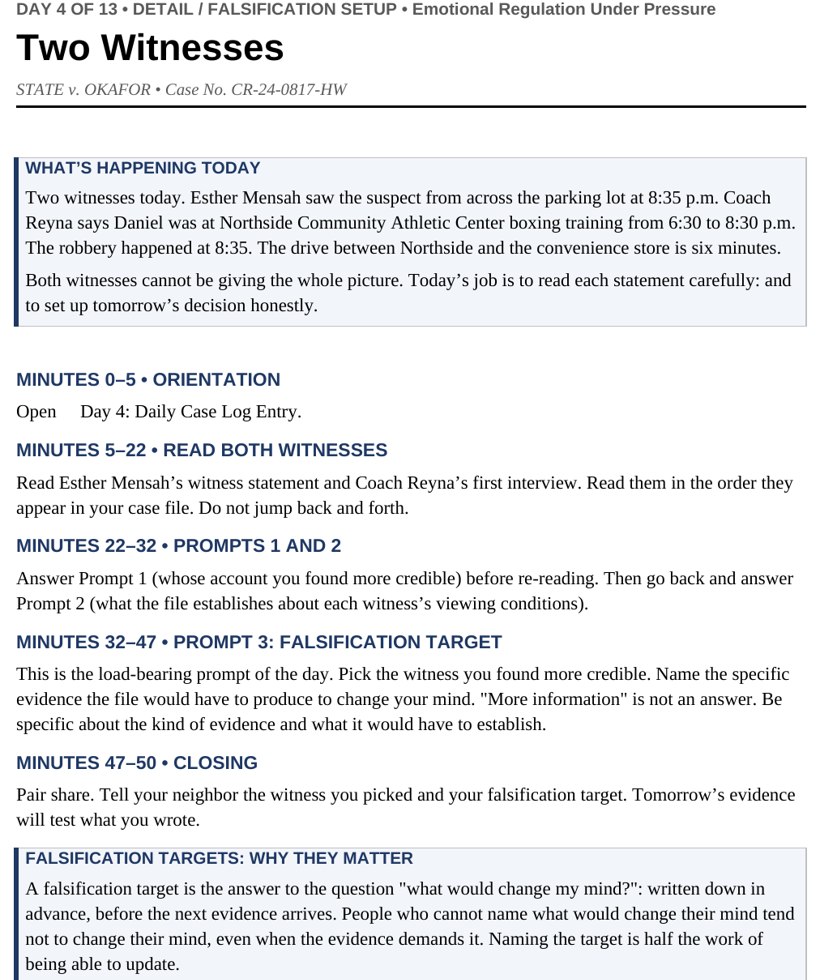
Your students are not answering questions. They are making a real call from the file.
This is a day from the actual case file your students work, not a worksheet about a case. They open the Okafor file as investigator-paralegals in the Hartwell County Public Defender's Office. The page in front of them is real evidence: a deposition from Detective Karen Voss, a note on inconclusive surveillance footage, a witness account that does not quite line up. The prompt does not ask them to summarize. It asks them to commit. At each inflection day they choose one of three named paths, Integrate, Hold-and-Test, or Dismiss, and they have to say why the file supports that move. There is no answer key page to copy. There is only the file, and the call they are willing to defend.
Tap to see a real case day
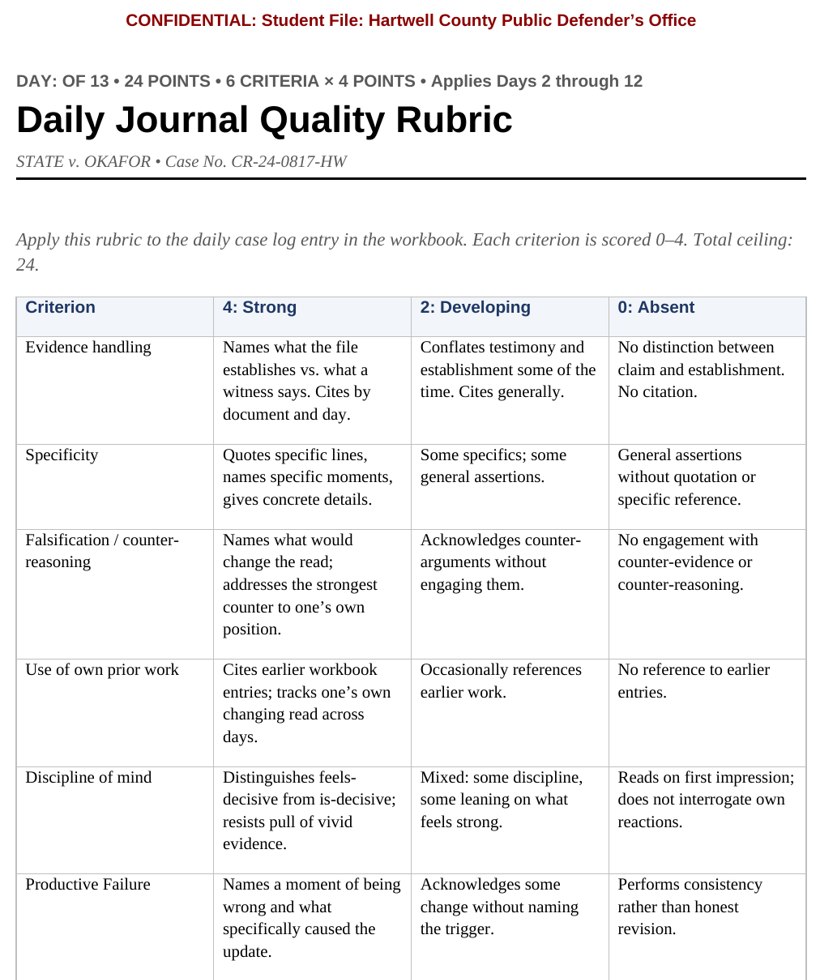
They are graded on their reasoning, not on guessing the verdict.
The Daily Rubric runs on what we call Boring Choice Wins. A student who flags a viewing-condition limitation in a witness statement scores higher than a student who makes a dramatic, ungrounded claim about guilt. The rubric rewards the quality of the reasoning path under uncertainty, not the conclusion reached. That design removes teacher-grading creep, the slow drift toward grading on whether a student landed where you landed. Because the simulation refuses to settle whether Daniel Okafor committed the robbery, there is no correct verdict to reward. What earns the score is a clean read of evidence: naming what a document establishes, naming what it does not, and stating the falsification condition that would change the student's mind. A sound process behind an open question beats a lucky guess.
Tap to read the grading rubric
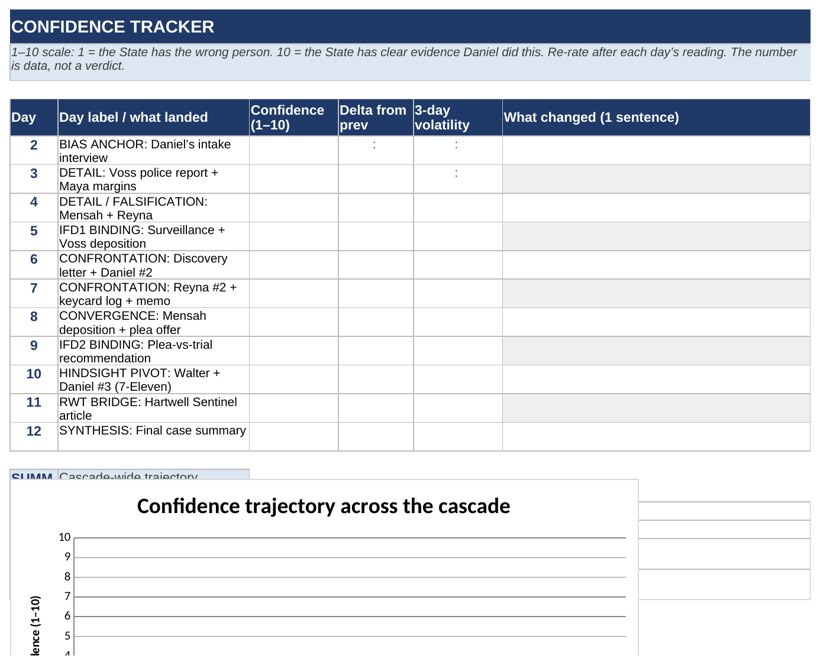
Let the workbook hold the busywork so students spend their energy on the judgment.
The Tracker is a tech-enabled spreadsheet that carries the clerical load. As students work the file, they log each piece of evidence into the Evidence Hierarchy, six tiers running from Physical Evidence at Tier 1 down to Inference at Tier 6. The Tracker time-stamps their daily decisions, holds their confidence ratings, and quotes their own earlier reasoning back to them on revision days. Students are not copying tables by hand or hunting for the note they wrote on Day 4. The structure is already there. That means the energy that would go to formatting and filing goes instead to the hard part: deciding what a tier-1 fact actually proves, and noticing the moment the State's case has no tier-1 or tier-2 evidence identifying the suspect at all.
Tap to see the tracker
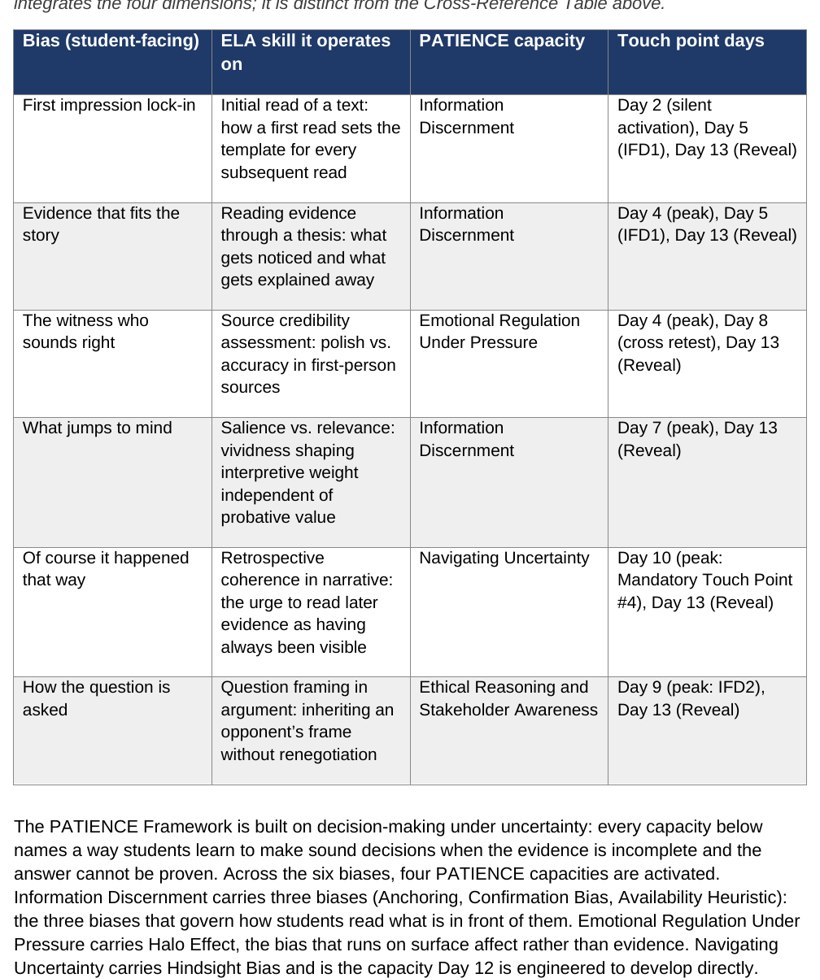
Every day is already scripted. You bring the facilitation, the simulation brings the rest.
The Teacher Guide scripts all thirteen sessions. Each day gives you the sequence, the evidence drop, the prompts, and the moves that keep the case moving without telling students what to think. It includes Five Diagnostic Student Profiles so you can read the room and respond. When the Believer locks in early, you ask for a specific falsification condition. When the Skeptic presumes deception, you surface the Day 7 keycard log against their Day 4 stance. When the Methodical Auditor freezes, you remind them the rubric grades the decision under uncertainty, not the finality of the answer. Prep is light because the World Bible and Design Notes hold the case together. You facilitate. The structure does the rest.
Tap to read the teacher guide
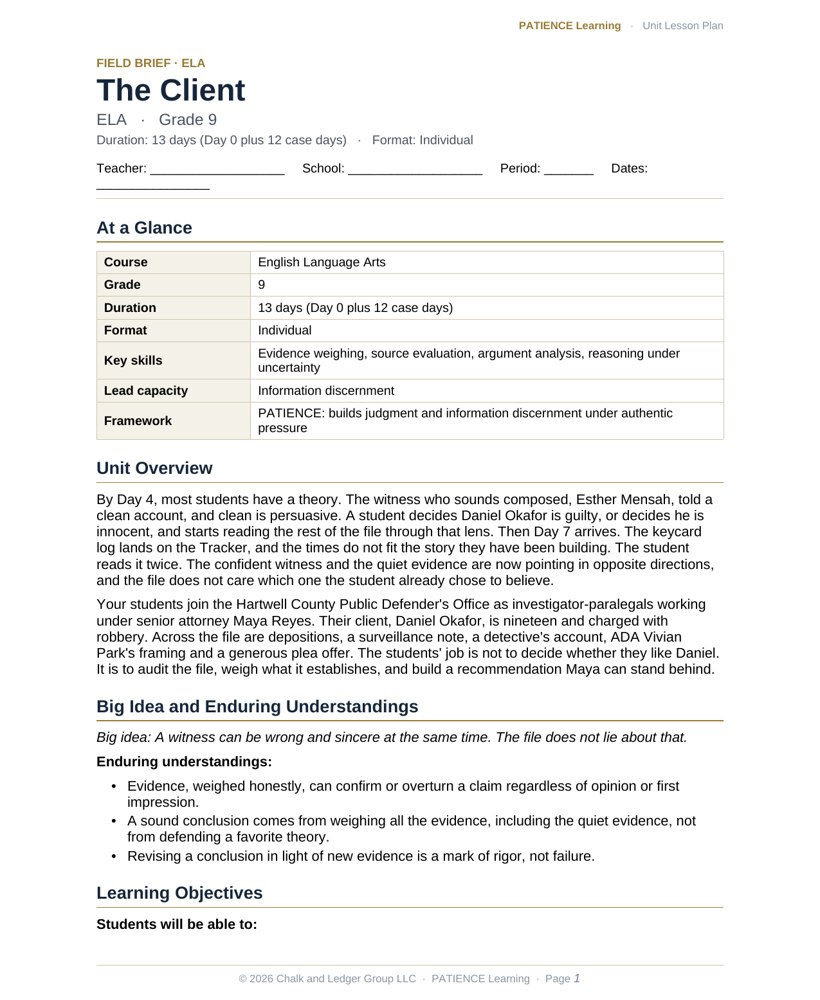
The lesson plan is already written.
Every simulation comes with a fully editable, admin-ready lesson plan. Standards alignment, daily pacing, learning objectives, differentiation, and an assessment plan are already done, so you can hand it to an administrator or adapt it to your district template in minutes.
Tap to preview the lesson plan
Close
Close
Close
Close
The day the story they liked stops surviving the file.
By Day 4, most students have a theory. The witness who sounds composed, Esther Mensah, told a clean account, and clean is persuasive. A student decides Daniel Okafor is guilty, or decides he is innocent, and starts reading the rest of the file through that lens. Then Day 7 arrives. The keycard log lands on the Tracker, and the times do not fit the story they have been building. The student reads it twice. The confident witness and the quiet evidence are now pointing in opposite directions, and the file does not care which one the student already chose to believe.
This is the pivot. The student can protect the theory, the comfortable one they have been defending since Day 4, or trust what the log actually establishes. Choosing the theory means ignoring a tier-1 fact. Choosing the evidence means admitting the polished witness was carrying a halo, not a case. When the student finally weights the log over the witness, the file reorganizes. They see that the State has no physical evidence identifying the suspect, and that they had been mistaking a well-told story for proof.
State v. Okafor, from inside the defender's office.
Your students join the Hartwell County Public Defender's Office as investigator-paralegals working under senior attorney Maya Reyes. Their client, Daniel Okafor, is nineteen and charged with robbery. Across the file are depositions, a surveillance note, a detective's account, ADA Vivian Park's framing and a generous plea offer. The students' job is not to decide whether they like Daniel. It is to audit the file, weigh what it establishes, and build a recommendation Maya can stand behind.
| Grade level | 9 |
| Course | English Language Arts |
| Duration | 13 days (Day 0 plus 12 case days) |
| Format | Individual |
| Key skills | Evidence weighing, source evaluation, argument analysis, reasoning under uncertainty |
Engineering better thinkers.
Discernment is the whole game here, because the file is built to mislead a careless reader. Each day pairs a bias students will actually feel with the capacity that defeats it, and students live the pattern for twelve days before it is ever named on Day 13.
| Bias targeted | The remedy, built into the work |
|---|---|
| Anchoring | Productive failure recoveryThe first impression of the client locks in early. The 13-day structure gives the Day 2 read time to cool, then forces students to revisit and revise it against evidence that arrives in the second week. |
| Confirmation bias | MetacognitionOnce a student picks a theory, the file rewards reading evidence through it. The Tracker quotes their own earlier reasoning back to them so they have to notice what they ignored to keep the story intact. |
| Sunk cost fallacy | Adaptive strategyStudents invest days building a case for one path. At each inflection day they may Integrate, Hold-and-Test, or Dismiss, which makes changing course a named, scoreable move rather than an admission of failure. |
| Availability bias | Information discernmentThe vivid detail crowds out the probative one. The Evidence Hierarchy makes students rank each item by tier, separating what jumps to mind from what actually carries weight in a courtroom. |
| Tunnel vision | Navigating uncertaintyThe Day 12 Unresolvable Question refuses a correct verdict. Students develop the stamina to hold a case open, resisting premature closure and recommending on what the file establishes, not on what they privately believe. |
| Overconfidence | Emotional regulationA composed witness like Esther Mensah creates unearned credibility. Students learn to spot the halo carrier, separate polish from accuracy, and rate their own confidence honestly against the tier of evidence behind it. |
13 days of evidence under pressure.
Day 0 sets the office, the client, and the rules of evidence. The case then drips forward: first impressions form, get tested against forensic detail and conflicting accounts, and twice force a binding commitment. The arc bends toward a question the file refuses to answer, then names the biases students just lived.
| Day | What lands | Skill in focus |
|---|---|---|
| 0 | The defender's office, the client, and the Evidence Hierarchy | Orientation to role and rules |
| 2 | First read of the file and an initial confidence rating | Forming a defensible first impression |
| 4 | The composed witness account settles in as the favored theory | Source credibility, halo detection |
| 5 | IFD1: a client-credibility call on inconclusive footage and the Voss deposition (critical pivot) | Committing under uncertainty |
| 7 | The keycard log lands and contradicts the favored story | Weighing tier-1 evidence against testimony |
| 9 | IFD2: a plea-vs-trial recommendation with a steel-manned counter | Argument construction and rebuttal |
| 10 | A quote-yourself prompt confronts the Day 2 confidence rating | Metacognitive revision |
| 11 | The RWT Bridge: spotting framing techniques in a Hartwell Sentinel article | Transfer to civic and media texts |
| 12 | The Unresolvable Question forces a recommendation on what the file establishes (critical pivot) | Reasoning without a correct answer |
| 13 | The reveal: each lived pattern gets its research name, plus a productive-failure reflection | Naming biases, updating thinking |
Standards alignment.
The Client works squarely in the Grade 9 CCSS-ELA strands. Reading Informational Text drives the daily work: students cite textual evidence and weigh what it supports (RI.9-10.1), determine central ideas across a complex file (RI.9-10.2), and analyze how an author advances a point of view and frames an argument (RI.9-10.6). Argument writing is the spine of both inflection days, where students build a claim, develop it with evidence, and address counterclaims (W.9-10.1). Speaking and Listening shows up as students evaluate the reasoning and rhetoric of witnesses and the prosecution (SL.9-10.3), and Language work runs through close attention to loaded vocabulary and framing (L.9-10.5).
The hidden architecture.
Here is the engine. The file is built so a confident, polished witness, Esther Mensah, pulls students toward an early theory, and the Discovery-First design withholds bias names until Day 13 so they cannot intellectualize their way past the trap. The planted contradiction is the Day 7 keycard log, a tier-1 fact whose timing breaks the comfortable story. Students who anchored on Day 4 must now choose between protecting that theory and trusting the log. The structural payoff is that the State carries no tier-1 or tier-2 evidence identifying the suspect, so any honest audit of the Evidence Hierarchy forces a shift from storytelling to evidence. The Day 12 Unresolvable Question then refuses to crown a verdict, which is the point: the sound recommendation rests on what the file establishes, not on what anyone believes.
Turnkey, classroom-ready.
- An admin-ready lesson plan. A fully editable plan with standards alignment, daily pacing, differentiation, and assessment, ready to adapt to your district template. Included with every purchase.
- 13-day playbooks. Minute-by-minute facilitation for every session, with the evidence drop and prompts already sequenced.
- A tech-enabled Tracker. Logs evidence by tier, time-stamps decisions, and quotes students' own reasoning back to them on revision days.
- Turnkey student files. The full Okafor case: depositions, surveillance notes, the keycard log, plea materials, and the RWT Bridge article.
- A dual rubric system. Grades the quality of reasoning, not whether they solve it, with Five Diagnostic Student Profiles for targeted coaching.
- A World Bible and Design Notes. The bedrock that keeps the cognitive cascade intact no matter who teaches it.
Hand your students a real file and a real call.
Bring The Client to your Grade 9 room and watch students learn to weigh evidence honestly, hold a question open, and defend a call the file can support.
Get this simulationPreview real pages from the simulation before you spend a dollar. No guessing, no surprises.