The Cash Flow
Knowing about money is not the same as managing yourself with money.
See what your students get, and why it lands.
No mockups. Every page below is real, pulled straight from the files you download. Tap any one to see it full size.
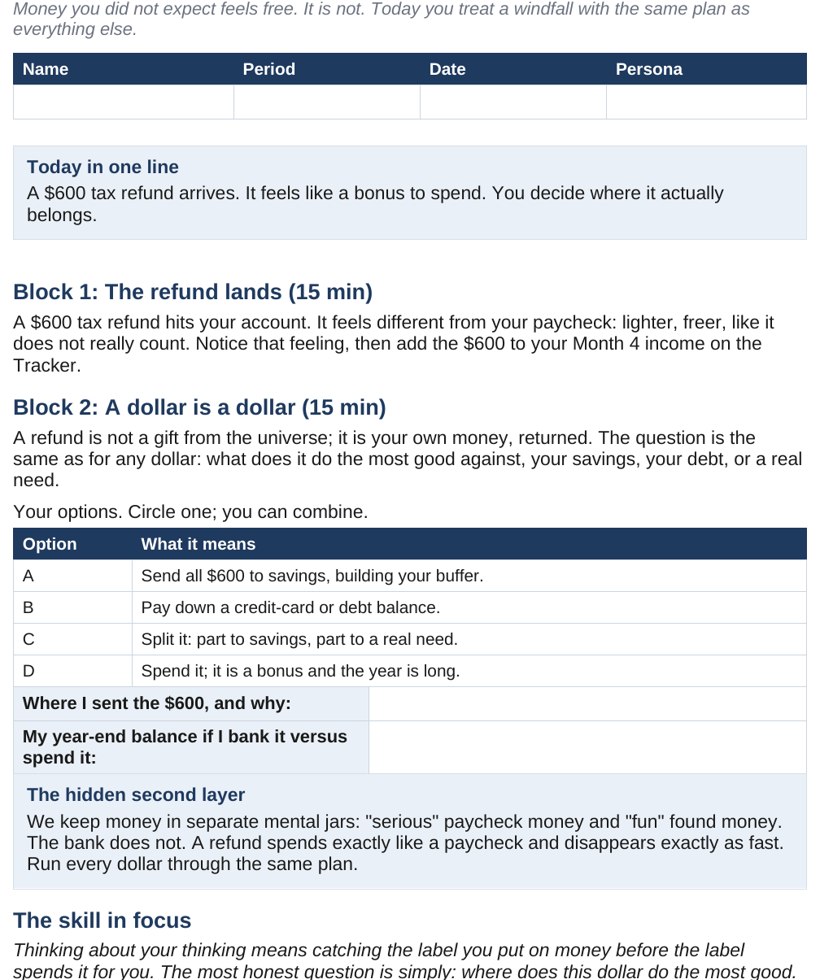
Your students are not answering questions. They are making a call.
On Day 6 the car breaks and the repair is $800. The page does not ask your students to define an emergency fund. It hands them their real balance to the penny, the bill, and a deadline, then asks what they will actually do. Cut the savings transfer this month? Skip a fixed cost? Reach for easy payments? Each choice changes next month's numbers, and the workbook carries the consequence forward. This is the difference between a worksheet and a decision. A worksheet asks students to recall a rule. The case forces them to weigh scarcity against long-term health while the cash in front of them runs short, which is exactly where real money goes wrong.
Tap to see a student case page
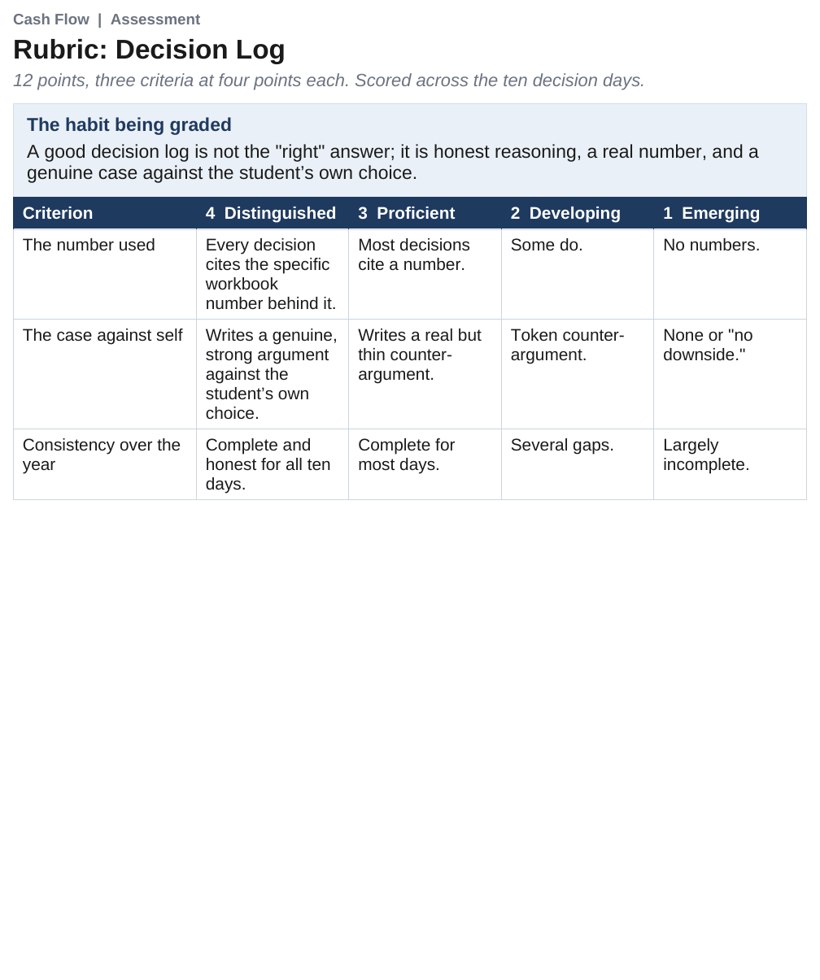
They are graded on their reasoning, not on landing the right number.
A student can end the year in the red and still earn the top mark, because the rubric reads the thinking, not the balance. Four scaled rubrics move students from Emerging to Distinguished. The Daily Journal asks them to cite exact workbook figures and name what they felt. The Decision Log scores the habit of thinking about their thinking, and to reach Distinguished a student has to write an honest, strong case against their own choice. The Signature Capacity rubric looks for one specific thing during the Day 6 crisis: evidence of a deliberate pause and a return to the balance sheet. A sound process behind a painful year beats a lucky guess every time.
Tap to read the grading rubric
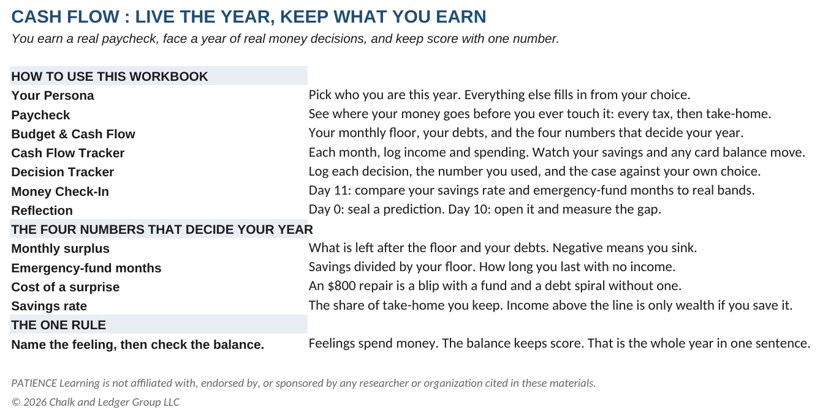
Let the workbook hold the arithmetic so students spend their energy on judgment.
The workbook is a live engine. It tracks every dollar to the penny, compounds debt in real time, and carries each month's result into the next so a single choice ripples across the year. Because the math grades itself against a locked engine, your students are never auditing their own arithmetic and neither are you. They pick one of four personas, record year-end predictions, then face one month of decisions each class day. If a student is absent, they resume at the next month with no progress lost. The point is simple. When the busywork is automated, student attention goes to the choice in front of them, which is where the learning lives.
Tap to see the tracker
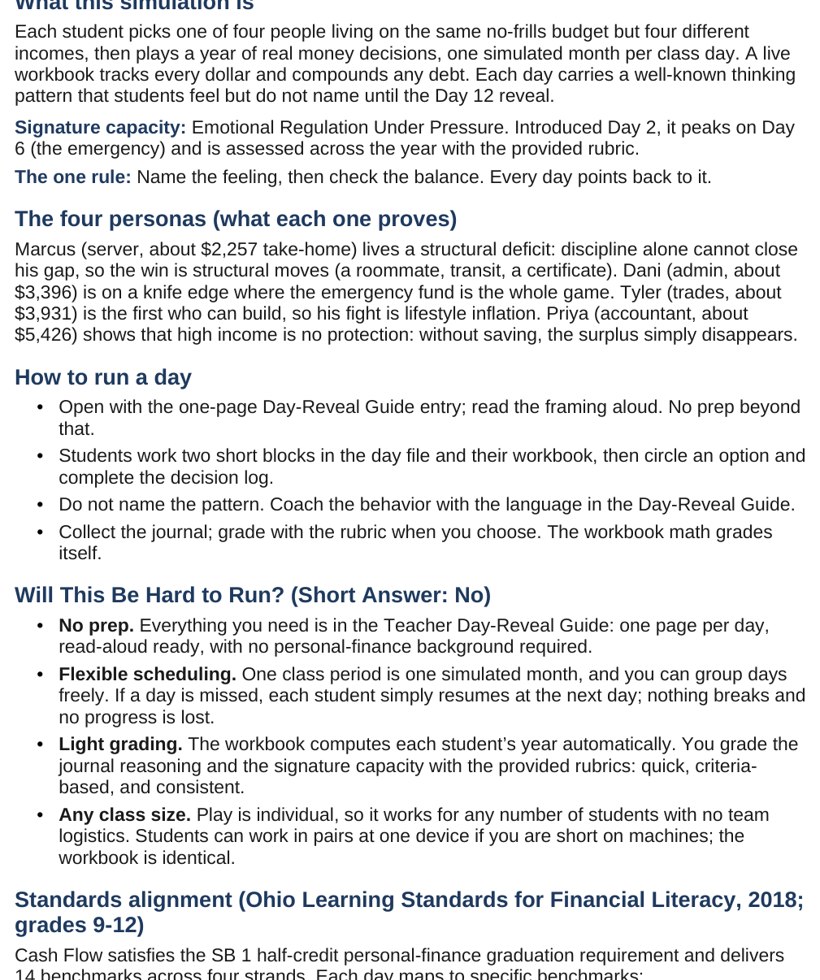
Every day is already scripted. You bring the facilitation.
This is a zero-prep build, and it is meant for any teacher, not just a finance specialist. The Teacher Day-Reveal Guide hands you the read-aloud framing for each event and walks the two short work blocks. Deploy the live workbook and the Day 0 file, let students select personas, then open the guide and run the day. The one-day, one-month logic means days group freely to fit any bell schedule. Play is individual and device-agnostic, and if hardware is short, students pair at a single device. On Day 12 you run the Bias Reveal and Debrief Script and collect the Money Philosophy capstone. Your time goes to coaching behavior, not managing logistics or grading math.
Tap to read the teacher guide
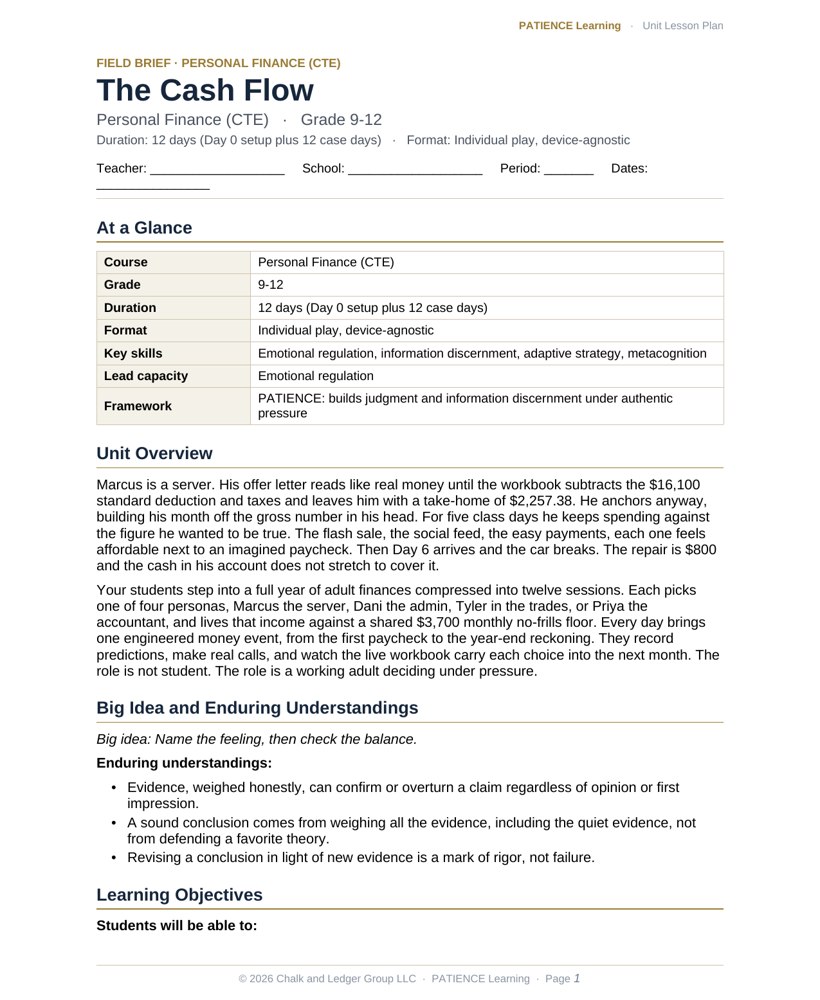
The lesson plan is already written.
Every simulation comes with a fully editable, admin-ready lesson plan. Standards alignment, daily pacing, learning objectives, differentiation, and an assessment plan are already done, so you can hand it to an administrator or adapt it to your district template in minutes.
Tap to preview the lesson plan
Close
Close
Close
Close
The day the math stops being theory and starts being your own paycheck.
Marcus is a server. His offer letter reads like real money until the workbook subtracts the $16,100 standard deduction and taxes and leaves him with a take-home of $2,257.38. He anchors anyway, building his month off the gross number in his head. For five class days he keeps spending against the figure he wanted to be true. The flash sale, the social feed, the easy payments, each one feels affordable next to an imagined paycheck. Then Day 6 arrives and the car breaks. The repair is $800 and the cash in his account does not stretch to cover it.
At the pivot Marcus has to choose between the story he told himself and the balance on the screen. He can protect the theory that discipline alone will close the gap, or he can trust the numbers and admit the floor is structural. When he checks the balance, the year reframes. A highly disciplined Marcus still ends at a deficit of $1,129.58, and without structural moves like a roommate or transit he sinks to a deficit of $16,822.01. The lesson is not that he failed. The lesson is that the feeling lied and the balance sheet did not.
One simulated year of money, one month per class day.
Your students step into a full year of adult finances compressed into twelve sessions. Each picks one of four personas, Marcus the server, Dani the admin, Tyler in the trades, or Priya the accountant, and lives that income against a shared $3,700 monthly no-frills floor. Every day brings one engineered money event, from the first paycheck to the year-end reckoning. They record predictions, make real calls, and watch the live workbook carry each choice into the next month. The role is not student. The role is a working adult deciding under pressure.
| Grade level | 9-12 |
| Course | Personal Finance (CTE) |
| Duration | 12 days (Day 0 setup plus 12 case days) |
| Format | Individual play, device-agnostic |
| Key skills | Emotional regulation, information discernment, adaptive strategy, metacognition |
Engineering better thinkers.
Money decisions fail on feeling, not on math. Each day stages a peak emotional moment that triggers a named bias, then pairs it with the capacity that defeats it. Students feel the pull first, name it second, and build the habit of returning to the balance sheet under pressure.
| Bias targeted | The remedy, built into the work |
|---|---|
| Anchoring | Productive failure recoveryDay 1 reveals that the gross offer was never the real number. Students who anchored high recover by rebuilding every plan from take-home pay, not the headline figure. |
| Confirmation bias | MetacognitionThe Decision Log forces a written case against the student's own choice, so they have to argue the opposite of what they want to believe before they commit. |
| Sunk cost fallacy | Adaptive strategyDay 10 year-end data tempts students to defend a failing plan because of past spending. The remedy is plain: only the next dollar is still yours to control. |
| Social proof | Information discernmentDay 5 drives an $180 keeping-up purchase off the feed. Students learn to read that feeds show other people's spending, never their balances. |
| Scarcity and tunneling | Navigating uncertaintyThe Day 6 $800 repair narrows focus to immediate cash at the cost of long-term health. The emergency fund becomes the off-ramp that keeps the year intact. |
| Overconfidence | Emotional regulationDay 8 a 6 percent raise threatens to vanish into lifestyle inflation. Students pay the raise to their future self first instead of trusting an optimistic forecast. |
12 months of decisions, one per class day.
Day 0 sets up the workbook, personas, and year-end predictions. From there the year unfolds one engineered event at a time, each tuned to a specific bias. The pressure builds toward the Day 6 crisis, then turns reflective as the year-end data exposes the patterns students have been living. Day 12 names every bias and collects the capstone.
| Day | What lands | Bias in focus |
|---|---|---|
| 0 | Setup: deploy the workbook, pick a persona, record year-end predictions | Baseline |
| 1 | The first paycheck lands far below the gross offer (critical pivot) | Anchoring |
| 2 | A $250 flash sale with a fake deadline | Present bias |
| 3 | A subscription audit surfaces $45 a month in zombie charges | Status quo and inertia |
| 4 | A $600 tax refund feels like found money | Mental accounting |
| 5 | The social feed drives an $180 keeping-up purchase | Social proof and FOMO |
| 6 | The car breaks: an $800 repair narrows every choice (critical pivot) | Scarcity and tunneling |
| 7 | Buy-now-pay-later hides a $440 total cost behind easy payments | Framing effect |
| 8 | A 6 percent raise threatens to vanish into lifestyle inflation | Overconfidence |
| 9 | A $300 market dip stings more than the math warrants | Loss aversion |
| 10 | Year-end reflection tempts a defense of the failing plan | Sunk cost fallacy |
| 12 | Bias reveal, debrief script, and the Money Philosophy capstone | Synthesis |
Standards alignment.
Cash Flow aligns to the National Standards for Personal Financial Education from the Council for Economic Education and Jump$tart, covering Earning Income, Spending, Saving, Using Credit, and Managing Risk through lived decisions rather than definitions. It maps to the Common Career Technical Core Finance cluster and the Career Ready Practices, with emphasis on CRP8, applying critical thinking to solve problems, and CRP11, using technology to manage decisions. The simulation runs a 2026 tax year model with a $16,100 standard deduction for real-world accuracy. Assessment is honest and concrete: four scaled rubrics measure reasoning, metacognition, emotional regulation, and a final philosophy of money. There are no Common Core codes claimed here, because this is a finance build, not an ELA build.
The hidden architecture.
The engine is built so discipline cannot save a bad structure. Every persona shares a $3,700 monthly floor, but the take-home pay does not. Marcus clears $2,257.38, and even a maximally disciplined Marcus ends the year in the red, which means students who believe budgeting alone wins will watch that belief break against the numbers. The planted contradiction is the gap between the gross offer and the take-home figure on Day 1, an anchor that quietly distorts every choice until Day 6 forces a reckoning. The $800 repair is timed to land after students have overspent on feeling, so scarcity hits hardest exactly when the cushion is thinnest. The sound conclusion is not a number. It is the One Rule: name the feeling, then check the balance.
Turnkey, classroom-ready.
- An admin-ready lesson plan. A fully editable plan with standards alignment, daily pacing, differentiation, and assessment, ready to adapt to your district template. Included with every purchase.
- A 12-day playbook. Minute-by-minute facilitation for every session, with read-aloud framing and two short work blocks per day.
- A live, engine-proven workbook. Tracks every dollar to the penny, compounds debt in real time, and grades the math against a locked engine.
- Four student personas. Marcus, Dani, Tyler, and Priya, each with a distinct income and a shared no-frills floor that sets the stakes.
- Turnkey student files. The Day 0 setup, prediction and reflection sheets, and the Money Philosophy capstone, ready to distribute.
- A four-rubric system. Grades the quality of reasoning, the case against self, emotional regulation under pressure, and the final philosophy.
- The Bias Reveal and Debrief Script. Names all ten patterns on Day 12 so students leave able to spot the pull in their own lives.
Give your students the year before it costs them the real one.
Bring Cash Flow to your classroom and let your students feel the pull of every money bias in a place where the only thing they can lose is a lesson.
Get this simulationPreview real pages from the simulation before you spend a dollar. No guessing, no surprises.