The Caravan
The boring caravan wins. The one chasing the windfall ends up a tavern cautionary tale.
See what your students get, and why it lands.
No mockups. Every page below is real, pulled straight from the files you download. Tap any one to see it full size.
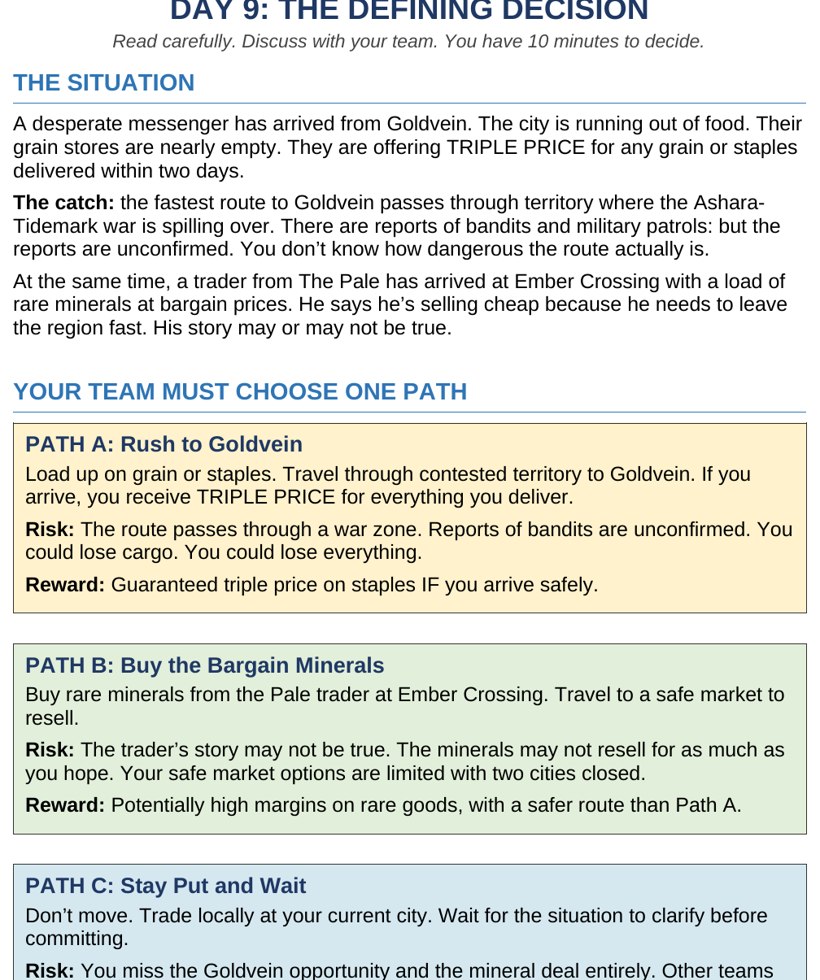
Your students are not answering questions. They are making a real call.
This is the Day 9 Defining Decision. Geopolitical war has erupted, prices have spiked, and three teams of merchant-strategists must choose a path with their caravan's gold on the line. Path A rushes to Goldvein, where prices have tripled but raiders take a fifteen percent cut. Path B bargains for minerals on calculated margins. Path C stays put. There is no answer key on the page. Students weigh the Herald's rumor cards, the market sheet, and what the route closures already taught them, then they commit. A worksheet was never going to teach this. They feel the weight of an incomplete picture and decide anyway, which is exactly the merchant mindset the case is built to grow.
Tap to see the Day 9 decision
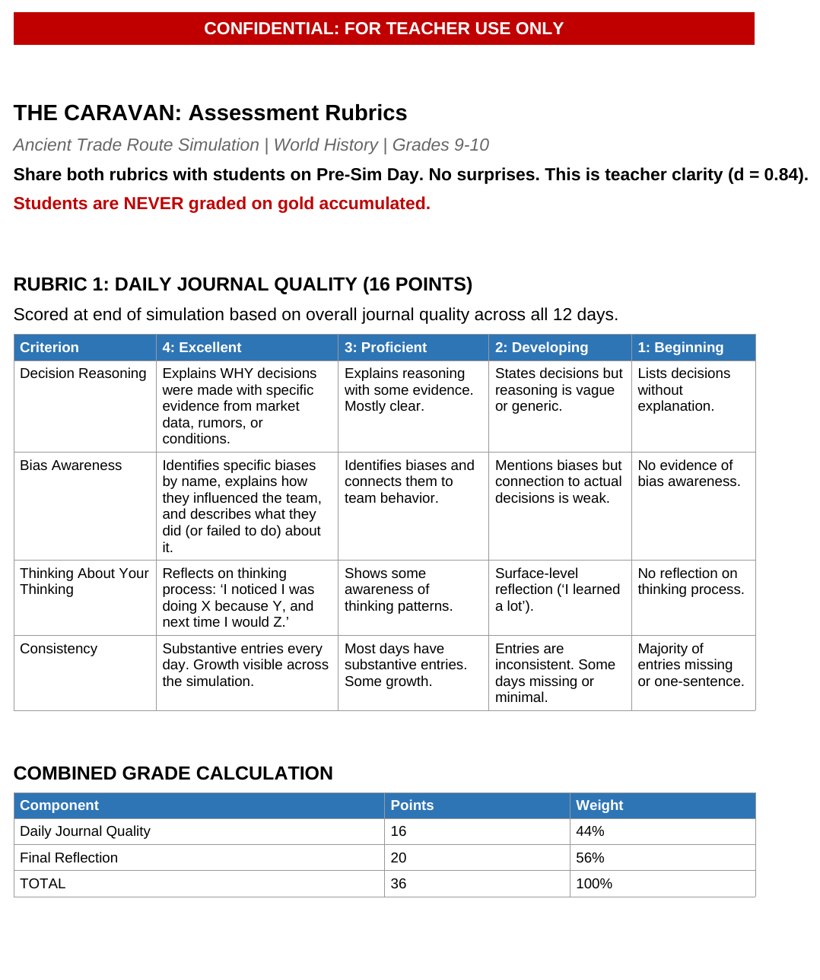
They are graded on their reasoning, not on the gold they bring home.
The reveal on Day 10 is the whole point. A team that rushed to Goldvein and got rich without ever calculating the fifteen percent raider loss simply got lucky. A team that chose minerals on calculated margins showed superior reasoning, windfall or not. The rubric grades that difference. It is a 36-point system, sixteen points for the Daily Journals and twenty for the Final Reflections, and it scores the quality of the call, not the size of the payout. A sound process behind a losing trade beats a lucky guess every time. Your students learn that judgment is the asset, and the rubric makes that lesson impossible to miss.
Tap to read the grading rubric
Let the workbook hold the busywork so the energy goes to judgment.
Running a caravan means tracking gold, inventory, shifting market prices, and route conditions across twelve days. The student workbook is a spreadsheet that carries all of it. Prices update, balances calculate, and the team's running position stays visible without anyone doing arithmetic by hand. That matters because the math is not the lesson. The reasoning is. When the Thornwall route closes or the Day 5 Silk Trap dangles a limited batch of goods, students should be arguing about whether the rumor is reliable and whether the margin is real, not recomputing totals. The workbook frees that energy. Your students spend their fifty minutes weighing evidence and defending a route, which is where the growth happens.
Tap to see the tracker
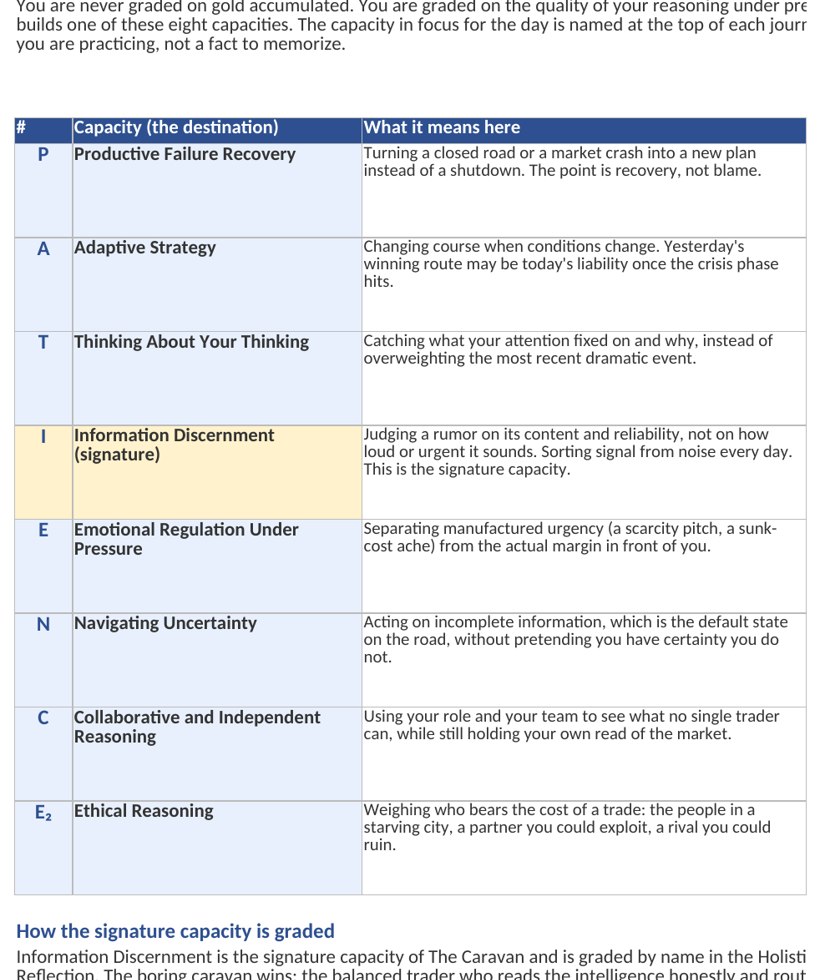
Every day is already scripted. You bring the facilitation.
The teacher guide hands you a no-prep playbook for every fifty-minute period. Each day is laid out with Diagnosis, Intervention, Implementation, and Evaluation steps, so you know what to watch for, what to say, and when to step back. The engineered moments are flagged: when the Thornwall route closes in Act II, when the Silk Trap baits scarcity, when the Day 9 decision lands. You bring the facilitation and the questions that push a team further. The simulation brings the structure, the events, the rumor cards, and the rubric. Prep is light because the design already did the heavy lifting. You walk in ready to run a rigorous session without building one from scratch.
Tap to read the teacher guide
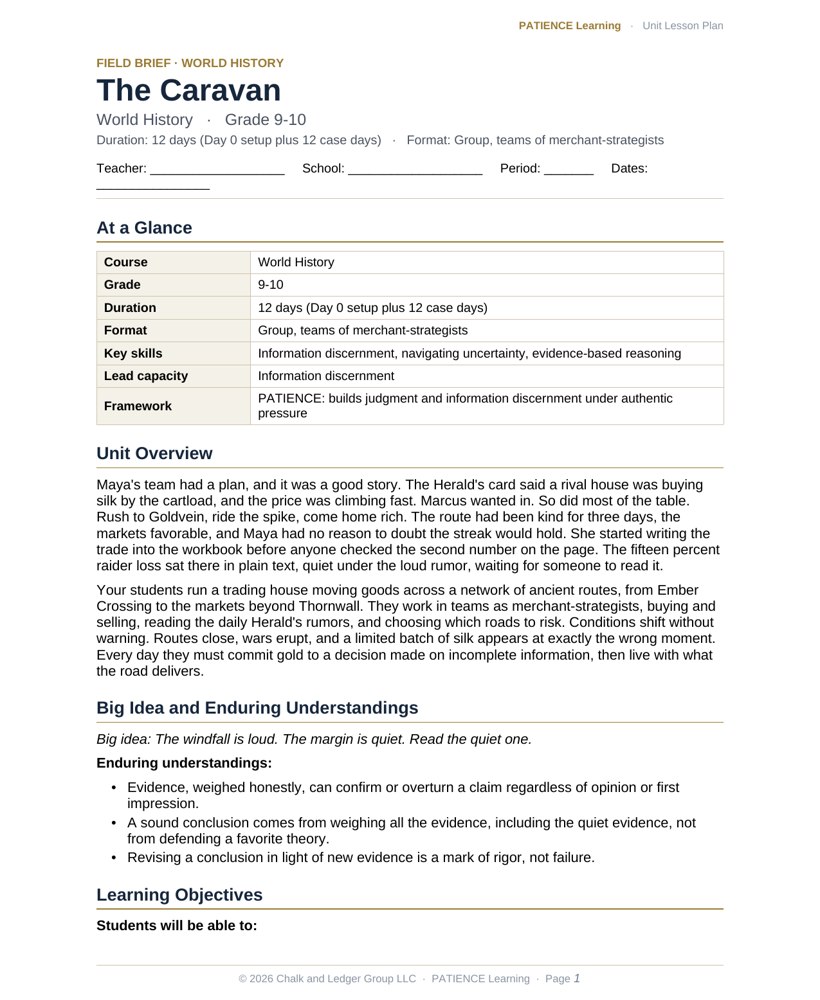
The lesson plan is already written.
Every simulation comes with a fully editable, admin-ready lesson plan. Standards alignment, daily pacing, learning objectives, differentiation, and an assessment plan are already done, so you can hand it to an administrator or adapt it to your district template in minutes.
Tap to preview the lesson plan
Close
Close
Close
Close
The day the exciting plan collapses against the math.
Maya's team had a plan, and it was a good story. The Herald's card said a rival house was buying silk by the cartload, and the price was climbing fast. Marcus wanted in. So did most of the table. Rush to Goldvein, ride the spike, come home rich. The route had been kind for three days, the markets favorable, and Maya had no reason to doubt the streak would hold. She started writing the trade into the workbook before anyone checked the second number on the page. The fifteen percent raider loss sat there in plain text, quiet under the loud rumor, waiting for someone to read it.
Maya read it. The windfall she had been picturing shrank the moment she ran the margin against the raider cut and the tripled prices. Now she had a choice: protect the story the team loved, or trust the number on the page. She argued for the minerals instead, the boring path, the calculated one. The table pushed back. She held the evidence up anyway. When the consequences landed on Day 10, the steady call had quietly outperformed the exciting one, and Maya saw what discipline actually buys.
A merchant caravan on the ancient trade roads.
Your students run a trading house moving goods across a network of ancient routes, from Ember Crossing to the markets beyond Thornwall. They work in teams as merchant-strategists, buying and selling, reading the daily Herald's rumors, and choosing which roads to risk. Conditions shift without warning. Routes close, wars erupt, and a limited batch of silk appears at exactly the wrong moment. Every day they must commit gold to a decision made on incomplete information, then live with what the road delivers.
| Grade level | 9-10 |
| Course | World History |
| Duration | 12 days (Day 0 setup plus 12 case days) |
| Format | Group, teams of merchant-strategists |
| Key skills | Information discernment, navigating uncertainty, evidence-based reasoning |
Engineering better thinkers.
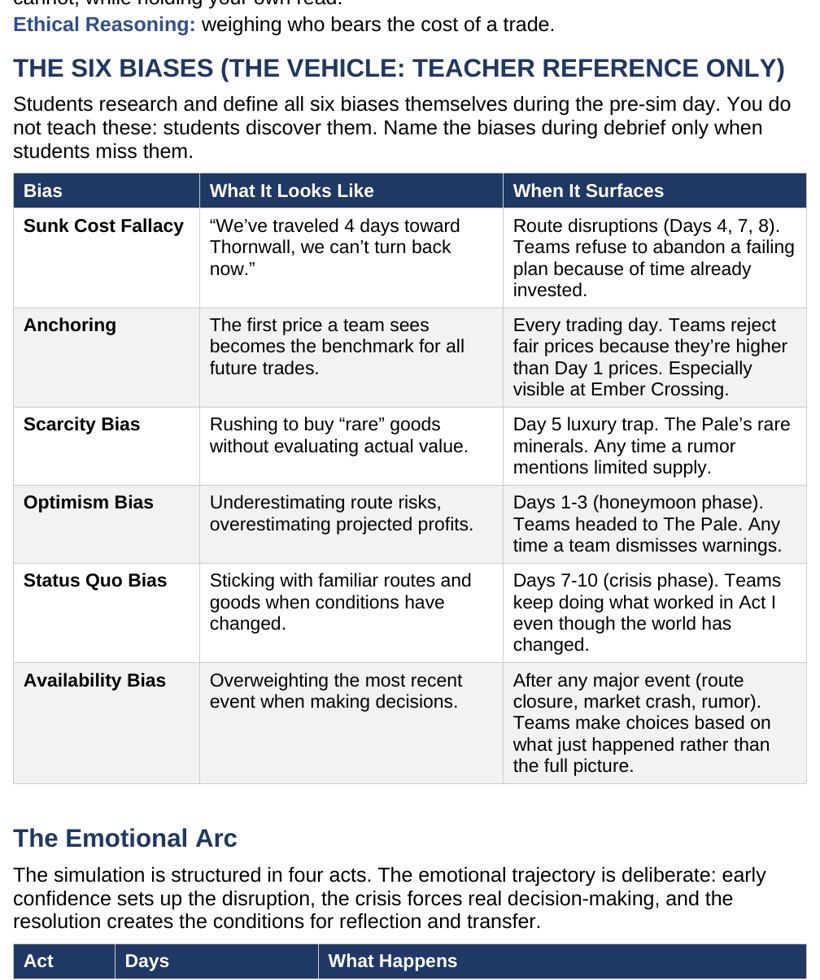
Discernment matters here because the caravan drowns students in rumor, urgency, and dramatic news. Each day pairs a named bias with the capacity that defeats it, so students do not read about the trap, they fall into it and then climb out with a tool.
| Bias targeted | The remedy, built into the work |
|---|---|
| Anchoring | Productive failure recoveryStudents benchmark every trade against Day 1 prices and reject fair offers because they remember them being cheaper. Recovering from that frozen position teaches them to value goods at today's market, not yesterday's memory. |
| Confirmation bias | MetacognitionTeams seize the rumor that fits their plan and ignore the one that complicates it. The Daily Journal forces them to name what their attention fixed on and why, turning reaction into examined reflection. |
| Sunk cost fallacy | Adaptive strategyWhen the Thornwall route closes, teams cling to the failing plan they already invested in. Adapting means recognizing that yesterday's plan is today's liability and pivoting before the loss compounds. |
| Availability bias | Information discernmentDramatic war news pulls every eye while the quiet Thornwall reopening goes unnoticed. Students learn to judge intelligence on reliability and freshness rather than how loud or vivid it sounds. |
| Tunnel vision | Navigating uncertaintyFixed on one path, teams miss the alternatives the road still offers. Acting on incomplete data without false certainty builds the merchant mindset of holding options open under pressure. |
| Overconfidence | Emotional regulationThe honeymoon streak convinces teams they cannot lose, so they underestimate the next risk. Separating manufactured urgency from actual margin de-escalates the panic and bravado that wreck a caravan. |
12 days of trade, rumor, and consequence.
Day 0 sets up the teams, the workbook, and the rules. Then the case runs in four acts: a confident open road, a first disruption, a geopolitical crisis that peaks at the Day 9 decision, and a return where consequences land and the hidden drivers of success are revealed.
| Day | What lands | Skill in focus |
|---|---|---|
| 1 | The open road. Favorable markets and safe routes build confidence. | Establishing strategy |
| 2 | Teams settle into patterns and benchmark against early prices. | Reading the market |
| 3 | The honeymoon holds, and optimism quietly hardens into assumption. | Pattern recognition |
| 4 | The Thornwall route closes. The first rug pull triggers sunk cost. | Adaptive strategy |
| 5 | The Silk Trap dangles limited goods, baiting scarcity and anchoring. | Information discernment |
| 6 | Teams sort which rumors are reliable and which are manufactured. | Source credibility |
| 7 | Geopolitical war erupts and availability bias floods the table. | Navigating uncertainty |
| 8 | Dramatic news distracts while the quiet Thornwall reopening waits. | Filtering signal from noise |
| 9 | The Defining Decision. Rush, bargain, or stay put with gold on the line. | Reasoning under pressure |
| 10 | Consequences land. The Day 10 reveal separates luck from sound judgment. | Evaluating outcomes |
| 11 | Cross-team comparison surfaces the hidden drivers of success. | Metacognition |
| 12 | Final reflections bridge the caravan to real-world risk and judgment. | Transfer |
Standards alignment.
The Caravan targets the C3 Framework and NCSS world-history standards, anchored in historical thinking and reasoning. Source credibility maps to the Herald's rumor cards, where students judge the reliability and freshness of conflicting intelligence (C3 D3.1.9-12 and D3.2.9-12). Theses and evidence run through the Daily Journals, where every trade and route choice must be defended with evidence from market prices and geography (D2.His.16.9-12 and C3 D4.1.9-12). Multiple causation is experienced directly as a route closure cascades into a price spike and then into war (D2.His.14.9-12). Students do disciplined historical reasoning, not memorization.
The hidden architecture.
The case is engineered to reward discipline and punish drama, then make students feel the difference. The honeymoon of Act I is a setup: it builds confidence so the rug pulls land harder. The Day 5 Silk Trap plants a contradiction, a loud scarcity rumor sitting beside a thin margin, so confirmation bias and anchoring pull teams toward a bad trade. The Day 9 decision hides a fifteen percent raider loss under a tripled-price windfall. Teams that read the quiet number reason their way to minerals. Teams that chase the windfall may get lucky, and the Day 10 reveal exposes that luck for what it is. The boring caravan wins because the design makes sure it does.
Turnkey, classroom-ready.
- An admin-ready lesson plan. A fully editable plan with standards alignment, daily pacing, differentiation, and assessment, ready to adapt to your district template. Included with every purchase.
- 12-day playbooks. Minute-by-minute facilitation for every session, structured around Diagnosis, Intervention, Implementation, and Evaluation.
- A tech-enabled workbook. A spreadsheet that tracks gold, inventory, prices, and route conditions so students spend their energy on judgment, not arithmetic.
- Turnkey student files. Herald rumor cards, market sheets, and the Daily Journal, ready to print and run.
- A dual rubric system. Grades the quality of reasoning, not whether they get rich, across a 36-point Journal and Final Reflection model.
- AI-resistant assessment. Credit requires specific team arguments and lived emotional reactions, so generic responses flag themselves.
Bring the caravan to your classroom.
Give your students a case where the careful call beats the exciting guess, and watch them learn to navigate uncertainty instead of fearing it.
Get this simulationPreview real pages from the simulation before you spend a dollar. No guessing, no surprises.