The Campaign
The campaign that earns less but is defended with evidence beats the one nobody can explain.
See what your students get, and why it lands.
No mockups. Every page below is real, pulled straight from the files you download. Tap any one to see it full size.
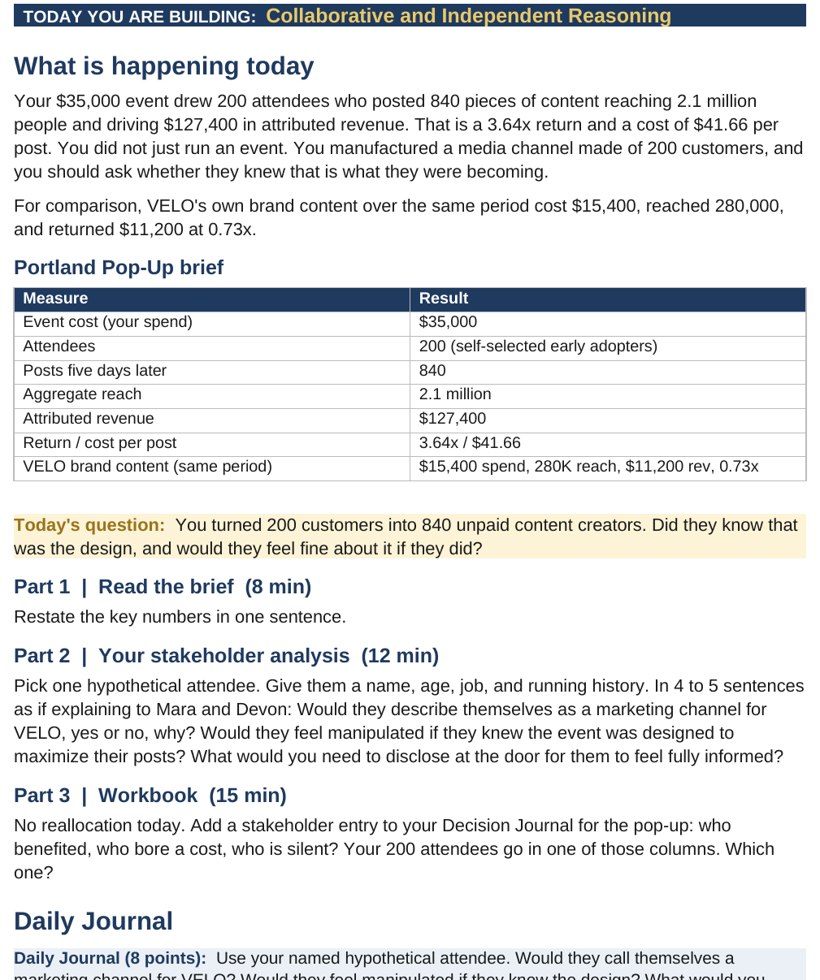
Your students are not answering questions. They are making a real call.
On Day 3 the page in front of your student is not a worksheet. It is a reallocation window for a $750,000 media campaign, and it is closing. The data shows two influencer partners side by side: Sarah delivers a 107x return, Maya delivers 2.1x. Class spend on social sits at 32 percent while the target audience is only 18 percent there. The student has to move at least $25,000, name which channel loses the money, and write the rationale that justifies it. There is no answer bank. There is evidence, a budget, and a decision that holds for the rest of the simulation. Your students read the numbers, weigh the tradeoff, and commit the way a real Media Director commits.
Tap to see a student case page
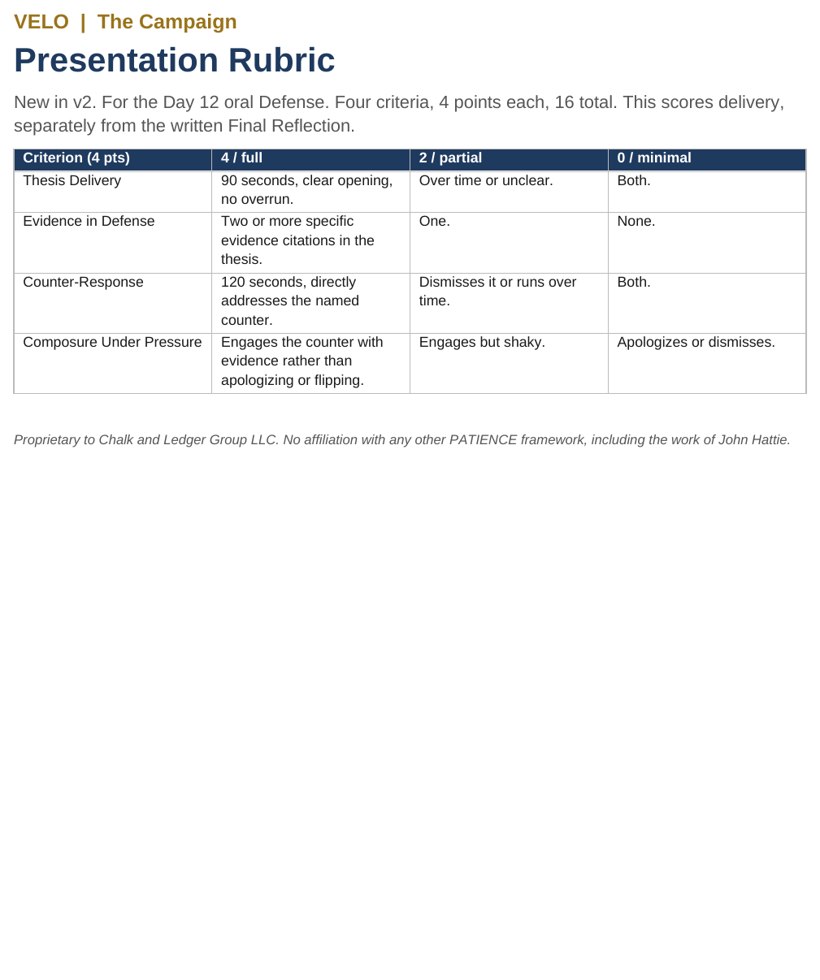
They are graded on the reasoning, not on the revenue.
The rubric scores 140 points, and almost none of them reward winning. The daily journal carries 80 points across ten entries, each one judged on reasoning, evidence use, and whether the student is starting to see the patterns in their own choices. A campaign that lands $502,000 but is defended with specific numbers will outscore a campaign that lands $613,000 the student cannot explain. That is the design. A sound process behind a modest result beats a lucky allocation every time, so your strongest reasoners are rewarded even when the dice do not break their way. The rubric also makes the math reproducible, which means the grade is about thinking, not about who guessed the channel mix.
Tap to read the grading rubric
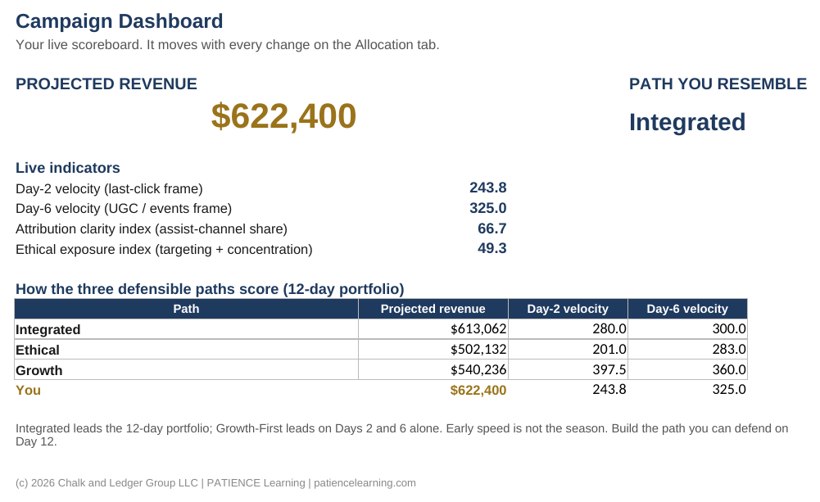
Let the workbook hold the math so students spend their energy on judgment.
The student workbook is a cockpit. It tracks the $750,000 across all six channels, applies the scoring model behind the scenes, and reproduces the results to the penny, so nobody loses an afternoon to arithmetic. Daily performance data lands in the tracker, the student reads it, and the journal fields are right there to capture the reasoning while it is fresh. When a reallocation window opens, the workbook shows what moving funds will do before the student commits. The point is simple. Spreadsheet busywork is not the lesson here. The lesson is the judgment, so the tool carries the calculation and your students carry the thinking. That is also what keeps the scoring objective and equitable across a full roster.
Tap to see the tracker
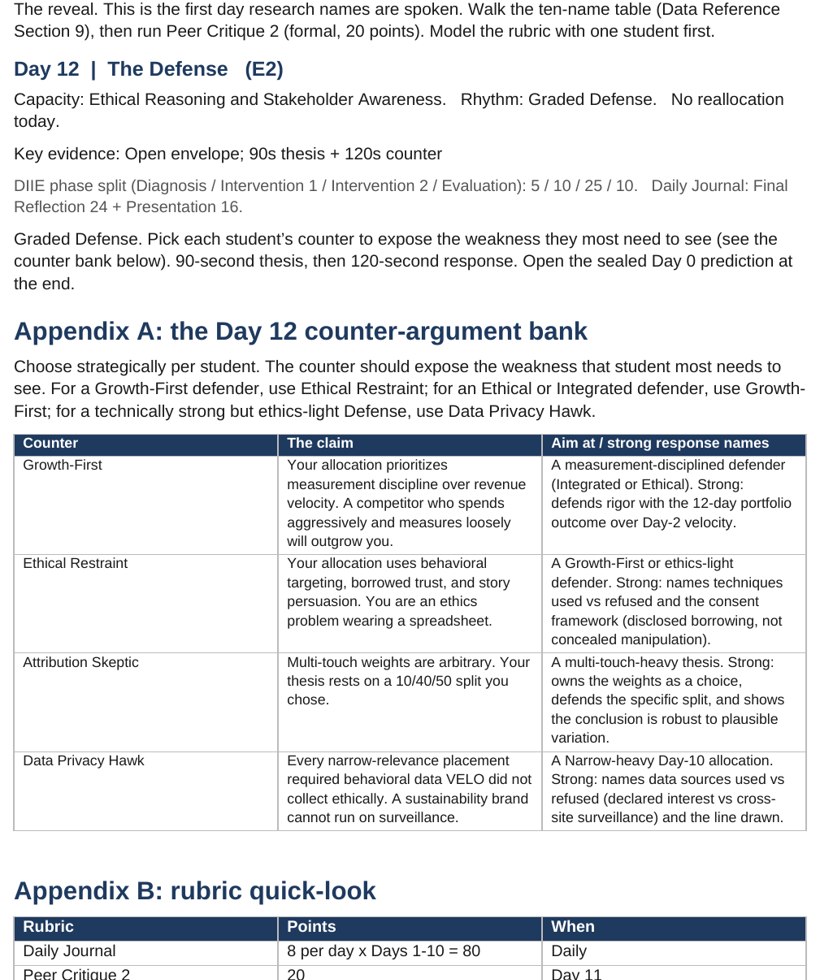
Every day is already scripted. You bring the room, the simulation brings the rest.
The teacher guide is a command center built for any instructor, including one who has never taught media psychology. Each day follows the DIIE rhythm, Diagnosis, two Interventions, and Evaluation, with phased say-scripts that give you the exact language for the hard pivots. A counter-argument bank arms you for the Day 12 defense, and a teacher-only data reference explains the why behind every number, so you are never caught flat. You do not need to be a subject matter expert to run this with authority. The simulation removes the expert burden and leaves you free to do the part only a teacher can do, which is challenge a student's assumptions out loud. Prep stays light because the script is already written.
Tap to read the teacher guide
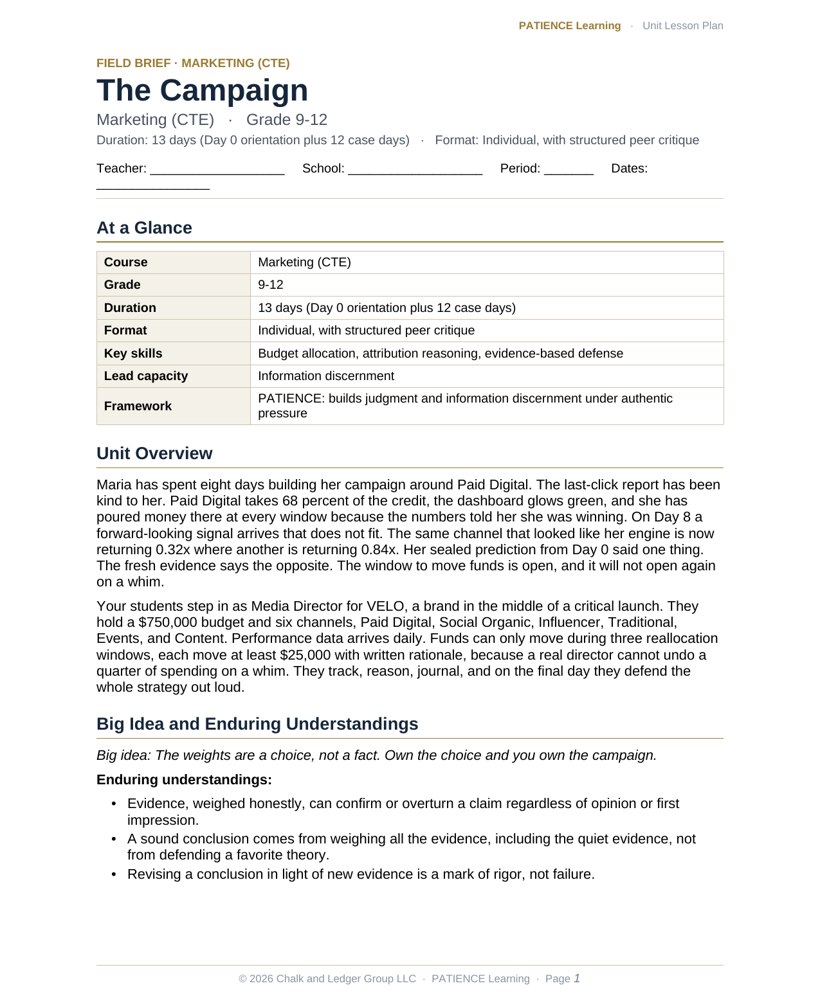
The lesson plan is already written.
Every simulation comes with a fully editable, admin-ready lesson plan. Standards alignment, daily pacing, learning objectives, differentiation, and an assessment plan are already done, so you can hand it to an administrator or adapt it to your district template in minutes.
Tap to preview the lesson plan
Close
Close
Close
Close
The day the channel that built the campaign stops being worth defending.
Maria has spent eight days building her campaign around Paid Digital. The last-click report has been kind to her. Paid Digital takes 68 percent of the credit, the dashboard glows green, and she has poured money there at every window because the numbers told her she was winning. On Day 8 a forward-looking signal arrives that does not fit. The same channel that looked like her engine is now returning 0.32x where another is returning 0.84x. Her sealed prediction from Day 0 said one thing. The fresh evidence says the opposite. The window to move funds is open, and it will not open again on a whim.
She can protect the theory she has defended all week, or she can trust the number in front of her. Maria reads the multi-touch model and watches Paid Digital's credit collapse from 68 percent to 34 percent. The reach was real. The relevance was not. She moves at least $25,000 out, writes the rationale, and names what the last-click view was hiding. Once she chooses the evidence over the story, the rest of her portfolio starts to make sense. The boring, careful move was the right one, and she can explain exactly why.
Media Director at VELO, $750,000 and six channels.
Your students step in as Media Director for VELO, a brand in the middle of a critical launch. They hold a $750,000 budget and six channels, Paid Digital, Social Organic, Influencer, Traditional, Events, and Content. Performance data arrives daily. Funds can only move during three reallocation windows, each move at least $25,000 with written rationale, because a real director cannot undo a quarter of spending on a whim. They track, reason, journal, and on the final day they defend the whole strategy out loud.
| Grade level | 9-12 |
| Course | Marketing (CTE) |
| Duration | 13 days (Day 0 orientation plus 12 case days) |
| Format | Individual, with structured peer critique |
| Key skills | Budget allocation, attribution reasoning, evidence-based defense |
Engineering better thinkers.
Marketing happens on rented land, where algorithms shift overnight and attribution is never clean. Discernment is the durable skill. Each day in The Campaign pairs a thinking trap with the capacity that defeats it, so students practice the move instead of memorizing the name.
| Bias targeted | The remedy, built into the work |
|---|---|
| Anchoring | Productive failure recoveryThe Day 0 sealed prediction anchors students to a first allocation. When reach turns out to be the wrong audience, they recover by rebuilding the plan rather than defending the opening guess. |
| Confirmation bias | MetacognitionA glowing last-click dashboard confirms what students want to believe. The journal forces them to watch their own reasoning and ask what the convenient number is hiding. |
| Sunk cost fallacy | Adaptive strategyEight days of spend on a favored channel tempts students to keep feeding it. The forward-looking return signal pushes them to adapt and move the money where it now works. |
| Availability bias | Information discernmentStudents over-weight the channels their own media diet makes vivid. Class social sits at 32 percent against an 18 percent audience, and the gap teaches them to weigh data over what feels present. |
| Tunnel vision | Navigating uncertaintyLocked reallocation windows force students to hold a long view under uncertainty rather than chase the daily metric and lose the portfolio. |
| Overconfidence | Emotional regulationA 312 percent branded-search spike feels like proof of genius. Students learn to regulate the rush, check the attribution, and stay honest about what they actually caused. |
13 days of evidence, allocation, and defense.
Day 0 sets the budget and a sealed prediction. From there the case builds in complexity, moving students from reactive daily reads to a coherent portfolio strategy. Three locked reallocation windows enforce permanence, the reveal on Day 11 names the patterns students already lived, and Day 12 is the oral defense.
| Day | What lands | Skill in focus |
|---|---|---|
| 0 | Orientation, sealed prediction, opening $750K allocation | Navigating uncertainty |
| 1 | The Gap: class social 32% vs audience 18%, a +14 point miss | Thinking about your thinking |
| 2 | First daily read, performance data lands, journal the early pattern | Information discernment |
| 3 | The Voice: reallocation window 1, Sarah 107x vs Maya 2.1x (critical pivot) | Ethical reasoning |
| 4 | Hold under the locked window, defend the allocation in writing | Navigating uncertainty |
| 5 | The Setup: reallocation window 2, branded search up 312% | Navigating uncertainty |
| 6 | Check the spike against attribution, resist the easy story | Metacognition |
| 8 | The Good Money: reallocation window 3, the 0.32x vs 0.84x gap (critical pivot) | Emotional regulation |
| 10 | Portfolio coherence, the long view starts to compound | Adaptive strategy |
| 11 | The Big Picture: the reveal of ten research names, peer critique | Thinking about your thinking |
| 12 | The Defense: final thesis and oral defense | Ethical reasoning |
Standards alignment.
The Campaign aligns to MBA Research National Marketing Standards and the Common Career Technical Core for Marketing, with the Career Ready Practices threaded through every session. Students work the marketing functions directly, building a promotional budget, allocating across channels, reading performance data, and adjusting strategy under attribution uncertainty. The daily journal and the Day 12 defense develop the Career Ready Practices for applying critical thinking, communicating clearly and effectively, and using technology to manage information. Assessment ties to district capstone expectations. There are no Common Core State Standards codes attached, because this is a CTE marketing course aligned to its own industry-recognized frameworks rather than to ELA or math standards.
The hidden architecture.
The engineered pivot lives in attribution duality. For eight days the last-click model flatters Paid Digital, handing it 68 percent of the credit, and students naturally pour money there because the dashboard rewards them for it. The planted contradiction is the multi-touch model, which drops that same channel to 34 percent and exposes a forward return of 0.32x against a stronger channel's 0.84x. The reach was always real. The relevance was the lie. Confirmation bias and sunk cost keep students loyal to the channel that made them feel like winners, so the simulation withholds the multi-touch view until the Day 8 window forces the comparison. The sound conclusion is not a number, it is a stance, that the weights are a choice the student must own and defend.
Turnkey, classroom-ready.
- An admin-ready lesson plan. A fully editable plan with standards alignment, daily pacing, differentiation, and assessment, ready to adapt to your district template. Included with every purchase.
- 13-day playbooks. Phased DIIE facilitation with say-scripts for every session, including the language for the hard cognitive pivots.
- A tech-enabled workbook. The student cockpit tracks all six channels and reproduces the scoring model to the penny, so the math never steals the lesson.
- Turnkey student files. Daily case pages, the evidence drops, the journal, and the reallocation windows ready to hand out.
- A dual rubric system. Grades the quality of reasoning across 140 points, not whether the campaign wins.
- A counter-argument bank. Ready-made challenges for the Day 12 oral defense, so you can pressure-test any student's thesis.
- A teacher data reference. The answer key and scoring model that explain the why behind every number on the page.
Give your students a campaign worth defending.
Bring The Campaign to your marketing classroom and let your students learn the discipline that real media directors live by, one honest decision at a time.
Get this simulationPreview real pages from the simulation before you spend a dollar. No guessing, no surprises.