The Brief
The boring math beats the loud headline. Your students learn that the hard way, on purpose.
See what your students get, and why it lands.
No mockups. Every page below is real, pulled straight from the files you download. Tap any one to see it full size.
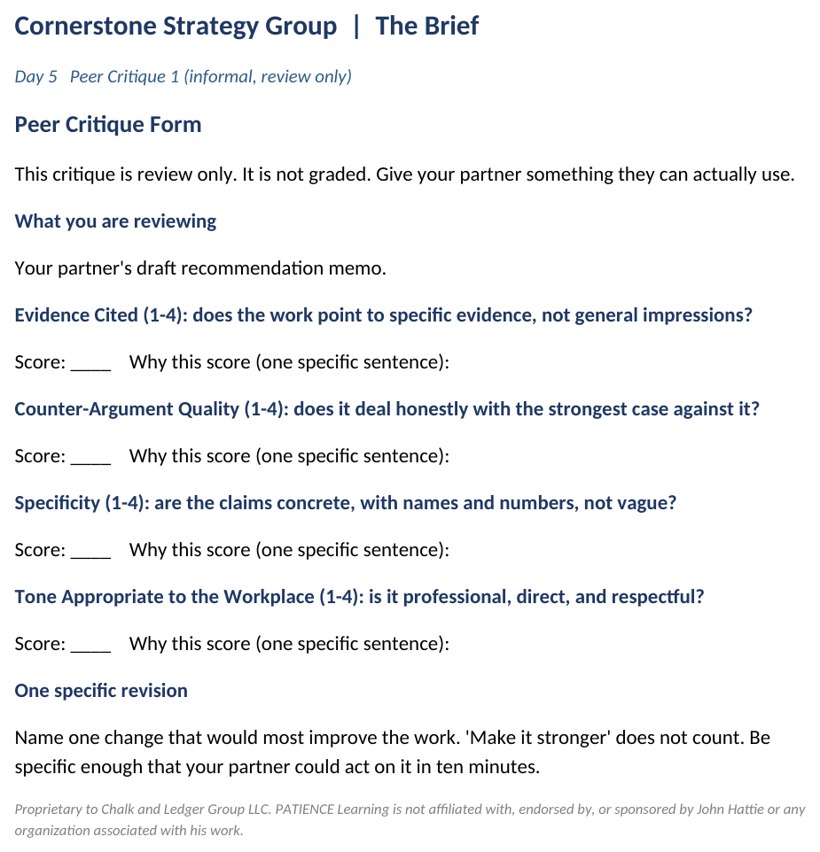
Your students are not answering questions. They are making a call.
On Day 1 your students sit at the Evidence Desk as junior analysts for Cornerstone Strategy Group. The client, Redline Fitness, wants advice on launching a budget-tier membership. The brief is vague, the data is mixed, and an Analyst-Hour constraint means they cannot test everything. They have to choose. A loud national headline says budget gyms are surging. A quiet Redline member survey tells a different story. Students decide which thread is worth their limited time, then defend that choice in their daily journal. There is no answer key feeding them the move. They weigh cannibalization math against gut instinct and commit, the way a real analyst commits, with their name on the recommendation.
Tap to see a real student case page
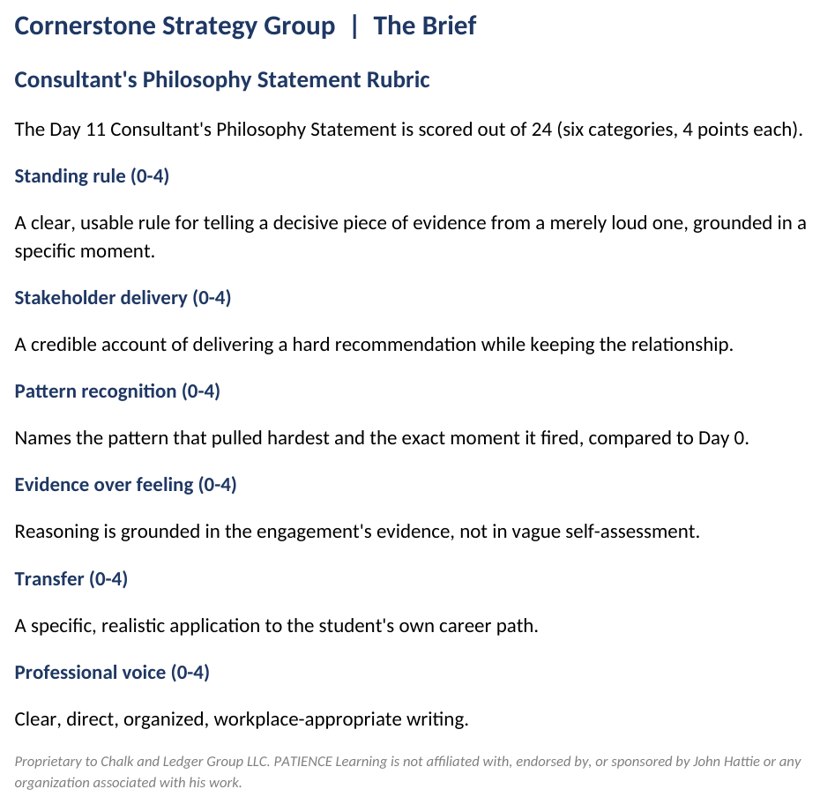
A sound process behind a wrong call beats a lucky guess.
The rubric grades 120 points, and not one of them goes to picking Launch or Do Not Launch correctly. Daily journals carry 80 points, scored on evidence specificity, professional voice, and whether the student lands the day's PATIENCE capacity. Peer critiques add 16 points on Day 8 for spotting thinking gaps in a teammate's logic. The capstone Consultant's Philosophy Statement is worth 24 points and asks each student to set a standing rule for evidence and name the cognitive patterns that steered their week. A student who reaches a defensible Do Not Launch with shaky reasoning scores below one who builds an airtight case, even for the call the math does not support. Reasoning is the grade.
Tap to read the grading rubric
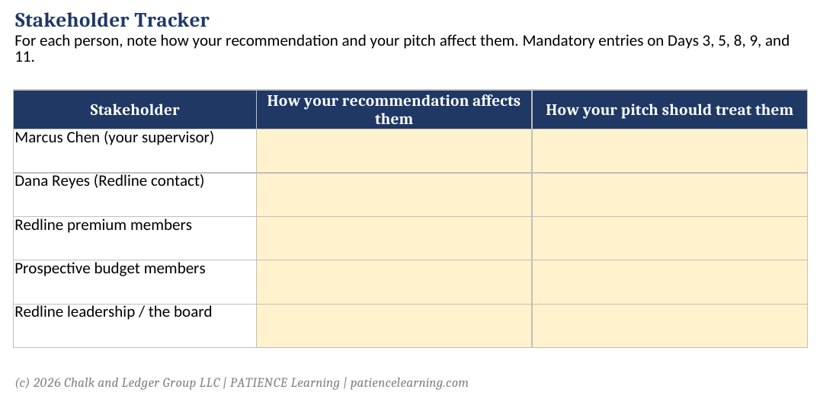
Let the workbook hold the busywork so judgment gets the energy.
The 05_Workbook.xlsx dashboard does the bookkeeping your students should not waste their attention on. It runs a four-counter scoreboard, Evidence Strength, Claim-Evidence Alignment, Stakeholder Trust, and Scope Discipline, and it updates automatically as students log their work. No manual tally, no grade-as-you-go. Every student file is self-contained and needs no pre-grading, so a student opens it and starts thinking instead of formatting. The tracker also enforces the Analyst-Hour constraint, which keeps the pressure honest. Students see their scope discipline slip in real time when they chase the loud headline, and they feel the cost. The software carries the mechanics so your students spend their hours on the call itself.
Tap to see the tracker
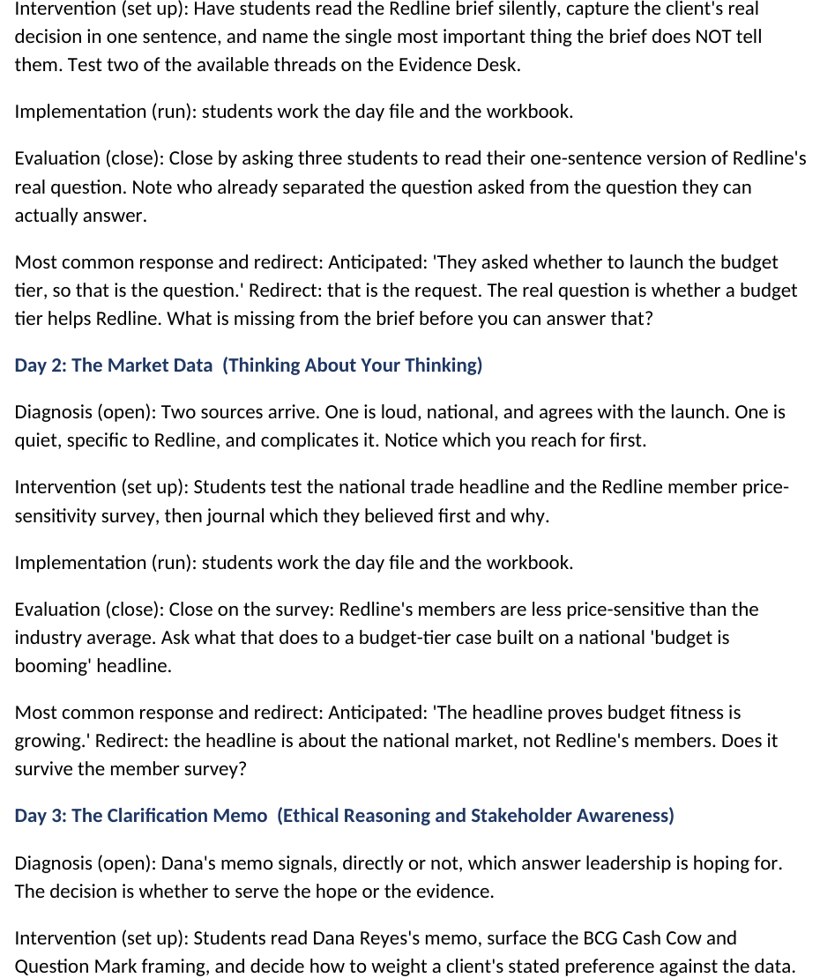
Every day is already scripted. You bring the coaching.
You do not need a background in business analytics or cognitive science to run this. The teacher guide hands you a DIIE Say-Script for each day, Diagnosis, Intervention, Implementation, and Evaluation, with opening lines, setup steps, and redirect language for the errors students reliably make. When a student treats a national trend as evidence about Redline's specific members, the script tells you exactly what to say. Automated scoring through the dashboard means you are not grading at night. Self-contained student files mean no prep stacks. The design moves you from lecturer to executive coach, walking the room, asking the hard question, and letting the evidence and the software carry the instruction.
Tap to read the teacher guide
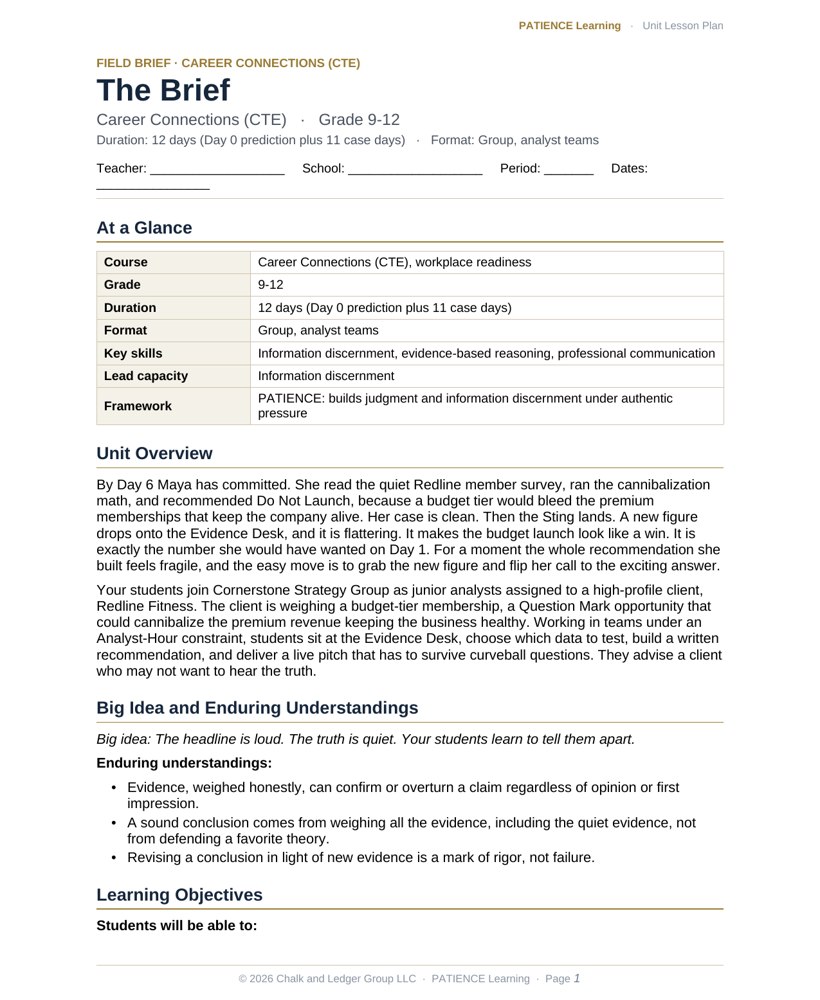
The lesson plan is already written.
Every simulation comes with a fully editable, admin-ready lesson plan. Standards alignment, daily pacing, learning objectives, differentiation, and an assessment plan are already done, so you can hand it to an administrator or adapt it to your district template in minutes.
Tap to preview the lesson plan
Close
Close
Close
Close
The day the flattering number arrives.
By Day 6 Maya has committed. She read the quiet Redline member survey, ran the cannibalization math, and recommended Do Not Launch, because a budget tier would bleed the premium memberships that keep the company alive. Her case is clean. Then the Sting lands. A new figure drops onto the Evidence Desk, and it is flattering. It makes the budget launch look like a win. It is exactly the number she would have wanted on Day 1. For a moment the whole recommendation she built feels fragile, and the easy move is to grab the new figure and flip her call to the exciting answer.
Maya has a choice. She can protect the theory the new number flatters, or she can test it the way she tested everything else. She checks whether the Sting describes Redline's actual members or just a national crowd, and it describes the crowd. The figure is loud and irrelevant. She names it weak in her journal and holds her recommendation. What she sees once she chooses the evidence is the whole point of the week: the exciting number was bait, and the discipline of testing it, not her instinct, is what kept her right.
Junior analysts at Cornerstone Strategy Group.
Your students join Cornerstone Strategy Group as junior analysts assigned to a high-profile client, Redline Fitness. The client is weighing a budget-tier membership, a Question Mark opportunity that could cannibalize the premium revenue keeping the business healthy. Working in teams under an Analyst-Hour constraint, students sit at the Evidence Desk, choose which data to test, build a written recommendation, and deliver a live pitch that has to survive curveball questions. They advise a client who may not want to hear the truth.
| Grade level | 9-12 |
| Course | Career Connections (CTE), workplace readiness |
| Duration | 12 days (Day 0 prediction plus 11 case days) |
| Format | Group, analyst teams |
| Key skills | Information discernment, evidence-based reasoning, professional communication |
Engineering better thinkers.
In a boardroom the cost of chasing the loud signal is real, so discernment is the whole job. Each day pairs one cognitive bias your students will actually feel against the capacity that defeats it, so the remedy gets practiced inside the case rather than lectured at them.
| Bias targeted | The remedy, built into the work |
|---|---|
| Anchoring | Productive failure recoveryStudents fix on the client's vague hope as the answer, then recover when the cannibalization math forces them to rebuild the recommendation from evidence instead of the first impression. |
| Confirmation bias | MetacognitionOn the Mirror day a fresh reader tests whether a stuck point is a writing gap or a thinking gap, surfacing the evidence students quietly skipped because it did not fit. |
| Sunk cost fallacy | Adaptive strategyWhen the late Sting figure flatters a position, students decide whether a number is signal or distraction, and revise a committed call rather than defend the hours already spent. |
| Availability bias | Information discernmentThe loud national headline is vivid and easy to recall, so students test whether it describes Redline's actual members or just a crowd, and name it weak when it does not. |
| Tunnel vision | Navigating uncertaintyStudents commit to Launch or Do Not Launch despite missing data, holding a defensible position without pretending the uncertainty is gone or narrowing to one thread too early. |
| Overconfidence | Emotional regulationIn the Prep and the Room, students cut a strong point under a pitch constraint and field curveball questions, keeping composure instead of overstating a case they cannot fully back. |
12 days from vague brief to live pitch.
Day 0 has students seal a Predictions Form before they know anything. The case then runs in three phases: investigation under an Analyst-Hour constraint, commitment and revision of a written recommendation, and a live pitch followed by the Reveal, where the sealed predictions come back to confront them.
| Day | What lands | Capacity in focus |
|---|---|---|
| 0 | Students seal a Predictions Form before seeing the evidence | Metacognition |
| 1 | Finding the real question behind the client's vague brief | Information discernment |
| 2 | Weighing the loud national headline against the quiet member survey | Metacognition |
| 3 | Deciding whether to echo the client's hope or protect their interest | Ethical reasoning |
| 4 | Testing the boring math: cannibalization and lifetime value | Information discernment |
| 5 | Committing to Launch or Do Not Launch despite the uncertainty | Navigating uncertainty |
| 6 | The Sting: deciding if a flattering new number is signal or distraction (critical pivot) | Adaptive strategy |
| 7 | The Mirror: is the stuck point a writing gap or a thinking gap | Metacognition |
| 8 | The Prep: cutting a strong point under a pitch constraint | Emotional regulation |
| 9 | The Room: delivering the live pitch and handling curveballs | Independent and collaborative reasoning |
| 10 | A self-audit of where the week's thinking slipped | Productive failure recovery |
| 11 | The Reveal: opening the sealed predictions as the biases are named (critical pivot) | Metacognition |
Standards alignment.
The Brief aligns to the Career Ready Practices and the Common Career Technical Core (CCTC), the national framework for career and technical education. It targets practices for applying appropriate academic and technical skills, using critical thinking to make sense of problems, communicating clearly and effectively, and considering the environmental, social, and economic impacts of decisions. It also builds the 21st-century employability skills districts ask CTE to deliver: critical thinking, problem solving, creativity, and professional communication. Because this is a Career Connections simulation rather than an English or math course, it carries no Common Core State Standards codes, and we do not claim any.
The hidden architecture.
The case is engineered so the exciting answer is wrong and the evidence is quiet. The national headline is planted to be loud, vivid, and irrelevant, a trap for availability bias, because it describes a national crowd, not Redline's specific members. The decisive evidence is the boring math: a member price-sensitivity survey and a cannibalization analysis showing the budget tier would eat the premium Cash Cow. Day 6's Sting is the real engine. A flattering late figure arrives precisely when a disciplined student has already committed to Do Not Launch, tempting them to flip to the answer they wanted on Day 1. The student who tests the Sting against Redline's actual members holds firm. The student who grabs it scores as a Headline-Chaser. The whole design forces the sound conclusion by making the seductive one fail under testing.
Turnkey, classroom-ready.
- An admin-ready lesson plan. A fully editable plan with standards alignment, daily pacing, differentiation, and assessment, ready to adapt to your district template. Included with every purchase.
- 12-day playbooks. A DIIE Say-Script for every session with opening lines, setup steps, and redirect language for common student errors.
- A tech-enabled workbook. The 05_Workbook.xlsx dashboard tracks Evidence Strength, Claim-Evidence Alignment, Stakeholder Trust, and Scope Discipline, updating automatically.
- Turnkey student files. Self-contained case pages, the Evidence Desk, and the sealed Predictions Form, with no pre-grading required.
- A dual rubric system. Grades the quality of reasoning across 120 points, not whether students reach the right recommendation.
- The Reveal kit. The Day 11 sequence that names the 10 cognitive biases and reopens each student's sealed prediction for the Mirror effect.
Bring the boardroom into your classroom.
Give your students twelve days inside a real decision, where the discipline of testing the evidence, not the thrill of the headline, is what earns the grade.
Get this simulationPreview real pages from the simulation before you spend a dollar. No guessing, no surprises.