The Ascent
The textbook number was 7,670 m/s. The mission needed 9,170. That gap is the whole course.
See what your students get, and why it lands.
No mockups. Every page below is real, pulled straight from the files you download. Tap any one to see it full size.
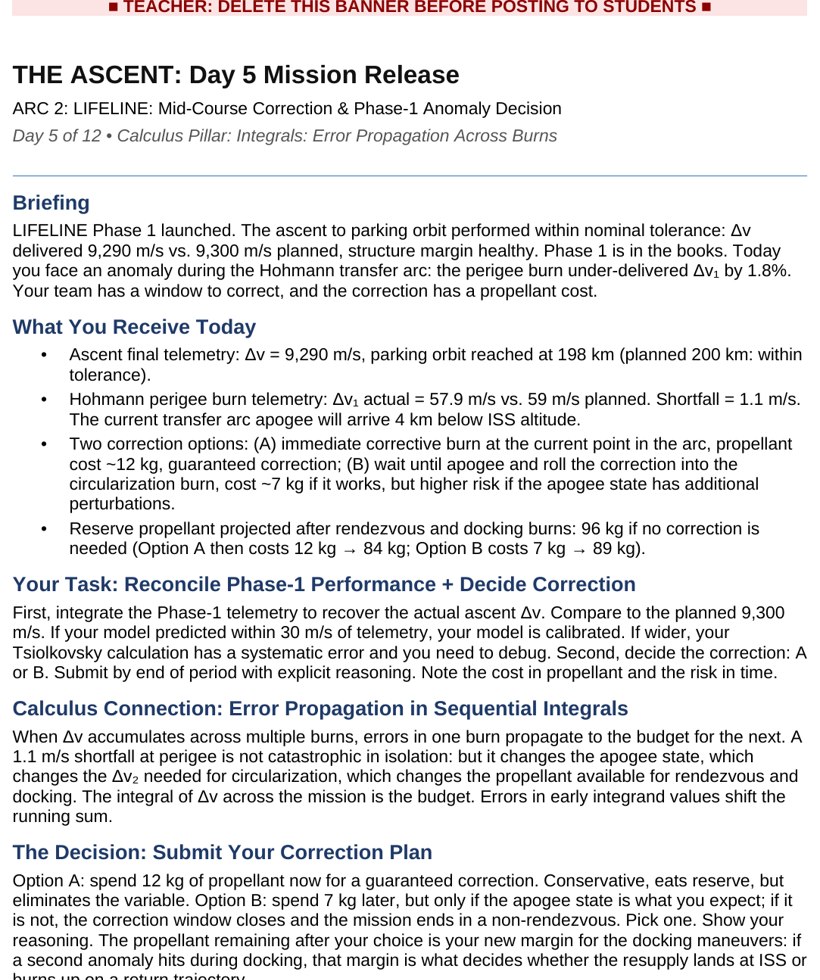
A worksheet was never going to teach this. Your students are running a launch.
Each day opens with a real mission release: vehicle specs, telemetry, and a Go or No-Go call that has to be made before the period ends. In STARFALL, teams of two or three compute a Tsiolkovsky budget for a low-orbit launch and discover the textbook velocity of 7,670 m/s leaves out gravity losses and drag, so the real requirement is 9,170 m/s. Your students are not answering questions. They are deciding whether a launch flies, whether a crew aborts, whether a Mars cargo run holds its margin. The math is the only thing standing between their decision and a catastrophic failure, so they treat it that way.
Tap to see a daily release
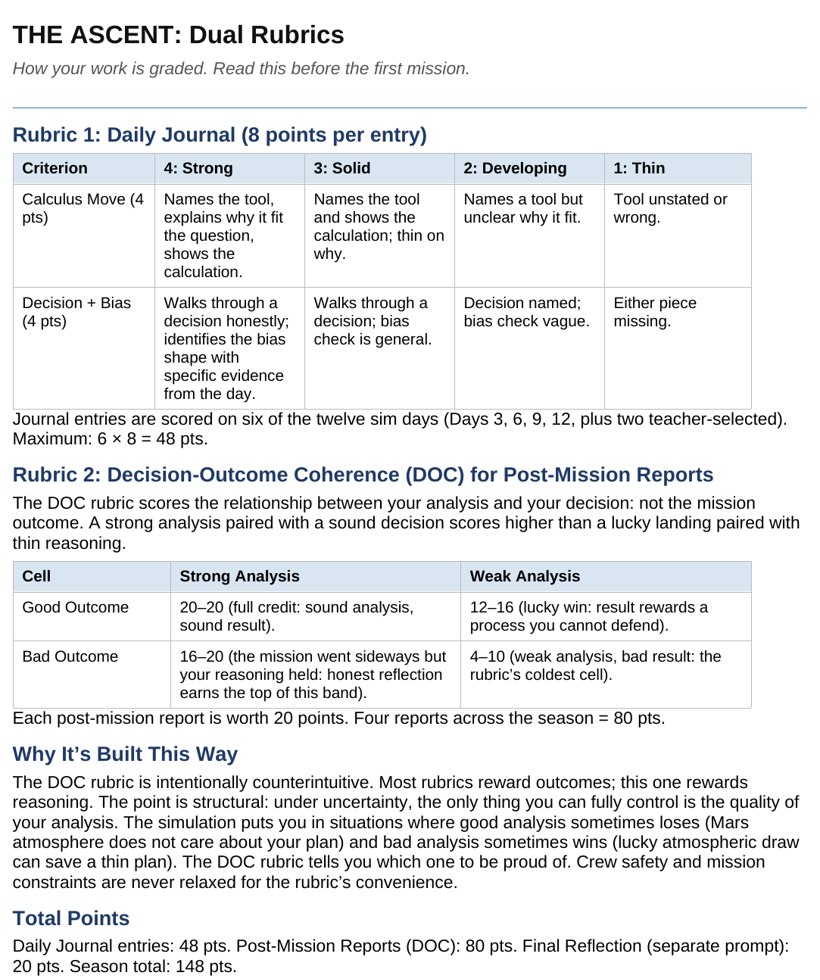
They are graded on the reasoning, not on whether the mission flies.
The Decision-Outcome Coherence rubric separates the process from the result. A team that runs sound analysis and loses the mission still scores 16 to 20, because the reasoning was robust and the failure was honest. A team that gets lucky with a weak process scores 12 to 16, a flagged win it cannot defend. In the ARTEMIS mission, a crew may push through a hardware anomaly carrying a 14 percent failure probability, a deliberate echo of the Challenger disaster. Even if the lucky 86 percent draw lands, the rubric still penalizes the team for violating the safety constraint. A sound process behind a failed launch beats a reckless win every time, and the grade says so.
Tap to read the grading rubric
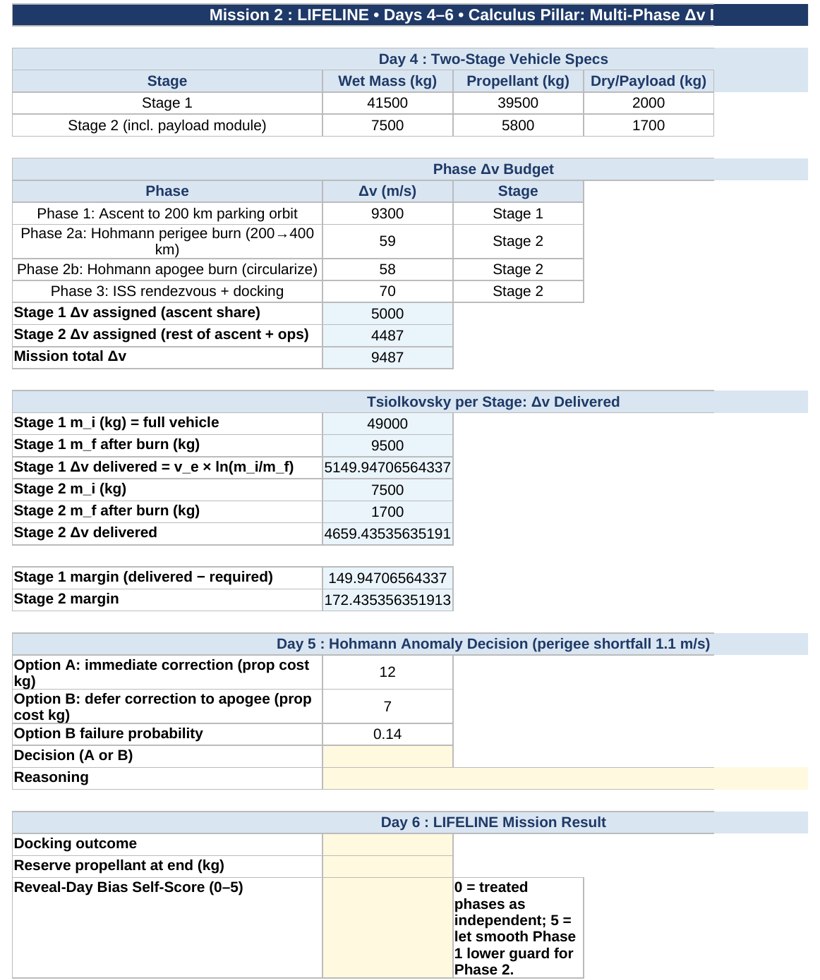
Let the workbook hold the busywork so the energy goes to the judgment.
The student workbook is an Excel tool built for the missions. It handles telemetry integration, multi-phase delta-v bookkeeping, sensitivity analysis, and the post-mission report, so teams are not buried in arithmetic when the clock is running. During the 20-minute calculation block, the Lead Analyst owns the model, the Mission Engineer turns it into propellant loads and timing, and the Mission Communicator builds the Reasoning Record that the rubric will grade. The numbers are real, drawn from the actual rocket equation and numerical integration with nothing fudged. The workbook does the grinding, which frees your students to argue about what the numbers mean and whether the margin holds.
Tap to see the tracker
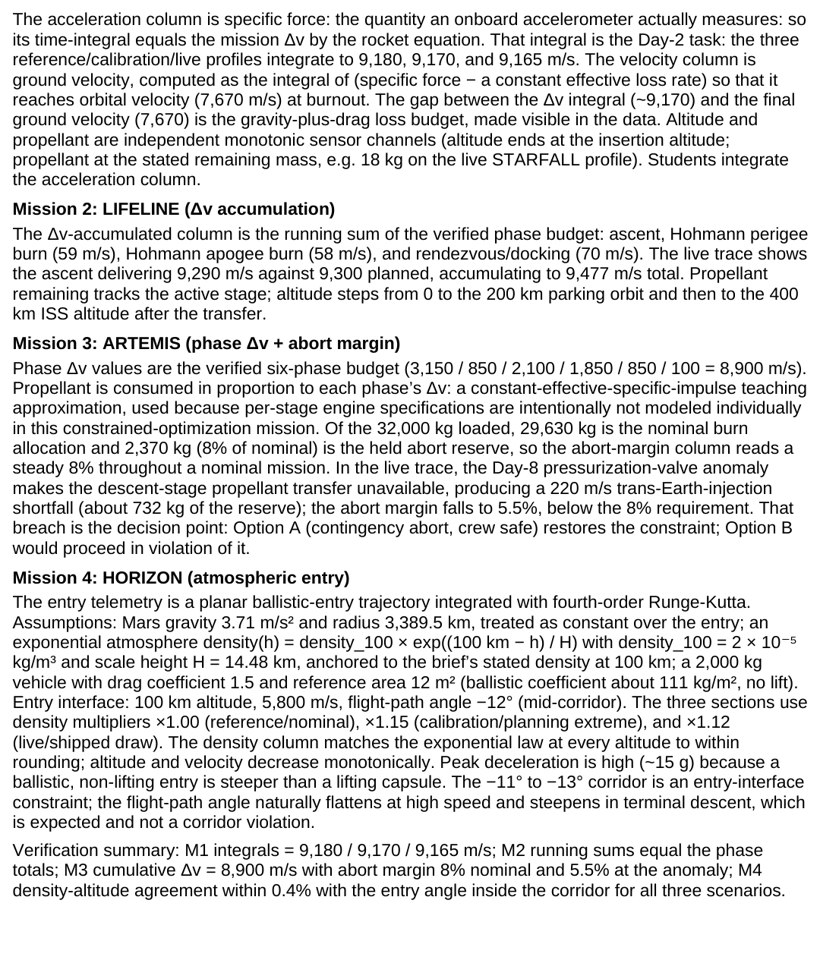
Every day is already scripted. You bring the facilitation, the simulation brings the rest.
The teacher guide is fifteen daily playbooks, one for every session. Each one runs the 50-minute period minute by minute: a 5-minute briefing, a 20-minute calculation block, a 20-minute decision and lock block, then a 5-minute submission. The Reveal days, 3, 6, 9, and 12, swap the calculation work for naming the bias and the reflection that lands it. Every playbook carries coaching notes, canonical answer keys, and the legacy archetypes that help you spot a Tight-Margin Optimist or a Streak Reasoner mid-mission. Prep is light because the day is planned. You watch the teams, ask the hard question, and let the consequences do the teaching.
Tap to read the teacher guide
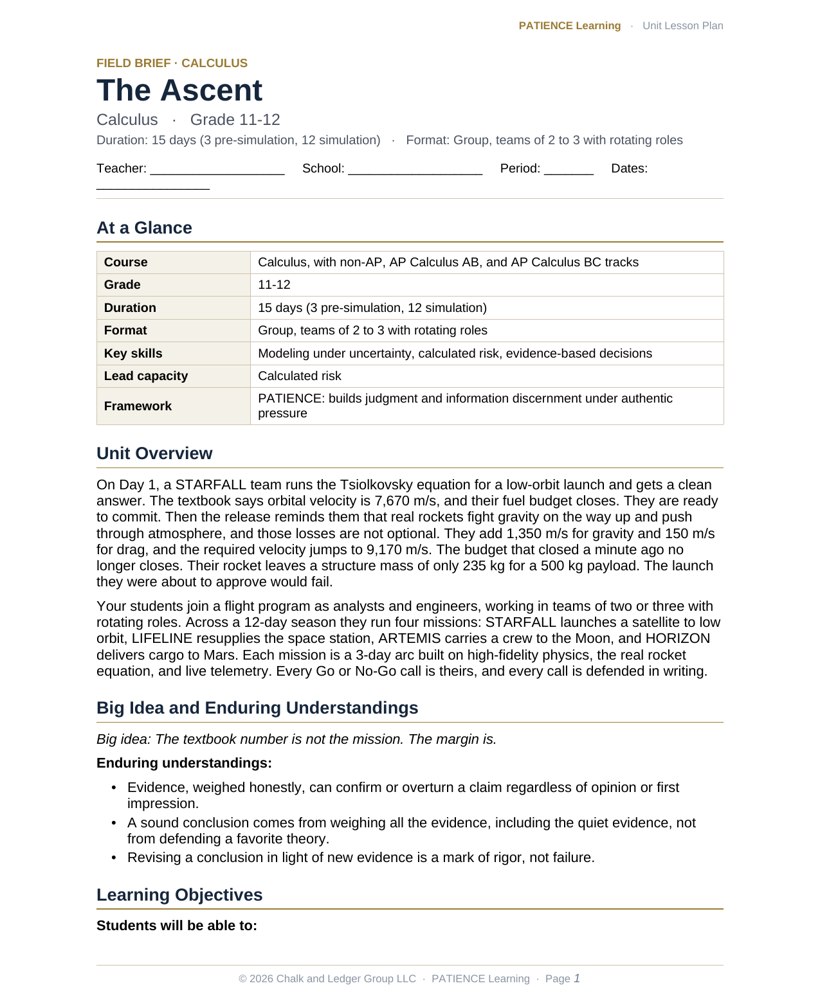
The lesson plan is already written.
Every simulation comes with a fully editable, admin-ready lesson plan. Standards alignment, daily pacing, learning objectives, differentiation, and an assessment plan are already done, so you can hand it to an administrator or adapt it to your district template in minutes.
Tap to preview the lesson plan
Close
Close
Close
Close
The moment the textbook number turns out to be fatal.
On Day 1, a STARFALL team runs the Tsiolkovsky equation for a low-orbit launch and gets a clean answer. The textbook says orbital velocity is 7,670 m/s, and their fuel budget closes. They are ready to commit. Then the release reminds them that real rockets fight gravity on the way up and push through atmosphere, and those losses are not optional. They add 1,350 m/s for gravity and 150 m/s for drag, and the required velocity jumps to 9,170 m/s. The budget that closed a minute ago no longer closes. Their rocket leaves a structure mass of only 235 kg for a 500 kg payload. The launch they were about to approve would fail.
At the pivot, the team has a choice. They can trust the clean textbook figure that made their plan work, or they can trust the budget that says the plan is broken. Protecting the number is comfortable and lets them submit on time. Trusting the evidence means admitting the design does not fly and starting the margin over. When they choose the evidence, they stop chasing points and start doing the work an engineer actually does. They see that precision was never the busywork. It was the line between a mission and a crater.
Four missions, one season, no fudged numbers.
Your students join a flight program as analysts and engineers, working in teams of two or three with rotating roles. Across a 12-day season they run four missions: STARFALL launches a satellite to low orbit, LIFELINE resupplies the space station, ARTEMIS carries a crew to the Moon, and HORIZON delivers cargo to Mars. Each mission is a 3-day arc built on high-fidelity physics, the real rocket equation, and live telemetry. Every Go or No-Go call is theirs, and every call is defended in writing.
| Grade level | 11-12 |
| Course | Calculus, with non-AP, AP Calculus AB, and AP Calculus BC tracks |
| Duration | 15 days (3 pre-simulation, 12 simulation) |
| Format | Group, teams of 2 to 3 with rotating roles |
| Key skills | Modeling under uncertainty, calculated risk, evidence-based decisions |
Engineering better thinkers.
In a launch program, discernment is survival. Every day pairs a named cognitive bias with the capacity that defeats it, and the bias is never named in advance. Your students fall into the trap, feel the consequence, and only then learn what caught them.
| Bias targeted | The remedy, built into the work |
|---|---|
| Planning fallacy | Productive failure recoverySTARFALL hands teams a budget that looks complete until gravity and drag losses break it, so they learn to recover the model and rebuild the margin instead of defending a plan that already failed. |
| Confirmation bias | MetacognitionThe Reasoning Record forces teams to write down why they believe the numbers before the Reveal, so they catch themselves trusting the figure that confirms the plan they already wanted. |
| Sunk cost fallacy | Adaptive strategyARTEMIS plants a mid-mission anomaly that tempts teams to push a crewed launch they have already invested in, and the abort margin makes them choose strategy over the cost already sunk. |
| Steady-state assumption | Information discernmentLive telemetry drifts from the clean model, so teams must read the new data honestly and decide which numbers to trust rather than assuming conditions stay fixed. |
| Low-odds dismissal | Navigating uncertaintyHORIZON runs a Mars trajectory where small probabilities still carry mission cost, training teams to size an uncertain risk rather than wave it away because it is unlikely. |
| Overconfidence | Emotional regulationThe DOC rubric penalizes a reckless win that violated a safety constraint, so teams learn to hold their nerve and respect the margin even when a risky call happened to pay off. |
15 days of mission-critical calculus.
The three pre-simulation days build the toolkit: the rocket equation, the math tracks, and the bias definitions students research without yet knowing which mission hides which trap. Then the season runs four 3-day arcs of rising stakes, each ending in a Reveal that names the bias the team just lived through.
| Day | What lands | Skill in focus |
|---|---|---|
| 0a | Pre-sim: the rocket equation and the math tracks, non-AP through BC | Mathematical modeling |
| 0b | Pre-sim: telemetry, the workbook, and the team roles | Information discernment |
| 0c | Pre-sim: students research bias definitions, missions still hidden | Metacognition |
| 1 | STARFALL begins: the Tsiolkovsky budget breaks against gravity and drag (critical pivot) | Calculated risk |
| 2 | STARFALL: tighten the launch margin and commit the Go or No-Go | Attend to precision |
| 3 | STARFALL Reveal: the planning fallacy is named | Productive failure recovery |
| 4 | LIFELINE: multi-phase delta-v integration for a station resupply | Modeling under uncertainty |
| 6 | LIFELINE Reveal: optimism bias is named | Adaptive strategy |
| 7 | ARTEMIS: constrained optimization and the crew abort margin | Navigating uncertainty |
| 8 | ARTEMIS: a hardware anomaly tempts a 14 percent failure push (critical pivot) | Calculated risk |
| 9 | ARTEMIS Reveal: the sunk cost fallacy is named | Emotional regulation |
| 10 | HORIZON: numerical ODE integration for a Mars cargo run | Modeling under uncertainty |
| 12 | HORIZON Reveal: low-odds dismissal is named, the season closes | Navigating uncertainty |
Standards alignment.
The Ascent maps to AP Calculus and the CCSS Mathematical Practices without content swapping. STARFALL works Units 2 and 4, deriving the rocket equation and treating acceleration as a function of time. LIFELINE covers Units 6 and 8 through multi-phase integration. ARTEMIS hits Unit 5 with constrained optimization and abort margins. HORIZON reaches Unit 8 and BC topics with numerical ODE integration using Euler and RK4. All eight Mathematical Practices are exercised, with MP1, MP3, MP4, and MP6 central: students persevere through delta-v budgeting, construct arguments in their reports, model every mission, and attend to precision in STARFALL's tight structure margins.
The hidden architecture.
The design works because the trap comes before the name. Students research the biases in pre-simulation, but the mission-to-bias mapping is withheld, so they cannot brace for what is coming. STARFALL hands them a textbook velocity of 7,670 m/s that feels authoritative and closes their budget, then makes the unaccounted gravity and drag losses break it at 9,170 m/s. ARTEMIS plants a 14 percent failure anomaly mid-mission, a deliberate Challenger echo, so a team that has already committed feels the pull of sunk cost firsthand. The DOC rubric then refuses to reward the lucky win, scoring the violated safety constraint as reckless. The consequence lands before the lecture, which is why the lesson sticks.
Turnkey, classroom-ready.
- An admin-ready lesson plan. A fully editable plan with standards alignment, daily pacing, differentiation, and assessment, ready to adapt to your district template. Included with every purchase.
- 15 daily playbooks. Minute-by-minute facilitation for every session, with coaching notes and canonical answer keys.
- An Excel student workbook. Telemetry integration, sensitivity analysis, and post-mission reporting, all built in so teams focus on judgment.
- Twelve daily releases. Pre-built mission briefings and anomaly prompts that drive the narrative and force the calls.
- The DOC dual rubric. Grades the quality of reasoning, not whether the mission flew, so a sound failed plan beats a lucky reckless one.
- Three math tracks. Non-AP, AP Calculus AB, and AP Calculus BC versions of every mission, one high floor and one high ceiling.
- Legacy archetypes. Coaching profiles that help you name and steer student decision patterns mid-mission.
Give your students a launch worth defending.
Bring The Ascent to your classroom and let your students discover that calculus is the only thing standing between a mission and a crater.
Get this simulationPreview real pages from the simulation before you spend a dollar. No guessing, no surprises.