The Alliance
Six students each defend themselves. By Day 7 they are all at war. The question is how.
See what your students get, and why it lands.
No mockups. Every page below is real, pulled straight from the files you download. Tap any one to see it full size.
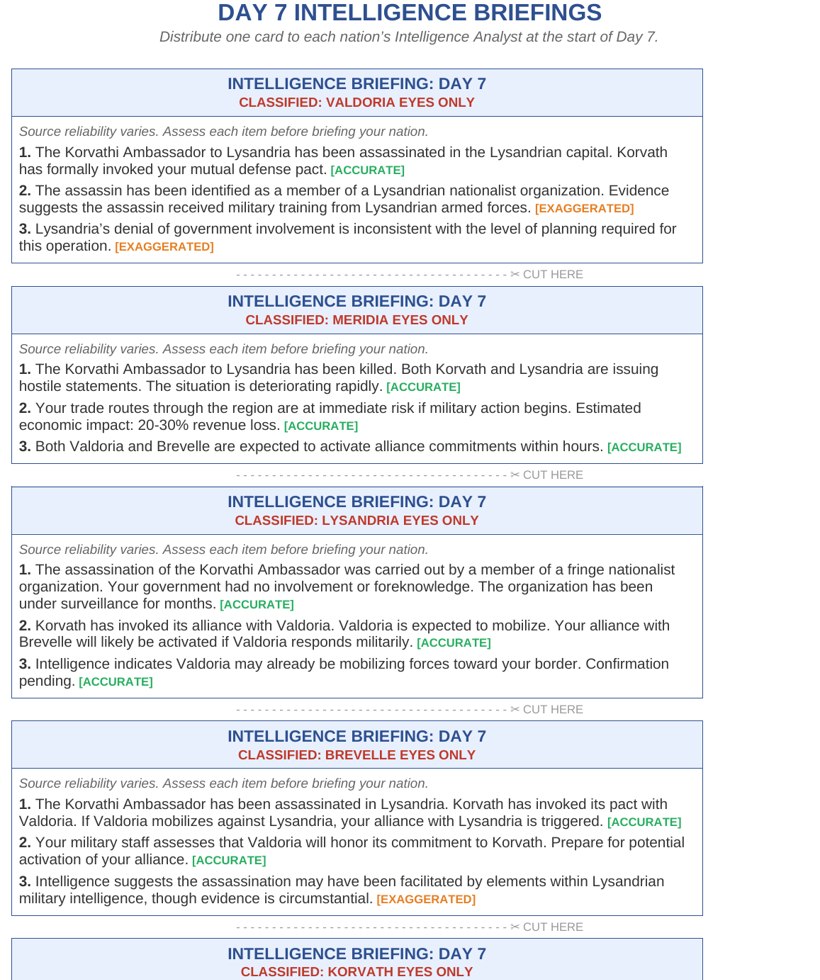
Your students are not answering questions. They are deciding whether a nation goes to war.
A worksheet asks who signed which treaty in 1914. This asks something harder. Each day your students sit as the Head of State of a nation like Valdoria or Korvath and work from Intelligence Briefing cards, the same evidence a real diplomat would weigh. The briefings carry variable reliability, marked Accurate, Exaggerated, or False, so the call is never clean. Students read the signal, check it against their Trust Score and Public Opinion pressure, then commit a decision in writing: escalate, hold, or open negotiations. There is no answer key on the desk. There is a stack of evidence, a nation that will live or fall by the choice, and a journal that records the reasoning behind it.
Tap to read an intelligence briefing
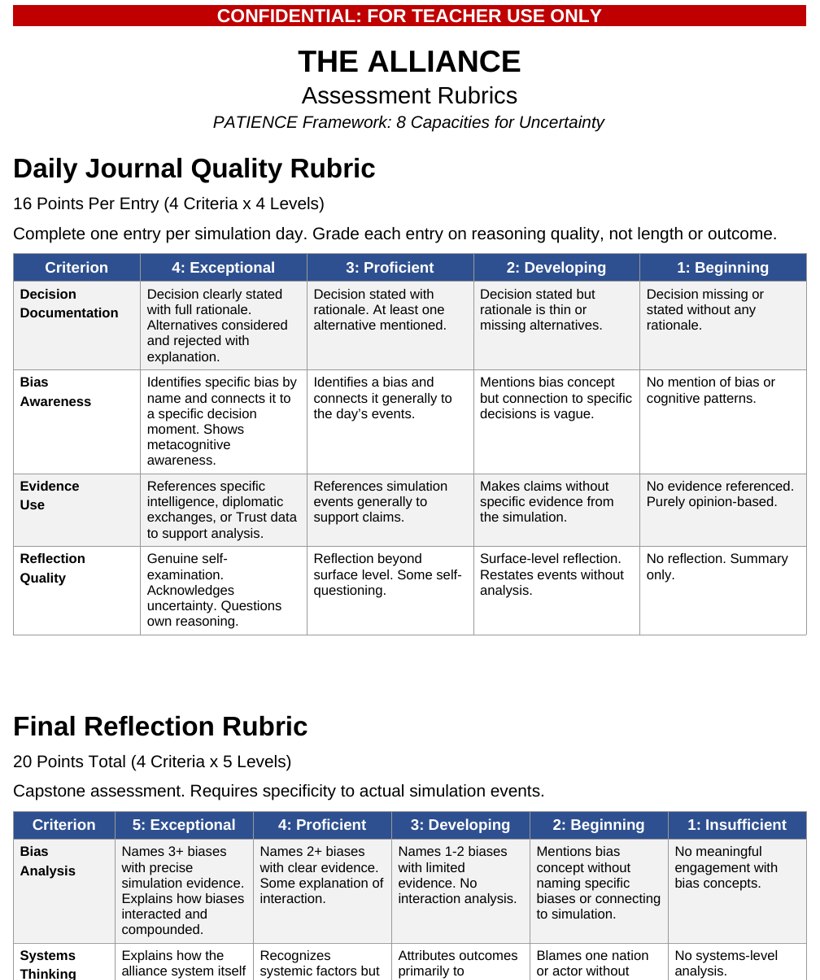
They are graded on how they reasoned, not on whether their nation survived.
The simulation has no winner, so it cannot be gamed by lucky escalation. Grading runs on reasoning quality across 212 points: twelve daily journals at 16 points each, plus a 20-point Final Reflection. A student whose nation collapses into war can earn full marks if the decision was sound on the evidence in hand, and a student who stumbles into peace can lose points for guessing. The rubric rewards Specificity. Vague talk about alliances scores low. Naming the Day 7 cascade, citing a specific briefing, tracing a Trust Score change, that scores high. The grade measures the thinking, which is also why it resists copied or AI-generated work that cannot reference the live classroom.
Tap to read the grading rubric
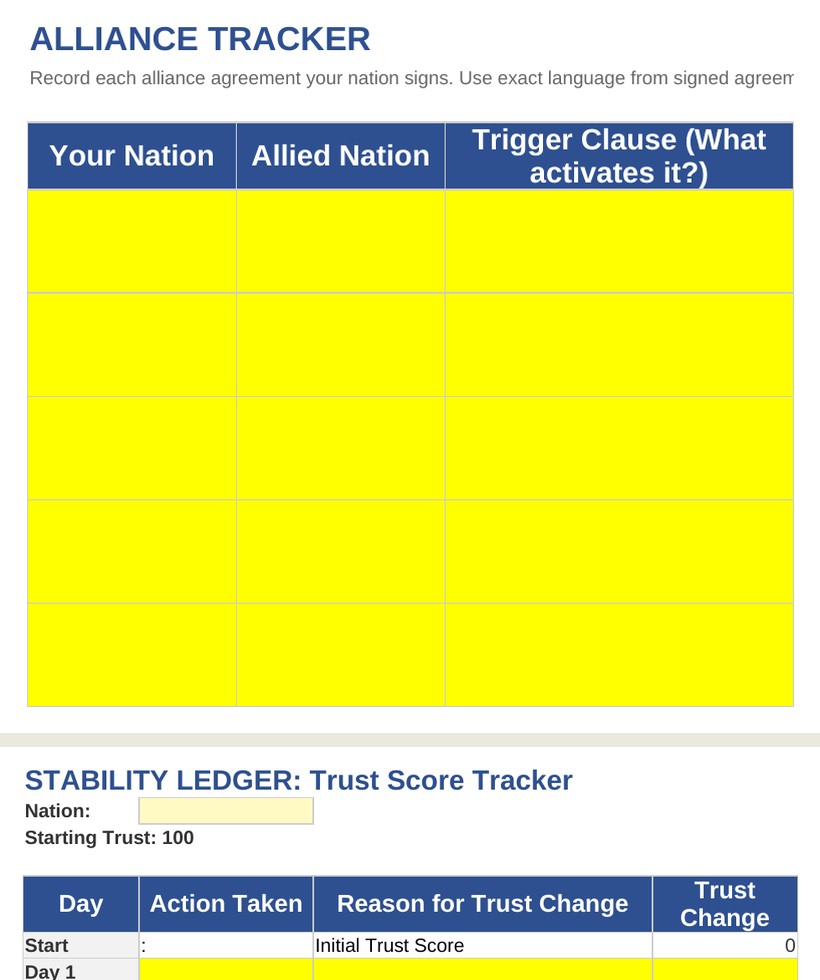
Let the workbook carry the bookkeeping so students spend their energy on judgment.
The Digital Student Workbook is an Excel-based tool that holds the mechanical load of running a nation. It tracks each day's decision, the Trust Score movement, the Public Opinion pressure, and the journal entry behind every call, so students are not lost shuffling cards or recalculating ledgers mid-cascade. When the alliance web begins to fail on Day 7, the workbook keeps the history straight while students concentrate on the only thing that matters: reading the evidence and defending the next move. The Stability Ledger gives the same support in tactile form for nations that prefer paper. Either way, the busywork lives in the tool, and the judgment lives in the student.
Tap to see the tracker
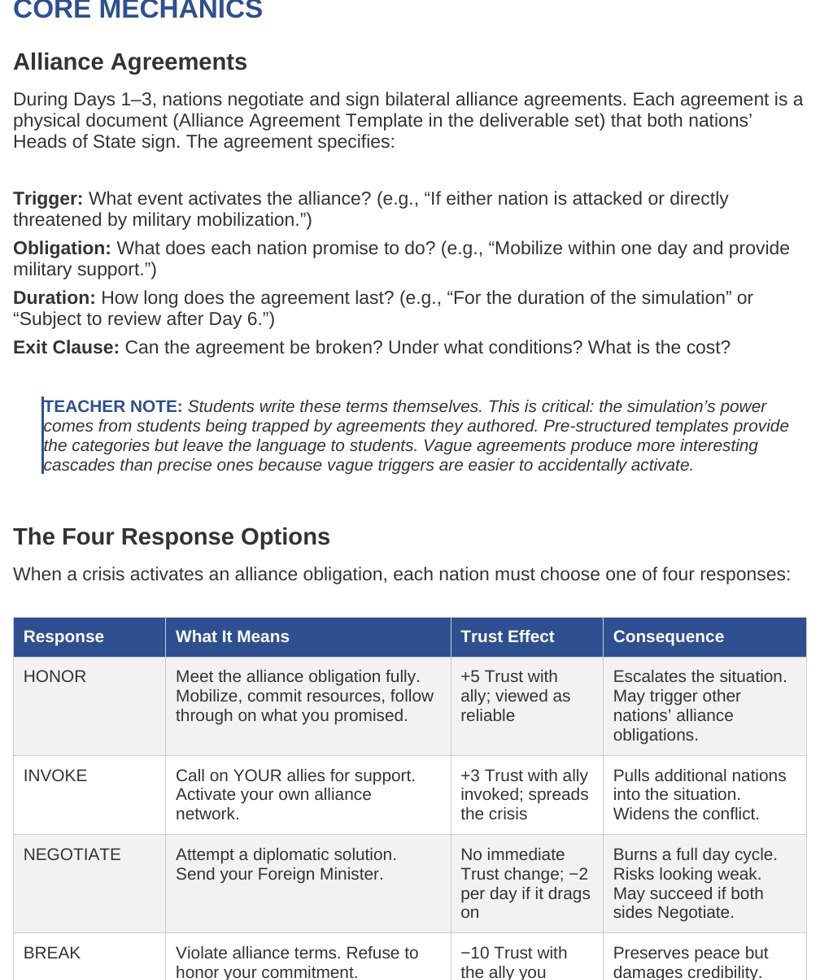
Every one of the 13 days is already scripted. You bring the facilitation, the simulation brings the rest.
The Comprehensive Teacher Guide runs the unit day by day. Each session has a playbook of facilitation steps, journal prompts, and the consequence matrix that tells you exactly how a nation's decision ripples into the next morning. You do not write briefings, design the cascade, or improvise outcomes. The Bias-Capacity Connection Map shows you which cognitive trap each day is built to surface and which PATIENCE capacity defeats it, so you can name the moment when a student walks into it. Google Classroom-ready files cover the daily prompts, bias templates, and reflection guides. Prep stays light. You move from sage on the stage to facilitator while your students take ownership of six nations.
Tap to read the teacher guide
The lesson plan is already written.
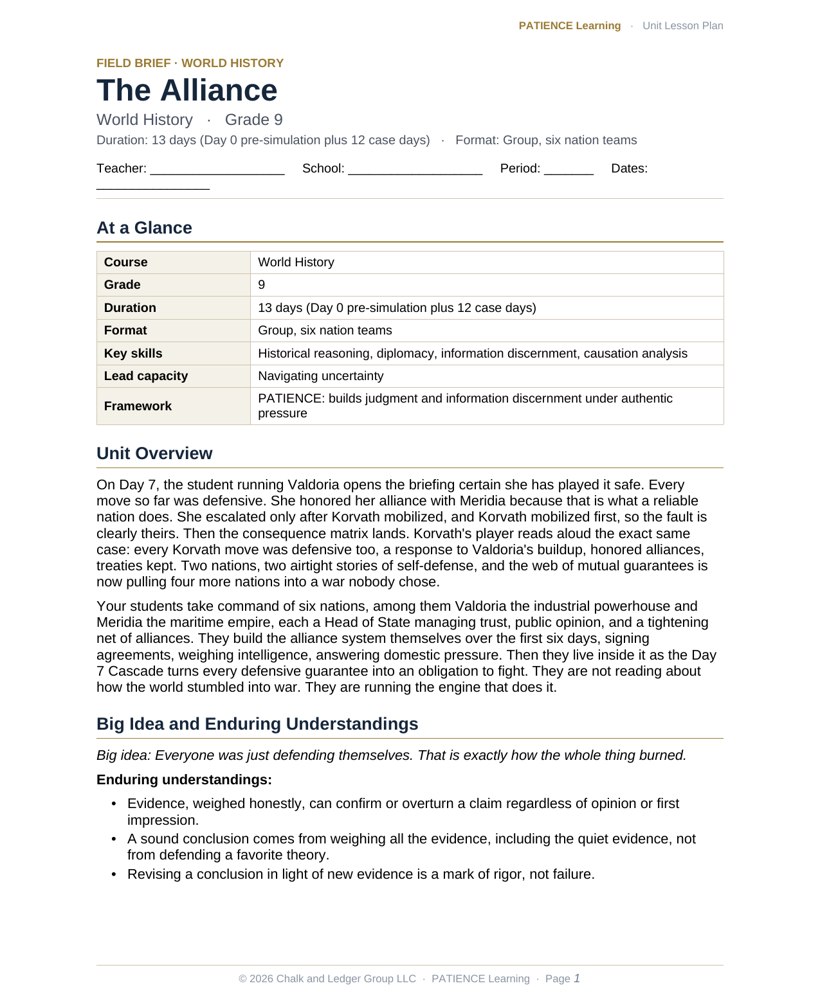
Every simulation comes with a fully editable, admin-ready lesson plan. Standards alignment, daily pacing, learning objectives, differentiation, and an assessment plan are already done, so you can hand it to an administrator or adapt it to your district template in minutes.
Tap to preview the lesson plan
Close
Close
Close
Close
The morning both sides realize they are only defending themselves, and they are still at war.
On Day 7, the student running Valdoria opens the briefing certain she has played it safe. Every move so far was defensive. She honored her alliance with Meridia because that is what a reliable nation does. She escalated only after Korvath mobilized, and Korvath mobilized first, so the fault is clearly theirs. Then the consequence matrix lands. Korvath's player reads aloud the exact same case: every Korvath move was defensive too, a response to Valdoria's buildup, honored alliances, treaties kept. Two nations, two airtight stories of self-defense, and the web of mutual guarantees is now pulling four more nations into a war nobody chose.
She wants to protect the theory. The theory says she is the careful one and the war belongs to Korvath. The evidence on the table says the war belongs to the structure, the chain of promises she helped build, the assumption that the other side's caution was aggression. At the pivot she has to choose: defend the story that makes her blameless, or trust the briefings that make her complicit. When she chooses the evidence, she sees the machine she helped assemble, and she sees that the only move that ever broke it was the boring one nobody made: pause, doubt her own read, negotiate before the cascade.
Six nations, 1914, and a web of treaties built to keep the peace.
Your students take command of six nations, among them Valdoria the industrial powerhouse and Meridia the maritime empire, each a Head of State managing trust, public opinion, and a tightening net of alliances. They build the alliance system themselves over the first six days, signing agreements, weighing intelligence, answering domestic pressure. Then they live inside it as the Day 7 Cascade turns every defensive guarantee into an obligation to fight. They are not reading about how the world stumbled into war. They are running the engine that does it.
| Grade level | 9 |
| Course | World History |
| Duration | 13 days (Day 0 pre-simulation plus 12 case days) |
| Format | Group, six nation teams |
| Key skills | Historical reasoning, diplomacy, information discernment, causation analysis |
Engineering better thinkers.
World War I did not start because leaders lacked facts. It started because smart people read the evidence through their fears. This simulation surfaces those fears by name. Each day pairs one cognitive bias with the PATIENCE capacity that defeats it, traced in the student's journal.
| Bias targeted | The remedy, built into the work |
|---|---|
| Loss aversion | Productive failure recoveryFear of looking weak pushes students toward risky escalation. When a nation's gamble fails, the journal forces them to study the loss and recover with a steadier read instead of doubling down. |
| Fundamental attribution error | MetacognitionStudents see their own moves as defensive and the rival's as aggressive. Writing daily about their own thinking exposes the double standard and makes them check the story before they act on it. |
| Commitment trap | Adaptive strategyHonoring an alliance that now leads to catastrophe feels like integrity. The capacity to adapt teaches students to revisit a promise against new evidence rather than march off the cliff to keep their word. |
| Reactive devaluation | Information discernmentA peace offer gets rejected because of who sent it, not what it says. Sorting briefings by reliability trains students to weigh the content of a proposal apart from the source they distrust. |
| Normalcy bias | Navigating uncertaintyWarning signs get waved off because the last crisis worked out. Facing an uncertain cascade with no answer key teaches students to take the signal seriously even when calm feels safer. |
| Zero-sum bias | Emotional regulationThe assumption that any rival gain is their own loss drives escalation under pressure. Steadying the response opens room to see the shared interest that a panicked, all-or-nothing read erases. |
13 days of evidence, escalation, and reckoning.
Day 0 introduces the nations and the cognitive biases students will meet. The first six case days build the alliance architecture as students sign treaties and weigh intelligence. The Day 7 Cascade tips that architecture into collapse, and the final days carry students through escalation to the Legacy Report, where each nation reckons with the war it helped make.
| Day | What lands | Skill in focus |
|---|---|---|
| 0 | Nations, roles, and a primer on the six engineered biases | Bias awareness |
| 1 | First decisions as Head of State, reading the opening briefings | Information discernment |
| 2 | Alliance agreements signed, the web begins to form | Collaborative reasoning |
| 3 | Public opinion pressure enters the daily calculation | Emotional regulation |
| 4 | Conflicting briefings force a reliability judgment | Information discernment |
| 5 | Trust Scores swing as nations test one another | Navigating uncertainty |
| 6 | The alliance architecture is complete and load-bearing | Adaptive strategy |
| 7 | The Cascade begins, defensive treaties turn into obligations to fight (critical pivot) | Metacognition |
| 8 | Escalation spreads, students confront the attribution error in their own logs | Metacognition |
| 9 | A peace proposal arrives and tests reactive devaluation (critical pivot) | Navigating uncertainty |
| 10 | The commitment trap forces a choice between a promise and a catastrophe | Adaptive strategy |
| 11 | Consequences settle, students trace causation back through their own decisions | Productive failure recovery |
| 12 | The Legacy Report, each nation reckons with the war it built | Independent reasoning |
Standards alignment.
The Alliance is built on the C3 Framework and NCSS world-history practice. Students develop compelling and supporting questions and plan inquiries under D1, evaluate sources of varied reliability and credibility under D3, and construct evidence-based explanations and arguments about historical causation under D4. The historical-thinking work targets D2.His.14.9-12 on the multiple causes of events and D2.His.16.9-12 on integrating evidence from multiple sources. The diplomacy and decision work supports D2.Civ.6.9-12 and D2.Civ.10.9-12 on civic deliberation. The unit covers the alliance system, militarism, and the outbreak of World War I while building the reasoning standards ask for.
The hidden architecture.
The pivot is engineered, not random. Across the first six days every nation is handed briefings and incentives that make escalation feel defensive and alliances feel like integrity. The cascade on Day 7 is the planted contradiction: each student is holding an airtight case for their own innocence, and the consequence matrix proves that every rival holds the identical case. Their biases lead them astray on purpose. The fundamental attribution error tells them their buildup is caution and the other's is threat. The commitment trap tells them honoring the treaty is honor. The sound conclusion only appears when a student stops defending the story and reads the evidence as a system, at which point the boring move they never made, pause and negotiate, becomes the obvious one.
Turnkey, classroom-ready.
- An admin-ready lesson plan. A fully editable plan with standards alignment, daily pacing, differentiation, and assessment, ready to adapt to your district template. Included with every purchase.
- A 13-day teacher guide. Daily playbooks, rubrics, and a consequence matrix that scripts every session.
- Six detailed nation profiles. Valdoria, Meridia, Korvath, and the rest, each with its own industry, politics, and pressures.
- 48 intelligence briefing cards. Sorted by day with variable reliability, marked Accurate, Exaggerated, or False.
- 24 public opinion cards. Real-time domestic pressure that students must weigh against strategy.
- A digital student workbook. An Excel-based tracker for decisions, Trust Scores, and journals, plus the tactile Stability Ledger.
- A dual rubric system. Grades the quality of reasoning across 212 points, not whether a nation survives.
Let your students build the machine, then take it apart.
Bring The Alliance to your World History classroom and let your students feel how careful, frightened people sleepwalk a continent into a war nobody chose.
Get this simulationPreview real pages from the simulation before you spend a dollar. No guessing, no surprises.