The Account
The most confident account is not the most reliable one.
The most confident account is not the most reliable one.
The Account makes your eighth graders the historian reconstructing what really happened from accounts that do not agree. Over ten days the owner, the workers, and the newspaper each tell it differently, and a photograph complicates all three. The students who corroborate and rank reliability, instead of trusting the loudest voice, write the honest history. It is source work, lived.
See what your students get, and why it lands.
No mockups. Every page below is real, pulled straight from the files you download. Tap any one to see it full size.
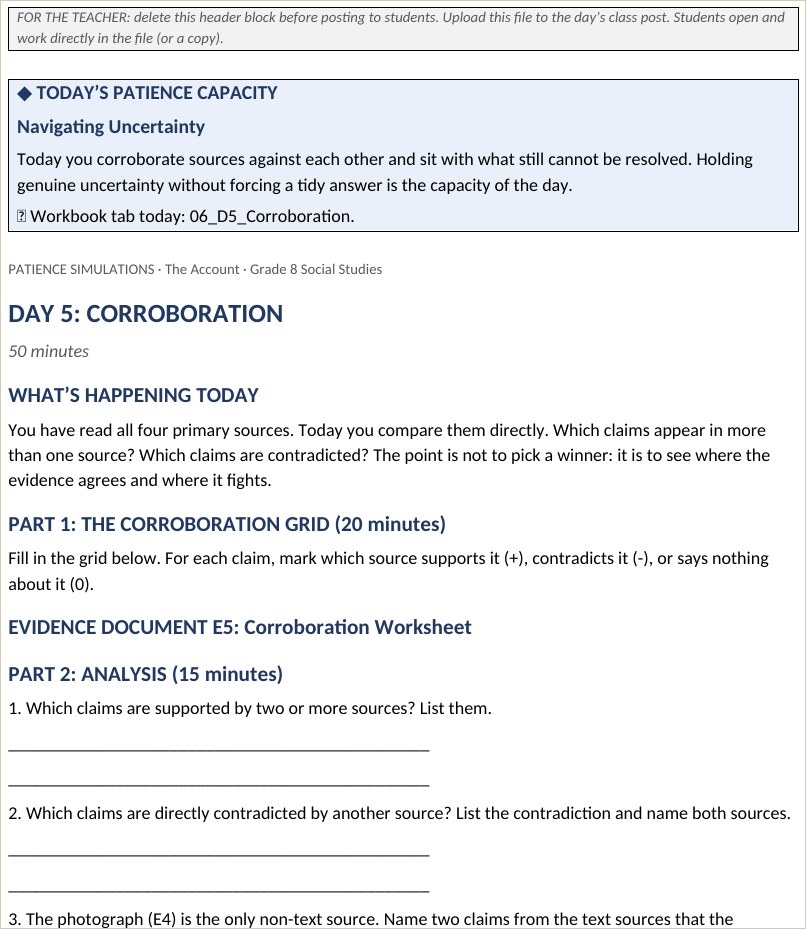
A worksheet was never going to teach this.
Your eighth graders are not reading a single textbook version of events. They are a historian holding conflicting accounts of the same event, where the most confident telling is not the best supported and a photograph fits only some of the stories. The historians who corroborate across sources, instead of trusting the loudest one, reconstruct what actually happened. That is historical source analysis, with a real account on the line.
Tap to read the corroboration
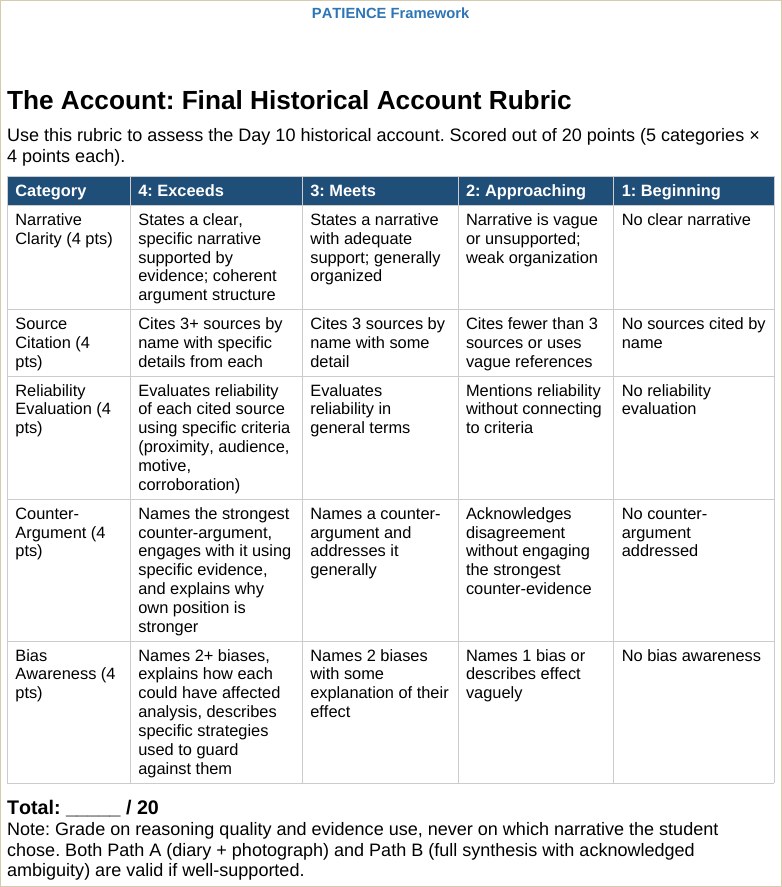
They are graded on their reasoning, not on the reconstruction.
Here is what surprises teachers. A student whose reconstruction matched the intended one is not graded higher than one whose did not. The answer is not the point. Students are assessed on the quality of their reasoning, traced through their own daily journal. A careful corroboration that landed differently scores higher than a lucky guess. That is how an eighth grader learns that how you reason matters more than whether you guessed right.
Tap to read the grading note
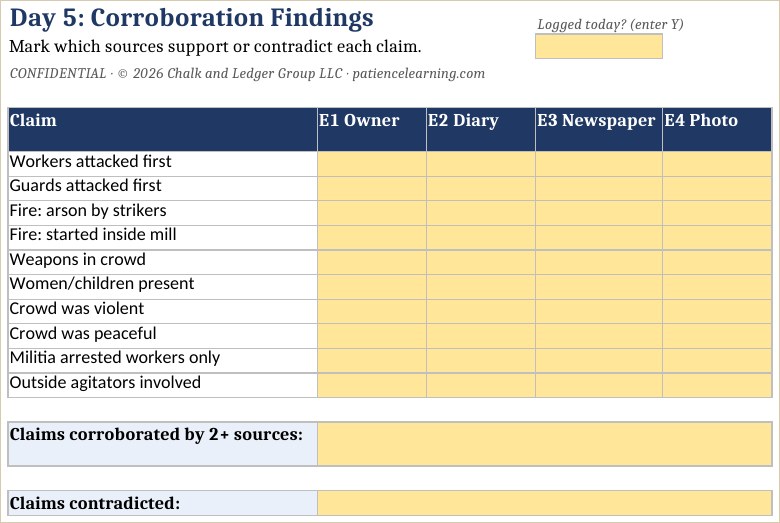
Let the workbook rank the accounts.
The Account comes with a workbook that holds each account and ranks it on reliability, bias, and corroboration. The historian logs what each one supports, and the picture builds across the ten days. Their attention stays on the hard part, which version holds up, instead of on keeping the stories straight.
Tap to see the reliability ranking
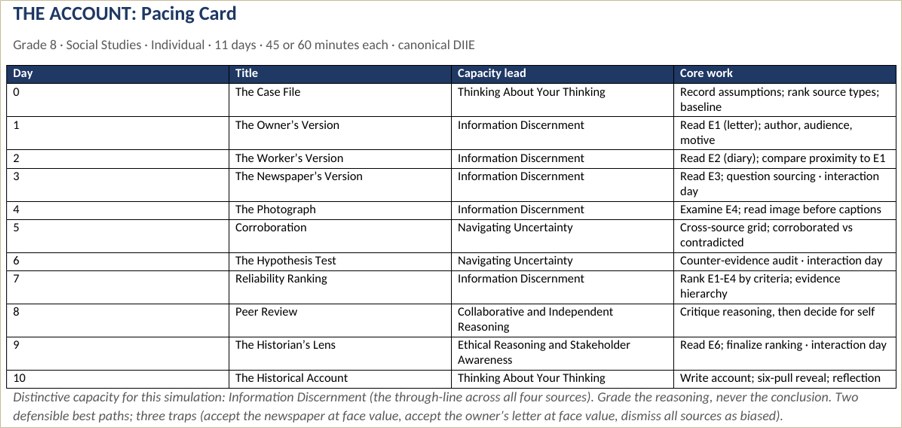
Every day is already scripted. You just run the room.
You do not need a historiography background to teach this. The guide scripts every day, names what students will likely say, and gives you exactly how to respond. The accounts, the photograph, the historian's lens, and the final write-up are all written for you. You bring the facilitation. The simulation brings everything else.
Tap to read the teacher guide
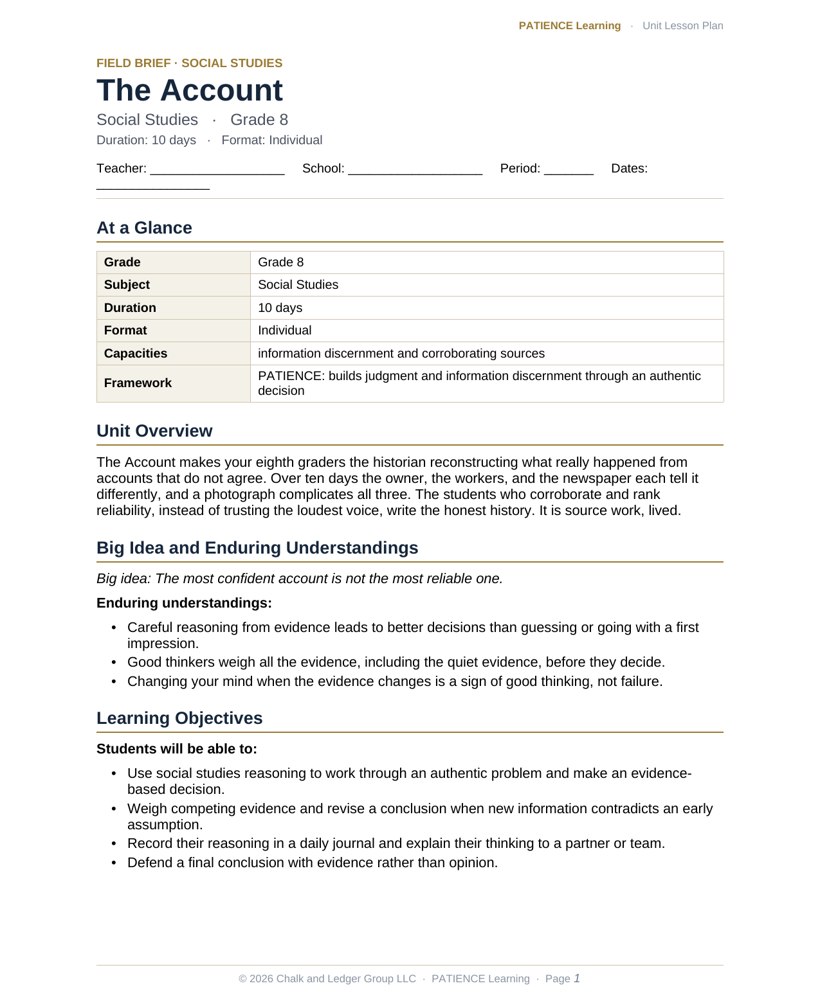
The lesson plan is already written.
Every simulation comes with a fully editable, admin-ready lesson plan. Standards alignment, daily pacing, learning objectives, differentiation, and an assessment plan are already done, so you can hand it to an administrator or adapt it to your district template in minutes.
Tap to preview the lesson plan
Close
Close
Close
Close
Everything you need to run it.
- An admin-ready lesson plan. A fully editable plan with standards alignment, daily pacing, differentiation, and assessment, ready to adapt to your district template. Included with every purchase.
- Eleven days of playbooks (Day 0 plus ten) that script every session.
- A student workbook that ranks accounts on reliability and corroboration.
- Conflicting accounts, a photograph, and a historian's lens that test real judgment.
- Daily journals and a rubric that grade reasoning, not the reconstruction.
- Scaffolded student files for the early days, for learners who need more support.
- Built on the PATIENCE framework: information discernment and corroborating sources.
Bring The Account to your classroom.
Ten days, fully planned, and a history your students have to reason out.
Get this simulationPreview real pages from the simulation before you spend a dollar. No guessing, no surprises.