Reconstruction
The bold reforms collapse when the troops leave. The boring institutions are the ones that last.
See what your students get, and why it lands.
No mockups. Every page below is real, pulled straight from the files you download. Tap any one to see it full size.
A worksheet was never going to teach the trade-offs of 1865.
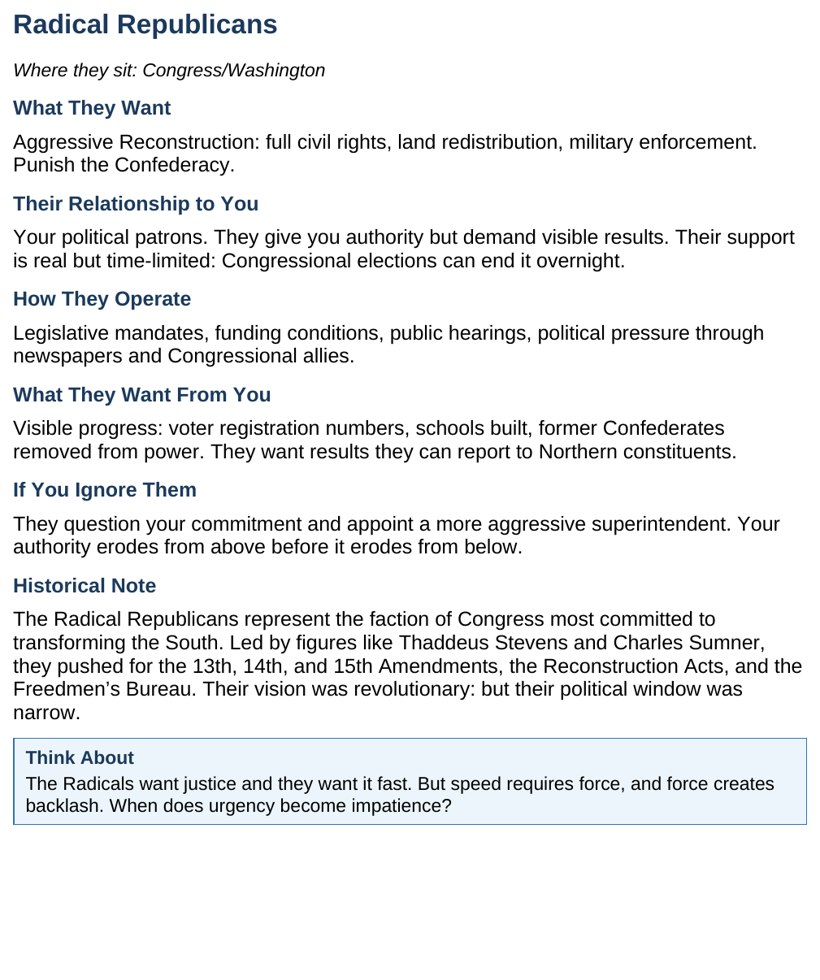
Your students are not answering questions about Reconstruction. They are the sole Superintendent of a Freedmen's Bureau district in Mercer County, and the day's dispatch just handed them a real call. The Faction document in front of them lays out five groups, Radical Republicans, Moderates, Redeemers, Freedpeople, and the Planter Aristocracy, each with a strategic interest and a consequence for neglect. Fund the schools, and a planter manufactures a labor stall. Register new voters, and the Redeemers escalate intimidation. There is no option that satisfies everyone, so your students argue from this document, weigh who they can afford to disappoint, and spend finite Political Capital to make a choice they will have to defend.
Tap to see the faction document
They are graded on the path, not whether the district thrives.
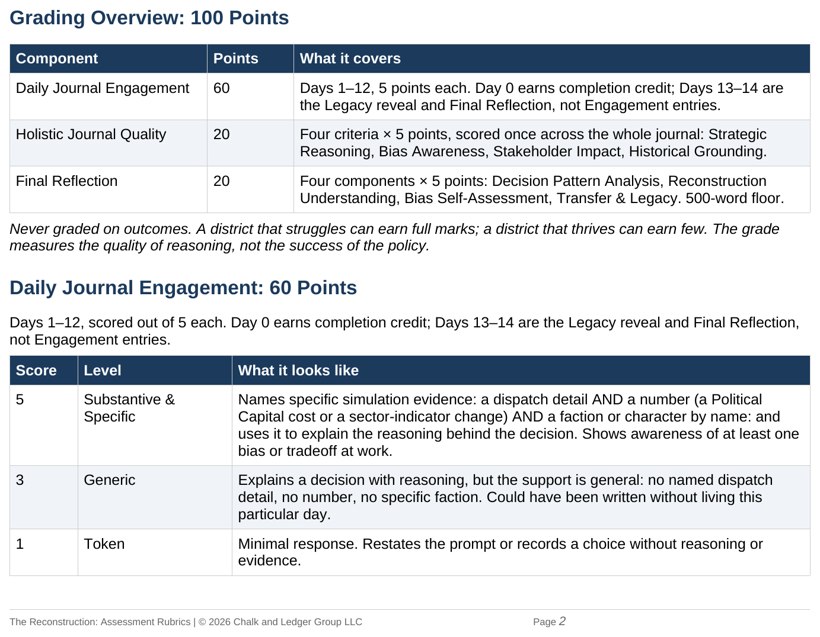
A student can run their district into the ground and still earn full marks, because the rubric grades the rigor of their reasoning, not the outcome. The Hybrid-100 model splits 100 points across daily journal engagement, holistic journal quality, and a final reflection. Each daily entry is scored against the Named and Numbered standard. To earn the full five points, a student must cite a specific dispatch detail, a number such as a Political Capital cost or a sector-health change, and a named faction or character like Isaac Turner or the Redeemers. A sound, evidence-led justification behind a district that fails beats a lucky guess every time. This protects risk-taking and rewards the careful thinking the era demands.
Tap to read the grading rubric
Let the workbook hold the bookkeeping so students spend their energy on judgment.
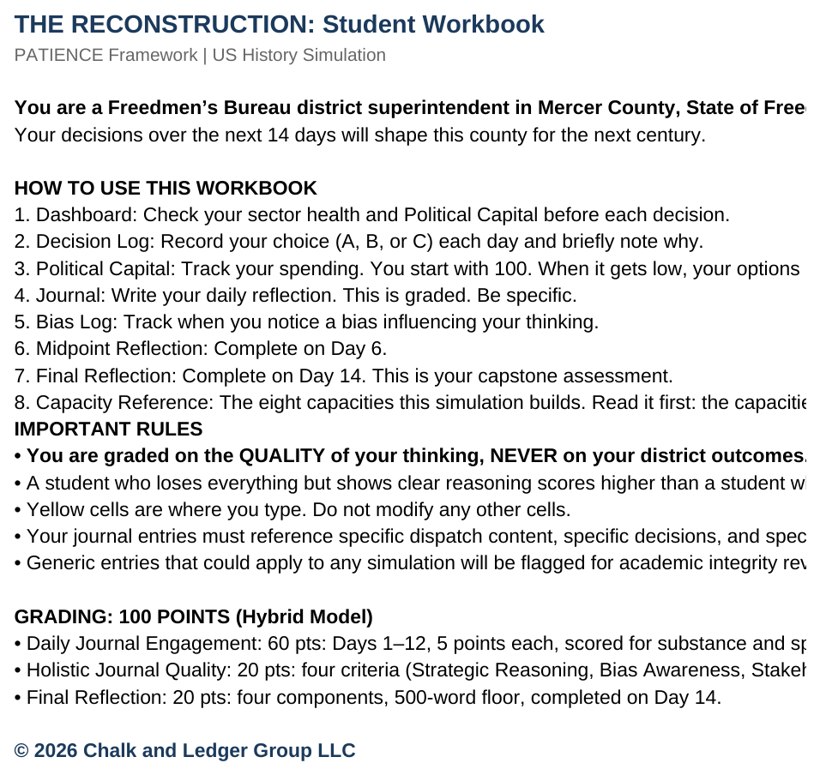
Reconstruction is full of moving parts, and the student Workbook carries them so your students do not have to. The spreadsheet tracks Political Capital as it is spent, the five sectors of district health from Education to Public Safety, and the running history of every decision made. When a student commits to a posture on the schoolhouse and the land early in the simulation, the Workbook holds that choice quietly until it returns days later as an Old Ghost. Because the tool does the tracking, a student is never lost in arithmetic when a dispatch forces a hard call. Their attention stays on the trade-off in front of them, on which faction they can afford to disappoint, and on writing the reasoning that earns the points.
Tap to see the tracker
Every day is already scripted. You bring the facilitation.
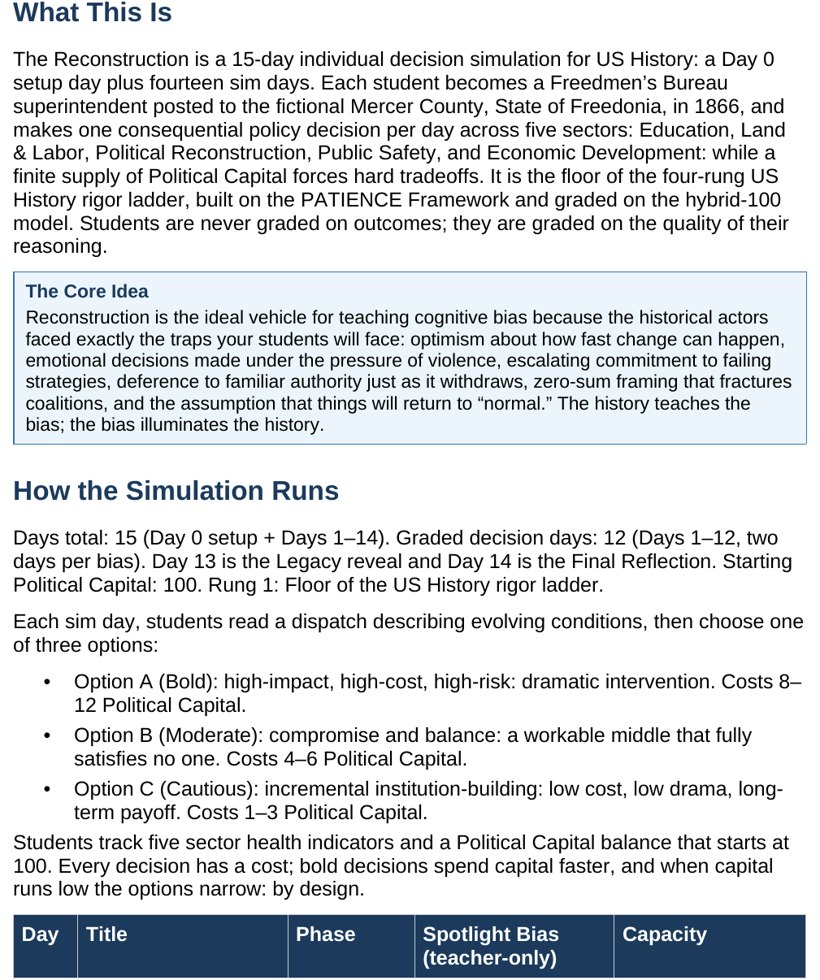
The Teacher Guide scripts the simulation day by day, so you can run it with zero nightly preparation. Each session follows the same three-beat rhythm: you read or project the day's dispatch to set the scene and surface a named bias, students select a policy option and spend Political Capital, then students journal their reasoning with evidence. The guide tells you exactly what to say, what to watch for, and how the day connects to the days before and after it. Self-contained sessions mean an interruption or a short class never breaks the narrative logic. You handle the discussion and the facilitation; the simulation handles the structure, the scenario, and the assessment, so prep stays light and your energy goes to your students.
Tap to read the teacher guide
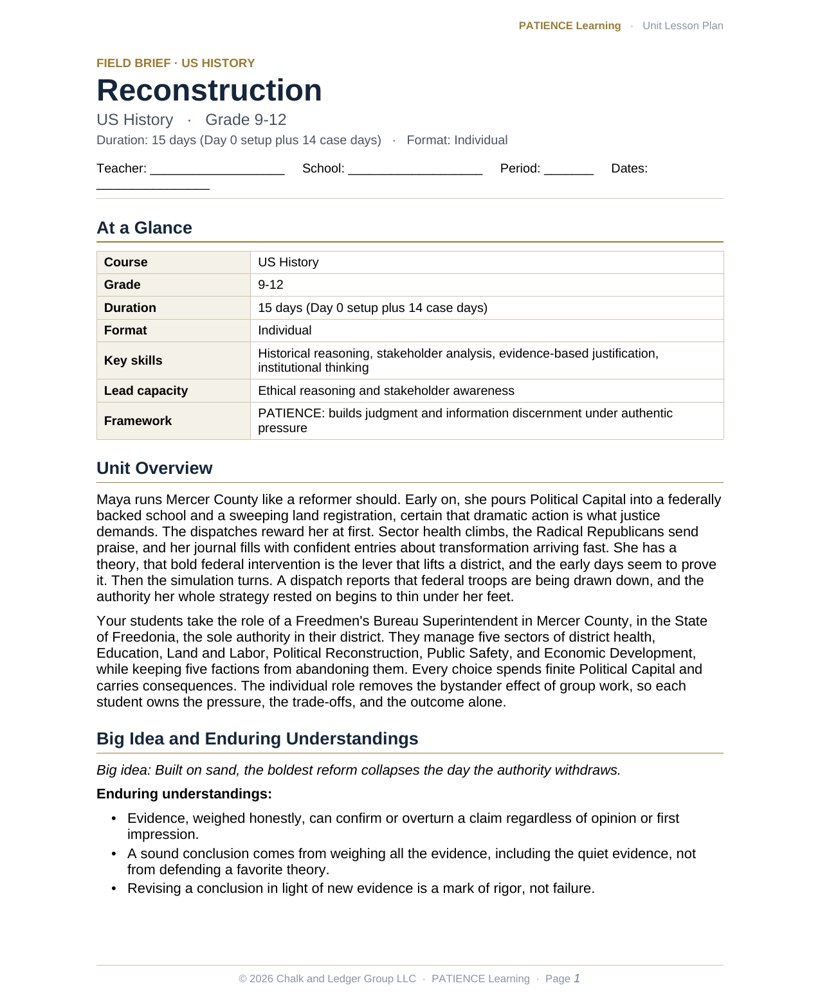
The lesson plan is already written.
Every simulation comes with a fully editable, admin-ready lesson plan. Standards alignment, daily pacing, learning objectives, differentiation, and an assessment plan are already done, so you can hand it to an administrator or adapt it to your district template in minutes.
Tap to preview the lesson plan
Close
Close
Close
Close
The moment the bold reform stops looking brave.
Maya runs Mercer County like a reformer should. Early on, she pours Political Capital into a federally backed school and a sweeping land registration, certain that dramatic action is what justice demands. The dispatches reward her at first. Sector health climbs, the Radical Republicans send praise, and her journal fills with confident entries about transformation arriving fast. She has a theory, that bold federal intervention is the lever that lifts a district, and the early days seem to prove it. Then the simulation turns. A dispatch reports that federal troops are being drawn down, and the authority her whole strategy rested on begins to thin under her feet.
At the pivot, Maya can defend her theory or read what the evidence is telling her. The Legacy Report looms, and her Old Ghost from earlier returns to test the posture she set on the schoolhouse and the land. She can keep insisting the bold path was right, or she can admit her gains were built on sand. When she trusts the evidence, she sees it plainly. The reforms that endure are the boring ones, the locally run schools and the community institutions that survive federal abandonment, because they never depended on troops staying.
One superintendent, one district, 1865 to 1877.
Your students take the role of a Freedmen's Bureau Superintendent in Mercer County, in the State of Freedonia, the sole authority in their district. They manage five sectors of district health, Education, Land and Labor, Political Reconstruction, Public Safety, and Economic Development, while keeping five factions from abandoning them. Every choice spends finite Political Capital and carries consequences. The individual role removes the bystander effect of group work, so each student owns the pressure, the trade-offs, and the outcome alone.
| Grade level | 9-12 |
| Course | US History |
| Duration | 15 days (Day 0 setup plus 14 case days) |
| Format | Individual |
| Key skills | Historical reasoning, stakeholder analysis, evidence-based justification, institutional thinking |
Engineering better thinkers.
Reconstruction faltered partly because of external opposition and partly because of the human tendencies that distort judgment under pressure. Here the history teaches the bias and the bias illuminates the history. Each day pairs one named bias with the capacity that defeats it.
| Bias targeted | The remedy, built into the work |
|---|---|
| Optimism bias | Navigating uncertaintyStudents overestimate how fast institutions change, then a dispatch shows reform stalling, forcing them to plan for a long, uncertain arc instead of a quick transformation. |
| Normalcy bias | MetacognitionAssuming a return to the old normal, students must catch their own assumption in the journal and reckon with how permanently 1865 has changed the ground under them. |
| Sunk cost fallacy | Adaptive strategyHeavy early investment tempts students to stay the course, but shifting conditions reward those who can abandon a failing plan and redirect Political Capital. |
| Authority bias | Information discernmentDefaulting to top-down federal solutions, students learn to separate signal from noise and weigh local capacity against the federal authority that may soon withdraw. |
| Zero-sum thinking | Collaborative and independent reasoningFraming coalition-building as win or lose, students discover that neglecting any single faction triggers systemic consequences across the whole district. |
| Hot-cold empathy gap | Emotional regulationTempted to decide policy in heated moments after violence or backlash, students practice making the call from evidence rather than from the emotion of the dispatch. |
15 days of decisions under withdrawing authority.
Day 0 sets up the district, the factions, and the Workbook. The case then runs across fourteen days of dispatches, decisions, and journals. An early posture on the schoolhouse and the land returns later as an Old Ghost, and the simulation closes with a Legacy Report and a transfer reflection that ties Mercer County to the historical record.
| Day | What lands | Bias in focus |
|---|---|---|
| 0 | District setup, faction briefing, and Workbook orientation | Setting the baseline |
| 1 | First dispatch and first spend of Political Capital | Optimism bias |
| 2 | Students set their posture on the schoolhouse and the land (critical pivot) | Authority bias |
| 3 | Land and labor friction between freedpeople, planters, and Washington | Sunk cost fallacy |
| 5 | Voter registration meets organized backlash | Zero-sum thinking |
| 7 | Public safety choice between military enforcement and local law | Hot-cold empathy gap |
| 9 | Economic pressure forces cooperation with the planter class | Normalcy bias |
| 10 | The Day 2 posture returns as an Old Ghost (critical pivot) | Adaptive strategy |
| 12 | Federal authority thins as troops draw down | Navigating uncertainty |
| 13 | The Legacy Report reveals the district ten years later | Metacognition |
| 14 | Final reflection connects Mercer County to the historical record | Transfer and stakeholder awareness |
Standards alignment.
Reconstruction aligns to the C3 Framework and NCSS standards for historical inquiry, and supports APUSH-level US History work for grades 9 through 12. Students develop and evaluate claims about Reconstruction-era policy (C3 D2.His.14.9-12 and D2.His.16.9-12), analyze the perspectives and interests of competing factions (D2.His.4.9-12 and D2.His.5.9-12), and use specific evidence to justify decisions (D2.His.10.9-12 and D4.1.9-12). The daily evidence standard, requiring a named detail, a number, and a stakeholder, builds the sourcing and corroboration habits these frameworks demand. The final reflection meets the C3 transfer goal by connecting the past to a named present-day institution.
The hidden architecture.
The simulation is engineered so the exciting choice betrays the student. Early dramatic reforms, the federally backed school and the sweeping land action, score well at first, which baits students into believing bold intervention is the answer. The planted contradiction is the troop drawdown late in the case. When federal authority withdraws, the Legacy Report shows that bold reforms built on that authority collapse, while the boring, locally owned institutions endure. The Old Ghost mechanic ties it together: the posture a student set on Day 2 returns on Day 10, so their own early bias drives the outcome they must then explain. Because every student's path is personalized by their own choices, no two journals match and generic AI summaries cannot pass the assessment.
Turnkey, classroom-ready.
- An admin-ready lesson plan. A fully editable plan with standards alignment, daily pacing, differentiation, and assessment, ready to adapt to your district template. Included with every purchase.
- A 15-day scripted playbook. Day-by-day facilitation for every session, built for zero nightly preparation.
- A tech-enabled student Workbook. Tracks Political Capital, the five sectors of district health, and every decision so students focus on judgment.
- Turnkey student files. Faction documents, dispatches, and the daily journal, ready to hand out and run.
- The Hybrid-100 rubric system. Grades the quality of reasoning against the Named and Numbered standard, not whether the district survives.
- The Decision Log and Legacy Report. Teacher tools that track each student's Old Ghost and reveal the district ten years on.
Put your students in the superintendent's chair.
Bring Reconstruction into your classroom as a real decision under pressure, where your students stop watching history and start building the institutions that last.
Get this simulationPreview real pages from the simulation before you spend a dollar. No guessing, no surprises.