Cash or Crash
Sales is vanity. Cash is survival. Your students learn the difference the hard way.
See what your students get, and why it lands.
No mockups. Every page below is real, pulled straight from the files you download. Tap any one to see it full size.
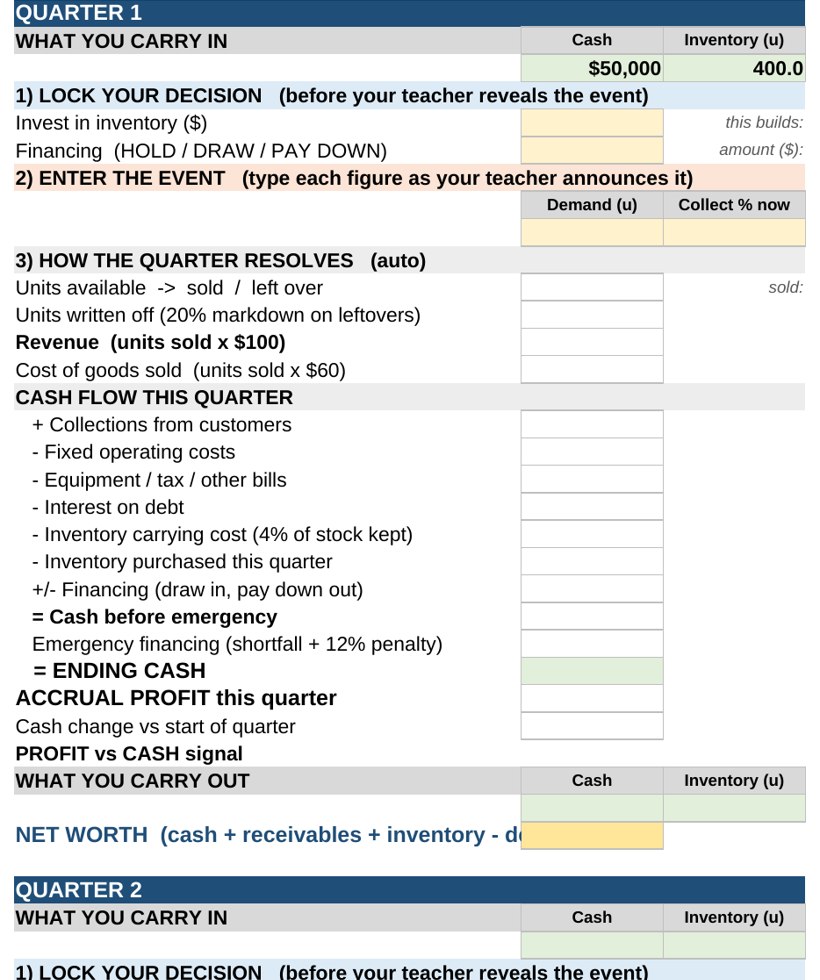
Your students are not answering questions. They are running a company.
Each quarter, your students sit in front of the blue DECISION band and make a real call. They set an Invest Amount and pick a Financing Posture, HOLD, DRAW, or PAY DOWN, and they commit before the market reveals what happens next. Unit price is $100, manufacturing runs $60 a unit, fixed costs are $12,000 a quarter, and emergency financing carries a 12 percent penalty. No worksheet asks for a definition here. The page asks for a decision, locked in writing, with the cash buffer they actually have. When the quarter turns and the event lands, they live with what they chose. That is the work, and it is closer to a boardroom than a textbook.
Tap to see a student decision page
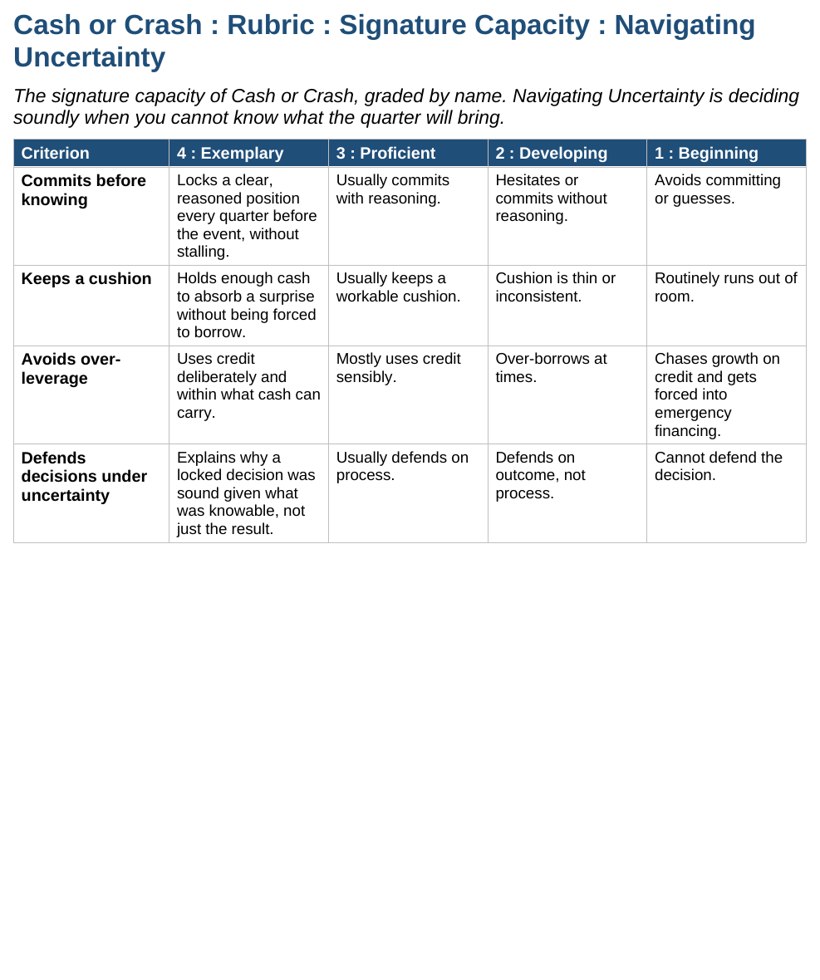
Graded on the reasoning, not the leaderboard.
A team can finish with a smaller net worth and still earn the top score. The rubric rewards the quality of thought over the luck of the draw. Exemplary work means holding a cushion big enough to absorb a surprise hit without borrowing, using credit deliberately and avoiding the 12 percent penalty, locking a reasoned position every quarter without stalling or hindsight editing, and defending each decision based on what was known at the time. A sound process behind a rough outcome beats a lucky guess every time. Three rubrics anchor the grade, the Final Reflection, the Quarterly Decision Journal, and the Signature Capacity, so your students are scored on calibration and honesty, not on whether the market broke their way.
Tap to read the grading rubric
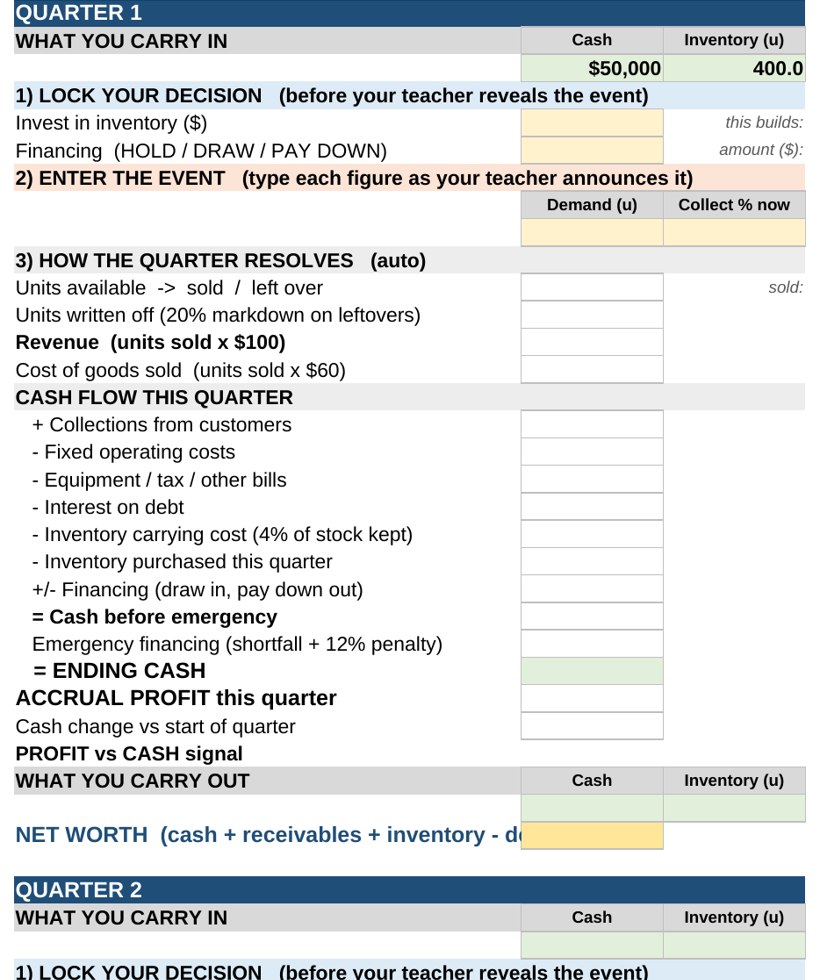
Let the workbook hold the math so judgment gets the energy.
The Team Workbook is the cash-flow engine. It tracks receivables, inventory, debt, and net worth, and it runs the numbers the moment a quarter locks. Your students do not burn class time on arithmetic. They spend it deciding. The workbook also surfaces signals that teach on their own, the Profit versus Cash flag and the forced-borrowing flag, so a team watches its sales climb toward $70,000 while cash sits at zero and feels the lesson before anyone names it. The decision journal lives inside the same file, capturing each locked position and the logic behind it. By the end, the workbook is both the tracker and the record your students reread to find exactly which traps caught them.
Tap to see the tracker
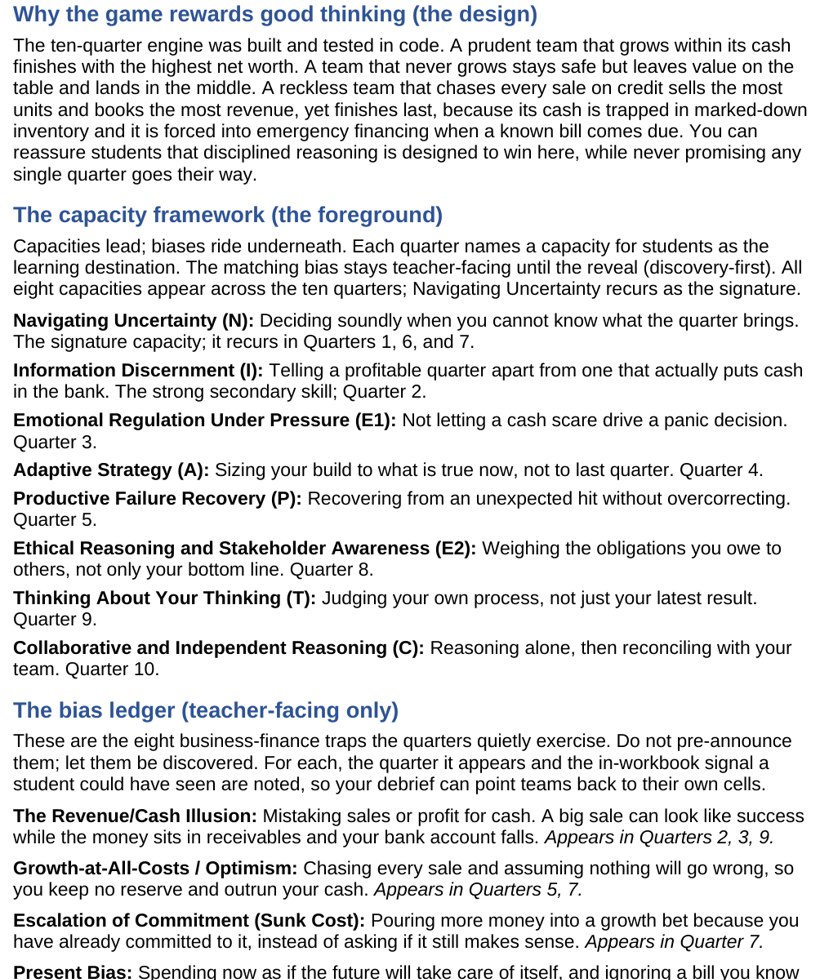
Every quarter is scripted. You bring the room.
Cash or Crash is zero-prep, and you do not need a finance background to run it. The Teacher Quarter-Events Guide gives you read-aloud scripts for every quarter, the reveal armor that keeps students from peeking at events they have not earned yet. The Class Leaderboard calculates net worth instantly, so you move from facilitator to expert analyst without touching a spreadsheet. When the simulation ends, the Bias Reveal and Debrief Script walks you through the terminal payoff, where each trap gets named and your students see their own data point to it. If a student misses a session, the game logic holds and the team resumes at the next lock point. You facilitate. The simulation handles the rest.
Tap to read the teacher guide
The lesson plan is already written.
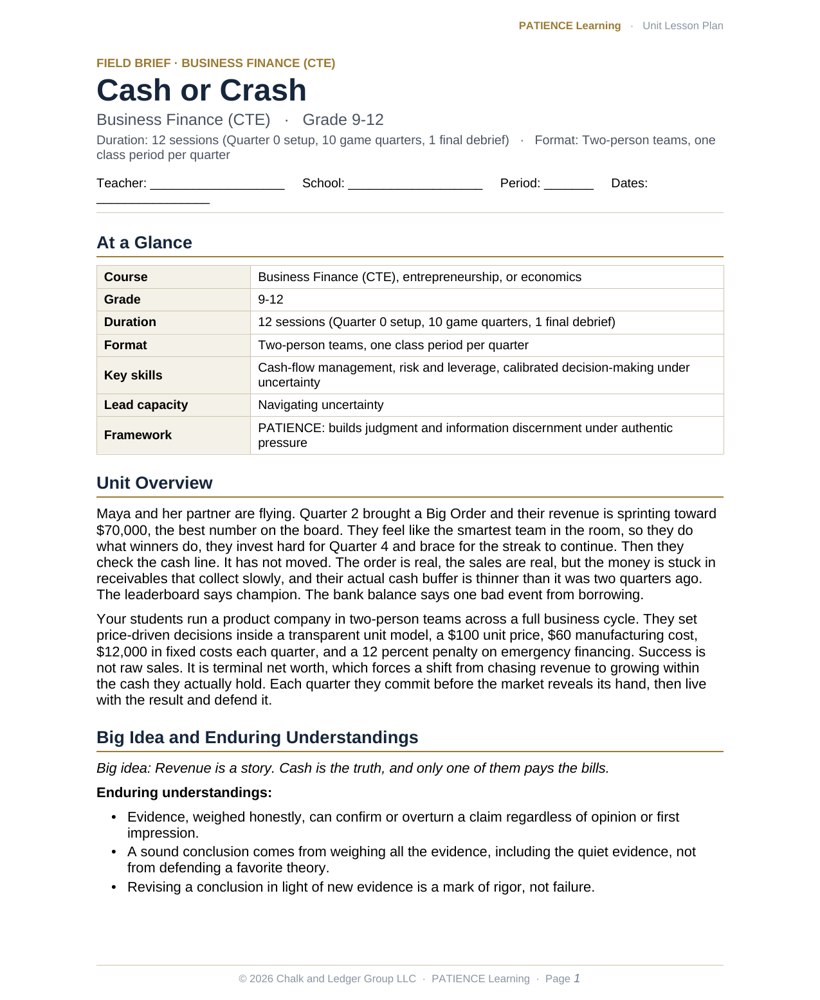
Every simulation comes with a fully editable, admin-ready lesson plan. Standards alignment, daily pacing, learning objectives, differentiation, and an assessment plan are already done, so you can hand it to an administrator or adapt it to your district template in minutes.
Tap to preview the lesson plan
Close
Close
Close
Close
The quarter the spreadsheet says you are winning and the cash says you are dead.
Maya and her partner are flying. Quarter 2 brought a Big Order and their revenue is sprinting toward $70,000, the best number on the board. They feel like the smartest team in the room, so they do what winners do, they invest hard for Quarter 4 and brace for the streak to continue. Then they check the cash line. It has not moved. The order is real, the sales are real, but the money is stuck in receivables that collect slowly, and their actual cash buffer is thinner than it was two quarters ago. The leaderboard says champion. The bank balance says one bad event from borrowing.
Here is the pivot. Maya wants to trust the revenue, the story she has been telling all week. The evidence in front of her says the revenue is not cash and cannot pay a bill. She can protect the theory and keep building, or she can trust the numbers, pull back the invest amount, and hold a reserve she cannot fully justify with the leaderboard. She chooses the cash. When the $20,000 equipment breakdown hits in Quarter 5, the teams that chased the high number borrow at 12 percent and crater. Maya absorbs the hit and keeps building.
Ten quarters. One company. Terminal net worth or insolvency.
Your students run a product company in two-person teams across a full business cycle. They set price-driven decisions inside a transparent unit model, a $100 unit price, $60 manufacturing cost, $12,000 in fixed costs each quarter, and a 12 percent penalty on emergency financing. Success is not raw sales. It is terminal net worth, which forces a shift from chasing revenue to growing within the cash they actually hold. Each quarter they commit before the market reveals its hand, then live with the result and defend it.
| Grade level | 9-12 |
| Course | Business Finance (CTE), entrepreneurship, or economics |
| Duration | 12 sessions (Quarter 0 setup, 10 game quarters, 1 final debrief) |
| Format | Two-person teams, one class period per quarter |
| Key skills | Cash-flow management, risk and leverage, calibrated decision-making under uncertainty |
Engineering better thinkers.
In finance, the costly errors are not arithmetic. They are biases that feel like instinct, chasing a high revenue number, doubling down on a losing bet, assuming last quarter repeats. Each quarter pairs a named trap your students discover in their own data with the capacity that defeats it, so the correction lands with skin in the game.
| Bias targeted | The remedy, built into the work |
|---|---|
| Anchoring | Productive failure recoveryTeams fixate on a comfortable starting position in Quarters 1 and 8 and read their runway and debt load fresh, recovering from the false security the opening cash balance created. |
| Confirmation bias | MetacognitionThe Profit versus Cash flag forces teams to notice the revenue story they want to believe is not matched by the cash line, and to question their own reading before they commit. |
| Sunk cost fallacy | Adaptive strategyWhen a growth bet stops making sense in Quarter 7, teams practice abandoning the position they have defended for quarters rather than escalating commitment to protect it. |
| Recency bias | Information discernmentAfter the Quarter 2 Big Order, teams overbuild in Quarter 4 and eat markdowns, learning to weigh the full record against the loudest recent quarter. |
| Growth-at-all-costs | Navigating uncertaintyThe $20,000 equipment breakdown in Quarter 5 wipes out teams with no reserve, teaching them to hold a buffer against events they cannot predict instead of chasing sales. |
| Overconfidence | Emotional regulationIn Quarter 6 the bank slashes credit from $45,000 to $22,000, blindsiding teams that assumed easy borrowing and forcing composure over panic when the safety net shrinks. |
12 sessions of decisions under pressure.
Quarter 0 builds the unit economics and finance baseline through a vocabulary assignment and workbook setup. Then the case runs ten quarters, each a single class period, where teams lock a decision, the market reveals an event, and the consequence compounds. A final debrief reveals the eight traps and where each team got caught.
| Quarter | What lands | Trap in focus |
|---|---|---|
| 0 | Setup, vocabulary, and unit economics baseline | Anchoring |
| 1 | First locked decision on a comfortable opening balance | Anchoring |
| 2 | The Big Order spikes revenue toward $70,000 while cash stalls (critical pivot) | Revenue/Cash Illusion |
| 3 | Slow collections meet a present-bias spending temptation | Present bias |
| 4 | Teams overbuild on recency and carry costly inventory | Recency bias |
| 5 | A $20,000 equipment breakdown punishes thin reserves (critical pivot) | Growth-at-all-costs |
| 6 | The bank cuts credit from $45,000 to $22,000 | Overconfidence |
| 7 | Boom market tempts escalation and herd expansion | Escalation of commitment |
| 8 | A $16,000 tax and insurance bill comes due | Present bias and anchoring |
| 9 | Late revenue illusion tests whether the lesson held | Revenue/Cash Illusion |
| 10 | Final quarter locks terminal net worth | Calibration |
| Debrief | Bias reveal, archetype reflection, and final scorecard | All eight traps |
Standards alignment.
Cash or Crash aligns to the National Standards for Personal Financial Education, with direct coverage of Spending and Saving, Managing Credit, and Financial Decision Making as students manage cash, weigh a 12 percent financing penalty, and justify decisions under uncertainty. It maps to the Common Career Technical Core for the Finance Career Cluster, supporting financial analysis, business management, and corporate finance pathways. The simulation also builds the cross-cutting employability skills CTE programs are accountable for, problem solving, critical thinking, decision making, and communication, all evidenced in the written decision journal and final reflection. Alignment is honest and pathway-relevant, not a checklist of unrelated codes.
The hidden architecture.
The simulation is engineered so that the exciting move is the wrong one. The central trap is the Revenue/Cash Illusion, planted in Quarter 2 as a Big Order that drives sales toward $70,000 while collections lag and cash stays flat. Teams that read the leaderboard instead of the cash line feel like winners and invest aggressively. That sets the spring. The $20,000 breakdown in Quarter 5 and the credit cut in Quarter 6 then punish exactly those teams, while the disciplined ones who held a buffer survive. The lock-before-you-know mechanic removes hindsight editing, so students cannot rescue a bad read after the fact. The sound conclusion, grow within your cash, is forced by the model itself, not by you.
Turnkey, classroom-ready.
- An admin-ready lesson plan. A fully editable plan with standards alignment, daily pacing, differentiation, and assessment, ready to adapt to your district template. Included with every purchase.
- The Team Workbook. The cash-flow engine, decision journal, and final scorecard in one file, with built-in Profit versus Cash and forced-borrowing flags.
- Quarter files 0 through 10. Capacity prompts and journal structures for each quarter, with no event figures so students cannot peek ahead.
- The Teacher Quarter-Events Guide. Read-aloud reveal scripts for every quarter, the reveal armor that drives a zero-prep run.
- The Class Leaderboard. Automated net worth tracking that updates instantly the moment each quarter locks.
- The Bias Reveal and Debrief Script. A guided walkthrough of all eight traps and the four archetypes for the closing payoff.
- The assessment suite. Three rubrics and a pacing card that grade the quality of reasoning, not whether students win.
Put your students in the boardroom.
Bring Cash or Crash to your classroom and let your students learn, through their own decisions, that disciplined reasoning beats the exciting guess every time.
Get this simulationPreview real pages from the simulation before you spend a dollar. No guessing, no surprises.