Bull or Bear
The boring, diversified, low-churn choice wins. Your students will learn that the hard way.
See what your students get, and why it lands.
No mockups. Every page below is real, pulled straight from the files you download. Tap any one to see it full size.
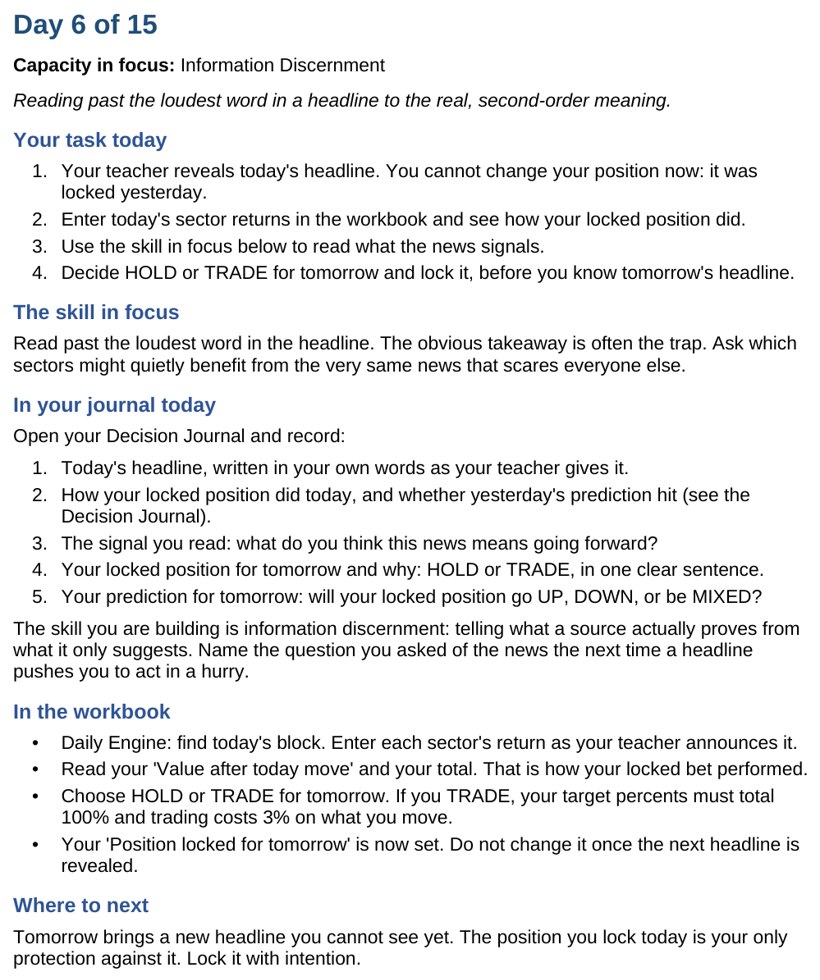
Your students are not answering questions. They are making a real call.
Each day opens with a headline that moves the market, and your students have to decide what to do with $100,000 spread across six sectors. A flying-car prototype sends Technology up 14 percent on pure hype. Bank contagion news drops Finance 16 percent the day after rate news pushed it higher. There is no worksheet to fill in here. Students read the news, weigh which sectors it actually touches, and position their portfolio for tomorrow before tomorrow's headline is revealed. The lock-in mechanic means they cannot react after the fact. They can only have reasoned well beforehand. That single rule turns every decision into a real judgment call with money on the line.
Tap to see a student decision page
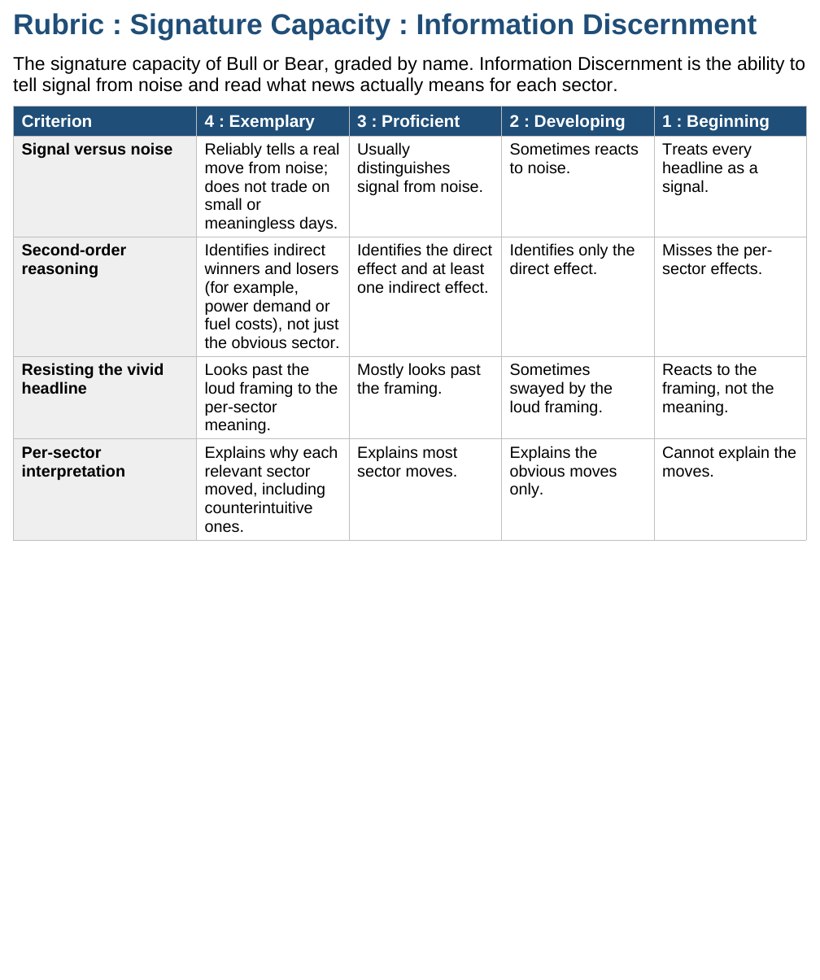
They are graded on the reasoning, not the result.
A student who panic-sold at the bottom and a student who held with a clear rationale can land in the same place on the leaderboard, so the leaderboard is only one of three scores. The rubric evaluates portfolio performance, the quality of justification in the decision journal, and prediction calibration, where you compare what a student wrote against the actual market drivers in the teacher guide. A sound process behind a wrong bet beats a lucky guess every time. The final reflection rubric rewards citing specific days, values, and fees, naming the real moments a bias steered a trade, and connecting it all back to real investing. Caliber of thinking is what earns the grade.
Tap to read the grading rubric
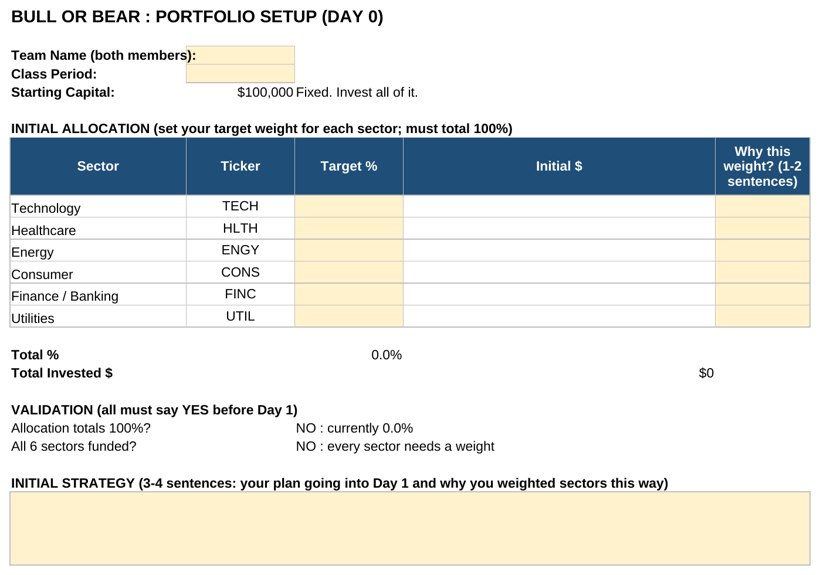
Let the workbook hold the busywork so students spend their energy on the judgment.
The team workbook runs the lock-in engine, calculates the 3 percent round-trip fee automatically, and updates portfolio value the moment teams enter their moves. Students are not doing arithmetic by hand or tracking percentages on scratch paper. They enter a position, the fee comes off before the market moves, and the new value appears. That frees their attention for the only thing that matters, which is the reasoning they record in the decision journal alongside every trade. A blank entry defaults to HOLD, so nobody is punished with an accidental zero, and a missed class simply lets the locked position ride like a real-world holding. The tool carries the mechanics so your students carry the thinking.
Tap to see the tracker
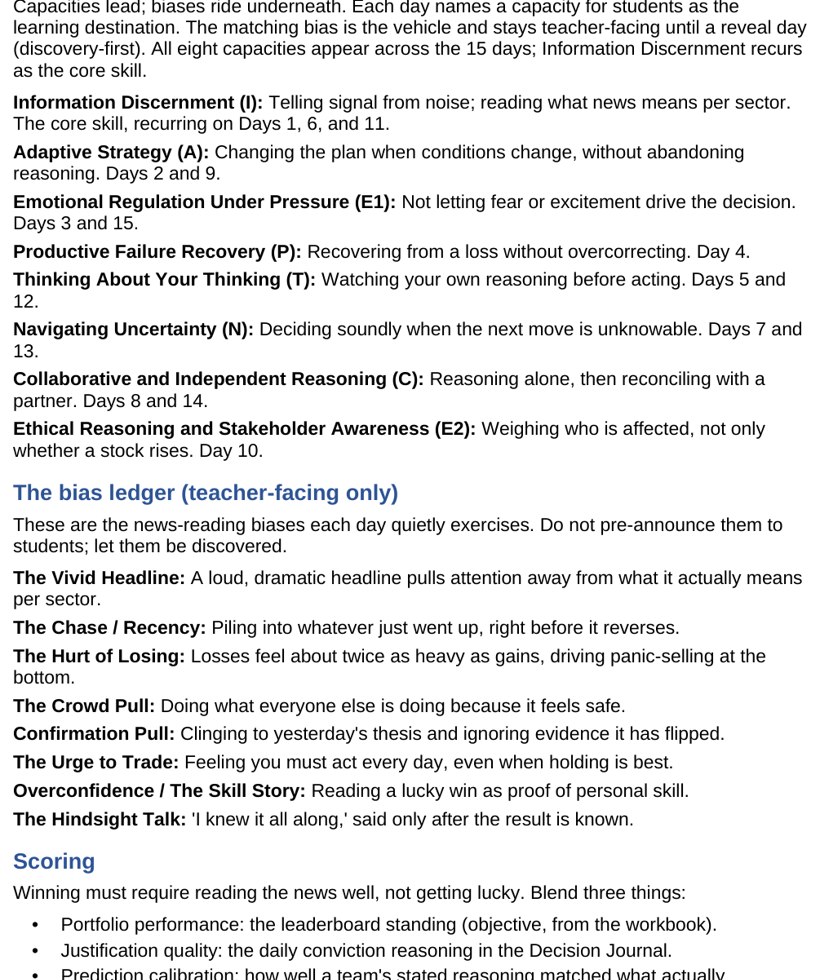
Every day is already scripted. You bring the facilitation, the simulation brings everything else.
The Teacher Market-Movements Guide is written so a non-specialist can lead a high-level finance discussion with total confidence. For every day it gives you the headline, a read-aloud script explaining the reason behind the move, and the trap to surface in the debrief. The daily loop is the same four steps each session: reveal the news and read the why, teams update and the workbook does the math, you lead a short discussion on the day's trap, and teams reason through and lock the next position. You are never improvising the finance. The guide hands you the answer to why Finance and Utilities move opposite each other on the same rate news, so you can run the room instead of cramming for it.
Tap to read the teacher guide
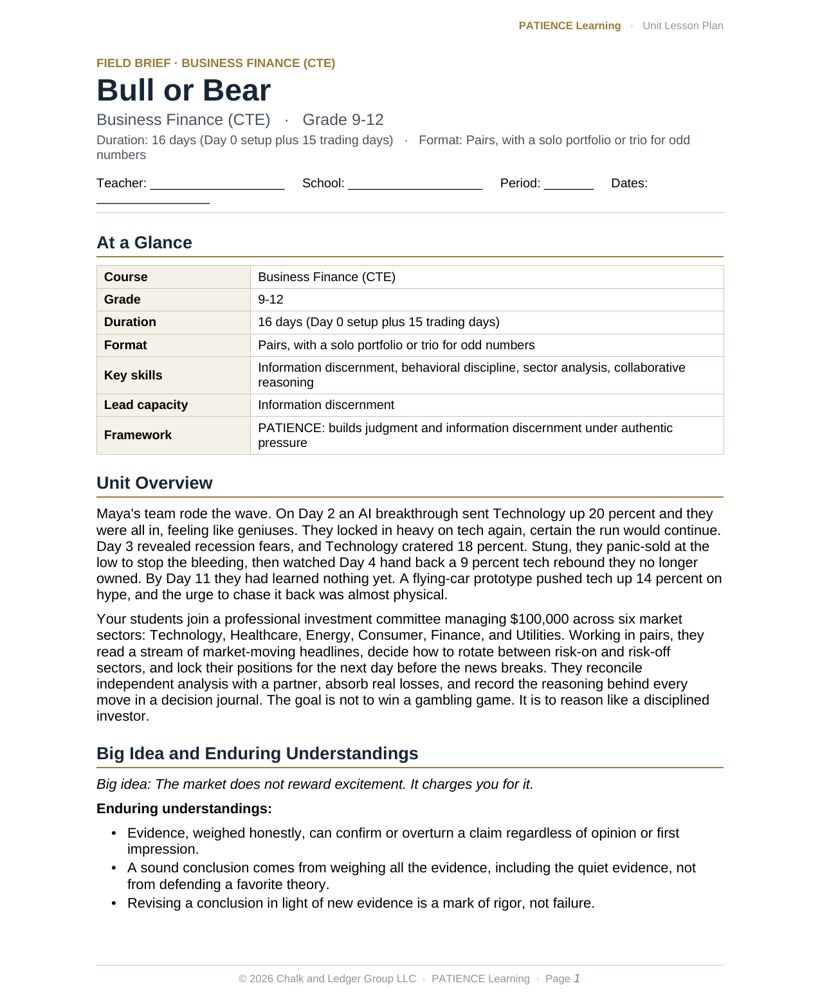
The lesson plan is already written.
Every simulation comes with a fully editable, admin-ready lesson plan. Standards alignment, daily pacing, learning objectives, differentiation, and an assessment plan are already done, so you can hand it to an administrator or adapt it to your district template in minutes.
Tap to preview the lesson plan
Close
Close
Close
Close
The day the exciting bet finally collapses against the math.
Maya's team rode the wave. On Day 2 an AI breakthrough sent Technology up 20 percent and they were all in, feeling like geniuses. They locked in heavy on tech again, certain the run would continue. Day 3 revealed recession fears, and Technology cratered 18 percent. Stung, they panic-sold at the low to stop the bleeding, then watched Day 4 hand back a 9 percent tech rebound they no longer owned. By Day 11 they had learned nothing yet. A flying-car prototype pushed tech up 14 percent on hype, and the urge to chase it back was almost physical.
This time Maya paused. She opened the journal and read her own Day 2 entry, the one that called a 20 percent jump proof of skill. She saw the pattern: every loss had come from chasing yesterday's winner and paying the 3 percent fee to do it. The flying-car had no revenue behind it. She talked her team out of the chase and into holding a diversified position. When the frenzy unwound, they did not get hurt. The boring choice, the one that felt like doing nothing, was the one that finally worked.
An investment committee, $100,000, and sixteen days of news.
Your students join a professional investment committee managing $100,000 across six market sectors: Technology, Healthcare, Energy, Consumer, Finance, and Utilities. Working in pairs, they read a stream of market-moving headlines, decide how to rotate between risk-on and risk-off sectors, and lock their positions for the next day before the news breaks. They reconcile independent analysis with a partner, absorb real losses, and record the reasoning behind every move in a decision journal. The goal is not to win a gambling game. It is to reason like a disciplined investor.
| Grade level | 9-12 |
| Course | Business Finance (CTE) |
| Duration | 16 days (Day 0 setup plus 15 trading days) |
| Format | Pairs, with a solo portfolio or trio for odd numbers |
| Key skills | Information discernment, behavioral discipline, sector analysis, collaborative reasoning |
Engineering better thinkers.
Markets punish the investor's own psychology more than any headline does. Each trading day pairs a named cognitive bias with the capacity that defeats it, and the bias stays teacher-facing so students feel the loss before they can name the trap. The reveal then turns a classroom error into a lasting guardrail.
| Bias targeted | The remedy, built into the work |
|---|---|
| Recency bias (The Chase) | Adaptive strategyDay 2's 20 percent tech jump followed by Day 3's 18 percent crater teaches students to adjust their plan to new conditions instead of piling into yesterday's winner at the top. |
| Confirmation bias | Information discernmentDay 7's bank contagion flips the rates-help-banks logic from Day 6, so students must let new evidence overturn a thesis rather than hold a losing position out of stubbornness. |
| Churn (Urge to Trade) | Navigating uncertaintyOn Days 5 and 14 the market barely drifts, and the 3 percent round-trip fee bleeds any team that trades for the sake of action, teaching them to hold steady when the future is unknowable. |
| The Vivid Headline | Information discernmentDay 11's flying-car prototype spikes tech 14 percent on a product with no revenue, forcing students to separate dramatic signal from fundamental noise before they position. |
| Loss aversion (Hurt of Losing) | Productive failure recoveryDay 3's losses tempt panic-selling that misses the Day 4 rebound, so students practice recovering from a drawdown without overcorrecting into a worse position. |
| Overconfidence (Skill Story) | Emotional regulationStudents who guess right early double down, then meet the Day 12 reversal of 15 percent in tech, learning to separate luck from skill and regulate the swings of fear and excitement. |
16 days of disciplined trading.
Day 0 sets the vocabulary and the six sectors so nobody trades blind. From there, fifteen trading days run a single arc: an early winning streak builds false confidence, a crash exposes panic-selling, and a long middle stretch rewards patience over churn before the closing reveal ties every trade back to the trap that drove it.
| Day | What lands | Capacity in focus |
|---|---|---|
| 0 | Setup, sector vocabulary, and how the lock-in and fee engine work | Getting ready |
| 1 | First headline and first locked position | Information discernment |
| 2 | AI breakthrough sends tech up 20 percent and confidence soars (critical pivot) | Adaptive strategy |
| 3 | Recession fears crater tech 18 percent and consumer 12 percent | Emotional regulation |
| 4 | Tech rebounds 9 percent, punishing those who panic-sold | Productive failure recovery |
| 5 | Market drifts and the fee engine punishes churn | Thinking about your thinking |
| 6 | Rate news lifts Finance on the rates-help-banks logic | Information discernment |
| 7 | Bank contagion drops Finance 16 percent and flips Day 6's logic (critical pivot) | Navigating uncertainty |
| 8 | Cybersecurity breach rewards the second-order winner, not the crowd | Collaborative reasoning |
| 10 | Pharma price hike lifts Healthcare and tests ethical reasoning | Ethical reasoning |
| 11 | Flying-car prototype spikes tech 14 percent on pure hype | Information discernment |
| 12 | Tech reverses 15 percent and humbles the overconfident | Thinking about your thinking |
| 15 | Fed cut, the close, and the bias reveal and debrief | Emotional regulation |
Standards alignment.
Bull or Bear aligns to the National Standards for Personal Financial Education from the Council for Economic Education, particularly the Investing standard, where students evaluate risk and return, diversification, and the costs of trading. It supports the Common Career Technical Core Finance career cluster standards for analyzing financial markets and instruments and for applying behavioral and ethical reasoning to investment decisions. The simulation also builds the employability skills employers name most often: critical thinking, disciplined decision-making under uncertainty, collaboration, and clear written justification. No Common Core codes are claimed, because this is a Business Finance CTE product and the alignment is to finance and career-readiness standards.
The hidden architecture.
The whole simulation is engineered to catch the student in a bias before naming it. The lock-in rule is the keystone: because students position blind, hindsight bias is impossible and only genuine foresight is rewarded. The market sequence is rigged to bait specific traps in order, the Day 2 surge into the Day 3 crash sets up The Chase, Day 6's rate logic into Day 7's contagion sets up confirmation bias, and the flying-car hype sets up the vivid headline. The 3 percent round-trip fee, deducted before the market moves, makes impatience cost real money instantly. Finance and Utilities are deliberately built to move opposite each other on the same rate news, which punishes shallow reading. The biases stay teacher-facing so the debrief reveal lands with full force.
Turnkey, classroom-tested.
- An admin-ready lesson plan. A fully editable plan with standards alignment, daily pacing, differentiation, and assessment, ready to adapt to your district template. Included with every purchase.
- A 16-day teacher guide. The Market-Movements Guide gives you read-aloud scripts explaining the reason behind every move, plus the daily four-step loop.
- A tech-enabled team workbook. An automated lock-in engine, a 3 percent fee calculator, and a decision journal built in, with a HOLD safety net for blank entries.
- A class leaderboard. An automated ranking system that drives healthy competition without letting lucky bets dominate the grade.
- Turnkey student files. Pacing cards and vocabulary assignments so Day 0 setup is ready to hand out.
- A scoring trilogy rubric. Grades portfolio performance, justification quality, and prediction calibration, rewarding the quality of reasoning over the result.
Teach the discipline the market actually rewards.
Bring your students inside a real investment committee, let them feel the cost of impatience, and send them out with the behavioral discipline that lasts a lifetime.
Get this simulationPreview real pages from the simulation before you spend a dollar. No guessing, no surprises.